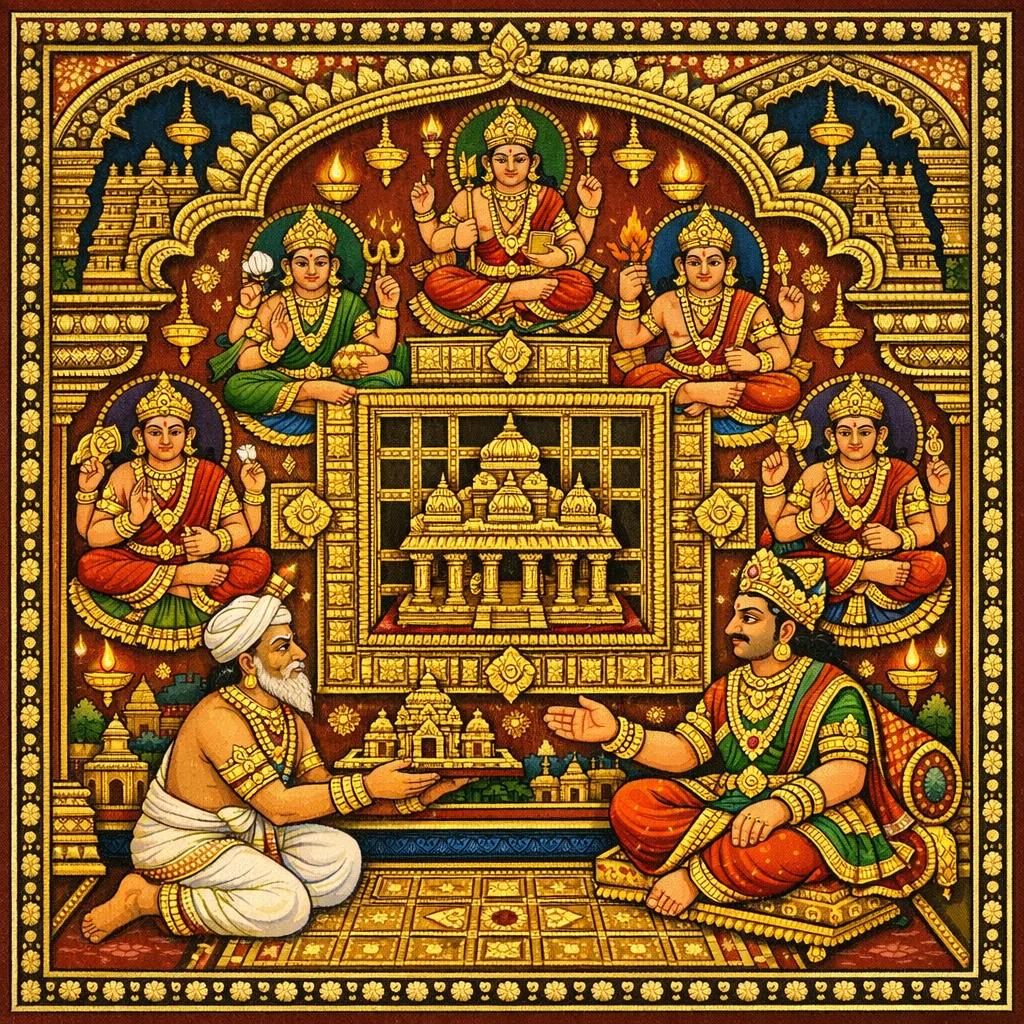
Adhyaya 105
नगरादिवास्तुकथनं (Discourse on Vāstu for Cities and Related Settlements)
Lord Īśvara teaches the ritual-technical basis of prosperity for settlements—cities, villages, and forts—by prescribing Vāstu worship through the 81-pada (9×9) maṇḍala. The chapter then inscribes subtle divine order onto space: it names eastern nāḍīs, lists epithets tied to the maṇḍala’s “feet”/padas, and assigns deities and forces to directions, interdirections, and petal-like sub-divisions (including specialized placements such as Māyā, Āpavatsa, Savitṛ/Sāvitrī/Vivasvān, Viṣṇu, Mitra, and others). Moving from cosmology to construction, it specifies plan-types (ekāśīpada temple, śatāṅghrika maṇḍapa), compartment placements, and proportional rules for walls, streets (vīthī/upavīthī), and layout variants (e.g., Bhadrā, Śrī-jaya). It introduces house typologies (one-, two-, three-, four-, eight-hall) and omen/diagnostic readings tied to directional deficiencies and marks (śūla/triśūla/triśālā). Finally, it gives functional zoning by direction (sleeping, weapons, wealth, cattle, initiation spaces), a remainder-based method for classifying house-types, and detailed doorway-result phalas—integrating Vāstu-śāstra as a Dharmic discipline aligning built form with devatā order for stable Bhukti and auspicious living.
Shlokas
Verse 1
इत्य् आग्नेये महापुराणे सामान्यप्रासादलक्षणं नाम चतुरधिकशततमो ऽध्यायः अथ पञ्चाधिकशततमो ऽध्यायः नगरादिवास्तुकथनं ईश्वर उवाच नगरग्रामदुर्गाद्या गृहप्रासादवृद्धये च द्वारे श्वभ्रबिद्धे इति ख , घ , ङ च मार्गवेधैश् च इति छ चुल्लीबिद्धे इति ख , ङ च शिलाबिद्धेन मूढतां इति ग , ज च नगरग्रामदुर्गादौ इति ख , छ , ज च नगरग्रामदुर्गाख्यमिति घ एकाशीतिपदैर् वस्तुं पूजयेत् सिद्धये ध्रुवं
Thus, in the Agni Mahāpurāṇa ends the one-hundred-and-fourth chapter titled “General Characteristics of Prāsādas (Palaces/Temples)”. Now begins the one-hundred-and-fifth chapter, “Discourse on Vāstu for Cities and Related Settlements”. The Lord said: “For the prosperity and increase of houses and prāsādas in cities, villages, forts, and the like, one should certainly worship Vāstu (the spirit/principle of the site) by means of the eighty-one padas (the 9×9 vāstu-maṇḍala), in order to obtain unfailing success.”
Verse 2
प्रागास्या दशधा नाड्यास्तासां नामानि च ब्रुवे शान्ता यशोवती कान्ता विशाला प्राणवाहिनी
In the eastern (fore) direction there are ten nāḍīs (subtle channels); I shall state their names: Śāntā, Yaśovatī, Kāntā, Viśālā, and Prāṇavāhinī.
Verse 3
सती वसुमती नन्दा सुभद्राथ मनोरमा उत्तरा द्वादशान्याश् च एकाशीत्यङ्घ्रिकारिका
“(She is) Satī, Vasumatī, Nandā, Subhadrā, and also Manoramā; Uttarā; and twelve other names as well—thus forming a set of eighty-one ‘aṅghri-kārikā’ (mnemonic name-verses arranged by ‘feet’/padas).”
Verse 4
हरिणी सुप्रभा लक्ष्मीर्विभूतिर्विमला प्रिया जया ज्वाला विशोका च स्मृतास्तत्रपादतः
At her feet, the following are remembered (as her names/epithets): Hariṇī, Suprabhā, Lakṣmī, Vibhūti, Vimalā, Priyā, Jayā, Jvālā, and Viśokā.
Verse 5
ईशाद्यष्टाष्टकं दिक्षु यजेदीशं धनञ्जयं शक्रमर्कं तथा सत्यं भृशं व्योम च पूर्वतः
In the directions one should worship the eightfold set beginning with Īśa—namely Īśa, Dhanañjaya, Śakra, Arka, Satya, Bhṛśa, and Vyoman—arranging their worship starting from the eastern direction.
Verse 6
हव्यवाहञ्च पूर्वाणि वितथं भौममेव च कृतान्तमथ गन्धर्वं भृगं मृगञ्च दक्षिणे
In the eastern quarter one should place (invoke) Havyavāha (Agni), Pūrvāṇi, Vitatha, and Bhauma (Mars); and in the southern quarter, Kṛtānta (Yama), Gandharva, Bhṛgu, and Mṛga.
Verse 7
पितरं द्वारपालञ्च सुग्रीवं पुष्पदन्तकं वरुणं दैत्यशेषौ च यक्ष्माणं पश्चिमे सदा
In the western quarter one should always place (invoke) the Pitṛs (ancestral spirits), the Dvārapāla (door-guardian), Sugrīva, Puṣpadantaka, Varuṇa, the remaining Daityas, and Yakṣmāṇa.
Verse 8
रोगाहिमुख्यो भल्लाटः सौभाग्यमदितिर्दितिः नवान्तः पदगो ब्रह्मा पूज्योर्धे च षडङ्घिगाः
‘Roga’, ‘Ahi-mukhya’ (chief of serpents), ‘Bhallāṭa’, ‘Saubhāgya’, ‘Aditi’, ‘Diti’, ‘Navānta’, ‘Padaga’, ‘Brahmā’, and ‘Pūjya’; and in the upper region there are also the ‘Ṣaḍ-aṅghigāḥ’ (six-legged beings).
Verse 9
ब्रह्मेशान्तरकोष्ठस्थ मायाख्यान्तु पद्द्वये तदधश्चापवत्साख्यं केन्द्रन्तरेषु षट्पदे
Within the inner compartments of Brahmā and Īśa, place the (syllable/seat) called Māyā upon the pair of lotus-petals; and beneath that, place the one named Āpavatsa upon the six petals that lie between the centers.
Verse 10
या दशान्याश्चेति ख , ग , घ , ङ , ज च सूत्रपादत इति ग सूत्रपातत इति छ शक्रमेकं तथापत्यमिति झ रोगाहिमोक्षेति ख , छ च सोमरूप्यदितौ दितिमिति ख षडङ्गका इति ग गोष्ठस्थ इति छ मरीचिकाग्निमध्ये तु सविता द्विपदस्थितः सावित्री तदधो द्व्यंशे विवस्वान् षट्पदे त्वधः
“‘And those ten others…’—so read the manuscripts Kha, Ga, Gha, Ṅa, and Ja. ‘From the quarter of the sūtra-foot’—so reads Ga; ‘from the quarter where the sūtra is cast/placed’—so reads Cha. ‘One is Śakra, and likewise the progeny’—so reads Jha. ‘(For) release from disease and from the serpent-affliction’—so read Kha and Cha. ‘Soma, of silvery form; in Aditi (and) in Diti’—so reads Kha. ‘Having six limbs (ṣaḍ-aṅga)’—so reads Ga. ‘Situated in the goṣṭha (cow-stall)’—so reads Cha. In the midst of the “ray-like fire” (marīcikā-agni), Savitṛ is stationed in a two-footed placement; below that, in a two-part division, is Sāvitrī; and below, in a six-footed placement, is Vivasvān.
Verse 11
पितृब्रह्मान्तरे विष्णुमिन्दुमिन्द्रं त्वधो जयं वरुणब्रह्मणोर्मध्ये मित्राख्यं षट्पदे यजेत्
In the interspace between the Pitṛ-deity and Brahmā one should worship Viṣṇu; in another position, the Moon and Indra; and below, Jaya. Between Varuṇa and Brahmā one should worship the deity named Mitra—thus is worship performed in the six-petalled (ṣaṭpada) diagram.
Verse 12
रोगब्रह्मान्तरे नित्यं द्विपञ्च रुद्रदासकम् तदधो द्व्यङ्घ्रिगं यक्ष्म षट्सौम्येषु धराधरं
In the (diagrammatic/ritual) interspace between the “disease” position and the Brahmā position, one should always place/recite the group called “Rudra-dāsaka” as the numerical set “two-and-five”. Below that, one should place/recite yakṣmā (the wasting disease) as “two-footed”; and in the six Saumya positions, one should place/recite “Dharādhara”.
Verse 13
चरकीं स्कन्दविकटं विदारीं पूतनां क्रमात् जम्मं पापं पिलिपिच्छं यजेदीशादिवाह्यतः
In due order, one should perform offerings (yajña/homa) to Carakī, Skanda-vikaṭa, Vidārī, and Pūtanā; then to Jamma, Pāpa, and Pilipiccha—beginning from the group headed by Īśa, for the driving away of afflictions.
Verse 14
एकाशीपदं वेश्म मण्डपश् च शताङ्घ्रिकः पूर्ववद्देवताः पूज्या ब्रह्मा तु षोडशांशके
The temple (veśman) is to be laid out on an eighty-one-square plan (ekāśīpada), and the maṇḍapa according to a one-hundred-unit measure (śatāṅghrika). The deities are to be worshipped as described earlier; and Brahmā is to be installed/worshipped in the sixteenth division (ṣoḍaśāṃśa).
Verse 15
मरीचिश् च विवस्वांश् च मित्रं पृथ्वीधरस् तथा दशकोष्ठस्थिता दिक्षु त्वन्ये बेशादिकोणगाः
Marīci, Vivasvān (the Sun), Mitra, and likewise Pṛthvīdhara are stationed in the ten directional compartments; and the other deities occupy the intermediate corners, beginning with Veśa.
Verse 16
दैत्यमाता तथेशाग्नी मृगाख्यौ पितरौ तथा पापयक्ष्मानिलौ देवाः सर्वे सार्धांशके स्थिताः
The Mother of the Daityas, likewise Īśa and Agni, the pair called Mṛga, and also the Pitṛs; and the forces named Pāpa, Yakṣmā, and Anila—all these deities are stationed in the Sārdhāṃśaka division.
Verse 17
यत्पाद्योकः प्रवक्ष्यामि सङ्क्षेपेण क्रमाद् गुह इति ख , छ च ब्रह्मान्ताः षोडशांशके इति ग , ज च पृथ्वीधरन्तथेति ख त्वन्येवेशादिके गणा इति ख , छ च दैत्यमाता भवेशाग्नी इति ख दैत्यमाता हरेशाग्नी इति घ , ज च यज्ञाद्योक इति ङ सदिग्विंशत्करैर् दैर्घ्यादष्टाविंशति विस्तरात्
Now I shall state, in due order and briefly, the architectural canons beginning with the “Guhā” class and the rest—(as in some recensions)—up to the “Brahmā” class, with division into sixteen parts; likewise “Pṛthvīdhara” and others; and the groups of types beginning with “Veśa/Veśa-like”. In variant readings these are listed as “Daityamātā–Bhaveśa–Agnī” or “Daityamātā–Hareśa–Agnī”, and also the set beginning with “Yajña”. The length is measured as 120 cubits, and the breadth as 28 cubits.
Verse 18
शिशिराश्रयः शिवाख्यश् च रुद्रहीनः सदोभयोः रुद्रद्विगुणिता नाहाः पृथुष्णोभिर्विना त्रिभिः
(There are the types called) “Śiśirāśraya” and “Śivākhya”, “Rudrahīna”, and “Sadobhaya”. The “Nāhā” group is fixed in number as “twice-Rudra”, and it is reckoned excluding the three called “Pṛthuṣṇu”.
Verse 19
स्याद्ग्रहद्विगुणं दैर्घ्यात्तिथिभिश् चैव विस्तरात् सावित्रः सालयः कुड्या अन्येषां पृथक्स्त्रिंशांशतः
The inner sanctuary (graha) should be twice the module in length, and in breadth it is to be expanded in accordance with the tithis (lunar days). The Sāvitra-type hall (sālaya) and its enclosing wall (kuḍyā) are to be laid out; for the other types, each is to be measured separately by the triṃśāṃśa (one-thirtieth) division.
Verse 20
कुड्यपृथुपजङ्घोच्चात् कुड्यन्तु त्रिगुणोच्छयं कुड्यसूत्रसमा पृथ्वी वीथी भेदादनेकधा
From the wall’s thickness and the height of its base-course (pajaṅghā), the wall’s elevation should be made threefold. The ground level should be kept even with the wall’s guideline (string-line). Streets or corridors (vīthīs) are of many kinds, according to their classifications.
Verse 21
भद्रे तुल्यञ्च वीथीभिर्द्वारवीथी विनाग्रतः श्रीजयं पृष्ठतो हीनं भद्रोयं पार्श् चयोर्विना
In the Bhadrā layout, the gateway-street (dvāra-vīthī) is to be made equal in width to the other streets, yet without any projecting front (agra). The Śrī-jaya arrangement is deficient at the rear; this Bhadrā form has no side-extensions on either flank.
Verse 22
गर्भपृथुसमा वीथी तदर्धार्धेन वा क्वचित् वीथ्यर्धेनोपवीथ्याद्यमेकद्वित्रिपुरान्वितम्
The main street (vīthī) should be made as wide as the inner core (garbha); in some cases it may be made half that. The subsidiary street (upavīthī) and the remaining parts may be made half the width of the vīthī, and the plan may be arranged for one, two, or three towns (puras).
Verse 23
सामान्यानाथ गृहं वक्ष्ये सर्वेषां सर्वकामदं एकद्वित्रिचतुःशालमष्टशालं यथाक्रमात्
Now I shall describe the general (common-use) house-plan, said to bestow upon everyone the fulfillment of all desired aims—namely the one-hall, two-hall, three-hall, four-hall, and eight-hall layouts, in proper sequence.
Verse 24
एकं याम्ये च सौमास्यं द्वे चेत् पश्चात् पुरोमुखम् चतुःशालन्तु साम्मुख्यात्तयोरिन्द्रेन्द्रमुक्तयोः
In the southern quarter (yāmya) there should be one face/opening, and in the northern quarter (saumya) it should be oriented northward. If there are two, arrange one facing west and one facing east. But in a four-sided hall (catuḥśālā) they should be set facing each other; then the auspicious results pertain to Indra and to release from Indra—worldly sovereignty and liberation.
Verse 25
शिवास्यमम्बुपास्यैष इन्द्रास्ये यमसूर्यकं र इत्य् आदिः, त्रिगुणोच्छ्रयमित्यन्तः पाठो झ पुस्तके नास्ति गर्भपीठसमा इति ख , घ , झ च सौम्यास्यं द्वे द्वे पश्चात्पुरोमुखमिति ख सौम्याख्यं द्वे च पश्चादधोमुखमिति झ सावित्रः सालयः कोटीनां तपसा प्राक्सौम्यस्थे च दण्दाख्यं प्राग्याम्ये वातसञ्ज्ञकं
This passage records variant readings concerning the “faces” (āsya) and placements used in ritual/maṇḍala arrangement: “śivāsya … ambu-pāsya …”, and for Indra’s face “yama-sūryaka …”, beginning with the syllable “ra”. The reading ending with “triguṇocchrayam” is not found in the Jha manuscript. The phrase “equal to the garbha-pīṭha (sanctum pedestal)” is attested in the Kha, Gha, and Jha manuscripts. Regarding the ‘Saumya’ face: Kha states there are “two and two”, placed behind and facing forward; whereas Jha reads that the two called ‘Saumya’ are behind, facing downward. It further notes: the ‘Sāvitra’ (solar) one is the ‘Sālaya’, so named through austerity of koṭis (crores) of years; and to the east of Saumya is one called ‘Daṇḍa’, while to the east of Yāmya (the south-eastern position) is one termed ‘Vāta’.
Verse 26
आप्येन्दौ गृहवल्याख्यं त्रिशूलं तद्विनर्धिकृत् पूर्वशलाविहीनं स्यात् सुक्षेत्रं वृद्धिदायकं
In the directional/elemental sector of Āpya and Indu, the mark called gṛha-valī and the sign called triśūla—when made complete and without defect (not diminished by a half‑part) and when the earlier ‘śalā’ blemish is absent—indicate a good tract of land, bestowing growth and prosperity.
Verse 27
याम्ये हीने भवेच्छूली त्रिशालं वृद्धिकृत् परं यक्षघ्नं जलहीनौकः सुतघ्नं बहुशत्रुकृत्
If the southern (yāmya) side is deficient or inauspicious, it signifies the arising of a śūla (spear). Triśāla is said to be a supreme cause of increase and prosperity. It indicates the destruction of yakṣas; a dwelling devoid of water; the death of a son; and the rise of many enemies.
Verse 28
र्नास्ति प्रकरणान्तरीयपाथोयमत्र लेखकभ्रमात् समागत इति भाति गृहशल्याख्यमिति ख पूर्वशाखाविहीनमिति ङ याम्ये हीने भवेच्चुल्ली त्रिशास्त्रं दितितत्परमिति झ याम्ये हीने भवेच्छत्री त्रिशालं वित्तहृत्परमिति ग इन्द्रादिक्रमतो वच्मि ध्वजाद्यष्टौ गृहाण्यहं प्रक्षालानुस्रगावासमग्नौ तस्य महानसं
“This appears to be a reading belonging to another topic that has entered here due to a scribe’s confusion—so it seems.” (Variant readings:) “called gṛha-śalya (a house-defect like a ‘splinter/foreign body’)” (kha); “devoid of an eastern wing/branch” (ṅa). “If the southern side is deficient, there will be a cullī (hearth); the ‘triśāstra’ is chiefly associated with Diti’s (inauspicious) line” (jha). “If the southern side is deficient, there will be a chattrī (canopied pavilion); the triśālā tends toward loss of wealth” (ga). “In the order beginning with Indra, I shall state the eight kinds of houses beginning with Dhvaja: Prakṣāla, Anusraga, Āvāsa, Agni; and, for that Agni-house, the mahānasa (great kitchen).”
Verse 29
याम्ये रसक्रिया शय्या धनुःशस्त्राणि रक्षसि धनमुक्त्यम्वुपेशाख्ये सम्यगन्धौ च मारुते
In the southern quarter are prescribed culinary preparations and bedding; in the Rākṣasī quarter are bows and weapons; in the Upēśā quarter are wealth and valuables to be kept secure; and in the Māruta (wind) quarter are proper fragrances (perfumes/incense).
Verse 30
सौम्ये धनपशू कुर्यादीशे दीक्षावरालयं स्वामिहस्तमितं वेश्म विस्तारायामपिण्डिकं
In the Saumya (north) direction one should make the place for wealth and cattle; in the Īśa (north‑east) direction, the initiation hall (dīkṣā) and the covered passage/verandah. The house should be measured by the owner’s hand (hasta); and in its breadth and length it should be without a projecting bulbous extension (apiṇḍika).
Verse 31
त्रिगुणं हस्तसंयुक्तं कृत्वाष्टांशैहृतं तथा तच्छेषोयं स्थितस्तेन वायसान्तं ध्वजादिकं
After tripling the given number and adding the hasta value, divide by eight; the remainder thus obtained determines the classification—beginning with “Vāyasa” and proceeding through “Dhvaja” and the others.
Verse 32
त्रयः पक्षाग्निवेदेषु रसर्षिवसुतो भवेत् सर्वनाशकरं वेश्म मध्ये चान्ते च संस्थितं
In the system of the three pakṣas (fortnights) and in the reckoning by Agni and the Vedas, the count becomes “rasa–ṛṣi–vasu,” that is, 6–7–8. When this numerical configuration/measure is placed in the middle of the house or at its end, it becomes a cause of total ruin.
Verse 33
तस्माच्च नवमे भागे शुभकृन्निलयो मतः तन्मधे मण्डपः शस्तः समो वा द्विगुणायतः
Therefore, in the ninth division the dwelling (or seat) of Śubhakṛt is prescribed; in its middle a maṇḍapa (pavilion) is recommended—either square in plan or rectangular, twice as long.
Verse 34
प्रत्यगाप्ये चेन्दुयमे हट्ट एव गृहावली एकैकभवनाख्यानि दिक्ष्वष्टाष्टकसङ्ख्यया
In the western and north-western quarters, the market-street (haṭṭa) is to be laid out as a row of houses; and the designations of each individual dwelling are to be assigned by direction according to the count of “eight and eight” (two directional sets of eight).
Verse 35
ईशाद्यदितिकान्तानि फलान्येषां यथाक्रमं भयं नारी चलत्वं च जयो वृद्धिः प्रतापकः
Beginning with the name Īśa and ending with Aditi-kānta, the results of these invocations are, in due order: fear, the attainment of a woman, fickleness, victory, increase (prosperity), and tejas—splendour and fiery prowess.
Verse 36
आङ्गैर् हतं तथेति घ , ज च कृत्वाष्टांशहतस्तथेति झ तस्मात्तु इति झ प्रागीशे चेन्दुयाम्ये वेति ख प्रागाप्ये चेन्दुयाम्ये इति छ , झ च सर्वनाशकरमित्यादिः, यथाक्रममित्यन्तः पाठो ज पुस्तके नास्ति धर्मः कलिश् च नैस्व्यञ्च प्राग्द्वारेष्वष्टसु ध्रुवं दाहो ऽसुखं सुहृन्नाशो धननाशो मृतिर्धनं
For the eight door-locations on the eastern side, the results are fixed in due order: loss of dharma (righteousness), strife (kali), poverty (naisvya), burning/fire (dāha), suffering (asukha), loss of friends (suhṛn-nāśa), loss of wealth (dhana-nāśa), and death (mṛti).
Verse 37
शिल्पित्वं तनयः स्याच्च याम्यद्वारफलाष्टकम् आयुःप्राव्राज्यशस्यानि धनशान्त्यर्थसङ्क्षयाः
One attains skill in the crafts and architecture (śilpa) and gains a son. These are the eight results of a southern (Yāmya) doorway: longevity; renunciant wandering (pravrājya); prosperity of crops; wealth; peace; acquisition of meaning/purpose; and diminution of losses.
Verse 38
शोषं भोगं चापत्यञ्च जलद्वारफलानि च रोगो मदार्तिमुख्यत्वं चार्थायुः कृशता मतिः
It yields wasting/consumption (śoṣa), enjoyment of pleasures (bhoga), and progeny; and it also gives results connected with water and gateways. It further produces disease, intoxication and distress, prominence/leadership, as well as wealth and longevity—together with leanness and discernment (mati).
Verse 39
मानश् च द्वारतः पूर्व ऊतरस्यान्दिशि क्रमात्
The prescribed measurements (māna) are to be set out from the doorway, beginning on the eastern side and then proceeding in due order (krama) toward the northern direction.
Frequently Asked Questions
The chapter emphasizes the 81-pada (9×9) Vāstu-maṇḍala as the base grid for worship and planning, with precise devatā assignments to directions and interspaces, plus proportional building rules (ekāśīpada temple plan, śatāṅghrika maṇḍapa, wall height as threefold, vīthī/upavīthī widths, and remainder-based house classification).
By treating planning and measurement as a form of ritual alignment (devatā-nyāsa on the maṇḍala), it converts architecture into disciplined Dharma-practice: ordered space supports auspicious living, reduces afflictions, and integrates prosperity-oriented action (Bhukti) with reverent cosmological orientation that steadies the mind toward higher aims (Mukti).
Yes. Multiple śloka segments preserve manuscript variants (e.g., kha/ga/gha/ṅa/cha/jha readings), indicating transmission layers and helping reconstruct technical terms and alternative interpretations in Vāstu diagnostics and placement rules.