Adhyaya 81
Chapter 81 — समयदीक्षाविधानम् (Procedure for Samaya Initiation)
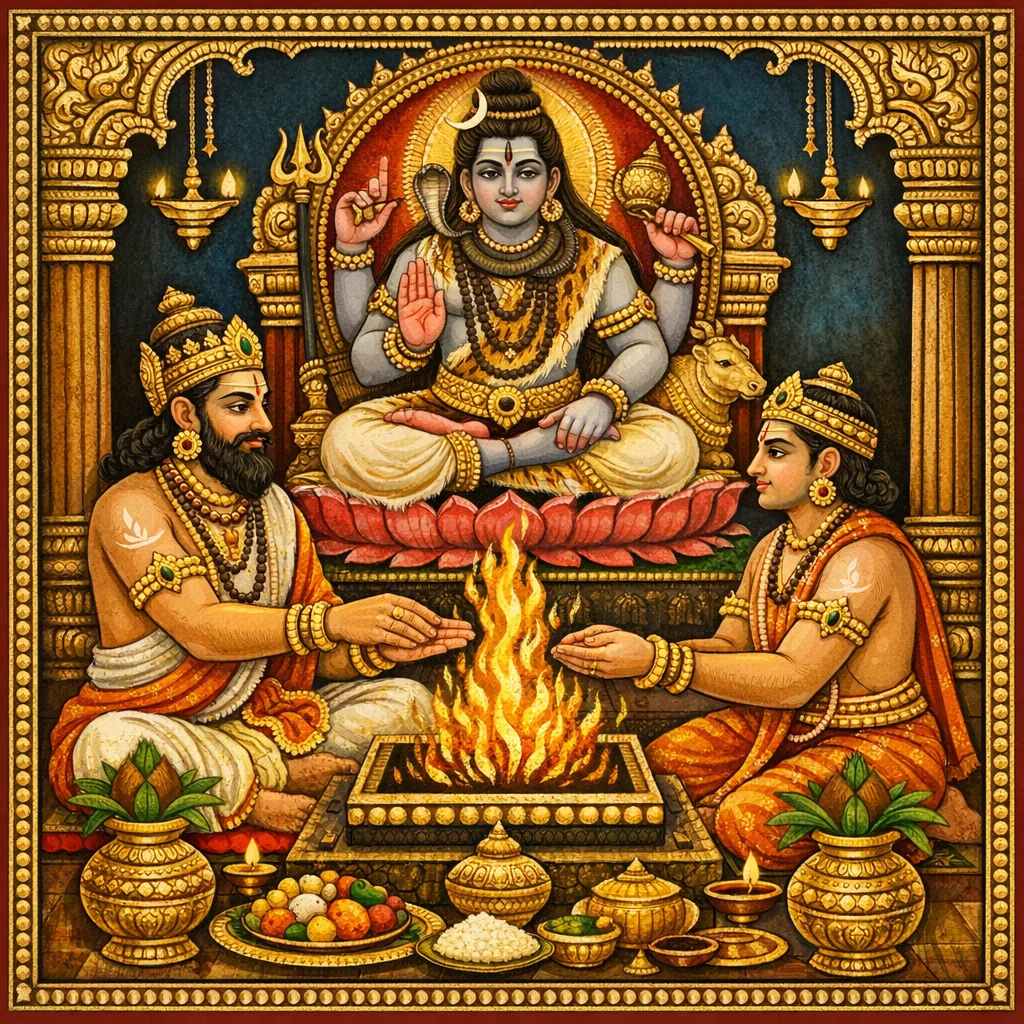
This chapter defines samaya-dīkṣā as an initiation that awakens knowledge in the disciple and grants both bhukti and mukti by cutting the bonds of mala and māyā. It classifies embodied states through kalā-typology (pralaya-ākala; sakala) and distinguishes dīkṣā as nirādhārā (supportless, arising from intense śakti-nipāta) versus sādhārā (with ritual supports), further as savījā (“with seed”) or nirvījā (“seedless”) according to samayācāra and eligibility. It then lays out a rigorous Śaiva-Āgamic rite: obstacle-removal, bhūta-śuddhi, special arghya, pañcagavya, protective astra/kavaca acts, and creative/identity nyāsas culminating in the certainty “Śivo’ham.” Śiva is installed in the maṇḍala, kalaśa, fire, and the disciple, making the rite both outer consecration and inner liberation. Detailed homa procedures follow (offerings and counts, dīpana/tarpaṇa, caru preparation, pūrṇāhuti), along with disciple-guidelines for bhukti versus mukti, purification by mantra-water and ash, pāśa-bheda symbolism, and the final bestowal of śiva-hasta authorizing continued Bhava-worship. The chapter concludes that samaya-dīkṣā makes one fit (yogya) for Śaiva arcana.
Shlokas
Verse 1
इत्य् आदिमहापुराणे आग्नेये दमनकारोहणविधिर्नाम अशीतितमो ऽध्यायः अथैकाशीतितमो ऽध्यायः समयदीक्षाविधानं ईश्वर उवाच वाक्ष्यामि भोगमोक्षार्थं दीक्षां पापक्षयङ्करीं मलमायादिपाशानां विश्लेषः क्रियते यया
Thus, in the Agni Purāṇa, the primordial Mahāpurāṇa, the eightieth chapter titled “The Rite of Mounting the Damanaka (plant)” concludes. Now begins the eighty-first chapter: “The Procedure for Samaya Initiation.” The Lord said: “I shall explain the initiation (dīkṣā) meant for both worldly enjoyment and liberation, which destroys sins—by which the bonds consisting of impurity (mala), māyā, and the rest are loosened and severed.”
Verse 2
ज्ञानञ्च जन्यते शिष्ये सा दीक्षा भुक्तिमुक्तिदा विज्ञातकलनामैको द्वितीयः प्रलयाकलः
That initiation (dīkṣā) in which knowledge is generated in the disciple is the giver of both worldly enjoyment and liberation. Among the (states) distinguished by the name of ‘kalā’, the second is the Pralaya-ākala, the ‘non-manifest’ one at dissolution.
Verse 3
तृतीयः सकलः शास्त्रे ऽनुग्राह्यस्त्रिविधो मतः तत्राद्यो मलमात्रेण मुक्तो ऽन्यो मलकर्मभिः
In the śāstric teaching, the third type is called “Sakala,” the complete one, and is held fit to receive grace; it is taught to be threefold. Of these, the first is liberated by the mere residue of impurity (mala) alone, while another is liberated through the purification of impurities and actions (karma).
Verse 4
कलादिभूमिपर्यन्तं स्तवैस्तु सकलो यतः निराधाराथ साधारा दीक्षापि द्विविधा मता
Because the worshipper is made complete in every respect through hymns (stava)—from the kalā-levels and upward down to the plane of earth—initiation (dīkṣā) is therefore regarded as twofold: nirādhārā, “without support,” and sādhārā, “with support.”
Verse 5
निराधारा द्वयोस्तेषां साधारा सकलस्य तु आधारनिरपेक्षेण क्रियते शम्भुचर्यया
For two of these states/practices there is no support (ādhāra), whereas for the complete, aggregate practice (sakala) there is a support. Yet through Śambhu-caryā, Śiva’s discipline, it is carried out in a way that is independent of any support.
Verse 6
तीव्रशक्तिनिपातेन निराधारेति सा स्मृता आचार्यमूर्तिमास्थाय मायातीव्रादिभेदया
By the descent (nipāta) of intense spiritual power, tīvra-śakti, she is remembered as “Nirādhārā,” the Śakti that rests on no support. Assuming the form of the ācārya (guru-teacher), she operates through distinctions such as “māyā” and “tīvra” (and other graded modes).
Verse 7
शक्त्या यां कुरुते शम्भुः सा साधिकरणोच्यते प्रलयानल इति ख, चिह्नितपुस्तकपाठः प्रलयात्मक इति ङ, चिह्नितपुस्तकपाठः इयं चतुर्विधा प्रोक्ता सवीजा वीजवर्जिता
That operation which Śambhu performs by means of Śakti is called “sādhikaraṇa.” In the marked manuscript reading it is “pralayānala” (“the fire of dissolution”), while another marked reading has “pralayātmaka” (“of the nature of dissolution”). This Śakti/operation is declared to be fourfold—(including two types:) with seed (savījā) and without seed (vījavarjitā).
Verse 8
साधिकारानधिकारा यथा तदभिधीयते समयाचारसंयुक्ता सवीजा जायते नृणां
As it is taught, people become qualified with entitlement or without entitlement (adhikāra) for rites according to their respective status; when joined with proper customary conduct (samayācāra), it becomes “with seed” (savīja)—fruitful and able to produce results for men.
Verse 9
निर्वीजा त्वसमर्थानां समयाचारवर्जिता नित्ये नैमित्तिके काम्ये यतः स्यादधिकारिता
But for those who are incapable, the rite is “seedless” (nirbīja), lacking the full Vedic prerequisites, and it is also devoid of the prescribed customary observances (samayācāra). For this reason, eligibility may still apply with respect to obligatory (nitya), occasional (naimittika), and desire-motivated (kāmya) rites.
Verse 10
साधिकारा भवेद्दीक्षा साधकाचार्ययोरतः निर्वीजा दीक्षितानान्तु यदास मम पुत्रयोः
Therefore, initiation (dīkṣā) is that which bestows proper ritual authority (adhikāra) upon both the sādhaka (disciple-practitioner) and the ācārya (initiating teacher). But when initiates are “seedless” (nirbīja—without the mantric seed/power), such initiation becomes ineffectual, as happened in the case of my sons.
Verse 11
नित्यमात्राधिकारत्वद्दीक्षा निरधिकारिका द्विविधेयं द्विरूपा हि प्रत्येकमुपजायते
Because it grants eligibility (adhikāra) only for the daily (nitya) rites, this initiation is said to be “without (full) adhikāra.” It is twofold; indeed, each of those arises in two forms.
Verse 12
एका क्रियावती तत्र कुण्डमण्डलपूर्विका मनोव्यापारमात्रेण या सा ज्ञानवती मता
There, one practice is action-oriented (kriyāvatī), preceded by the preparation of the fire-pit (kuṇḍa) and the ritual diagram (maṇḍala). But that practice which is performed solely through mental operation is regarded as knowledge-oriented (jñānavatī).
Verse 13
इत्थं लब्धाधिकारेण दीक्षाअचार्येण साध्यते स्कन्ददीक्षां गुरुः कुर्यात् कृत्वा नित्यक्रियां ततः
Thus, when the initiating ācārya has duly obtained the proper authority (adhikāra), the rite is to be accomplished. Thereafter, having performed the daily obligatory worship, the guru should confer the Skanda-initiation (Skanda-dīkṣā).
Verse 14
प्रणवार्ग्यकराम्भोजकृतद्वाराधिपार्चणः विघ्नानुत्सार्य देहल्यां न्यस्यास्त्रं स्वासने स्थितः
Having worshiped the Lord of the doorway with hands purified by the praṇava and the arghya-offering, he should drive away obstacles. Then, installing the protective ‘astra’ upon the threshold, he should remain seated upon his own seat (āsana).
Verse 15
कुर्वीत भूतसंशुद्धिं मन्त्रयोगं यथोदितं तिलतण्डुलसिद्धार्थकुशदूर्वाक्षतोदकं
One should perform the purification of the elemental constituents (bhūta-śuddhi) and apply the mantra-procedure (mantra-yoga) as previously prescribed, using sesame, rice-grains, mustard-seed, kuśa grass, dūrvā grass, akṣata (unbroken rice), and water.
Verse 16
सयवक्षीरनीरञ्च विशेषार्घ्यमिदन्ततः तदम्बुना द्रव्यशुद्धिं तिलकं स्वासनात्मनोः
Then this is the special arghya: water together with barley and milk. With that water one should purify the ritual materials and apply the tilaka to one’s own seat (āsana) and to oneself.
Verse 17
पूजनं मन्त्रशिद्धिञ्च पञ्चगव्यञ्च पूर्ववत् लाजचन्दनसिद्धार्थभस्मदूर्वाक्षतं कुशान्
One should perform worship and seek the successful accomplishment of the mantra (mantra-siddhi), and prepare pañcagavya as before; also keep ready lāja (popped rice), sandalwood, white mustard, sacred ash (bhasma), dūrvā grass, akṣata (unbroken rice-grains), and kuśa grass.
Verse 18
विकिरान् शुद्धलाजांस्तान् सधूपानस्त्रमन्त्रितान् कृतनित्यक्रियाद्वय इति ख, चिह्नितपुस्तकपाठः भस्मदूर्वाक्षतानिति ङ, चिह्नितपुस्तकपाठः शस्त्राम्बुप्रोक्षितानेतान् कवचेनावगुण्ठितान्
Having scattered the pure parched grains (lājā) together with incense, and having empowered them with the weapon-mantra (astra-mantra)—after completing the two daily obligatory rites (as one reading states; another marked reading has “ash, dūrvā-grass, and unbroken rice”)—one should sprinkle them with water sanctified by the astra-mantra and then protectively envelop them with the kavaca (protective) mantra.
Verse 19
नानाग्रहणाकारान् विघ्नौघविनिवारकान् दर्भाणान्तालमानेन कृत्वा षट्त्रिंशता दलैः
One should fashion them into various graspable forms, as removers of masses of obstacles, using the tips of darbha grass measured to the length of a tāla, and making them from thirty-six blades.
Verse 20
सप्तजप्तं शिवास्त्रेण वेणीं बोधासिमुत्तमं शिवमात्मनि विन्यस्य सृष्ट्याधारमभीप्सितं
Having recited the Śivāstra seven times, one should take the veṇī (braid/topknot) and the supreme sword of awakening (bodhāsi); by nyāsa, installing Śiva within one’s own self, one attains the desired support of creation.
Verse 21
निष्कलं च शिवं न्यस्य शिवो ऽहमिति भावयेत् उष्णीषं शिरसि न्यस्य अलं कुर्यात्स्वदेहकं
Having performed nyāsa of the partless (transcendent) Śiva, one should contemplate, “I am Śiva.” Placing the uṣṇīṣa (crowning head-ornament) upon the head by nyāsa, one should thereby adorn and sanctify one’s own body.
Verse 22
गन्धमण्डनकं स्वीये विदध्याद्दक्षिणे करे विधिनात्रार्चयेदीशमित्थं स्याच्छिवमस्तकं
Placing the fragrant ornament (gandha-maṇḍanaka) upon one’s own right hand, one should then worship the Lord (Īśa) according to the prescribed rite; in this manner it becomes the “head of Śiva,” i.e., it establishes the head-position within the sequence of worship.
Verse 23
विन्यस्य शिवमन्त्रेण भास्वरं निजमस्तके शिवादभिन्नमात्मानं कर्तारं भावयेद्यथा
Having performed nyāsa with the Śiva-mantra upon one’s own head, one should contemplate oneself as radiant, as the agent (doer), and as the Self not different from Śiva—thus.
Verse 24
मण्डले कर्मणां साक्षी कलशे यज्ञरक्षकः होमाधिकरणं वह्नौ शिष्ये पाशविमोचकः
In the ritual maṇḍala he is the witness of all acts; in the consecrated kalaśa he is the protector of the sacrifice; in the sacred fire he is the very locus and authority of the homa; and in the disciple he becomes the liberator from the bonds (of pāśa).
Verse 25
स्वात्मन्यनुगृहीतेति षडाधारो य ईश्वरः सो ऽहमेवेति कुर्वीत भावं स्थिरतरं पुनः
Thinking, “I am graced within my own Self,” one should again and again stabilize more firmly the conviction: “That Lord who is established in the six supports is none other than I alone.”
Verse 26
ज्ञानखड्गकरः स्थित्वा नैरृत्याभिमुखो नरः सार्घ्याम्बुपञ्चगव्याभ्यां प्रोक्षयेद्यागमण्डपं
Standing with the “sword of knowledge” in his hand and facing the south‑west (nairṛti) direction, the officiant should sprinkle (consecrate) the sacrificial pavilion with arghya-water and with pañcagavya.
Verse 27
चतुष्पथान्तसंस्कारैः संस्कुर्यादीक्षणादिभिः विक्षिप्य विकरांस्तत्र कुशकूर्चोपसंहरेत्
At the end of the rites performed at the crossroads, one should complete the consecration by ritual acts such as sprinkling and the like; having scattered the ritual offerings there, one should then conclude by gathering them up with a kuśa-grass brush (kuśakūrcha).
Verse 28
तानीशदिशि वर्धन्यामासनायोपकल्पयेत् नैरृते वास्तुगीर्वाणान् द्वारे लक्ष्मीं प्रपूजयेत्
Those (items/offerings) should be arranged as a seat in the Īśāna (northeast) direction, upon the auspicious Vardhanī spot that increases prosperity. In the Nairṛta (southwest) quarter one should worship the deities of the Vāstu; and at the doorway one should duly worship Lakṣmī.
Verse 29
आप्ये रत्नैः पूरयन्तीं हृदा मण्डपरूपिणीं अस्त्राम्बु इति ङ, चिह्नितपुस्तकपाठः शिष्ये पापविमोचक इति ङ, चिह्नितपुस्तकपाठः साम्बुवस्त्रे सरत्ने च धान्यस्थे पश्चिमानने
In the (water-)vessel, by the Hṛdā (“Heart”) mantra, one should visualize/establish the maṇḍala-formed (goddess/energy) as being filled with jewels. (Some marked manuscripts read here “astrāmbu”; and in the instruction addressed to the disciple, some marked manuscripts read “pāpavimocaka”.) It should be placed on a cloth damp with water, together with gems, set upon a bed of grain, with the face oriented toward the west.
Verse 30
ऐशे कुम्भे यजेच्छम्भुं शक्तिं कुम्भस्य दक्षिणे पश्चिमस्यान्तु सिंहस्थां वर्धनीं खड्गरूपिणीं
In such a consecrated kumbha one should worship Śambhu (Śiva). On the southern side of the kumbha one should worship Śakti; and on the western side one should worship Vardhanī—seated upon a lion and having the form of a sword.
Verse 31
दिक्षु शक्रादिदिक्पालान्विष्ण्वन्तान् प्रणवासनान् वाहनायुधसंयुक्तान् हृदाभ्यर्च्य स्वनामभिः
In the directions, one should worship—within the heart—the guardians of the quarters (Dikpālas), beginning with Indra (Śakra) and ending with Viṣṇu, seated upon the syllable Oṃ and furnished with their respective mounts and weapons; honoring them with the Hṛdā (Heart) mantra and invoking each by his own name.
Verse 32
प्रथमन्तां समादाय कुम्भस्याग्राभिगामिनीं अविच्छिन्नपयोधरां भ्रामयित्वा प्रदक्षिणं
Taking up the first (ritual offering/stream), and causing the unbroken flow—directed toward the front of the kumbha—to revolve rightward (clockwise), one should perform pradakṣiṇā (ritual circumambulation).
Verse 33
शिवाज्ञां लोकपालानां श्रावयेन्मूलमुच्चरन् संरक्षत यथायोगं कुम्भं धृत्वाथ तां धारेत्
Reciting the root-mantra, one should proclaim to the Lokapālas the command of Śiva: “Protect this rite as is proper.” Then, taking up the consecrated pot (kumbha), one should hold and bear it in the prescribed manner.
Verse 34
ततः स्थिरासने कुम्भे साङ्गं सम्पूज्य शङ्करं विन्यस्य शोध्यमध्वानं वर्धन्यामस्त्रमर्चयेत्
Then, on a steady seat, in the ritual pot (kumbha), having fully worshipped Śaṅkara together with all attendant parts (sāṅga), and having performed the nyāsa upon the pathway to be purified (śodhyam adhvānam), one should worship there the ‘Vardhanī’ weapon-mantra (astra).
Verse 35
ः अस्त्रासनाय हूं फट् ॐ ॐ अस्त्रमूर्तये नमः ॐ हूं फट् पाशुपतास्त्राय नमः ॐ ॐ हृदयाय हूं फट् नमः ॐ श्रीं शिरसे हूं फट् नमः ॐ यं शिखायै हूं फट् नमः ॐ गूं कवचाय हूं फट् नमः ॐ फट् अस्त्राय हूं फट् नमःचतुर्वक्त्रं सदंष्ट्रञ्च स्मरेदस्त्रं सशक्तिकं समुद्गरत्रिशूलासिं सूर्यकोटिसमप्रभं
“ḥ—unto the seat of the weapon, hūṁ phaṭ. Oṁ, oṁ—obeisance to the embodied form of the weapon (Astramūrti). Oṁ hūṁ phaṭ—obeisance to the Pāśupata weapon. Oṁ, oṁ—unto the heart (hṛdaya), hūṁ phaṭ, obeisance. Oṁ śrīṁ—unto the head (śirasa), hūṁ phaṭ, obeisance. Oṁ yaṁ—unto the topknot (śikhā), hūṁ phaṭ, obeisance. Oṁ gūṁ—unto the armor (kavaca), hūṁ phaṭ, obeisance. Oṁ phaṭ—unto the weapon (astra), hūṁ phaṭ, obeisance.” One should meditate upon the weapon as four-faced and fanged, endowed with Śakti, bearing a mace, a trident, and a sword, with a radiance equal to ten million suns.
Verse 36
भगलिङ्गसमायोगं विदध्याल्लिङ्गमुद्रया अट् ॐ ॐ अस्त्रमूर्तये नमः ॐ स्वां स्वं क्रूं फट् पाशुपतास्त्राय स्वाहा ॐ ॐ हृदयाय क्रूं फट् नमः ॐ पं शिखायै क्रूं फट् नमः ॐ खं कवचाय क्रूं फट् नमः ॐ हं फट् अस्त्राय फट् नमः इति ङ, चिह्नितपुस्तकपाठः अग्गुष्ठेन स्पृशेत् कुम्भं हृदा मुष्ट्यास्त्रवर्धनीं
One should effect the conjunction (samāyoga) of the Bhaga-liṅga by means of the liṅga-mudrā, with the exclamation “aṭ”. (Then recite:) “Oṁ Oṁ, obeisance to the Weapon-Form (Astramūrti). Oṁ svāṃ svaṃ krūṃ phaṭ—unto the Paśupata-weapon, svāhā. Oṁ Oṁ, unto the Heart (hṛdaya), krūṃ phaṭ, obeisance. Oṁ paṃ, unto the Topknot (śikhā), krūṃ phaṭ, obeisance. Oṁ khaṃ, unto the Armor (kavaca), krūṃ phaṭ, obeisance. Oṁ haṃ phaṭ, unto the Weapon (astra), phaṭ, obeisance.” Thus is the reading in a marked manuscript. With the thumb one should touch the kumbha; with the hand upon the heart and the fist clenched—this is the gesture that strengthens the weapon-mantra (astra-vardhanī).
Verse 37
भुक्तये मुक्तये त्वादौ मुष्टिना वर्धनीं स्पृशेत् कुम्भस्य मुखरक्षार्थं ज्ञानखड्गं समर्पयेत्
At the outset, for the sake of worldly enjoyment and liberation (mukti), one should touch the ‘Vardhanī’ with the clenched fist; and, to protect the mouth (opening) of the ritual pot (kumbha), one should offer and place the ‘sword of knowledge’ (jñāna-khaḍga).
Verse 38
शस्त्रञ्च मूलमन्त्रस्य शतं कुम्भे निवेशयेत् तद्दशांशेन वर्धन्यां रक्षां विज्ञापयेत्ततः
One should place the weapon, together with one hundred recitations/infusions of the root-mantra, into a water-pot (kumbha); then, with one-tenth of that (i.e., ten) in a sprinkling-vessel, one should formally declare and empower the protective rite (rakṣā).
Verse 39
यथेदं कृतयत्नेन भगवन्मखमन्दिरं रक्षणीयं जगन्नाथ सर्वाध्वरधर त्वया
O Lord—Jagannātha, the supporter of all sacrifices—this sacrificial temple (makha-mandira) has been prepared with due effort; therefore, it should be protected by You.
Verse 40
प्रणवस्थं चतुर्बाहुं वायव्ये गणमर्चयेत् स्थण्डिले शिवमभ्यर्च्य सार्घ्यकुण्डं व्रजेन्नरः
He should worship, in the north-western quarter (vāyavya), the Gaṇa who is established upon the syllable Oṁ and is four-armed. Having worshipped Śiva on a ritual ground (sthaṇḍila), the worshipper should then proceed to the arghya-offering pit (sārghya-kuṇḍa).
Verse 41
निविष्टो मन्त्रतृप्त्यर्थमर्घ्यगन्धघृतादिकं वामे ऽसव्ये तु विन्यस्य समिद्दर्भतिलादिकं
Having taken his seat, for the purpose of satisfying and duly completing the mantras, he should place on the left the arghya-offering, fragrance, ghee, and related requisites; and on the non-left side he should arrange the fuel-sticks (samid), kuśa/darbha grass, sesame, and similar items.
Verse 42
कुण्डवह्निस्रुगाज्यादि प्राग्वत् संस्कृत्य भावयेत् मुख्यतामूर्ध्ववक्त्रस्य हृदि वह्नौ शिवं यजेत्
Having prepared and consecrated, as before, the fire-pit (kuṇḍa), the ritual fire, the ladle (srug), ghee, and the other requisites, one should then perform the prescribed visualization (bhāvanā). Considering the upward-facing (ūrdhva-vaktra) aspect as the principal one, one should worship Śiva within the fire, in that heart-center.
Verse 43
स्वमूर्तौ शिवकुम्भे च स्थण्डिले त्वग्निशिष्ययोः सृष्टिन्यासेन विन्यस्य शोध्याध्वानं यथाविधि
Having performed sṛṣṭi-nyāsa (the creation-placement of mantras) upon one’s own bodily form, upon the Śiva-kumbha (Śiva’s consecration pot), upon the sthaṇḍila (ritual ground/altar), and upon oneself together with the fire and the disciple, one should then purify the adhvā (the ritual path, the series of tattvas and mantras) according to the prescribed rule.
Verse 44
कुण्डमानं मुखं ध्यात्वा हृदाहुतिभिरीप्सितं वीजानि सप्तजिह्वानामग्नेर्होमाय भण्यते
Having meditated on the kuṇḍa (fire-pit) as the divine mouth, and having offered the desired oblations as heart-offerings, one then recites the seed-syllables (bīja) of Agni’s seven tongues for the performance of homa.
Verse 45
विरेफावन्तिमौवर्णौ रेफषष्ठस्वरान्वितौ इन्दुविन्दुशिखायुक्तौ जिह्वावीजानुपक्रमात्
These two phonemes, Va and Ra, are endowed with the sound called repha and are connected with the sixth vowel; they bear the marks of the crescent, the dot (anusvāra), and a flame-like stroke—according to the successive procedure of the tongue-seed (jihvā-bīja), the articulatory basis of the tongue.
Verse 46
हिरण्या वनका रक्ता कृष्णा तदनु सुप्रभा अतिरिक्ता बहुरूपा रुद्रेन्द्राग्न्याप्यदिङ्मुखा
She is described as golden-hued, dwelling in the forest, red and black, and again radiant; surpassing in splendor, many-formed; and facing Rudra, Indra, Agni, and likewise the directions.
Verse 47
क्षीरादिमधुरैर् होमं कुर्याच्छान्तिकपौष्टिके अभिचारे तु पिण्याकसक्तुकञ्चुककाञ्चिकैः
For śāntika (pacificatory) and pauṣṭika (prosperity-increasing) rites, one should perform homa with sweet substances beginning with milk; but for abhicāra (aggressive sorcery), one should offer oil-cake, parched flour, husk/bran, and sour gruel.
Verse 48
लवणैर् आजिकातक्रकटुतैलैश् च कण्टकैः वायव्ये कालमर्चयेदिति ग, चिह्नितपुस्तकपाठः समिद्भिरपि वक्राभिः क्रुद्धो भाष्याणुना यजेत्
With salt, mustard, buttermilk, pungent oils, and also with thorns, in the Vāyavya (north‑west) direction one should worship Kāla—so reads the marked manuscript variant. Even with crooked fuel-sticks, when enraged, one should perform the offering according to the explanatory instruction (bhāṣya).
Verse 49
कदम्बकलिकाहोमाद्यक्षिणी सिद्ध्यति ध्रुवं बन्धूककिंशुकादीनि वश्याकर्षाय होमयेत्
By offering kadamba flower-buds into the fire as homa, the Yakṣiṇī is certainly brought to accomplishment. For the purposes of subjugation and attraction, one should perform fire-offerings with bandhūka, kiṃśuka, and similar plants or flowers.
Verse 50
बिल्वं राज्याय लक्ष्मार्थं पाटलांश् चम्पकानपि पद्मानि चक्रवर्तित्वे भक्ष्यभोज्यानि सम्पदे
Bilva is to be employed for gaining kingship; for obtaining Lakṣmī (fortune and prosperity), pāṭalā and campaka as well; lotuses for universal sovereignty as a cakravartin; and edible foods and prepared dishes for the attainment of material prosperity.
Verse 51
दूर्वा व्याधिविनाशाय सर्वसत्त्ववशीकृते प्रियङ्गुपाटलीपुष्पं चूतपत्रं ज्वरान्तकं
Dūrvā grass is used for the destruction of diseases and for bringing all beings under one’s influence; the flowers of priyaṅgu and pāṭalī, and mango leaves, are employed as remedies that bring fevers to an end.
Verse 52
मृत्युञ्जयो मृत्युजित् स्याद् वृद्धिः स्यात्तिलहोमतः रुद्रशान्तिः सर्वशान्त्यै अथ प्रस्तुतमुच्यते
By the rite or mantra of Mṛtyuñjaya one becomes a conqueror of death; by a sesame fire-offering (tila-homa) prosperity and increase arise. The Rudra-pacification rite (Rudra-śānti) is for attaining all pacifications; now the procedure at hand is being stated.
Verse 53
आहुत्यष्टशतैर् मूलमङ्गानि तु दशांशतः सन्तर्पयेत मूलेन दद्यात् पूर्णां यथा पुरा
Having offered eight hundred oblations (āhuti), one should then satisfy (santarpayet) the subsidiary limbs of the rite with a tenth part thereof; and with the root-mantra (mūla-mantra) itself one should offer the full oblation (pūrṇāhuti), as was done formerly according to the established procedure.
Verse 54
तथा शिष्यप्रवेशाय प्रतिशिष्यं शतं जपेत् दुर् निमित्तापसाराय सुनिमित्तकृते तथा
Likewise, for the disciple’s entry into initiation (śiṣya-praveśa), one should perform japa of the mantra a hundred times for each disciple; and similarly one should do japa to dispel inauspicious omens and to bring forth auspicious signs.
Verse 55
शतद्वयञ्च होतव्यं मूलमन्त्रेण पूर्ववत् मूलाद्यष्टास्त्रमन्त्राणां स्वाहान्तैस्तर्पणं सकृत्
Two hundred oblations should be offered, as before, with the root-mantra (mūla-mantra). Then, for the root-mantra and the eight weapon-mantras (astra-mantra) beginning with it, a single tarpaṇa (satiatory offering) should be performed, using formulas ending with “svāhā”.
Verse 56
शिखासम्पुटितैर् वीजैर् ह्रूं फडन्तैश् च दीपनं ॐ हौं शिवाय स्वाहेत्यादिमन्त्रैश् च तर्पणं
With seed-mantras (bīja) enclosed by the śikhā framing (śikhā-bīja), and with the bīja “hrūṃ” ending in the weapon-mantra “phaṭ”, one should perform dīpana—the rite of kindling and energizing. And with the mantras beginning with “oṃ hauṃ śivāya svāhā”, one should perform tarpaṇa—the rite of satisfying through oblation.
Verse 57
ॐ ह्रूं ह्रौं ह्रीं शिवाय ह्रूं फडित्यादिदीपनं ततः शिवाम्भसा स्थालीं क्षालितां वर्मगुण्ठितां
For dīpana (the kindling rite), one should utter: “oṃ hrūṃ hrauṃ hrīṃ śivāya hrūṃ phaṭ”—and similar syllables. Then, with consecrated “Śiva-water” (śivāmbhas), one should wash the ritual bowl (sthālī) and secure it, sealing it with a protective covering.
Verse 58
चन्दनादिसमालब्धां बध्नीयात् कटकं गले वर्मास्त्रजप्तसद्दर्भपत्राभ्यां चरुसिद्धये
Having anointed it with sandalwood and the like, one should tie the neck-amulet (kaṭaka) at the throat, using two leaves of sacred darbha grass over which the Varma and Astra mantras have been recited, for the successful accomplishment of the ritual oblation (caru).
Verse 59
हुं फडन्तैश् च ख, चिह्नितपुस्तकपाठः ॐ हूं हौं हूं शिवाय हूमिति ख, चिह्नितपुस्तकपाठः ॐ क्रं हौं क्रं शिवाय क्रूं इति ङ, चिह्नितपुस्तकपाठः धर्मगुण्ठितामिति ख, चिह्नितपुस्तकपाठः वर्माद्यैर् आसने दत्ते सार्धेन्दुकृतमण्डले न्यस्तायां मूर्तिभूतायां भावपुष्पैः शिवं यजेत्
With the bīja “huṃ” accompanied by the exclamation “phaṭ” (as some marked manuscripts read), one should employ mantra-forms such as “oṃ hūṃ hauṃ hūṃ śivāya hūṃ” (so reads one recension) or “oṃ kraṃ hauṃ kraṃ śivāya krūṃ” (so reads another). Having placed (the deity) upon the seat (āsana) furnished with protective coverings and the like, and within a maṇḍala made with the crescent moon together with its adjunct (sārdhendu), when the image has been installed by nyāsa and has become ‘embodied’ as a manifest form, one should worship Śiva with “flowers of contemplation” (bhāva-puṣpa), that is, inward offerings of devotion.
Verse 60
वस्त्रबद्धमुखायां वा स्थाल्यां पुष्पैर् वहिर्भवैः चुल्ल्यां पश्चिमवक्त्रायां न्यस्तायां मानुषात्मना
Or, in a pot (sthālī) whose mouth is tied over with cloth, one should place flowers that are outside-born (i.e., gathered from outside). That pot, set down by a human practitioner, is to be placed on the hearth (cullī) with its mouth/facing turned toward the west.
Verse 61
न्यस्ताहङ्कारवीजायां शुद्धायां वीक्षणादिभिः धर्माधर्मशरीरायां जप्तायां मानुषात्मना
When the seed of ego has been laid to rest and the inner field has been purified through practices beginning with disciplined observation, then—when japa is performed by the human self upon that body constituted of dharma and adharma (merit and demerit)—the intended inner purification is accomplished.
Verse 62
स्थालीमारोपयेदस्त्रजप्तां गव्याम्बुमार्जितां गव्यं पयो ऽस्त्रसंशुद्धं प्रासादशतमन्त्रितं
He should place a dish (sthālī) over which the Astra (weapon) mantra has been recited, and cleanse it with cow-water (gomūtra). Then cow’s milk, purified by the Astra mantra and consecrated by reciting the “Prāsāda” mantra one hundred times, should be used for the procedure.
Verse 63
तुण्डलान् श्यामकादीनां निक्षिपेत्तत्र तद्यथा एकशिष्यविधानाय तेषां प्रसृतिपञ्चकं
There one should place tuṇḍala and the like—such as śyāmaka—according to the prescribed method; for the regimen intended for a single pupil, the measure of those ingredients is five prasṛtis.
Verse 64
प्रसृतिं प्रसृतिं पश्चाद्वर्धयेद् द्व्यादिषु क्रमात् कुर्याच्चानलमन्त्रेण पिधानं कवचाणुना
Afterwards, one should increase step by step—beginning with two (units)—adding one prasṛti measure each time. Then, using the Fire-mantra (Anala-mantra), one should perform pidhāna (closing/sealing) with the kavaca-mantra in its subtle (anu) form.
Verse 65
शिवाग्नौ मूलमन्त्रेण पूर्वास्यश् चरुकं पचेत् सुखिन्ने तत्र तच्चुल्ल्यां श्रुवमापूर्य सर्पिषा
Facing east, one should cook the caru (sacrificial porridge) in the Śiva fire while reciting the root-mantra (mūla-mantra). When it is properly cooked, then at that very hearth one should fill the śruva (ritual ladle) with ghee.
Verse 66
स्वाहान्तैः संहितामन्त्रैर् दत्वा तप्ताभिघारणं संस्थाप्य मण्डले स्थालीं सद्दर्भे ऽस्त्राणुना कृते
Having performed the hot abhighāraṇa (sprinkling/aspersion) with Saṃhitā-mantras ending in “svāhā”, one should set the rite in order: within the maṇḍala, establish the sthālī (offering-pot) upon pure darbha-grass, after carrying out the astra rite (protective weapon-mantra) in its subtle (anu) form.
Verse 67
प्रणवेन पिधायास्यां तद्देहलेपनं हृदा सुशीतलो भवत्येवम् प्राप्य शीताभिघारणं
Having closed the mouth with the Praṇava (the syllable Oṁ), and applying that paste upon the body with focused intent from the heart, one becomes thoroughly cooled; thus is obtained the procedure of śītābhighāraṇa (cooling affusion/aspersion).
Verse 68
विदध्यात्संहितामन्त्रैः शिष्यं प्रति सकृत् सकृत् धर्माद्यासनके हुत्वा कुण्डमण्डलपश्चिमे
He should duly consecrate and empower the disciple by the Saṃhitā-mantras, repeating them again and again; having offered oblations upon the Dharma-seat and the other seats, he should establish the disciple on the western side of the fire-pit (kuṇḍa) and the maṇḍala.
Verse 69
सम्पातञ्च स्रुचा हुत्वा शुद्धिं संहितया चरेत् चरुकं सकृदालभ्य तयैव वषडन्तया
Having offered the concluding oblation (sampāta) with the ladle (sruc), one should perform the purification rite with the prescribed Saṃhitā-mantra. Then, having touched the caru-offering once, one should make the oblation with that very mantra ending with the exclamation “vaṣaṭ”.
Verse 70
धर्माद्यैर् आसने इति क, चिह्नितपुस्तकपाठः सार्दाम्बुकृतमण्डले इति ख, चिह्नितपुस्तकपाठः धर्माद्यासनके धृत्वेति ख, ग, चिह्नितपुस्तकपाठः धेनुमुद्रामृतीभूतं स्थण्डिलेशान्तिकं नयेत् साज्यभागं स्वशिष्याणां भागो देवाय वह्नये
Having made the rite ‘nectar-like’ by means of the Dhenu-mudrā, one should bring the pacificatory offering (śāntika) to the sthaṇḍila, the earthen altar/fire-spot. The portion accompanied with ghee is for one’s own disciples; the principal portion is for the god—Agni (Vahni).
Verse 71
कुर्यात्तु स्तोकपालादेः समध्वाज्यमितिदं त्रयं नमो ऽन्तेन हृदा दद्यात्तेनैवाचमनीयकं
One should perform the rite beginning with the sprinkling-vessel (stokapāla) and the rest, using (substances such as) honey and ghee—this triad. It should be offered with the heart-mantra (hṛdaya) ending in “namaḥ”; by that very mantra the ācamana-water for ritual sipping and purification is consecrated.
Verse 72
साज्यं मन्त्रशतं हुत्वा दद्यात् पूर्णां यथाविधि मण्डलं कुण्डतः पूर्वे मध्ये वा शम्भुकुम्भयोः
Having offered one hundred mantra-oblation portions together with ghee, one should then perform the pūrṇāhuti, the full and final offering, according to rule. The ritual maṇḍala should be arranged to the east of the fire-pit (kuṇḍa), or in the middle, between Śambhu (Śiva) and the kumbha, the ritual water-pot.
Verse 73
रुद्रमातृगणादीनां निर्वर्त्यान्तर्बलिं हृदा शिवमध्ये ऽप्यलब्धाज्ञो विधायैकत्वभावनं
Having duly performed in the heart the inner oblation (antar-bali) for Rudra, the Mothers’ host (Mātṛgaṇa), and the like, even one who has not obtained full ritual authorization should, within Śiva (in Śiva-consciousness), cultivate the contemplation of oneness (ekatva-bhāvanā).
Verse 74
सर्वज्ञतादियुक्तो ऽहं समन्ताच्चोपरि स्थितः ममांशो योजनास्थानमधिष्ठाहमध्वरे
Endowed with omniscience and the like, I abide above and all around. In the sacrifice (adhvara), a portion of Mine presides over the appointed measured stations (yojanā-sthāna).
Verse 75
शिवो ऽहमित्यहङ्कारी निष्क्रमेद् यागमण्डपात् न्यस्तपूर्वाग्रसन्धर्भे शस्त्राणुकृतमण्डले
With the self-assertion (ahaṅkāra) of the mantra-thought, “I am Śiva,” he should depart from the sacrificial pavilion (yāga-maṇḍapa), in a ritual setting where the forward-pointing arrangement has been placed in advance and the circle/diagram has been formed (or marked) with weapons.
Verse 76
प्रणवासनके शिष्यं शुक्लवस्त्रोत्तरीयकं स्नातञ्चोदङ्मुखं मुक्त्यै पूर्ववक्त्रन्तु भुक्तये
Seat the disciple upon a Pranava-seat; let him wear white garments with a white upper-cloth, and, having bathed, let him face north for liberation (mukti)—whereas facing east is prescribed for the attainment of worldly enjoyments (bhukti).
Verse 77
ऊर्ध्वं कायं समारोप्य पूर्वास्यं प्रविलोकयेत् चरणादिशिखां यावन्मुक्तौ भुक्तौ विलोमतः
Raising the body upright and facing east, one should steadily contemplate from the feet up to the crown; and, in the practices of release (mukti) and enjoyment (bhukti), one should proceed in reverse order (vilomataḥ) as instructed.
Verse 78
चक्षुषा सप्रसादेन शैवं धाम विवृण्वता अस्त्रोदकेन सम्मोक्ष्य मन्त्राम्बुस्नानसिद्दये
With eyes made serene and gracious, while inwardly contemplating and revealing the Śaiva abode, one should remove and purify obstacles by means of water empowered by the Astra-mantra, for the successful performance of the mantra-consecrated water-bath (mantrāmbu-snāna).
Verse 79
भस्मस्नानाय विघ्नानां शान्तये पापभित्तये सृष्टिसंहारयोगेन ताडयेदस्त्रभस्मना
For the rite of bathing with sacred ash (bhasma)—to pacify obstacles and to break down sin—one should ritually strike or apply the ash consecrated by the Astra, employing the yogic procedure of creation and dissolution (sṛṣṭi–saṃhāra).
Verse 80
पुनरस्त्राम्बुना प्रोक्ष्य सकलीकरणाय तं स्थण्डिलोपान्तिकं नयेदिति ङ, चिह्नितपुस्तकपाठः तेनैवाचमनीयमिति क, ख, ग, चिह्नितपुस्तकत्रयपाठः पाशभित्तये इति ग, चिह्नितपुस्तकपाठः नाभेरूर्ध्वं कुशाग्रेण मार्जनीयास्त्रमुच्चरन्
Sprinkling again with the consecrated “astra-water,” one should lead him near the edge of the ritual ground (sthaṇḍila) for the purpose of sakalīkaraṇa (making complete). With that very water he should perform ācamana (purificatory sipping). Reciting the mārjanīya-astra, he should wipe the body above the navel with the tip of kuśa grass.
Verse 81
त्रिधाअलभेत तन्मूलैर् अघमर्षाय नाभ्यधः द्वैविध्याय च पाशानां आलभेत शराणुना
For the rite of Aghamarṣaṇa (sin-expelling), one should perform the offering/immolation in a threefold manner with those root-parts, below the navel. And for establishing the twofold classification of the pāśa (nooses/bonds), one should perform the offering with the arrow-head (śarāṇu).
Verse 82
तच्छरीरे शिवं साङ्गं सासनं विन्यसेत्ततः पुष्पादिपूजितस्यास्य नेत्रे नेत्रेण वा हृदा
Then, upon that body, one should perform nyāsa—installing Śiva together with His limbs (sāṅga) and also His seat (āsana). For this deity, worshipped with flowers and the like, the installation is to be made into the eyes—either eye by eye, or all at once through the heart (hṛdā).
Verse 83
बध्वामन्त्रितवस्त्रेण सितेन सदशेन च अप्_८१०८३अब्प्रदक्षिणक्रमादेनं प्रवेश्य शिवदक्षिणं
Having bound (him/it) with a consecrated cloth—white and with ten knots/turns as prescribed—one should then bring him/it in by the proper sequence of circumambulation, keeping Śiva to the right (performing pradakṣiṇā).
Verse 84
सवस्त्रमासनं दद्यात् यथावर्णं निवेदयेत् संहारमुद्रयात्मानं मूर्त्या तस्य हृदम्बुजे
One should offer a seat together with cloth, and present the offerings according to the prescribed order of color/varṇa. Then, by means of the Saṁhāra-mudrā, one should place (merge) oneself—together with one’s embodied form—into His lotus of the heart.
Verse 85
निरुध्य शोधिते काये न्यासं कृत्वा तमर्चयेत् पूर्वाननस्य शिष्यस्य मूलमन्त्रेण मस्तके
Having restrained (the senses/breath) and purified the body, one should perform nyāsa and then worship him; for the disciple facing east, the root-mantra (mūla-mantra) should be placed/recited upon the head.
Verse 86
शिवहस्तं प्रदातव्यं रुद्रेशपददायकं शिवसेवाग्रहोपायं दत्तहस्तं शिवाणुना
One should bestow the ‘Śiva-hand’, which grants the state or rank of Rudra and Īśa; this is the means of formally accepting one into Śiva’s service. The hand is to be conferred by the Śiva-initiate (śivāṇu).
Verse 87
शिवे प्रक्षेपयेत् पुष्पमपनीयार्चकन्तारं तत्पात्रस्थानमन्त्राढ्यं शिवदेवगणानुगं
One should cast a flower upon Śiva; removing the (ritually) impure or obstructing factor in the worshipper’s vicinity, one should then establish the proper vessel and its place, richly accompanied by mantras, in conformity with Śiva and the hosts of his deities (gaṇas).
Verse 88
विप्रादीनां क्रमान्नाम कुर्याद्वा स्वेच्छया गुरुः प्रणतिं कुम्भवर्धन्योः कारयित्वानलान्तिकं
The guru should assign the name in the proper sequence beginning with the brāhmaṇas (and the other classes), or else according to his own wish. Having caused reverential obeisance to be performed to the kumbha (ritual water-pot) and the vardhanī (sprinkling vessel), he should then proceed to the rites done in the proximity of the sacred fire.
Verse 89
सदक्षिणासने तद्वत् सौम्यास्यमुपवेशयेत् शिष्यदेहविनिष्क्रान्तां सुषुम्णामिव चिन्तयेत्
Likewise, on the right-hand seat he should seat the one of gentle, placid countenance; and he should visualize the vital current as having departed from the disciple’s body, as though it were the suṣumṇā, the central subtle channel.
Verse 90
निजग्रहलीनाञ्च दर्भमूलेन मन्त्रितं सुवर्णञ्चेति ग, चिह्नितपुस्तकपाठः शिवात्मनेति ख, ग, चिह्नितपुस्तकद्वयपाठः अपनीयाधिकाम्बरं इति घ, चिह्नितपुस्तकपाठः सदक्षिणासन तत्रेति ङ, चिह्नितपुस्तकपाठः दर्भाग्रं दक्षिणे तस्य विधाय करपल्लवे
Placing (the person/object) under one’s control and consecrating it with a mantra by means of the root of darbha-grass that has been mantrically empowered—(the manuscripts also preserve variant readings such as “suvarṇam—gold,” “śivātmane,” “apanīya adhikāmbaraṃ,” and “sa-dakṣiṇāsana tatreti”)—one should arrange the tip of the darbha on his right side, upon the palm of the hand (i.e., in the right hand) as prescribed in the rite.
Verse 91
तम्मूलमात्मजङ्घायामग्रञ्चेति शिखिध्वजे शिष्यस्य हृदयं गत्वा रेचकेन शिवाणुना
“(The teacher) should place its ‘root’ upon his own shin, and its ‘tip’ (agra) in the region of the śikhā (crown-lock), O Agni marked by the banner; then, having entered the disciple’s heart, he should act by exhalation (recaka) with the auspicious subtle ‘particle’ (śiva-aṇu).”
Verse 92
पुरकेण समागत्य स्वकीयं हृद्यान्तरं शिवाग्निना पुनः कृत्वा नाडीसन्धानमीदृशं
Having come to steadiness by inhalation (pūraka), and again kindling one’s own inner region of the heart with the Śiva-fire (Śiva-agni), one should effect such a linking of the nāḍīs, the subtle channels.
Verse 93
हृदा तत्सन्निधानार्थञ्जुहुयादाहुतित्रयं शिवहस्तस्थिरत्वार्थं शतं मूलेन होमयेत् इत्थं समयदीक्षायां भवेद्योग्यो भवार्चने
With the Hṛdā mantra, in order to bring about His presence, one should offer three oblations. Then, for the steadiness of the “Śiva-hand” (firmness and correctness of the hand in ritual acts and mudrās), one should perform a hundred oblations with the Mūla-mantra. Thus, through samaya-dīkṣā, one becomes qualified for the worship of Bhava (Śiva).
Frequently Asked Questions
A precise Śaiva-Agamic workflow: classification of dīkṣā (nirādhārā/sādhārā; savījā/nirvījā), establishment of Śiva across maṇḍala–kalaśa–agni–śiṣya, and the protective/mantric technology of astra, kavaca, vardhanī, nyāsa, and homa counts (e.g., 800 oblations, then daśāṁśa for aṅgas, plus pūrṇāhuti).
It frames initiation as knowledge-producing and bond-severing (mala–māyā–pāśa), culminating in Śiva-identity contemplation (“Śivo’ham”) and the conferral of ritual authority (adhikāra) through samaya-dīkṣā, making the disciple fit for sustained Bhava (Śiva) worship aimed at both disciplined worldly flourishing and liberation.
Savījā is ‘seeded’—effective and result-bearing when joined to samayācāra and proper entitlement; nirvījā is ‘seedless,’ associated with incapacity and lack of prescribed observances, limiting the scope and potency of ritual authority.
The rite is designed as a total consecration ecology: Śiva is witness in the maṇḍala, protector in the kalaśa, authority in the fire, and liberator in the disciple—so outer ritual supports mirror and activate inner transformation.