Adhyaya 101
Chapter 101 — प्रासादप्रतिष्ठा (Prāsāda-pratiṣṭhā): Consecration and Installation of the Temple
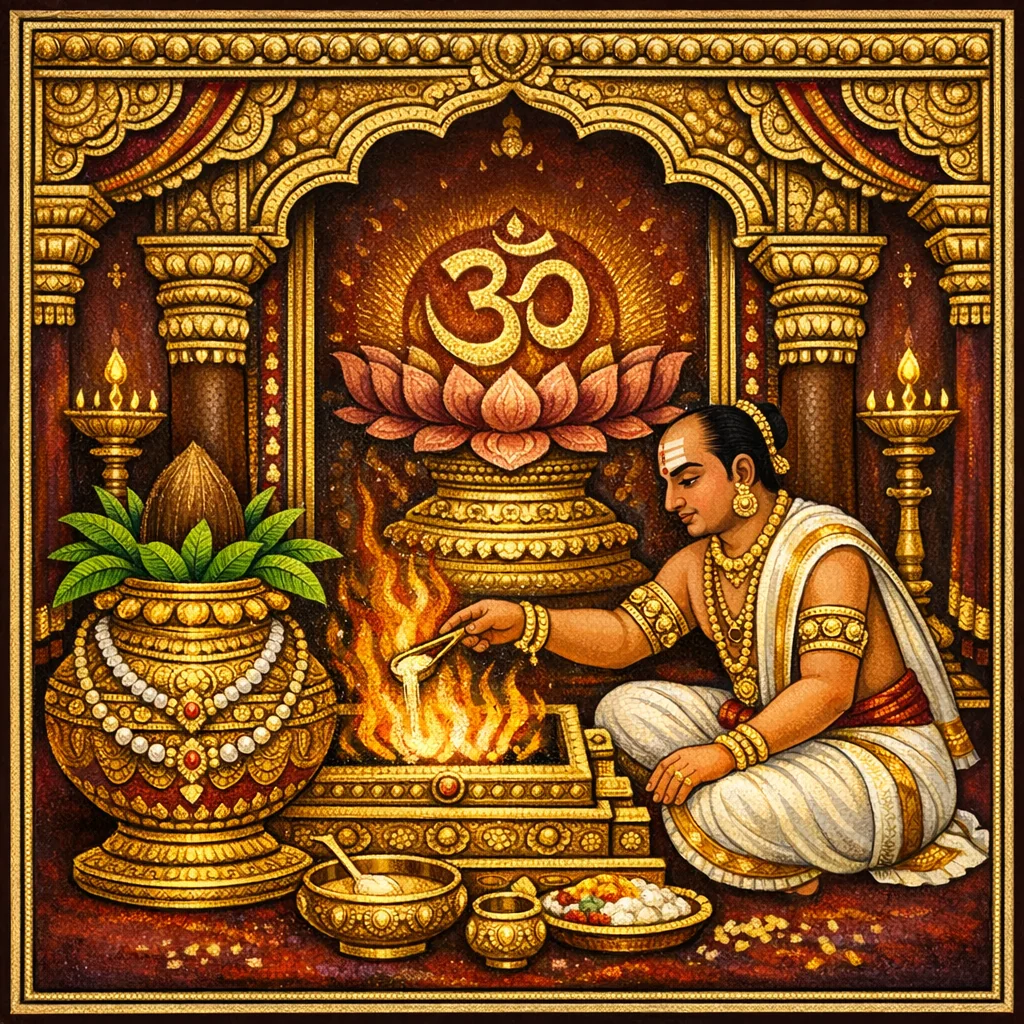
In this chapter, Lord Agni sets forth a Prāsāda-pratiṣṭhā (temple consecration and installation) sequence that unites Vāstu placement with tantric-āgamic interiorization. The installation point is fixed near the end of the śukanāśā, centered on the eastern altar-platform, establishing the temple’s spatial grammar of vitality. A lotus-seat is installed from Ādhāra-śakti and sealed with praṇava; a ritual base on gold (or equivalent) is then prepared with sanctifying substances including pañcagavya. A kumbha is set with honey and milk, furnished with a fivefold deposit of precious items, and adorned with cloth, garlands, fragrance, flowers, and incense; auxiliary implements and auspicious mango pallavas are arranged. The rite turns inward: through prāṇāyāma (pūraka/recaka) and nyāsa, the guru awakens Śambhu, draws a fire-like spark from dvādaśānta, and installs it into the kumbha as a tantric conduit of presence. The deity-form is completed by integrating attributes, kalās, Kṣānti, Vāgīśvara, the networks of nāḍīs and prāṇas, indriyas and their deities, and all-pervading Śiva through mudrā, mantra, homa, sprinkling, touch, and japa—culminating in a threefold sectional arrangement of the kumbha for stable divine indwelling.
Shlokas
Verse 1
इत्य् आग्नेये महापुराणे द्वारप्रतिष्ठा नाम शततमो ऽध्यायः अथैकाधिकशततमो ऽध्यायः प्रासादप्रतिष्ठा ईअवर उवाच प्रासादस्थापनं वक्ष्ये तच्चैतन्यं स्वयोगतः शुकनाशासमाप्तौ तु पूर्ववेद्याश् च मध्यतः
Thus, in the Agni Mahāpurāṇa ends the hundredth chapter called “Consecration of the Gateway.” Now begins the one-hundred-and-first chapter, “Consecration of the Temple (prāsāda).” The Lord said: “I shall explain the procedure for establishing a temple, and how it is endowed with sacred vitality (caitanya) through my own yogic power. The principal placement is to be made at the end of the śukanāśā (projecting porch/vestibule), in the middle of the eastern altar-platform.”
Verse 2
आधारशक्तितः पद्मे विन्यस्ते प्रणवेन च स्वर्णाद्ये कतमोद्द्भतं पञ्चगव्येन संयुतं
When the lotus-seat is established beginning with the Ādhāra-śakti, and installed with the Praṇava (Oṃ), then—upon gold and the like—one should set the ritual base, produced from “Katama” (a specified sacred substance) and combined with pañcagavya.
Verse 3
मधुक्षीरयुतं कुम्भं न्यस्तरत्रादिपञ्चकं स्रग्वस्त्रं गन्धलिप्तञ्च गन्धवत्पुष्पभूषितं
One should set in place a kumbha (ritual water-pot) containing honey and milk, with the set of five items—beginning with ratna (precious objects)—deposited therein/thereon. One should also arrange a garland and cloth; the pot is to be anointed with fragrant substances and adorned with fragrant flowers.
Verse 4
चूतादिपल्लवानाञ्च कृती कृत्यञ्च विन्यसेत् , झ च विन्यसेत् प्रणवेन तु इति ग मधुक्षीरयुतं न्यस्तरत्नादिपञ्चकं तत इति ग गन्धवत्पुष्पधूपितमिति ग , ङ , छ च वह्निकृत पद्मं विन्यसेदिति ख वह्निकूपं यवं न्यसेदिति ग वह्निकूपेषु च न्यसेदिति ज पूरकेण समादाय सकलीकृतविग्रहः
One should arrange mango and other tender shoots (pallavas), and set in place the ritual implements such as the offering ladles (kṛtī) and the required ritual acts (kṛtya). One should also place the seed-syllable “jha” together with the Praṇava (Oṃ). Then one should set down the five precious substances beginning with gems (ratna-ādi-pañcaka), combined with honey and milk. (These items) should be made fragrant and consecrated with perfumed flowers and incense. One should place a lotus-form arrangement fashioned for Agni, and in the fire-pits (vahni-kūpa) one should put barley (yava). Having thus gathered the rite by means of pūraka (the in-breath), the form (vigraha) is made complete (sakalīkṛta).
Verse 5
सर्वात्मभिन्नात्मानं स्वाणुना स्वान्तमारुतः आज्ञया बोधयेच्छम्भौ रेचकेन ततो गुरुः
Then the guru, in accordance with the injunction of the practice, should awaken Śambhu (Śiva) through recaka (exhalation), directing the inward-moving breath within one’s own subtle channel (nāḍī), so that the individual self—distinct from the all-pervading Self—becomes consciously realized.
Verse 6
द्वादशान्तात् समादाय स्फुरद्वह्निकणोपमं निक्षिपेत् कुम्भगर्भे च न्यस्ततन्त्रातिवाहिकं
Drawing it up from the dvādaśānta (the upper terminal point of the vital current), resembling a sparkling particle of fire, one should deposit it into the interior of the kumbha (ritual vessel), along with the tantric ‘conduit’ that has been established through nyāsa.
Verse 7
विग्रहन्तद्गुणानाञ्च बोधकञ्च कलादिकं क्षान्तं वागीश्वरं तत्तु ब्रातं तत्र निवेशयेत्
There one should install the form (vigraha) along with its qualities (attributes), and also the enlightening instructor-principle (bodhaka), together with the arts (kalā) and allied disciplines; and one should place there Kṣānti (forbearance) and Vāgīśvara (Lord of Speech)—indeed, that sacred ensemble should be installed in that place.
Verse 8
दश नाडीर्दश प्राणानिन्द्रियाणि त्रयोदश तदधिपांश् च संयोज्य प्रणवाद्यैः स्वनामभिः
Having conjoined the ten nāḍīs, the ten prāṇas (vital airs), the thirteen faculties (indriyas), and their presiding deities, one should connect them by their own names, beginning with the Praṇava (Oṃ).
Verse 9
स्वकार्यकारणत्वेन मायाकाशनियामिकाः विद्येशान् प्रेरकान् शम्भुं व्यापिनञ्च सुसम्वरैः
As regulators of the māyic sphere (māyā and the subtle ‘ether’), being the causal ground of their own effects, they impel the Vidyeśvaras; and they also impel Śambhu—the all-pervading—through well-contained restraints (saṃvara).
Verse 10
अङ्गानि च विनिक्षिप्य निरुन्ध्याद्रोधमुद्रा सुवर्णाद्युद्भवं यद्वा पुरुषं पुरुषानुगं
Having properly arranged the limbs, one should restrain (the senses/breath) by the Rodha-mudrā; and one should meditate either on the golden-radiant Puruṣa, or on the Puruṣa that follows the Puruṣa—namely, the individual self aligned with the Supreme Person.
Verse 11
पञ्चगव्यकषायाद्यैः पूर्ववत् संस्कृतन्ततः शय्यायां कुम्भमारोप्य ध्यात्वा रुद्रमुमापतिं
Then, after duly purifying it as before with pañcagavya, decoctions, and the like, one should place the ritual pot (kumbha) upon the consecrated couch (śayyā) and meditate upon Rudra, the consort of Umā.
Verse 12
इ ख , छ च प्रयामिका इति ख , छ च व्यापिनञ्च स्वशक्तित इति झ व्यापिनञ्चास्य संस्रवैर् इति ङ अज्ञाने चेति घ , झ च अङ्कादि चेति ङ निर्मञ्छ्य द्रोणमुद्रया इति ग निरुन्ध्याद् द्रवमुद्रया इति झ तस्मिंश् च शिवमन्त्रेण व्यापकत्वेन वियसेत् सन्निधानाय होमञ्च प्रओक्षणं स्पर्शनं जपं
‘Prayāmikā’ (so read in the Kha and Cha recensions). ‘Pervading (vyāpin)’—‘from one’s own power’ (Jha recension); and ‘pervading through its outflows/emanations’ (Ṅa recension). ‘In (cases of) ignorance’ (Gha and Jha recensions). ‘Beginning with the mark/sign (aṅka-ādi)’ (Ṅa recension). Having cleansed (the vessel/space), one should seal it with the Droṇa-mudrā (Ga recension); or one should close and restrain it with the Drava-mudrā (Jha recension). There, by means of the Śiva-mantra, one should expand the rite in the mode of all-pervasiveness for (Śiva’s) presence—together with homa (oblations), prokṣaṇa (sprinkling), sparśana (ritual touching), and japa (mantra repetition).
Verse 13
सान्निध्याबोधनं सर्वम्भागत्रयविभागतः विधायैवं प्रकृत्यन्ते कुम्भे तं विनिवेशयेत्
Having thus performed the entire rite of awakening (invoking) the divine presence, with the kumbha arranged by a threefold division into sections, at the conclusion of the procedure one should install that (deity/presence) in the ritual pot.
Frequently Asked Questions
It details the temple consecration workflow: spatial placement near the śukanāśā, lotus-seat installation from Ādhāra-śakti with praṇava, kumbha preparation using pañcagavya plus honey–milk and ratna-ādi-pañcaka, and the completion of presence via nyāsa, prāṇāyāma, mudrā, Śiva-mantra vyāpti, and homa/prokṣaṇa/sparśana/japa.
The rite is structured as an outer Vāstu installation synchronized with inner yogic operations: prāṇāyāma (pūraka/recaka), dvādaśānta visualization, and nyāsa transform the kumbha and site into a stabilized seat of Śiva’s all-pervading presence, aligning technical correctness with sādhanā.
The chapter highlights pañcagavya purification, a kumbha filled with honey and milk, a fivefold deposit beginning with precious items (ratna-ādi-pañcaka), plus cloth, garland, fragrance, flowers, and incense as the sensory and symbolic completion of the vessel.
The passage records recension variants for terms such as “prayāmikā,” different readings for “vyāpin” phrases, and alternative mudrā readings (Droṇa-mudrā vs Drava-mudrā), indicating a living ritual manuscript tradition.