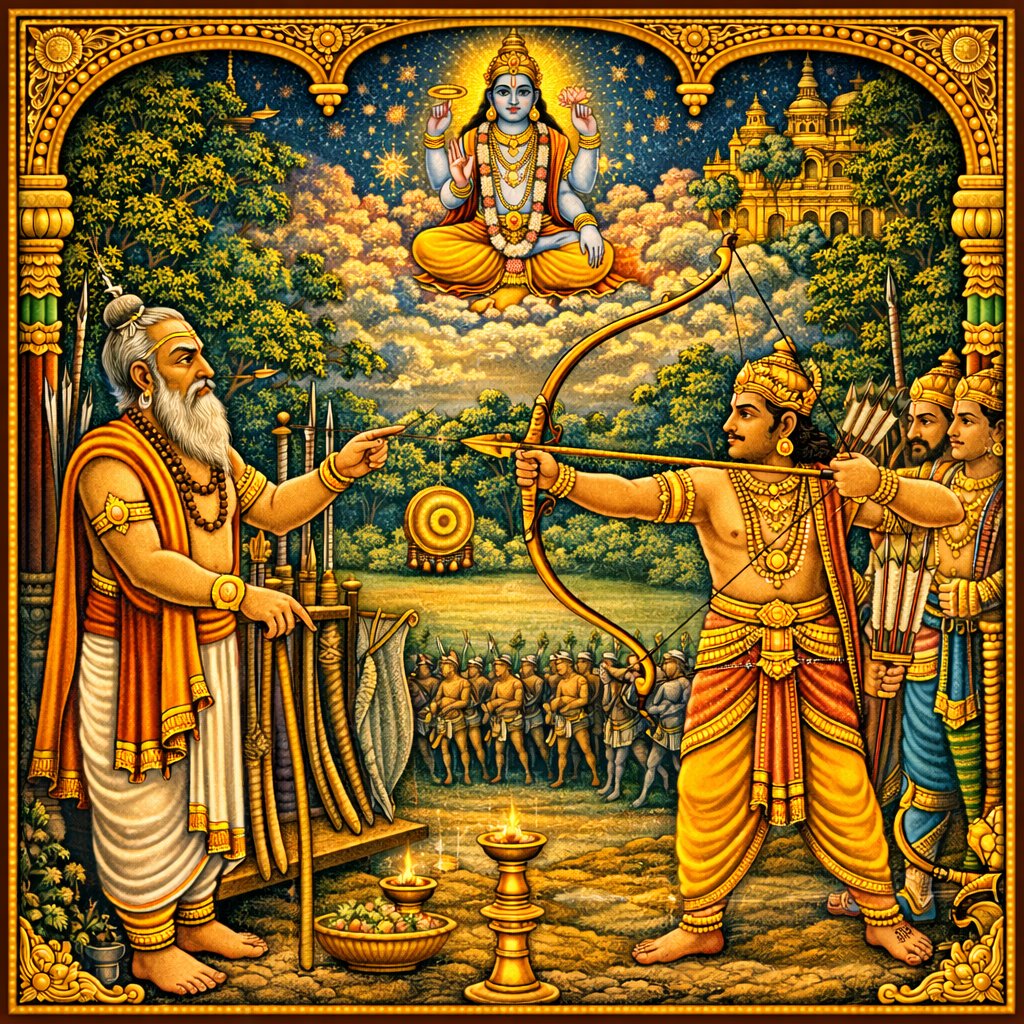
Dhanurveda
The Martial Science
The ancient science of archery and warfare (dhanurveda) covering weapons, military formations, training methods, and martial codes.
Adhyayas in Dhanurveda
Adhyaya 248
Chapter 248: धनुर्वेदः (Dhanurveda — Science of War and Archery Discipline)
Lord Agni begins the Dhanurveda by defining warfare-science as “four-footed,” structured by the four military arms—chariot, elephant, horse, and infantry—and, in Vedic teaching terms, as “fivefold” by modes of weapon-use: discharged projectiles, hand-thrown weapons, set-and-released devices, non-discharged weapons, and unarmed/arm-to-arm combat. He further refines the subject through paired classifications—śastra vs. astra (weapons vs. missiles) and straightforward vs. deceptive (māyā) methods—naming representative mechanism-releases (yantra-mukta) and hand-releases (pāṇi-mukta). The chapter then turns to discipline: readiness through protective gear, graded engagements (bow-centered and spear-centered), and the social-pedagogic order of instruction (the Brāhmaṇa teaches Kṣatriya/Vaiśya; Śūdra participation is possible through training and auxiliary service to the king). A substantial technical core details stances and measures (samapada, vaiśākha, maṇḍala, ālīḍha, pratyālīḍha, vikaṭa, sampuṭa), followed by archery procedure: salutation, safe clearance while stringing, navel/hip placement, the eye–ear aiming line, finger-grips on the arrow, draw-and-release mechanics, follow-through, and performance grading. Standard measures for arrows and bows are prescribed, and the principles are extended to horse, chariot, and elephant contexts—presenting martial technique as a dharma-governed discipline.
Adhyaya 249
Chapter 249 — धनुर्वेदकथनम् (Exposition of Dhanurveda): Archery Procedure, Target-Training, and Yogic Restraint
Lord Agni begins this Dhanurveda lesson with preparatory rites and readiness of equipment: the bow is made to proper full length, purified, and set within a sacrificial setting, showing martial training to be grounded in dharma. The archer then follows a strict sequence—take the arrow, bind the quiver-strap on the right, draw the arrow with the right hand while keeping the gaze locked on the target, lift the bow with the left, and nock the arrow firmly (including use of the siṃhakarṇa implement for secure seating). Skill is joined to inner discipline: the mind must not sink, it must stay fixed on the mark, and release is made from the correct bodily point on the right side. Practice advances through defined target-forms (including measured marks such as the sixteen-aṅgula candraka), post-release control drills (ulkā-śikṣā), and increasingly complex shots—eye-marks, square targets, turning shots, moving shots, and low/high piercings. Targets are classified as firm (dṛḍha), difficult (duṣkara), and wonderfully difficult (citra-duṣkara), with training prescribed on both right and left and with stable target mounting. The chapter culminates by linking procedural mastery (karma-yoga-vidhi) with yogic education: disciplined mind and gaze, and conquest of yama, uniting martial excellence with spiritual self-restraint.
Adhyaya 250
Dhanurveda-kathanam (The Teaching of Martial Science)
In this Dhanurveda chapter, Lord Agni presents martial competence as a disciplined progression: training hand, mind, and sight until one strikes the target reliably, and only then becoming fit to operate from a mount or vehicle. He then gives technical prescriptions—measures for cords and nooses, preferred forms, and proper materials for bowstrings—showing that victory depends on correct construction as much as on courage. Training is set within formal instruction, with the teacher arranging the practitioner’s stance and guiding coordinated hand actions. Practical combat follows: coiling and hurling a whirling implement at an armored foe, regulated movement-patterns (valgita, pluta, pravrajita) governed by proper conjunction (samayoga), and restraints after victory. Weapon carriage and draw-technique are specified (sword on the left; firm left-hand grip, right-hand extraction), along with dimensional metrics for implements, spikes, and armor placements. The chapter closes by stressing the conditioning of mounts for mobility and deployment, uniting individual skill with logistical readiness under dharmic procedure.
Adhyaya 251
Dhanurveda-kathana (Exposition of Martial Science): Movements, Weapon-Operations, Combat Postures, and Battle Readiness
Lord Agni sets forth a technical taxonomy of battlefield movements and attack-patterns (bhrānta, udbhrānta, śyenapāta, ākula), then gives named pairs and structural units as codified categories for training and recitation. He teaches practical curricula: (1) sword-and-shield discipline with thirty-two stances (pratyālīḍha, ālīḍha, varāha, lulita), (2) grappling and wrestling maneuvers—turning, seizing, upward/downward throws, holding and dislodging, (3) punitive bonds and nooses with their classifications and prescribed operations (vyasta-pāśa), and (4) weapon-specific karmas for cakra, śūla, tomara, gadā, parāśu, mudgara, bhindipāla, laguḍa, vajra, paṭṭiśa, and the sword—culminating in yantra-karman (mechanical/engine operations). The chapter also lists hand-gestures (hastas/mudrās), bodily effects and markers, and protective or medicinal/ritual items. The closing verses address battlefield logistics—arming elephants and chariots, appointing goad-bearers, archers, sword-bearers, and shield-bearers, and sanctifying weapons with mantra—ending with the royal charge to conquer and then protect the realm in accordance with dharma.
Adhyaya 252
Chapter 252 — व्यवहारकथनं (Vyavahāra-kathana: On Legal Procedure)
Agni begins a jurisprudential manual within the Dhanurveda stream, defining vyavahāra as discerning naya from anaya and explaining it through layered fourfold schemes: four parts, four bases, and fulfillment by four policy-means. Adjudication is grounded in dharma, courtroom procedure, customary practice (caritra), and royal ordinance (rāja-śāsana), stressing the interplay of claim and reply and the central role of witnesses. The chapter lists the classical eighteen titles of dispute—debt, deposits, partnerships, revocation of gifts, service and wages, sale by a non-owner, non-delivery, bad bargain, breach of convention, land disputes, marital matters, inheritance, violence, verbal insult and bodily assault, gambling, and miscellaneous cases—said to branch into a hundred subtypes by human action. Agni then sets out court ethics (impartial sabhyas, learned brahmanas), documentation protocols, rules on counter-charges and surety, penalties for false accusation, and the hierarchy of proof (documents, possession, witnesses; ordeals if absent). He closes with doctrines on prescription, title versus enjoyment, invalidation by fraud or force, mitigating conditions, theft restitution, and interest norms, placing the king as guarantor of order through disciplined procedure.