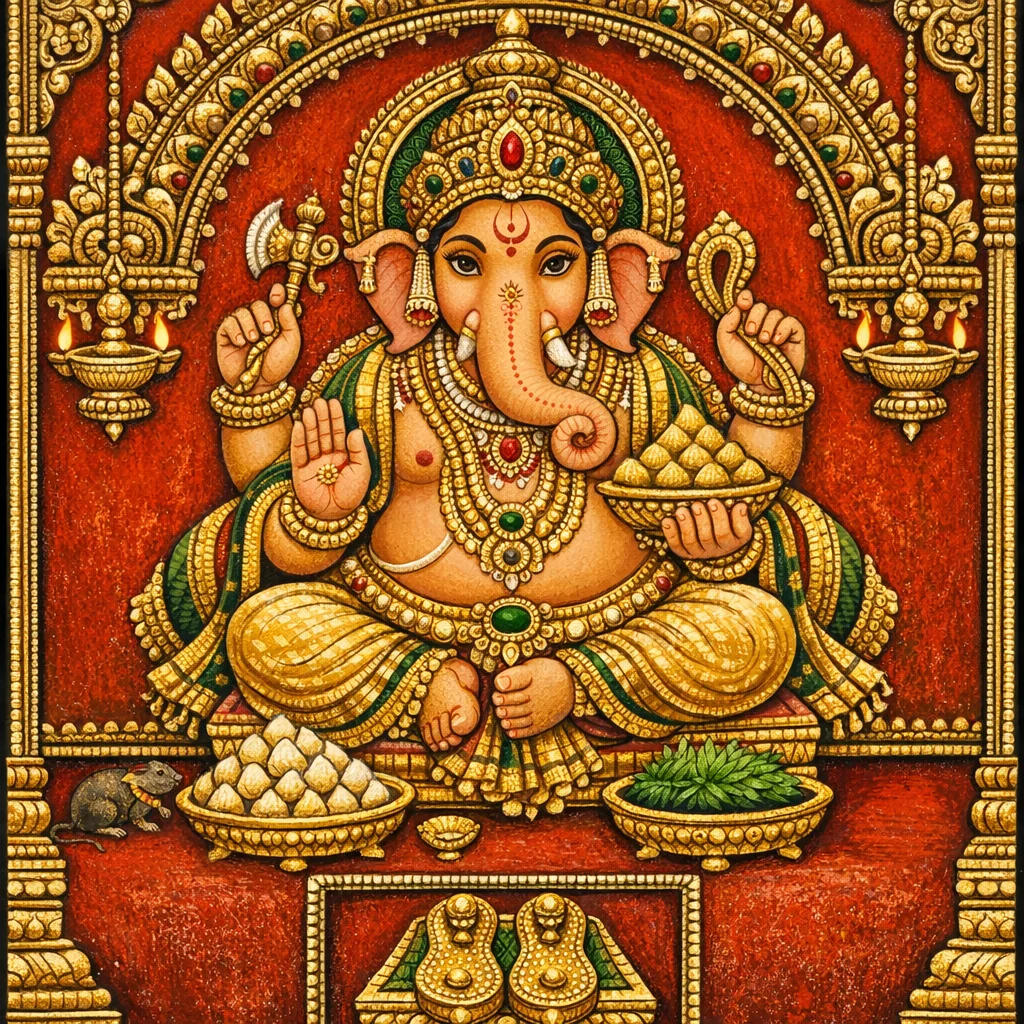
Adhyaya 71
Gaṇeśa-pūjā-vidhiḥ (The Procedure for Worship of Gaṇeśa)
In the Vāstu-Pratiṣṭhā and Īśāna-kalpa setting, Īśvara sets forth a Gaṇeśa-worship procedure to secure nirvighnatā (freedom from obstacles) before undertaking major rites. It begins with mantra-nyāsa, placing Gaṇapati’s epithets upon bodily loci (hṛdaya, śiras, śikhā, varma, netra, astra) to consecrate the practitioner’s body as a ritual instrument. The worship then unfolds around a mandala, honoring Gaṇa, the Guru and pādukā, Śakti and Ananta, Dharma, and the diagram’s structural layers (the principal “bone-circle” with upper and lower coverings), thus integrating lineage, power, cosmic support, and order. Goddess-forms—Padmakarṇikā-bījā, Jvālinī, Nandayā, Sūryeśā, Kāmarūpā, Udayā, Kāmavartinī—are invoked, followed by notes on textual variants and a brief mapping of bīja phonemes to elemental functions used in ritual preparation. The chapter concludes with a Gaṇapati gāyatrī and a litany of Gaṇeśa’s names, emphasizing him as Vighnanāśaka for successful pratiṣṭhā and dharmic accomplishment.
Shlokas
Verse 1
इत्य् आदिमाहापुराणे आग्नेये पादपारामप्रतिष्ठाकथनं नाम सप्ततितमो ऽध्यायः अथ एकसप्ततितमो ऽध्यायः गणेशपूजाविधिः ऐश्वर उवाच गणपूजां प्रवक्ष्यामि निर्विघ्नामखिलार्थदां गणाय स्वाहा हृदयमेकदंष्ट्राय वै शिरः
Thus, in the Agni Purāṇa within the Primordial Mahāpurāṇa, ends the seventieth chapter entitled “The account of establishing the supreme state through the ‘pāda-pārāma-pratiṣṭhā’.” Now begins the seventy-first chapter: “The procedure for worship of Gaṇeśa.” Īśvara said: “I shall set forth the worship of Gaṇa (Gaṇeśa), which removes obstacles and grants all aims. (Perform nyāsa:) ‘To Gaṇa, svāhā’—this is the heart; ‘to the One-tusked (Ekadaṃṣṭra)’—this is the head.”}]}}json}{
Verse 2
गजकर्णिने च शिखा गजवक्त्राय वर्म च महोदराय स्वदन्तहस्तायाक्षि तथास्त्रकम्
For “Gajakarṇin” (Elephant-eared) assign the śikhā (crown-tuft); for “Gajavaktra” (Elephant-faced) assign the armor (varma); for “Mahodara” (Big-bellied) assign the eyes (akṣi); and likewise assign the weapon-mantra (astra) to “Svadantahasta” (He whose hand holds his own tusk).
Verse 3
गणो गुरुः पादुका च शक्त्यनन्तौ च धर्मकः मुख्यास्थिमण्डलं चाधश्चोर्ध्वच्छदनमर्चयेत्
One should worship in proper sequence: Gaṇa, the Guru, the Guru’s sandals (pādukā), Śakti and Ananta, Dharma, the principal bone-circle of the maṇḍala (mukhya-asthi-maṇḍala), and also the coverings below and above.
Verse 4
पद्मकर्णिकवीजांश् च ज्वालिनीं नन्दयार्चयेत् सूर्येशा कामरूपा च उदया कामवर्तिनी
One should worship the Goddess as Padmakarṇikā-bījā (the seed-mantra), and as Jvālinī (the Flaming One); and also as Nandayā, as Sūryeśā, as Kāmarūpā, as Udayā, and as Kāmavartinī.
Verse 5
निर्विघ्नां पापनाशिनीमिति ग, घ, चिह्नितपुस्तकद्वयपाठः बलकर्णिने चेति ख, ग, घ, ङ, चिह्नितपुस्तकपाठः महोदराये दण्डहस्तायाक्षि इति ङ, चिह्नितपुस्तकपाठः मुख्यास्तिमण्डलमिति ख, ङ, चिह्नितपुस्तकद्वयपाठः सत्यां च विघ्ननाशा च आसनं गन्धमृत्तिका यं शोषा रं च दहनं प्लवो लं वं तथामृतम्
“(She is) unobstructed and the destroyer of sins”—so read two marked manuscripts. “And (she is) for Balakarṇa”—so read the marked manuscripts (kha, ga, gha, ṅa). “For Mahodara, for the staff-bearer (daṇḍahasta), (and as) the Eye”—so reads the marked ṅa manuscript. “The chief is the bone-maṇḍala (mukhya-asthi-maṇḍala)”—so read the two marked manuscripts (kha, ṅa). And (she is) “Satyā” and also “Vighna-nāśā” (remover of obstacles). The seat (āsana) is fragrant earth/clay; “yaṃ” is drying up (śoṣaṇa); “raṃ” is burning (dahana); “laṃ” is floating (plava); “vaṃ” is nectar, amṛta.
Verse 6
लम्बोदराय विद्महे महोदराय धीमहि तन्नो दन्ती प्रचोदयात् गणपतिर्गणाधिपो गणेशो गणनायकः गणक्रीडो वक्रतुण्ड एकदंष्ट्रो महोदरः
We know and revere Lambodara (the Pendulous-bellied One); we meditate upon Mahodara, the Great-bellied Lord. May that Dantī (the Tusked One) impel and illumine us. He is Gaṇapati, Gaṇādhipa, Gaṇeśa, Gaṇanāyaka; the one who sports among the gaṇas (gaṇa-krīḍa); Vakratuṇḍa (Curved-trunked); Ekadaṃṣṭra (Single-tusked); Mahodara (Great-bellied).
Verse 7
गजवक्त्रो लम्बुक क्षिर्विकटो विघ्ननाशनः धूम्रवर्णा महेन्द्राद्याः पूज्या गणपतेः स्मृताः
Elephant-faced, pot-bellied, (Kṣirvi) the formidable one, the destroyer of obstacles, smoke-hued—these, and others beginning with Mahendra, are remembered as venerable names/forms of Lord Gaṇapati, worthy of worship.
Frequently Asked Questions
The chapter emphasizes mantra-nyāsa with precise deity-epithet assignments to bodily loci (heart, head, crown-tuft, armor, eyes, weapon-mantra), followed by a structured mandala worship order (Gaṇa, Guru/pādukā, Śakti, Ananta, Dharma, and diagrammatic layers).
By foregrounding Gaṇeśa as Vighnanāśaka, it frames technical ritual correctness as a discipline of purification and dharmic alignment, ensuring that Vāstu-Pratiṣṭhā proceeds with auspiciousness while cultivating devotion, lineage-respect (guru), and inner steadiness through nyāsa and mantra.
A Gaṇapati gāyatrī is given: “लम्बोदराय विद्महे महोदराय धीमहि तन्नो दन्ती प्रचोदयात्”, positioning Gaṇeśa as the meditated deity who impels insight and successful completion of rites.