Adhyaya 82
अध्याय 82 — संस्कारदीक्षाकथनम् (Saṃskāra-Dīkṣā: Consecratory Initiation)
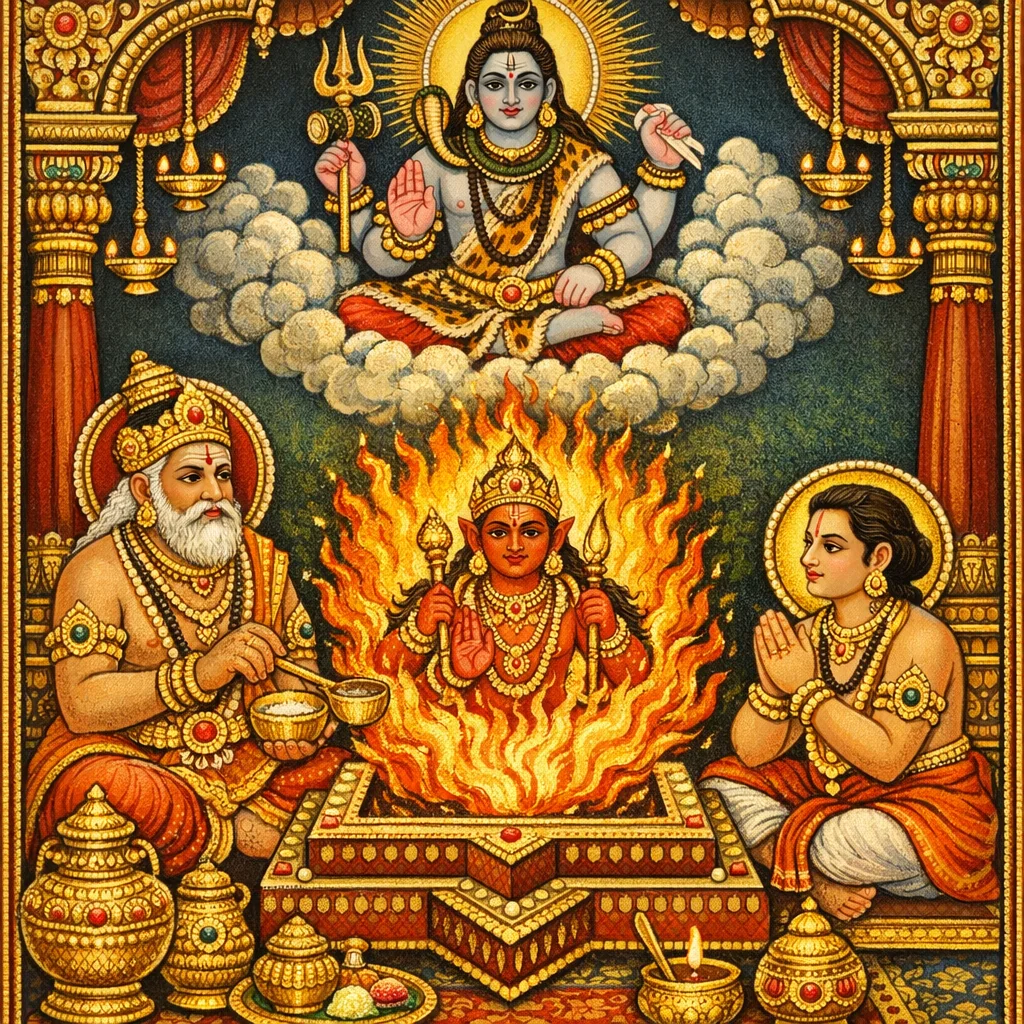
This chapter closes the account of Samaya-dīkṣā and immediately begins Saṃskāra-dīkṣā as a more transformative consecration. Grounded in Āgamic ritual logic, it invokes Maheśa in the sacrificial fire, performs heart-centered nyāsa, and offers a precisely counted pañcāhuti (five-oblation) sequence to stabilize divine presence. The inner rite intensifies through Astra-mantra consecration—striking the “child” at the heart and visualizing a star-like flash of consciousness—while breath disciplines (recaka, pūraka, kumbhaka) align with the bīja “huṃ” and mudrās (Saṃhāra, Udbhava) to withdraw, install, and seal mantra-energy in the practitioner and then in the disciple’s heart-lotus (karṇikā). It also gives practical diagnostics: homa succeeds with a blazing, smokeless fire and fails with a weak, smoky one, and it lists auspicious fire-signs. Ethical and disciplinary vows follow—non-blasphemy, reverence for śāstra and nirmālya, lifelong worship of Śiva–Agni–Guru, and compassionate giving according to capacity. The rite culminates in making the disciple fit for Āgamic knowledge of fire-offerings, linking initiation, purity, and competence for Vāstu-Pratiṣṭhā and Īśāna-kalpa applications.
Shlokas
Verse 1
इत्य् आदिमहापुराणे आग्नेये समयदीक्षाकथनं नाम एकाशीतितमो ऽध्यायः अथ द्व्यशीतितमो ऽध्यायः संस्कारदीक्षाकथनं ईश्वर उवाच वक्ष्ये संस्कारदीक्षायां विधानं शृणु षण्मुख आवाहयेन्महेशस्य वह्निस्थस्य शिरो हृदि
Thus, in the Agni Purāṇa—within the primordial Great Purāṇa—ends the eighty-first chapter called “The Account of Samaya-dīkṣā (initiation by vow/discipline).” Now begins the eighty-second chapter, “The Account of Saṃskāra-dīkṣā (consecratory initiation).” The Lord said: “I shall declare the procedure for saṃskāra-initiation; listen, O Six-faced one. One should invoke Maheśa, abiding in the sacrificial fire, placing the ‘head’ (mantra/nyāsa) in the heart.”
Verse 2
संश्लिष्टौ तौ समभ्यर्च्य सन्तर्प्य हृदयात्मना तयोः सन्निधये दद्यात्तेनैवाहुतिपञ्चकं
Having duly worshipped those two in close union and having satisfied them with heartfelt devotion, one should, for their continued presence, offer—by that very same rite—a set of five oblations, precisely.
Verse 3
कुसुमेनास्त्रलिप्तेन ताडयेत्तं हृदा शिशुं प्रस्फुरत्तारकाकारं चैतन्यं तत्र भावयेत्
With a flower anointed with the Astra-mantra (weapon-mantra), one should strike that “child” within the heart by means of the Hṛdā mantra; then one should contemplate there a consciousness (caitanya) that flashes forth in the form of a star.
Verse 4
शिवात्मनेति ख, ग, चिह्नितपुस्तकद्वयपाठः शिवहस्ते च स्थित्यर्थमिति ग, चिह्नितपुस्तकपाठः कुसुमेनाष्टजप्तेनेति ङ, चिह्नितपुस्तकपाठः प्रविश्य तत्र हुङ्कारमुक्तं रेचकयोगतः संहारिण्या तदाकृष्य पूरकेण हृदि न्यसेत्
Entering there (into that subtle locus), one should utter the bīja “huṃ” in conjunction with exhalation (recaka). Then, by means of the saṃhāriṇī (the withdrawing/contracting power), drawing it back, one should place it (nyāsa) in the heart with inhalation (pūraka).
Verse 5
ततो वागीश्वरीयौनौ मुद्रयोद्भवसञ्ज्ञया हृत्सम्पुटितमन्त्रेण रेचकेन विनिक्षिपेत्
Then, at the ‘yoni’ (source-seat) of Vāgīśvarī, using the mudrā known as Udbhava, one should place (install/insert) it by exhalation (rechaka), together with the mantra enclosed by the heart-seal (hṛt-sampuṭa).
Verse 6
ॐ हां हां हां आत्मने नमः जाज्वल्यमाने निर्धूमे जुहुयादिष्टसिद्धये अप्रवृद्धे सधूमे तु होमो वह्नौ न सिद्ध्यति
“Om—hāṃ hāṃ hāṃ—obeisance to the Self (Ātman).” One should offer into the homa-fire for the accomplishment of the desired result when the fire is blazing and smokeless; but when the fire is weak and smoky, the homa performed in that fire does not succeed.
Verse 7
स्निग्धः प्रदक्षिणावर्तः सुगन्धिः शस्यते ऽनलः विपरीतस्फुलिङ्गी च भूमिस्पर्शः प्रशस्यते
A fire is approved (as auspicious) when it is glossy and steady (well-fed), when its flame curls to the right, when it is fragrant, when its sparks fly in the reverse direction (i.e., not toward the sacrificer), and when it touches the ground (burns low and constant).
Verse 8
इत्येवमादिभिश्चिह्नैर् हुत्वा शिष्यस्य कल्मषं पापभक्षणहोमेन दहेद्वा तं भवात्मना
Having offered oblations accompanied by such marks (signs) and the like, one should burn away the disciple’s defilement (kalmaṣa); or, by means of the ‘sin-devouring’ homa (pāpa-bhakṣaṇa), one should consume that impurity, with the awareness of self-identification with Bhava (Śiva).
Verse 9
द्विजत्वापादनार्थाय तथा रुद्रांशभावने आहारवीजसंशुद्धौ गर्भाधानाय संस्थितौ
For the sake of conferring true ‘twice-born’ (dvija) status, and also for cultivating the Rudra-element (rudrāṃśa) in the offspring, the couple should undertake the rite of conception (garbhādhāna) after purifying both diet (āhāra) and seed (bīja).
Verse 10
सीमन्ते जन्मतो नामकरणाय च होमयेत् शतानि पञ्च मूलेन वौषडादिदशांशतः
At the sīmantonnayana rite, at the time of birth, and at the name-giving (nāmakaraṇa), one should perform a fire-offering (homa) of five hundred oblations using the prescribed root-substance; and the mantra-endings such as “vauṣaṭ” and the others should be employed in a one-tenth proportion, as laid down by rule.
Verse 11
शिथिलीभूतबन्धस्य शक्तावुत्कर्षणं च यत् आत्मनो रुद्रपुत्त्रत्वे गर्भाधानं तदुच्यते
When, after the bodily bindings (restraints) have become relaxed, there is an elevation (stimulation) of potency; and when the self is said to assume the state of being a “son of Rudra”—that is called garbhādhāna, the act/condition of conception.
Verse 12
स्वान्तत्र्यात्मगुणव्यक्तिरिह पुंसवनं मतं मायात्मनोर्विवेकेन ज्ञानं सीमन्तवर्धनं
Here, “Puṁsavana” is held to mean the manifestation of one’s own independent inner qualities; and “Sīmantavardhana” is the arising of knowledge through discernment between Māyā and the Self (Ātman).
Verse 13
शिवादितत्त्वशुद्धेस्तु स्वीकारो जननं मतं ममन्त्रेणेति ङ, चिह्नितपुस्तकपाठः ॐ हां हां आत्मने नम इति ग, घ, चिह्नितपुस्तकपाठः ॐ हां आत्मने नम इति ङ, चिह्नितपुस्तकपाठः पापक्षयेण होमनेति ङ, चिह्नितपुस्तकपाठः वीजसंसिद्धौ इति ङ, चिह्नितपुस्तकपाठः बोधनं यच्छिवत्वेन शिवत्वार्हस्य नो मतं
In the purification of the principles (tattva) beginning with Śiva, “acceptance” is regarded as a kind of spiritual rebirth—so teaches my mantra, according to one recension. In the marked manuscripts the reading is: “Oṃ hāṃ hāṃ—obeisance to the Self,” while another recension reads: “Oṃ hāṃ—obeisance to the Self.” It is also read: “by the homa for the destruction of sins,” and “for the accomplishment (siddhi) of the seed-mantra (bīja).” But awakening one who is fit for Śivahood into Śivahood merely by such a formula is not our view.
Verse 14
संहारमुद्रयात्मानं स्फुरद्वह्निकणोपमं विदधीत समादाय निजे हृदयपङ्कजे
Assuming the Saṃhāra-mudrā, one should visualize oneself as resembling a flashing spark of fire, and—having thus gathered (the mind/energy)—place it within one’s own lotus of the heart.
Verse 15
ततः कुम्भयोगेन मूलमन्त्रमुदीरयेत् कुर्यात् समवशीभावं तदा च शिवयोर्हृदि
Then, employing kumbhaka-yoga (breath retention), one should intone the root mantra; and then one should bring about a state of complete subjugation/attunement, placing it thereafter in the heart of Śiva and Śivā (the divine pair).
Verse 16
ब्रह्मादिकारणात्यागक्रमाद्रेचकयोगतः नीत्वा शिवान्तमात्मानमादायोद्भवमुद्रया
By the sequence of relinquishing the causal principles beginning with Brahmā, and through the discipline of exhalation (recaka), having led the self to the terminus in Śiva, one should then establish it by means of the Udbhava-mudrā.
Verse 17
हृत्सम्पुटितमन्त्रेण रेचकेन विधानवित् शिष्यस्य हृदयाम्भोजकर्णिकायां विनिक्षिपेत्
Knowing the prescribed procedure, one should, by exhalation (recaka), install the mantra—enclosed within the heart (hṛt-sampuṭa)—into the pupil’s heart-lotus, upon its central pericarp (karṇikā).
Verse 18
पूजां शिवस्य वह्नेश् च गुरुः कुर्यात्तदोचितां प्रणतिञ्चात्मने शिष्यं समयान् श्रावयेत्तथा
The guru should perform the duly appropriate worship of Śiva and of Agni; and he should also have the disciple bow in obeisance to himself, and likewise cause him to listen to (be instructed in) the prescribed vows and disciplinary observances (samaya).
Verse 19
देवं न निन्देच्छास्त्राणि निर्माल्यादि न लङ्घयेत् शिवाग्निगुरुपूजा च कर्तव्या जीवितावधि
One should not revile the Deity, nor transgress (disrespect) the scriptures, nor profane nirmālya—sacred remnants such as offerings and garlands. Worship of Śiva, Agni, and one’s Guru should be performed for the whole duration of one’s life.
Verse 20
बालबालिशवृद्धस्त्रीभोगभुग्व्याधितात्मनां यथाशक्ति ददीतार्थं समर्थस्य समग्रकान्
To children, the simple-minded, the aged, women, those devoted to sensual enjoyment, and those afflicted by illness—one should give aid according to one’s capacity; but to a capable person one should provide complete provisions.
Verse 21
भूताङ्गानि जटाभस्मदण्डकौपीनसंयमान् ईशानाद्यैर् हृदाद्यैर् वा परिजप्य यथाक्रमात्
He should duly perform japa in sequence, consecrating by mantra the bhūta-aṅgas and the observances of matted hair (jaṭā), sacred ash, staff, loincloth, and self-restraint—either with the Īśāna and related mantras or with the Hṛdaya and related mantras, in due order.
Verse 22
स्वाहान्तसंहितमन्त्रैः पात्रेष्वारोप्य पूर्ववत् सम्पादितद्रुतं हुत्वा स्थण्डिलेशाय दर्शयेत्
Having placed the oblations into the vessels while reciting mantras joined with the concluding utterance “svāhā”, and then—just as prescribed earlier—having offered into the fire the prepared melted ghee, one should present it as an offering to Sthaṇḍileśa, the Lord of the altar.
Verse 23
रक्षणाय घटाधस्तादारोप्य क्षणमात्रकं शिवादाज्ञां समादाय ददीत यतिने गुरुः
For protection, the guru should place the vessel beneath the disciple’s head or seat for just a moment; then, having received Śiva’s command (authorization), he should bestow it upon the yati, the renunciate disciple.
Verse 24
एवं समयदीक्षायां विशिष्टायां विशेषतः वर्धनमिति घ, चिह्नितपुस्तकपाठः ददीतान्नमिति घ, चिह्नितपुस्तकपाठः वह्निहोमागमज्ञानयोग्यः सञ्जायते शिश्रुः
Thus, in the specially distinguished samaya-initiation (samaya-dīkṣā)—in particular, according to the marked manuscript readings (“vardhanam” and “dadīt annam”)—the disciple becomes qualified for the knowledge of the Āgamas concerning fire and fire-offerings (vahni-homa).
Frequently Asked Questions
The chapter emphasizes precise ritual-technology: heart-centered mantra-nyāsa sealed by hṛt-sampuṭa, coordinated with prāṇāyāma (recaka/pūraka/kumbhaka) and specific mudrās, along with diagnostic fire-signs that determine homa efficacy.
It frames initiation as purification and reconfiguration of consciousness: karmic defilement is ‘burned’ through homa, mantra is installed in the heart-lotus, and ethical vows stabilize the transformation—uniting ritual competence (Bhukti) with Śiva-oriented inner discipline (Mukti).