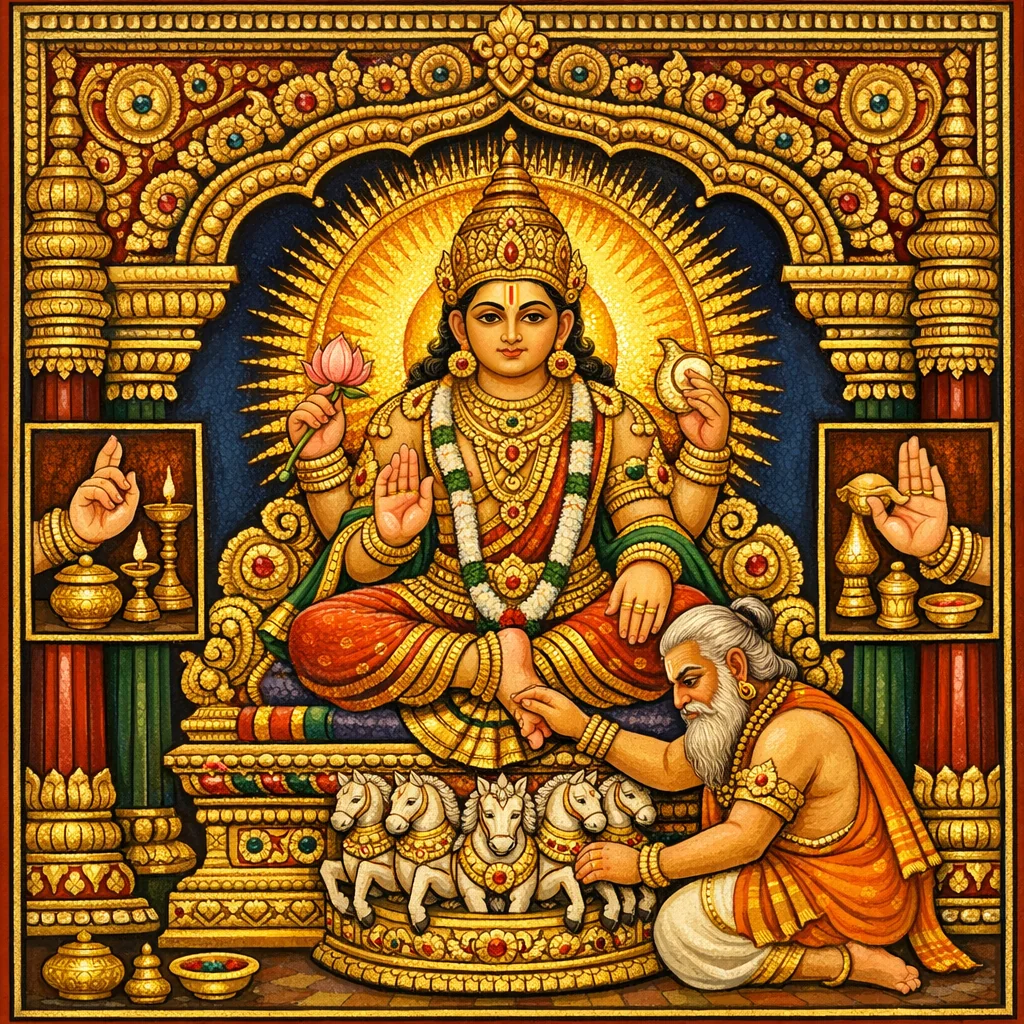
Adhyaya 99
Sūrya-pratiṣṭhā-kathana (Account of Installing Sūrya)
In this chapter, the Lord sets forth a Sūrya-pratiṣṭhā (installation of Sūrya) rite within the framework of Vāstu–pratiṣṭhā and the Īśāna-kalpa. The ceremony begins with mantra–letter sequences (bīja/varṇa groupings) and proceeds “as previously taught” through maṇḍapa arrangements and preliminaries such as snāna (ritual bathing) and śuddhi (purifications). Upon the Vidyā-āsana/śayyā, the officiant performs aṅga-nyāsa for Bhāskara, then installs the tri-tattva, followed by the khādi-pañcaka together with the vowels, indicating a layered placement of sound (mantra), principle (tattva), and form (the installation locus). After re-purifying the piṇḍī, nyāsa is extended through the tattva-pañcaka up to the specified sa-deśa-pada (designated locus). The guru then establishes the sarvatomukhī Śakti and, with his own hand, installs Sūrya endowed with Śakti. Finally, naming conventions ending in “svāmin” and the previously taught Sūrya-mantras are reaffirmed as authoritative for the installation.
Shlokas
Verse 1
ख , ग , घ , ङ च ॐ हूं स इति घ ह्रीं क्रियाशक्तये नम इति झ ॐ क्रियाशक्तये नम इति घ जप्त्वानुरूपतः इति ग , छ , च अथोनशततमो ऽध्यायः सूर्यप्रतिष्ठाकथनं ईश्वर उवाच वक्ष्ये सूर्यप्रतिष्ठाञ्च पूर्ववन्मण्डपादिकं स्नानादिकञ्च सम्याद्य पूर्वोक्तविधिना ततः
“(The mantra-letters:) kha, ga, gha, ṅa, and ca; then ‘oṃ hūṃ sa’—(indicated as) ‘gha’; then ‘hrīṃ—obeisance to the Power of Action (kriyā-śakti)’—(indicated as) ‘jha’; then ‘oṃ—obeisance to the Power of Action’—(indicated as) ‘gha’; having recited (these) by the appropriate method—(indicated as) ‘ga, cha, ca’. Now begins the ninety-ninth chapter: ‘The account of installing Sūrya.’ The Lord said: ‘I shall explain the installation of Sūrya, and, as before, the maṇḍapa (pavilion) and related arrangements; and, having duly performed the bathing and other rites according to the previously stated procedure, thereafter…’
Verse 2
विद्यामासनशय्यायां साङ्गं विन्यस्य भास्करं त्रितत्त्वं विन्यसेत्तत्र सस्वरं खादिपञ्चकं
Upon the seat (or ritual couch) of the Vidyā, having performed the aṅga-nyāsa for Bhāskara (the Solar deity), one should then place there the ‘three principles’ (tri-tattva); and thereafter one should install, together with the vowels, the group of five beginning with ‘kha’ (khādi-pañcaka).
Verse 3
शुद्ध्यादि पूर्ववत् कृत्वा पिण्डीं संशोध्य पूर्ववत् सदेशपदपर्यन्तं विन्यस्य तत्त्वपञ्चकं
Having performed the purificatory acts and the rest as previously prescribed, and having purified the piṇḍī again in the same manner, one should then perform nyāsa of the five principles (tattva-pañcaka) up to the point termed “sa-deśa-pada,” the designated locus or region.
Verse 4
शक्त्या च सर्वतोमुख्या संस्थाप्य विधिवततः स्वाणुना विधिवत् सूर्यं शक्त्यन्तं स्थापयेद्गुरुः
Having duly installed the all-facing (sarvatomukhī) Śakti, the guru should, in the prescribed manner and with his own hand, duly establish Sūrya—endowed with Śakti as his power or consort.
Verse 5
स्वाम्यन्तमथवादित्यं पादान्तन्नाम धारयेत् सूर्यमन्त्रास्तु पूर्वोक्ता द्रष्टव्याः स्थापनेपि च
Then, for Āditya (the Sun), one should assign or inscribe the name ending with “svāmin” at the end of the pāda (quarter/section). The Sun-mantras taught earlier are to be applied and consulted in the rite of installation as well.
Frequently Asked Questions
A staged installation workflow: aṅga-nyāsa of Bhāskara on the Vidyā-seat, placement of tri-tattva and tattva-pañcaka, khādi-pañcaka with vowels, repeated piṇḍī purification, and the prior installation of sarvatomukhī Śakti before establishing Sūrya.
It frames consecration as disciplined alignment of mantra (sound), tattva (principle), and ritual action (kriyā), so that correct Vāstu–pratiṣṭhā becomes a dharmic technology supporting worship, inner purification, and the integrated pursuit of bhukti and mukti.