Adhyaya 58
Chapter 58 — स्नानादिविधिः (Snānādi-vidhiḥ): Rules for Ritual Bathing and Related Consecration Rites
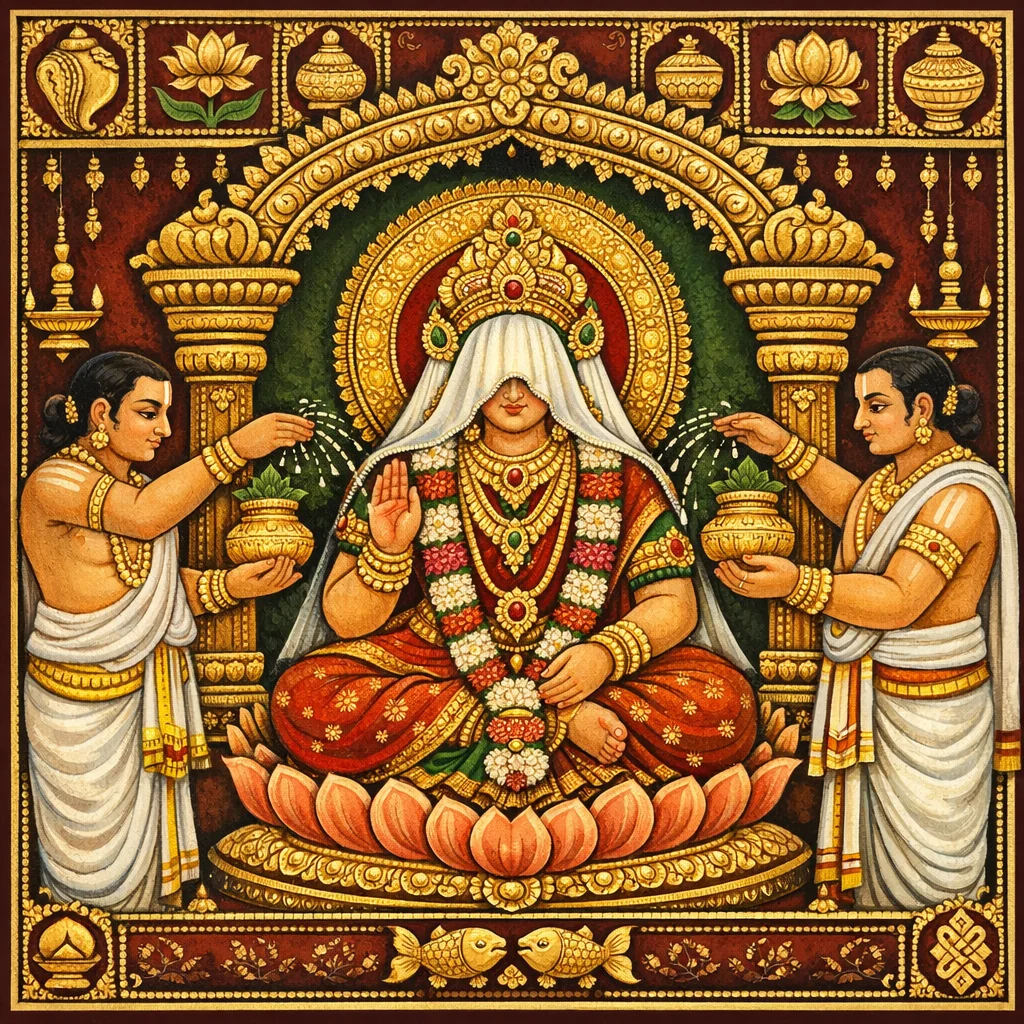
Continuing the Vāstu–Pratiṣṭhā sequence after kalaśādhivāsa, Lord Agni teaches the snānādi (snapana and ancillary) protocol that transforms an artisan-made icon into an awakened, purified presence fit for public worship. The ācārya kindles a Vaiṣṇava fire in the Īśāna (north-east) quarter, performs intensive Gāyatrī homa, and consecrates the kalaśa jars by sampāta; purification extends to the workshop and the ritual party, with music and the protective kautuka bound on the right hand (including for the deśika). The icon is installed, praised, and entreated to be free of śilpi-doṣa, then led to the bathing pavilion for netronmīlana (“opening of the eyes”) with prescribed mantras and offerings. A detailed snapana follows—anointing, rubbing, warm-water washing, sprinkling, and bathing with river/tīrtha waters, fragrant substances, herbs, pañcagavya, and multiple mantra-frames—culminating in Viṣṇu’s invocation with many kalaśas. The rite proceeds to kautuka-mocana, madhuparka, pavitraka preparation, and a full suite of upacāras (incense, añjana, tilaka, garlands, royal insignia), concluding with procession and aṣṭamaṅgala arrangements, applicable also to other deities (including Hara) and specifying snapana placement such as the “Nidrā” pot at the head-region.
Shlokas
Verse 1
इत्य् आदिमहापुराणे आग्नेये कलशाधिवासो नाम सप्तपञ्चाशत्तमो ऽध्यायः अथ अष्टपञ्चाशत्तमो ऽध्यायः स्नानादिविधिः भगवानुवाच ऐशान्यां जनयेत् कुण्डं गुरुर्वह्निञ्च वैष्णवं गायत्र्यष्टशतं हुत्वा सम्पातविधिना घटान्
Thus, in the Agni Purāṇa, the fifty-seventh chapter entitled “Kalaśādhivāsa (consecration/installation of the ritual jars)” concludes. Now begins the fifty-eighth chapter, “Rules for bathing and related rites.” The Blessed Lord said: “In the north-eastern quarter, the teacher should prepare a fire-pit (kuṇḍa) and kindle the Vaiṣṇava fire. Having offered eight hundred oblations with the Gāyatrī, he should consecrate the ritual jars according to the rite called sampāta.”
Verse 2
प्रोक्षयेत् कारुशालायां शिल्पिभिर्मूर्तिपैर् व्रजेत् तूर्यशब्दैः कौतुकञ्च बन्धयेद्दक्षिणे करे
He should perform sprinkling (prokṣaṇa) in the artisans’ workshop, proceed accompanied by the craftsmen and the makers of images amid the sound of musical instruments, and bind the protective consecration-thread (kautuka) on the right hand.
Verse 3
विष्णवे शिपिविष्टेति ऊर्णासूत्रेण सर्षपैः पट्टवस्त्रेण कर्तव्यं देशिकस्यापि कौतुकं
Reciting the formula “viṣṇave śipiviṣṭe,” one should prepare the protective kautuka (ritual thread/amulet) with a woolen cord together with mustard seeds and with a silk or cloth band; such a kautuka is to be made even for the officiating teacher (deśika).
Verse 4
मण्डपे प्रतिमां स्थाप्य सवस्त्रां पूजितान् स्तुवन् नमस्तेर्च्ये सुरेशानि प्रणीते विश्वकर्मणा
Having installed the icon in the maṇḍapa and, after worshipping it—clothed in garments—praising it, one should say: “Homage to You, O adorable Goddess, O Lady of the gods, fashioned by Viśvakarmā.”
Verse 5
प्रभाविताशेषजगद्धात्रि तुभ्यं नमो नमः त्वयि सम्पूजयामीशे नारायणमनामयं
O Sustainer of the entire world, who sets all the worlds in motion—salutations to You, again and again. In You, O Lord, I duly worship Nārāyaṇa, the flawless One, free from affliction.
Verse 6
रहिता शिल्पिदोषैस्त्वमृद्धियुक्ता सदा भव एवं विज्ञाप्य प्रतिमां नयेत्तां स्नानमण्डपं
“May you be free from the faults of craftsmanship; may you always be endowed with prosperity.” Having thus addressed and invoked the image, one should then lead that idol to the bathing pavilion.
Verse 7
शिल्पिनन्तोषयेद्द्रव्यैर् गुरवे गां प्रदापयेत् चित्रं देवेति मन्त्रेण नेत्रे चोन्मीलयेत्ततः
One should please the artisan with gifts and present a cow to the preceptor. Then, with the mantra “citraṃ deva”, one should perform the opening of the eyes (netronmīlana) of the deity-image.
Verse 8
मण्डले इति ग, चिह्नितपुस्तकपाठः अग्निर्ज्योतीति दृष्टिञ्च दद्याद्वै भद्रपीठके ततः शुक्लानि पुष्पाणि घृतं सिद्धार्थकं तथा
“In the maṇḍala”—so reads the marked book-variant. On the auspicious pedestal (bhadrapīṭha), one should then bestow the “gaze/visualization” with the mantra “agniḥ jyotiḥ” (“Agni is light”); thereafter offer white flowers, ghee (ghṛta), and also siddhārthaka (white mustard).
Verse 9
दूर्वां कुशाग्रं देवस्य दद्याच्छिरसि देशिकः मधुवातेति मन्त्रेण नेत्रे चाभ्यञ्जयेद्गुरुः
The officiating teacher (deśika) should place dūrvā grass and the tip of kuśa grass upon the head of the deity (image); and with the mantra beginning “madhu-vāta…”, the guru should also anoint the eyes.
Verse 10
हिरण्यगर्भमन्त्रेण इमं मेति च कीर्तयेत् घृतेनाभ्यञ्जयेत् पश्चात् पठन् घृतवतीं पुनः
Using the Hiraṇyagarbha mantra, one should recite the formula “imaṃ me” as well. Thereafter one should anoint with clarified butter (ghṛta, ghee), and while reciting again, repeat the ṛc/mantra called “Ghṛtavatī”.
Verse 11
मसूरपिष्टे नोद्वर्त्य अतो देवेति कीर्तयन् क्षालयेदुष्णतोयेन सप्त ते ऽग्रेति देशिकः
The officiant (deśika) should apply a rubbing (udvartana) with a paste of lentils while reciting “ato deve…”, and then wash it off with warm water, uttering “sapta te ’gre…”.
Verse 12
द्रुपदादिवेत्यनुलिम्पेदापो हि ष्ठेति सेचयेत् नदीजैस्तीर्थजैः स्नानं पावमानीति रत्नजैः
Reciting the mantra beginning “Drupadā…”, one should anoint the body; reciting “Āpo hi ṣṭhā…”, one should sprinkle water. Bathing should be done with waters from rivers and sacred fords (tīrthas), while purification with gems is to be performed with the hymn called “Pāvamānī”.
Verse 13
समुद्रं गच्छ चन्दनैस्तीर्थमृत्कलशेन च शन्नो देवीः स्नापयेच्च गायत्र्याप्युष्णवारिणा
“Go to the ocean,” taking sandal (candana) and also a water-jar (kalaśa) containing sacred earth from a tīrtha. And having recited “Śaṃ no devīḥ”, one should bathe; likewise one should bathe with warm water while reciting the Gāyatrī.
Verse 14
पञ्चमृद्धिर्हिरण्येति स्नापयेत्परमेश्वरं सिकताद्भिरिर्मं मेति वल्मीकोदघटेन च
Reciting the mantra beginning “pañcamṛddhiḥ” and then “hiraṇya iti,” one should bathe Parameśvara; likewise, with sand while reciting “irmaṃ me,” and also with water brought in a pot made from an anthill (valmīka).
Verse 15
तद्विष्णोरिति ओषध्यद्भिर्या ओषधीति मन्त्रतः यज्ञायज्ञेति काषायैः पञ्चभिर्गव्यकैस्ततः
Reciting the mantra beginning “tad viṣṇoḥ,” the rite is performed with medicinal herbs; likewise, as prescribed, with the mantra “yā oṣadhīḥ”; and with the mantra “yajñāyajña”; then one proceeds with decoctions and with the five products of the cow (pañcagavya).
Verse 16
पयः पृथिव्यां मन्त्रेण याः फलिनी फलाम्बुभिः विश्वतश् चक्षुः सौम्येन पूर्वेण कलसेन च
With a mantra, one should place or sprinkle milk upon the earth; then invoke the fruit-bearing powers with waters mixed with fruits; establish the all-seeing Eye; and perform this also with the gentle, eastern water-pot (kalaśa).
Verse 17
सोमं राजानमित्येवं विष्णो रराटं दक्षतः हंसः शुचिः पश्चिमेन कुर्यादुद्वर्तनं हरेः
Reciting the mantra beginning “Somaṃ rājānam…,” one should rub and cleanse Viṣṇu’s forehead; from the right with “Haṃsaḥ,” from the left with “Śuciḥ,” and from the west one should perform Hari’s udvartana, the purificatory dry-rubbing with powder.
Verse 18
मूर्धानन्दिवमन्त्रेण धात्रीं मांसीं च के ददेत् मानस्तोकेति मन्त्रेण गन्धद्वारेति गन्धकैः
With the mantra beginning “mūrdhānaṁ divā…,” one should offer dhātrī (āmalakī) and māṁsī (spikenard). With the mantra beginning “mā naḥ stoke…,” and with the Vedic formula “gandha-dvāre…,” one should offer the fragrant substances (perfumes).
Verse 19
मयूरपिच्छेनोद्वर्त्य इति घ, चिह्नितपुस्तकपाठः गायत्र्या गन्धवारिणा इति ग, घ, ङ, चिह्नितपुस्तकत्रयपाठः धात्रीमांस्युदकेन चेति घ, चिह्नितपुस्तकपाठः इदमापेति च घटैर् एताशीतिपदस्थितैः एह्येहि भगवन् विष्णो लोकानुग्राहकारक
“Rub (the body) with a peacock-feather”—so reads one recension; “(bathe) with fragrant water while reciting the Gāyatrī”—so read three recensions; “and (with) water infused with dhātrī (āmalakī) and māṃsī (jatāmāṃsī)”—so reads one recension. Then, with pots (kalaśas) set in the eighty positions, reciting “Idam āpaḥ …”, one should invoke: “Come, come, O Blessed Lord Viṣṇu, benefactor who bestows grace upon the worlds.”
Verse 20
यज्ञभागं गृहाणेमं वासुदेव नमोस्तु ते अनेनावाह्य देवेशं कुर्यात् कौतुकमोचनं
“Accept this portion of the sacrifice, O Vāsudeva—obeisance to you. By means of this (mantra), having invoked the Lord of gods (Devēśa), one should perform the untying/removal of the consecration-thread (kautuka-mocana).”
Verse 21
मुञ्चामि त्वेति सूक्तेन देशिकस्यापि मोचयेत् हिरण्मयेन पाद्यं दद्यादतो देवेति चार्घ्यकं
With the hymn (mantra) beginning “muñcāmi tvā… (I release you)”, one should also effect the release (ritual absolution) of the officiating teacher (deśika). One should offer the foot-washing water (pādya) in a golden vessel; and then, with the (mantra) beginning “ato deva…”, one should offer the arghya-oblation.
Verse 22
मधुवाता मधुपर्कं मयि गृह्णामि चाचमेत् अक्षन्नमीमदन्तेति किरेद्दर्वाक्षतं बुधः
Reciting “Madhuvātā…,” he should accept the madhuparka (the honey-mixture) and then sip water for purification (ācamanam). Saying, “akṣannamīm adanta iti,” the wise man should then scatter unbroken rice-grains (akṣata) with a ladle (darvī).
Verse 23
काण्डान्निर्मञ्छनं कुर्याद्गन्धं गन्धवतीति च उन्नयामीति माल्यञ्च इदं विष्णुः पवित्रकं
One should prepare the pavitraka (purificatory sacred thread/garland) by stripping fibres from stalks. While offering perfume one should say, “(You are) fragrant”; and while raising and placing the garland one should say, “I lift (it up).” This (rite) is the pavitraka for Viṣṇu.
Verse 24
वृहस्पते वस्त्रयुग्मं वेदाहमित्युत्तरीयकं महाव्रतेन सकलीपुष्पं चौषधयः क्षिपेत्
For (the deity) Bṛhaspati, one should cast as an offering a pair of garments while reciting the mantra “vedāham”; and an upper-cloth (uttarīya) with the mantra “mahāvratena”; likewise one should offer the ‘sakalī’ flower and medicinal herbs.
Verse 25
धूपं दद्याद्धूरसीति विभ्राट्सूक्तेन चाञ्जनं युञ्जन्तीति च तिलकं दीर्घायुष्ट्वेति माल्यकं
One should offer incense with the mantra “dhūr asi”; collyrium (añjana) with the Vibhrāṭ-sūkta; the forehead mark (tilaka) with the mantra “yuñjantī”; and a garland with the mantra “dīrghāyuṣṭva”.
Verse 26
इन्द्रच्छत्रेति छत्रन्तु आदर्शन्तु विराजतः चामरन्तु विकर्णेन भूषां रथन्तरेण च
The parasol is to be designated “Indra’s parasol”; the mirror as “the Radiant One’s” (Virājataḥ); the fly-whisk (cāmara) with “Vikarṇa”; and the ornamentation likewise with “Rathantara”.
Verse 27
व्यजनं वायुदैवत्यैर् मुञ्चामि त्वेति पुष्पकं वेदाद्यैः संस्तुतिं कुर्याद्धरेः पुरुषसूक्ततः
Offering the fan (vyajana), presided over by the deities of Wind, one should say, “muñcāmi tvā iti”—“I wave/release it for you.” Then, with flowers, one should perform praise of Hari by Vedic hymns, beginning with the Puruṣa-sūkta.
Verse 28
सर्वमेतत्समं कुर्यात् पिण्डिकादौ हरादिके देवस्योत्थानसमये सौपर्णं सूक्तमुच्चरेत्
One should perform all of this in the same manner in the case of the piṇḍikā and other (forms/rites), and likewise for Hara (Śiva) and the other deities. At the time of the deity’s awakening/raising (utthāna), one should recite the Sauparṇa Sūkta.
Verse 29
उत्तिष्ठेति समुत्थाप्य शय्याया मण्डपे नयेत् शाकुनेनैव सूक्तेन देवं ब्रह्मरथादिना
Having roused (the deity) with the words “Arise!”, one should lead (him) from the bed to the maṇḍapa; and with the Śākuna Sūkta alone, one should conduct the god in procession by means of the Brahma-chariot and the like.
Verse 30
अतो देवेति सूक्तेन प्रातिमां पिण्डिकां तथा श्रीसूक्तेन च शय्यायां विष्णोस्तु शकलीकृतिः
With the hymn beginning “ato deva…”, one should fashion the icon (pratimā) and likewise the pedestal-lump (piṇḍikā); and with the Śrī-sūkta, upon the couch (śayyā), the segmented, assembled formation of Viṣṇu is to be made.
Verse 31
तत्त्वायामीति घ, चिह्नितपुस्तकपाठः मृगराजं वृषं नागं व्यजनं कलशं तथा वैजयन्तीं तथा भेरीं दीपमित्यष्टमङ्गलं
‘Tattvāyāmīti…’—so reads the marked manuscript-variant. The eight auspicious emblems are: the lion (king of beasts), the bull, the nāga-serpent, the fly-whisk (cāmara), the ritual water-pot (kalaśa), the vaijayantī (victory garland/banner), the bherī (drum), and the lamp (dīpa).
Verse 32
दर्शयेदश्वसूक्तेन पाददेशे त्रिपादिति उखां पिधानकं पात्रमम्बिकां दर्विकां ददेत्
He should (ritually) present the rite with the Aśva-sūkta; at the foot-region (of the altar/ritual ground) he should place the three-footed stand. He should then provide the ukhā (fire-pot), its cover, the vessel, the ambikā (designated implement), and the darvī (offering ladle).
Verse 33
मुषलोलूखलं दद्याच्छिलां सम्मार्जनीं तथा तथा भोजनभाण्डानि गृहोपकारणानि च
One should provide a pestle and mortar, a grinding-stone, and likewise a broom; and also vessels for preparing and serving food, as well as other useful household implements.
Verse 34
शिरोदेशे च निद्राख्यं वस्त्ररत्नयुतं घटं खण्डखाद्यैः पूरयित्वा स्नपनस्य विधिः स्मृतः
At the head-region one should place a pot called “Nidrā,” adorned with cloth and jewels; having filled it with pieces of sweet offerings, this is the remembered procedure for ritual ablution (snāpana).
Frequently Asked Questions
The chapter emphasizes a tightly ordered pratiṣṭhā-snapana pipeline: Īśāna-kūṇḍa and Vaiṣṇava fire setup, Gāyatrī-based homa (eight hundred oblations), sampāta-based kalaśa consecration, workshop prokṣaṇa, kautuka binding/release, netronmīlana, and a mantra-mapped bathing regimen using specified waters and substances (herbs, pañcagavya, perfumes), followed by pavitraka and royal upacāras.
It frames craftsmanship and ritual precision as sādhanā: purification of space, body, and icon, disciplined mantra-recitation, and regulated offerings culminate in invoking Viṣṇu’s grace for loka-anugraha (benefit of the worlds). The sequence turns technical Vāstu–pratiṣṭhā actions into dharmic worship that integrates bhukti (order, prosperity, communal stability) with mukti-oriented devotion and purity.
Kautuka functions as a protective consecration-thread marking ritual eligibility and safeguarding the rite; it is bound with specific materials and mantras, applied even to the deśika, and later ritually released (mocana) to conclude the protected phase.
Aṣṭamaṅgala are eight auspicious emblems (lion, bull, serpent, fly-whisk, kalaśa, vaijayantī, bherī, lamp) displayed to signal completeness, auspiciousness, and royal-temple legitimacy during installation and public-facing ritual phases.