Adhyaya 52
Chapter 52: देवीप्रतिमालक्षणं (Devī-pratimā-lakṣaṇa) — Characteristics of Goddess Images
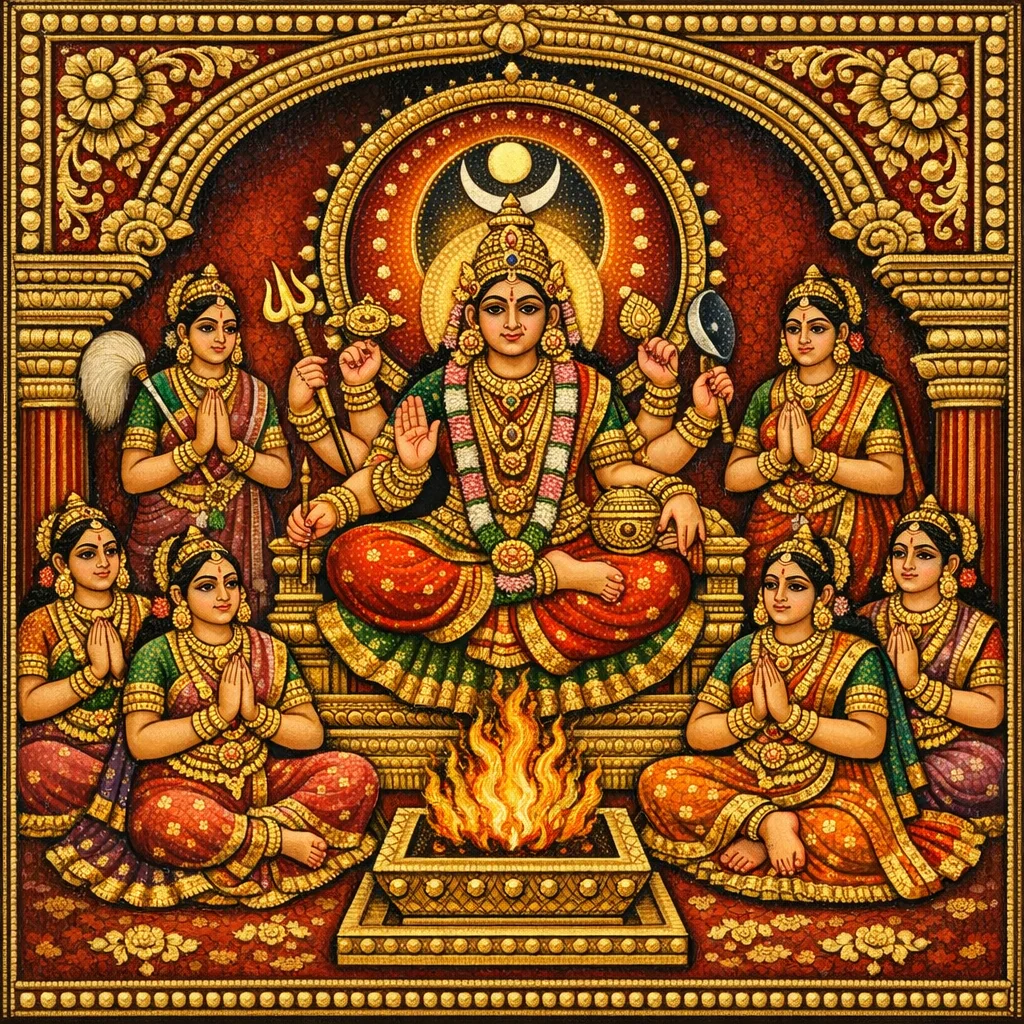
Continuing the Pratimā-lakṣaṇa sequence, Lord Agni announces a systematic teaching on Yoginī-groups in an “eight-and-eight” (aṣṭāṣṭaka) series, from the Aindrī set through the pacifying Śāntā set. The chapter then lists many Yoginī/Devī epithets and power-names, preserving manuscript-variant traditions on weapons and iconographic particulars. After the name-catalogues it turns to prescription: attendant goddesses should be shown with four or eight arms, bearing chosen weapons and bestowing siddhis. Bhairava’s form is defined in detail—fierce demeanor, matted jaṭā with a lunar emblem, and a full armament of sword, goad (aṅkuśa), axe (paraśu), bow, trident, khaṭvāṅga, and noose (pāśa), together with the varada boon-giving gesture. Ritual instructions follow, emphasizing aviloma (reverse) sequencing up to Agni, mantra division, and ṣaḍaṅga application. The chapter concludes with focused iconographic templates for Vīrabhadra, Gaurī/Lalitā, and a vivid Caṇḍikā mounted on a lion, striking down a buffalo with her trident—uniting theology, image-science, and installation-ritual into a single Āgamic blueprint.
Shlokas
Verse 1
इत्य् आदिमहापुराणे आग्नेये प्रतिमालक्षणं नाम एकपञ्चाशो ऽध्यायः अथ द्विपञ्चोशो ऽध्यायः देवीप्रतिमालक्षणं भगवानुवाच योगिन्यष्टाष्टकं वक्ष्ये ऐन्द्रादीशान्ततः क्रमात् हिनीसूत्रवान् शनिरिति ग, घ, चिह्नितपुस्तकद्वयपाठः खड्गो इति घ, चिह्नितपुस्तकपाठः मणिविद्याधराश् च खे इति ख, चिहितपुस्तकपाठः विस्तृतानना इति ख, चिह्नितपुस्तकपाठः शूलयुता इति ग, घ, ङ, चिह्नितपुस्तकपाठः अक्षोभ्या रूक्षकर्णो च राक्षसी कृपणाक्षया
Thus, in the Agni Purāṇa, the fifty-first chapter entitled “Characteristics of Images (Pratimā-lakṣaṇa)” concludes. Now begins the fifty-second chapter: “Characteristics of Goddess Images (Devī-pratimā-lakṣaṇa).” The Blessed Lord said: “I shall describe, in due sequence from the group beginning with Aindrī up to the pacifying (Śāntā) group, the set of eight-and-eight Yoginīs.” (What follows in the transmitted text contains manuscript variant readings regarding their attributes—such as being furnished with a sword, bearing jewels and vidyādharas, having a broad face, being endowed with a trident, and names/epithets like Akṣobhyā, Rūkṣakarṇā, Rākṣasī, and Kṛpaṇākṣayā.)
Verse 2
पिङ्गाक्षी च क्षया क्षेमा इला लीलालया तथा लोला लक्ता बलाकेशी लालसा विमला पुनः
And (she is) Pingākṣī, Kṣayā, Kṣemā, Ilā, Līlālayā; likewise Lolā, Laktā, Balākeśī, Lālasā, and again Vimalā.
Verse 3
हुताशा च विशालाक्षी हुङ्कारा वडवामुखी महाक्रूरा क्रोधना तु भयङ्करी महानना
She is Hutāśā (fire-born, fire-like), the wide-eyed one; she is Huṅkārā (embodiment of the sacred syllable huṁ), Vaḍavāmukhī (mare-faced, the consuming fire); exceedingly fierce, truly wrathful, terrifying, and great-faced.
Verse 4
सर्वज्ञा तरला तारा ऋग्वेदा तु हयानना साराख्या रुद्रशङ्ग्राही सम्बरा तालजङ्घिका
She is Omniscient; she is Taralā (swift, or trembling with power); she is Tārā; she is the essence of the Ṛgveda; she is Hayānanā (Horse-faced); she is known as Sārā (“Essence”); she upholds Rudra’s emblem or power; she is Sambarā; and she is Tālajaṅghikā (“She of tāla-palm-like legs”).
Verse 5
रक्ताक्षी सुप्रसिद्धा तु विद्युज्जिह्वा करङ्किणी मेघनादा प्रचण्डोग्रा कालकर्णी वरप्रदा
She is Raktākṣī (the Red-Eyed One), indeed widely renowned; Vidyujjihvā (whose tongue is like lightning); Karaṅkiṇī (the Skull-adorned One); Meghanādā (whose roar is like thunderclouds); Pracaṇḍogrā (exceedingly fierce and formidable); Kālakarṇī (the Black-eared/Ill-omened One); and Varapradā (the Bestower of boons).
Verse 6
चन्द्रा चन्द्रावली चैव प्रपञ्चा प्रलयान्तिका शिशुवक्त्रा पिशाची च पिशिताशा च लोलुपा
Chandrā, Chandrāvalī, Prapañcā, Pralayāntikā, Śiśuvaktrā, Piśācī, Piśitāśā, and Lolupā—these too are her names.
Verse 7
धमनी तापनी चैव रागिणी विकृतानना वायुवेगा वृहत्कुक्षिर्विकृता विश्वरूपिका
Dhamanī and Tāpanī; Rāgiṇī; Vikṛtānanā (of altered, terrific visage); Vāyuvegā (swift as the wind); Vṛhatkukṣi (of vast belly); Vikṛtā (the transformed, terrible one); and Viśvarūpikā (whose form is the universe).
Verse 8
यमजिह्वा जयन्ती च दुर्जया च जयान्तिका विडाली रेवती चैव पूतना विजयान्तिका
Yamajihvā, Jayantī, Durjayā, Jayāntikā, Viḍālī, Revatī, as well as Pūtanā and Vijayāntikā—these are the named powers invoked/recited for protection.
Verse 9
अष्टहस्ताश् चतुर्हस्ता इच्छास्त्राः सर्वसिद्धिदाः हः रससङ्ग्राही इति ख, चिह्नितपुस्तकपाठः वसुसङ्ग्राही इति घ, चिह्नितपुस्तकपाठः कालवर्णी इति ग, घ, चिह्नितपुस्तकद्वयपाठः चण्डा चण्दवतीति ङ, चिह्नितपुस्तकपाठः वामनी इति ख, ग, ङ, चिह्नितपुस्तकपाठः भैरवश्चार्कहस्तः स्यात् कूर्परास्यो जटेन्दुभृत्
The attendant goddesses are to be shown with eight hands or with four hands, bearing their desired weapons; they are bestowers of all siddhis. Bhairava should be depicted holding a shield in his hand, with a fierce, contracted visage, wearing matted locks and bearing the moon as an emblem in his hair.
Verse 10
खड्गाङ्कुशकुठारेषुविश्वभयभृदेकतः चापत्रिशूलखट्वाङ्गपाशकार्धवरोद्यतः
On one side, (the deity) bears a sword, a goad (aṅkuśa), and an axe, spreading fear throughout the worlds; on the other side, he is shown holding a bow, a trident, a khaṭvāṅga staff, and a noose (pāśa), with one hand raised in the boon-bestowing gesture (varada).
Verse 11
गजचर्मधरो द्वाभ्यां कृत्तिवासोहिभूषतः प्रेताशनो मातृमध्ये पूज्यः पञ्चाननोथवा
He should be meditated upon and worshipped as the bearer of an elephant-hide, clad in a hide-garment and adorned with serpents; as the eater of the (impure) offering connected with the dead; abiding in the midst of the Mothers (Mātṛkās); or else as the five-faced form (Pañcānana).
Verse 12
अविलोमाग्निपर्यन्तं दीर्घाष्टकैकभेदितं तत्षडङ्गानि जात्यन्तैर् अन्वितं च क्रमाद् यजेत्
One should perform the worship/oblation in proper order, proceeding by the reverse sequence (aviloma) up to the Fire (Agni), dividing the mantra by long vowels and by the eightfold units (aṣṭaka), and then applying, in sequence, its six limbs (ṣaḍ-aṅga) together with the prescribed class-endings (jāty-anta).
Verse 13
मन्दिराग्निदलारूढं सुवर्णरसकान्वितं नादविन्द्वन्दुसंयुक्तं मातृनाथाङ्गदीपितं
Mounted upon the petal of the maṇḍala-fire, endowed with a golden essence, conjoined with nāda and with the pair—bindu and the crescent-moon—, and illuminated by the Mothers and the Lord through their aṅgas (limbs/auxiliary parts).
Verse 14
वीरभद्रो वृषारूढो मात्रग्रे स चतुर्मुखः गौरीं तु द्विभुजा त्र्यक्षा शूलिनी दर्पणान्विता
Vīrabhadra is to be depicted mounted upon a bull; and, within the Mothers’ (Mātṛkās’) group, he is shown as four-faced. As for Gaurī, she is to be portrayed two-armed, three-eyed, bearing a trident, and furnished with a mirror.
Verse 15
शूलं गलन्तिका कुण्डी वरदा च चतुर्भुजा अब्जस्था ललिता स्कन्दगणादर्शशलाकया
She holds a trident; she is Galantikā and Kuṇḍī; she grants boons and is four-armed; seated upon a lotus, she is Lalitā, adorned/attended with the mirror and the stylus (śalākā) of Skanda’s gaṇas.
Verse 16
चण्डिका सशहस्ता स्यात् खड्गशूलारिशक्तिधृक् दक्षे वामे नागपाशं चर्माग्कुशकुठारकं धनुः सिंहे च महिषः शूलेन प्रहतोग्रतः
Caṇḍikā should be portrayed with six hands, bearing a sword, a spear, and the enemy-destroying śakti (javelin). In her right and left hands she holds a serpent-noose, a shield, a goad (aṅkuśa), a small axe, and a bow; she is seated upon a lion, and in front a buffalo is shown struck down by her trident (triśūla).
Frequently Asked Questions
It emphasizes iconographic specification (arm-count, weapons, mounts, emblems) alongside ritual technology: aviloma sequencing up to Agni, mantra division (dīrgha/aṣṭaka-bheda), and ṣaḍaṅga application for correct worship and installation contexts.
By treating image-making and worship as disciplined sacred craft: correct forms (pratimā-lakṣaṇa) and correct procedures (mantra/krama) align devotion with cosmic order, supporting both siddhi-oriented protection/auspiciousness and the dharmic purification conducive to liberation.