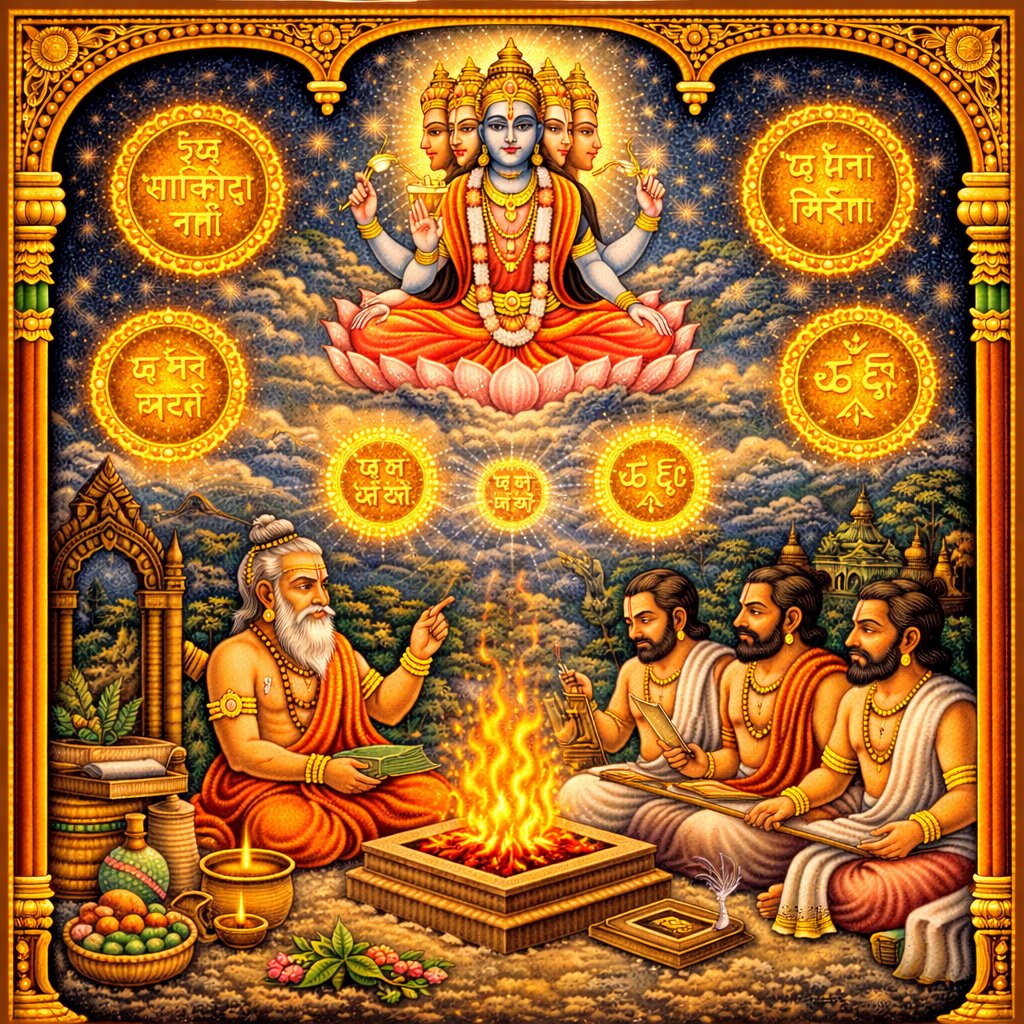
Mantra-shastra
Tantra & Sacred Formulae
The science of mantras, tantric rituals, yantra construction, and esoteric practices for spiritual attainment and protection.
Adhyayas in Mantra-shastra
Adhyaya 301
Chapter 301 — सूर्यार्चनं (Sūryārcana) / Sun-worship (closing colophon only)
This entry preserves only the closing colophon of the prior unit, identifying Adhyaya 301 as Sūryārcana (Sun-worship). In the Agni Purana’s pedagogic flow, solar worship bridges cosmic order (ṛta/dharma) and ritual efficacy: Sūrya is invoked as regulator of time, vitality, and clarity, preparing the practitioner for the next chapter’s more technical mantra-operations. The transition highlights the Purāṇa’s method—devotional worship is not separate from applied ritual science, but establishes the purity, authority, and energetic alignment needed for specialized mantras and the homa-based procedures that follow.
Adhyaya 302
Worship by Limb-Syllables (Aṅgākṣara-arcana)
Lord Agni begins this tantra-oriented teaching by fixing an auspicious ritual window through astral signs (Moon in one’s birth asterism, Sun in the seventh sign, and Puṣan/Puṣya timing) and by urging examination of the grāsa (eclipse magnitude/phase) before proceeding. He then turns to embodied ritual technique: ominous bodily marks are noted as life-shortening portents, and protective as well as devotional uses of mantra are prescribed. A śikhā-formula is given for fierce forces (Kruddholkā, Maholkā, Vīrolkā), and the Vaiṣṇava eight-syllabled mantra is assigned across the finger joints in a structured nyāsa. The practitioner installs letters and bīja-syllables at key bodily loci (heart, mouth, eyes, head, feet, palate, guhyā, hands) and mirrors the same nyāsa upon the deity, stressing ritual identity between self and iṣṭa-devatā. The chapter expands to maṇḍala/lotus placement, installing dharma-series and guṇa/śakti sets through the lotus regions up to the triad of circles (Sun, Moon, Dāhinī). Finally, Hari is invoked on the yoga-seat and worship proceeds by pañcopacāra with the mūla-mantra, directional forms (Vāsudeva etc.), weapons/attributes in the quarters, and āvaraṇa worship including Garuḍa, Viśvaksena, Someśa, and Indra’s retinue—promising comprehensive attainment through complete liturgical order.
Adhyaya 303
Chapter 303: Mantras for Worship Beginning with the Five-syllable (Pañcākṣara) — पञ्चाक्षरादिपूजामन्त्राः
Agni teaches a Śaiva tantric protocol of worship and initiation (dīkṣā) centered on the pañcākṣara mantra, presenting mantra as both cosmology and method. Śiva is first described as the knowledge-nature of Supreme Brahman dwelling in the heart, and the mantra’s syllables are correlated with the five elements, vital airs (prāṇa), senses, and the whole embodied field, culminating also in an eight-syllable completion. The chapter then details ritual procedure: purifying the dīkṣā-site, preparing caru and dividing it threefold, observances regarding sleep and dawn-reporting, repeated maṇḍala worship, clay-smearing and tīrtha bathing with Aghamarṣaṇa, prāṇāyāma, self-purification, and nyāsa. Visualization intensifies as syllables become colored limbs; śaktis are installed on lotus petals and pericarp; Śiva is invoked as crystal-white, four-armed, five-faced, with the pañcabrahma forms (Tatpuruṣa, etc.) placed by direction. The dīkṣā sequence follows—adhivāsa, gavyapañcaka, eye-sealing, entry, tattva-saṃhāra into the Supreme and re-creation by sṛṣṭi-mārga, circumambulation, flower-casting for name/seat selection, generation of Śiva-fire, homa counts with prescribed formulas, pūrṇāhuti and astra oblations, expiation, kumbha worship, abhiṣeka, samaya vows, and honoring the guru—adding that the method applies similarly to other deities such as Viṣṇu.
Adhyaya 304
Mantras for Worship Beginning with the Five-Syllabled (Mantra) — Concluding Colophon (Chapter 304 end)
This chapter is chiefly represented by its closing colophon, marking the completion of the Mantra-śāstra section on worship-mantras beginning with the pañcākṣarī (five-syllabled) formula. Within the Agni–Vasiṣṭha teaching frame, it functions as ritual technology, codifying mantra’s use in pūjā, the sequence of recitation, and the exact verbal forms as instruments of dharma. Even without the full internal verses here, its structural role is clear: it bridges general mantra-pūjā protocols to the next chapter’s specialized naming-liturgy, where divine names are mapped onto sacred geographies (kṣetra/tīrtha). The narrative thus moves from mantra as a universal worship tool to mantra as a place-sensitive practice that sacralizes pilgrimage, offering, and remembrance toward both merit and inner purification.
Adhyaya 305
Chapter 305 — Narasiṃha and Related Mantras (नारसिंहादिमन्त्राः)
Lord Agni shifts from earlier Vaiṣṇava name-litanies to a Mantra-śāstra (tantric) section aimed at forceful, protective use. He classifies hostile/kṣudra rites—stambhana (paralysis), vidveṣaṇa (enmity), uccāṭana (expulsion), utsādana (ruin/repulsion), bhrama (delusion), māraṇa (destruction), and vyādhi (disease)—and promises their “mokṣa,” a release or remedy, stressing both application and containment. He then gives operative mantras and methods: night japa in a cremation-ground to induce delusion; pratimā-vidhana (piercing an image) as a lethal rite; and powder-casting for utsādana. The teaching turns to Sudarśana/Chakra-based protection—nyāsa placements, weapon-bearing deity visualization, chakra-diagram coloration, kumbha installation, and a structured homa with prescribed materials and the count of 1008. It culminates in a fierce Narasiṃha mantra (oṃ kṣauṃ…) to destroy rākṣasa-like afflictions, fevers, graha disturbances, poisons, and disease, presenting Narasiṃha as a fiery apotropaic power within a carefully staged ritual system.
Adhyaya 306
Chapter 306 — त्रैलोक्यमोहनमन्त्राः (Mantras for Enchanting the Three Worlds)
Lord Agni introduces the Trailokya-mohana (three-world-enchanting) mantra, said to grant success in the four puruṣārthas. The chapter then lays out a structured tantric ritual sequence: preliminary worship, a fixed japa quota, abhiṣeka, and homa with prescribed substances and counts, followed by feeding brāhmaṇas and honoring the ācārya. The practitioner proceeds to bodily purification and inner ritual techniques—padmāsana, drying/disciplining the body, protective directional nyāsa (Sudarśana), bīja-meditations that expel impurity, nectar-visualization through the suṣumnā, prāṇāyāma, and śakti-nyāsa across the body. Deity-installation culminates in visualization of Viṣṇu (with Kāma/Smara motifs), Lakṣmī, Garuḍa, and weapon-worship with distinct astra-mantras. The chapter closes with the principal mantra “oṃ śrīṃ krīṃ hrīṃ hūṃ…,” tarpana protocols, higher japa/homa targets for longevity, and an appended Varāha formula aimed at sovereignty and long life—framing mantra-śāstra as both inner purification and outcome-driven rite.
Adhyaya 307
Trailokya-mohinī Śrī-Lakṣmī-ādi-pūjā and Durgā-yoga (Protective and Siddhi Rites)
Lord Agni teaches Vasiṣṭha a ritual regimen that unites prosperity rites centered on Trailokya-mohinī Śrī (Lakṣmī) with Durgā practices for protection and victory. It begins with a Lakṣmī mantra-series and nine aṅga formulas applied through nyāsa, prescribing very high japa counts (one to three lakhs) with a lotus-seed rosary. It then describes wealth-producing worship in Śrī or Viṣṇu shrines, including homa protocols (ghee-smeared rice in a khadira fire; bilva-based offerings) and remedial rites such as mustard-water abhiṣeka for graha-śānti and for gaining royal favor or influence (vaśyatā). A structured visualization follows: Śakra’s four-gated mansion, door-guarding Śrī-dūtīs, and an eight-petalled lotus mapped to the four Vyūhas (Vāsudeva, Saṅkarṣaṇa, Pradyumna, Aniruddha), culminating in Lakṣmī’s iconographic dhyāna in the lotus pericarp. Dietary and calendrical restraints are stated, along with offering sets (bilva, ghee, lotus, pāyasa). The chapter then turns to Durgā’s “hṛdaya” mantra with aṅgas, leaf-supported worship of her forms, offerings to weapon-deities, and homa substitutions for specific aims (vaśīkaraṇa, jaya, śānti, kāma, puṣṭi), concluding with battlefield invocation for victory.
Adhyaya 308
Chapter 308 — Worship of Tvaritā (त्वरितापूजा)
Lord Agni introduces Tvaritā-upāsanā immediately after the preceding chapter on Trailokya-mohinī Lakṣmī and allied rites. He first imparts the mantra-aṅgas and command-formulas that serve as the driving invocation for both bhukti and mukti. The rite then turns to embodied practice: aṅga-nyāsa and mantra-nyāsa are installed at prescribed bodily stations from head to feet, followed by an all-pervasive (vyāpaka) nyāsa. In dhyāna, Tvaritā is envisioned with kirāta/śabarī overtones—three-eyed, dark-hued, adorned with forest garlands and peacock-feather emblems, seated on a lion-throne, granting boons and fearlessness. Next comes an eightfold throne/lotus worship, with petal-wise placement of limb-gāyatrīs, attendant śaktis set in front and at the doorposts, and protective outer guardians. Finally, a siddhi-focused homa taxonomy is given: offerings in a yoni-shaped fire-pit with specific materials yield defined results (prosperity, protection, public favor, offspring, even hostile rites), culminating in higher japa counts, maṇḍala worship, and initiation-linked observances (dāna, pañcagavya, caru).
Adhyaya 309
Tvaritā-pūjā (The Worship of Tvaritā) — Transition Verse and Context
This closing transition sets a Tantric frame: Agni, speaking to Vasiṣṭha, turns from the prior material to the upāsanā of Tvaritā-devī. It stresses ritual exactitude as a revealed science—worship is not only devotion but an architectonic, operational discipline requiring a prepared locus (pura/fortified place) and a ritually drawn representation (rajo-likhita). In the Agni Purāṇa’s encyclopedic mode, Agni signals that the coming vidyā grants both Bhukti (worldly efficacy) and Mukti (liberative orientation), legitimizing technical rite as dharmic knowledge. The chapter stands as a threshold: it names the practice, frames its fruits, and introduces the Devī’s Vajrākulā mode as the governing iconographic and mantra-ritual identity for the instructions to follow.
Adhyaya 310
Tvaritā-mūla-mantra and Related Details (Dīkṣā, Maṇḍala, Nyāsa, Japa, Homa, Siddhi, Mokṣa)
Lord Agni sets forth a Tantra-ritual sequence centered on Tvaritā: preparation by nyāsa within a Siṃha–Vajra-kula lotus-diagram, then exact maṇḍala construction (ninefold division, accepted/rejected directional cells, outer line-sets, vajra-curvature, and a radiant central lotus). The rite proceeds to installation and worship: bīja placed clockwise, vidyā-aṅgas mapped to petals and center, diśāstra protective arrays, and Lokapāla-nyāsa on the outer garbha-maṇḍala. The chapter codifies practice counts—japa totals, aṅga proportions, and homa sequences—culminating in pūrṇāhuti as the initiatory seal by which the disciple becomes dīkṣita. Alongside bhukti aims (victory, sovereignty, treasure, siddhi), Agni teaches a mokṣa trajectory: karmically non-binding homa, establishment in the Sadāśiva-state, and the “water into water” dissolution metaphor for non-returning liberation. It closes with abhiṣeka, kumārī-pūjā, dakṣiṇā, and specialized nocturnal/liminal rites (doorway, solitary tree, cremation-ground) employing the dūtī-mantra for all-purpose attainments.
Adhyaya 311
The Root-Mantra of Tvaritā (Tvaritā-mūla-mantra)
This chapter functions as a transitional colophon and doctrinal hinge: it concludes the teaching on Tvaritā’s root-mantra (mūla-mantra) and signals a shift into a more technical exposition of Tvaritā-vidyā. In the Agneya framework, the mūla-mantra is treated as the seed-authority from which later ritual applications (prayoga) and diagrammatic deployments through yantra/cakra unfold. Placed immediately before the detailed methodology, this closure highlights a Purāṇic pedagogy: mantra is first established as a revealed nucleus, then expanded into operational branches through regulated sequences, nyāsa, and yantra/cakra construction. The chapter anchors lineage authenticity and textual continuity, preparing the practitioner-scholar to read the next chapter not as isolated spells, but as a systematic technology for dharma–kāma–artha results subordinated to scriptural order.
Adhyaya 312
Chapter 312 — Various Mantras (नानामन्त्राः)
Lord Agni teaches a compact Mantra-śāstra sequence beginning with Vināyaka (Gaṇeśa) worship: placing ādhāra-śakti and the lotus-structure, a kavaca with “hūṃ phaṭ,” and outer/inner invocations of Vighneśa through epithets and directional positioning. The chapter then turns to Tripurā worship, listing attendant Bhairava/Vaṭuka designations and related name-series, along with bīja markers (aiṁ, kṣeṁ, hrīṁ) and iconographic cues (abhaya, book, varada, mālā). It explains mantra-networking (jāla), hṛdayādi-nyāsa, and a kāmaka (wish-fulfilling) completion method. Applied rites follow, including uccāṭana using a named diagram, cremation-ground media, and thread-binding. Protective and victory mantras for battle are given, as well as prosperity and solar/Śrī invocations. The text further details longevity, fearlessness, pacification, and vaśīkaraṇa techniques (tilaka/añjana, touch, tila-homa, consecrated food). It culminates in Nityaklinnā’s root-mantra with ṣaḍaṅga, red-triangle visualization, directional installations, Kāma’s fivefold contemplation, and full mātrikā recitation, concluding with ādhāra-śakti/lotus/lion-seat and heart-centered installation.
Adhyaya 313
Tvaritājñānam (Knowledge of Tvaritā, the Swift Goddess) — Agni Purana, Adhyāya 314 (as introduced after 313)
Lord Agni turns from a prior catalog of mantras to a tantric ritual manual centered on Tvaritā, the Swift Goddess, and allied arts of protection and subjugation. It opens with Tvaritā’s bīja-laden mantra and worship by nyāsa, giving visualizations of her in two-armed and eight-armed forms, the establishment of ādhāra-śakti, lotus-seat, lion-mount, and limb placements (hṛd-ādi). A directional maṇḍala sequence follows: worship of Gāyatrī and feminine śaktis, then central installations and threshold guardians (Jayā, Vijayā, Kiṅkara). The text prescribes nāma-vyāhṛti offerings to the nāga-kings—Ananta, Kulikā, Vāsuki, Śaṅkhapāla, Takṣaka, Mahāpadma, Karkoṭa, and Padma/Padmā—and introduces diagrammatic practice: inscribing a Nigraha-cakra of eighty-one padas, naming suitable writing media, and where to place the sādhya’s name. The latter half expands into fierce protection and māraṇa-oriented procedures with Kālī/Kālarātrikā elements, Yama-boundary imagery, and coded protective utterances, along with ink recipes, liminal writing sites (cremation ground/crossroads), and deployment points (beneath a kumbha, an anthill, a vibhītaka tree). A complementary Anugraha-cakra is taught with auspicious materials, followed by grid-based Rudra/vidyā letter-ordering culminating in Pratyaṅgirā formulations and a combined Nigraha–Anugraha cakra of sixty-four positions. The chapter closes with an Amṛtī/Vidyā core (krīṃ saḥ hūṃ), a tri-hrīṃ encirclement, and practical modes (talismanic retention, ear-whispering) to remove enemies and despair, exemplifying the Purāṇa’s synthesis of mantra theory, yantra design, and applied ritual results under dharmic discipline.
Adhyaya 314
Adhyaya 314 — Tvaritājñāna (Immediate/Quick Knowledge) (Colophon/Transition)
This chapter is represented by its concluding colophon, marking the completion of the unit titled Tvaritājñāna (immediate/quick knowledge). In the Agneya style of transmission, the colophon serves as a structural hinge: it closes one vidyā-module and signals an immediate shift into the next technical sequence. Within the Mantra-śāstra (Tantra) theme, such transitions indicate a curriculum order in which rapid-access knowledge (tvarita-jñāna) leads into applied mantra procedures. The narrative frame remains unchanged—Lord Agni as revealer and Vasiṣṭha as recipient—showing that even “quick methods” belong to a broader dharmic pedagogy, not standalone magical recipes.
Adhyaya 315
Chapter 315: नानामन्त्राः (Various Mantras)
Continuing the mantra-śāstra sequence, Lord Agni presents applied formulas (prayoga) marked by bīja-syllables and forceful, command-like endings such as phaḍ. The chapter opens with rules for mantra construction—beginning with hūṃ, adorned with the pada “khecch(e),” and concluded with strong terminations—showing the technical, operative style of tantric manuals. Agni then assigns specific functions: a vidyā that “accomplishes all rites,” neutralizes poison and related afflictions, and can revive one near death from fatal venom or a deadly blow. Other brief mantras are linked to effects such as crushing poison and enemies, conquering sin-born diseases, and warding off obstacles and malicious forces. A vaśīkaraṇa (influence/subjugation) application is also included, and the chapter culminates in the Kubjikā-vidyā, an expanded goddess-mantra sequence remembered as “all-accomplishing.” Agni closes by indicating further transmission of mantras taught by Īśa to Skanda, preserving a lineage-based frame within the Purāṇic discourse.
Adhyaya 316
Derivation (Uddhāra) of the Sakalādi Mantra (सकलादिमन्त्रोद्धारः)
Lord Agni (invoked in the opening as Īśvara) presents a technical tantric blueprint for deriving (uddhāra) and applying the Sakalādi/Prāsāda-mantra system, mapping phonetic units—the varṇa series from a to kṣa (ka-series)—to divine forms and ritual functions. The chapter moves from ontological modes—sakala (manifest), niṣkala (partless), śūnya (void)—to practical mantra-engineering: deity-name enumerations, iconographic correspondences (kṣa as Narasiṃha; Viśvarūpa proportionality), and nyāsa placements tied to the five faces (Īśāna, Tatpuruṣa, Aghora/Dakṣiṇa, Vāmadeva, Sadyojāta). It then specifies ancillary mantras (hṛdaya, śiras, śikhā, netra, astra) and their terminal exclamations (namaḥ, svāhā, vauṣaṭ, hūṃ, phaṭ), culminating in a “sarva-karmakara” prāsāda-mantra said to accomplish all rites. The latter portion contrasts the sakala prāsāda with the niṣkala Sadāśiva configuration, discusses śūnya-tinged veiling, and situates the derived sets within Vidyeśvara taxonomy (eight lords), preserving a systematic bridge between metaphysics, phonology, iconography, and operative ritual.
Adhyaya 317
सकलादिमन्त्रोद्धारः (Sakalādi-mantra-uddhāra) — Chapter Colophon/Transition
This unit serves chiefly as a closing colophon and transition, marking the completion of the preceding chapter, “Sakalādi Mantra-uddhāra” (the extraction/derivation of a mantra beginning with ‘sakala’). In the Agni Purana’s Mantra-śāstra sequence, such colophons function as organizational hinges, affirming mantra-derivation (uddhāra) and phonetic/ritual analysis as formal disciplines. The transition readies the reader for the next instructional layer—Gaṇa-pūjā—where mantra-technology is applied to protective worship and the removal of obstacles. The broader Purāṇic pedagogy remains intact: precise mantra-handling is required for dharmic ritual and siddhi-oriented practice, yet is ultimately subordinated to spiritual discipline and right intention.
Adhyaya 318
वागीश्वरीपूजा (Worship of Vāgīśvarī)
In the didactic current of Mantra-śāstra, Lord Agni teaches Sage Vasiṣṭha the ritual worship of Vāgīśvarī (a Sarasvatī-form), detailing her maṇḍala, contemplative method, proper timing, mantra-structure, and the phonemic classes (varṇa) that support the rite. The chapter begins by stressing the inner establishment of Īśvara through steady, luminous contemplation and the guarded transmission of sacred syllables. Vāgīśvarī is visualized with a garland of fifty letters (varṇamālā), three eyes, boon- and fearlessness-mudrās, and rosary and book—uniting speech, knowledge, and mantra-power. The core discipline is varṇamālā-japa: 100,000 recitations while imagining the alphabet from ‘a’ to ‘kṣa’ descending from the crown to the shoulders and entering the body as a human-formed current of sound. For initiation, the guru constructs a lotus-maṇḍala with solar and lunar placements, prescribed pathways, doors, corner-bands, and color rules, installing deities/śaktis across its divisions—Sarasvatī at the center, with Vāgīśī and allied powers (Hṛllekhā, Citravāgīśī, Gāyatrī, Śāṅkarī, Mati, Dhṛti, and Hrīṃ-bīja forms). With ghee oblations, the sādhaka gains poetic mastery in Sanskrit and Prakrit and competence in kāvya-śāstra and related sciences, exemplifying the Purāṇa’s synthesis of spiritual discipline and cultural-intellectual attainment.
Adhyaya 319
वागीश्वरीपूजा (The Worship of Vāgīśvarī)
This chapter concludes a focused ritual unit within Mantra-śāstra by teaching the worship of Vāgīśvarī, a form of Śakti linked to speech, learning, and mantra-power. In the Agni Purāṇa’s encyclopedic instruction, this worship is a prerequisite vidyā: it steadies vāṅmaya (speech/recitation), sharpens memory, and ensures the accurate transmission of technical rites. The sequence is deliberate—mastery of mantra and its presiding power is established first, and only then does the text move into the more technical maṇḍala-vidhi (diagram construction). Thus Vāgīśvarī-pūjā is both devotional and practical, supporting right articulation of dharma, correct liturgical performance, and the practitioner’s ability to carry out precise measurements, placements, and mantra-inscriptions required for the architectural-ritual diagrams that follow.
Adhyaya 320
Aghīrāstra-ādi-Śānti-kalpaḥ (Rite for Pacification of Aghora-Astra and Other Weapons)
Lord Agni (Īśvara) teaches a structured rite of protection in which martial and cosmic forces are ritually harmonized before any undertaking. He first extols astra-yāga, the propitiation of presiding weapons, as a universal giver of success, arranged in a mandala with Śiva’s weapon at the center and Vajra and other weapons placed by directions beginning from the east. A parallel layout is prescribed for graha-pūjā: the Sun at the center and the remaining planets ordered from the eastern station, making planetary alignment a prerequisite for auspicious results. The main teaching then details astra-śānti through japa and homa of the Aghora-Astra, said to pacify graha-doṣas, diseases, inimical forces (māri), and Vināyaka-related obstacles. Graded counts (lakṣa/ayuta/sahasra) and offerings (tila, ghṛta, guggulu, dūrvā, akṣata, javā) are matched to specific omens—meteors, earthquakes, forest entry, blood-like tree sap, out-of-season fruiting, epidemics, elephant disorders, miscarriage, and travel signs—culminating in nyāsa and meditation on the powerful five-faced deity to secure victory and the highest siddhi.
Adhyaya 321
Pāśupata-Śānti (पाशुपतशान्तिः)
This chapter, following an earlier śānti-kalpa on Aghora and related astras, begins the teaching of Pāśupata-Śānti. The Lord sets forth a pacificatory rite (śānti) centered on the Pāśupata weapon-mantra, starting with japa and preparatory applications. A key technical point is the mantra’s ordered deployment: obstacle-destruction is performed from the “feet”/initial placement (pādatas-pūrva), suggesting a structured nyāsa-like or directional arrangement. The text then gives a compact sequence of astra-invocations ending with “phaṭ,” including solar, lunar, and Vighneśvara astra elements, followed by imperative ritual verbs—confound, conceal, uproot, terrify, revive, drive away, destroy misfortune. Its efficacy is quantified: one repetition removes obstacles; one hundred repetitions avert ominous portents and grant victory in battle. Finally, it prescribes a ghee-and-guggulu homa to accomplish even difficult aims, concluding that recitation of the Śastra-Pāśupata brings complete pacification.
Adhyaya 322
The Six Limbs (Ṣaḍaṅga) of the Aghora-Astra (अघोरास्त्राणि षडङ्गानि)
This chapter shifts from the prior Pāśupata-Śānti discussion to a technical teaching on the Aghora-Astra’s ṣaḍaṅga—the six mantric “limbs” enacted through japa, homa, nyāsa, and kavaca. Īśvara gives a compact haṃsa-based formula to subdue death and disease, and prescribes large oblations with dūrvā grass for śānti and puṣṭi. The scope then widens to apotropaic and coercive vidyās (mohanī, jṛmbhanī, vaśīkaraṇa, antardhāna) as an ordered repertoire, including rites against thieves, enemies, and graha-afflictions, with Kṣetrapāla-bali and reversal/return motifs. Alongside ritual procedures (mantra-washing rice, threshold recitations, fumigation recipes, tilaka compounds), it incorporates practical aims—victory in disputes, attraction, fortune, and progeny remedies—showing the Purāṇa’s encyclopedic blend of mantra-technology and applied materia medica. It culminates in explicit Śaiva doctrine: Īśāna and the Pañcabrahman (Sadyojāta, Vāmadeva, Aghora, Tatpuruṣa, Īśāna) are invoked through aṅga assignments and a detailed kavaca, centering protection in Sadāśiva and promising both enjoyment and liberation.
Adhyaya 323
Chapter 323 — The Six-Limbed Aghora Astras (षडङ्गान्यघोरस्त्राणि)
This chapter concludes by presenting the Aghorāstra weapon-mantra as a compact, technical formula for forceful protective use. In the Agneya mantra-śāstra stream, astras are treated as ritually activated “implements,” effective only with correct phonetics, intent (saṅkalpa), and proper procedural embedding through an aṅga (limb) structure. Its placement immediately before Rudra-śānti establishes a deliberate teaching sequence: first, a sharp apotropaic mantra-technology is given to neutralize threats; next, the text turns to pacificatory and restorative rites that stabilize practitioner and environment. The chapter thus bridges aggressive protection and harmonizing remediation, showing the Agni Purana’s integration of technical mantra-operations into a dharmic continuum of purification, safety, and spiritual readiness.
Adhyaya 324
Rudra-śānti (रुद्रशान्ति)
This chapter concludes the ritual-theological section on Rudra-śānti, a pacificatory framework that brings fearsome Rudra-power into auspicious balance. In the Agni Purana’s mantra-śāstra trajectory, śānti teachings bridge devotion and technique: the practitioner approaches Rudra not only for praise, but to harmonize a potent force through properly framed rites. Its placement marks a shift from appeasement and stabilization (śānti) toward finer tantric procedure and mantra-construction in the next adhyāya. In the encyclopedic logic of Agneya Vidyā, śānti is not isolated piety but a foundational operation preparing practitioner, ritual space, and subtle environment for later mantra-siddhi—along with timing rules, elemental correspondences, and lineage markers.
Adhyaya 325
Worship of Gaurī and Others (Gauryādi-pūjā) — Mantra, Maṇḍala, Mudrā, Homa, and Mṛtyuñjaya Kalaśa-Rite
This chapter presents Umā/Gaurī worship as a complete sādhana granting both Bhukti and Mukti, promising a full toolkit of mantra-dhyāna, maṇḍala construction, mudrā, and homa. It gives cues for mantra derivation (bīja formation, phonetic/jāti classes, ṣaḍaṅga linkage) and lays down core preliminaries: establishing an āsana with Praṇava, performing hṛdaya-based mūrti-nyāsa, and selecting worship materials and icon media (gold, silver, wood, stone). A fivefold layout of piṇḍas with the avyakta placed at the center/corners, along with directional and circular deity sequences, systematizes the maṇḍala’s ritual geography. Iconographic options for Tārā (arms, mount, hand-held implements) are detailed, implements and gestures assigned, and the teaching culminates in a mudrā taxonomy (Padma, Tiṅga, Āvāhanī, Śakti/Yoni) and a measured square maṇḍala with proportional expansions and gateways. The chapter concludes with offering rules (red flowers, north-facing homa, pūrṇāhuti), social-ritual ethics (bali, feeding kumārīs, distributing naivedya), siddhi claims (vāk-siddhi through large japa), and a focused Mṛtyuñjaya kalaśa-pūjā with homa substances and mantra counts for health, longevity, and protection from untimely death.
Adhyaya 326
Chapter 326 — देवालयमाहात्म्यम् (The Glory of Temples)
Within the Mantra-śāstra stream, this chapter shifts from vow-completion rites to the sacred economy of temple life. It describes protective and prosperity-giving ritual aids—threads, beads, and talismans—and sets rules for japa: mental recitation, the meru-bead protocol, and expiation if the rosary falls. The bell’s sound is taught as the essence of instruments, and purifying substances are prescribed for sanctifying homes, shrines, and liṅgas. The central mantra instruction exalts «Namaḥ Śivāya» in five-/six-syllable forms, culminating in «Oṃ namaḥ śivāya» as the supreme formula for liṅga worship, a compassionate source of dharma, artha, kāma, and mokṣa. The chapter then praises temple-building and liṅga installation as highest merit, multiplying the fruits of yajña, tapas, dāna, tīrtha, and Vedic study, while stressing accessibility: small or great offerings bear equal fruit when devotion is foremost. Finally, it gives a graded scale of merit for constructing devālayas with increasingly durable materials, affirming that even minimal acts of building yield great spiritual reward.
Adhyaya 327
Chapter 327 — छन्दःसारः (Chandas-sāra: The Essence of Metres)
This chapter turns from temple and mantra practice to the linguistic science that safeguards revelation: prosody (chandas). Agni presents a Piṅgala-aligned syllabus, defining metrical formation through basic syllabic units and the gaṇa system (triads) that encode patterns of laghu (light) and guru (heavy) syllables. It then sets out key rule-governed exceptions for accurate Vedic and śāstric recitation: a short syllable may count as long at a pāda-end; heaviness may arise from consonant clusters, visarga, anusvāra, and specific allophones (jihvāmūlīya and upadhmānīya). By formalizing how sound functions in metrical contexts, the chapter affirms the Purāṇic view that technical sciences are sacred supports—correct chanting preserves mantra efficacy, textual fidelity, and the continuity of ritual knowledge across generations.