Adhyaya 43
Chapter 43 — प्रासाददेवतास्थापनम् (Installation of Deities in a Temple)
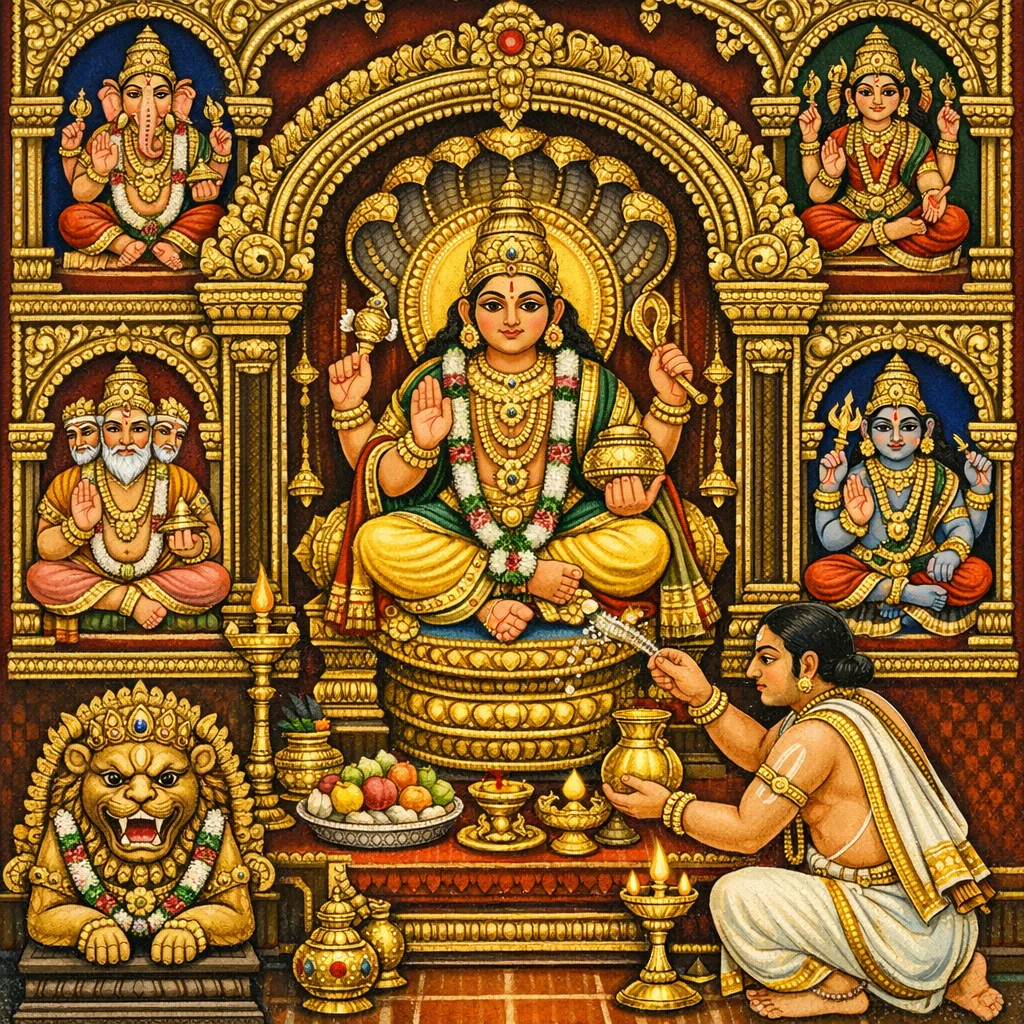
Lord Agni teaches that a temple becomes ritually effective through proper deity-sthāpana (installation) and correct icon preparation. It begins with pañcāyatana placement: Vāsudeva/Nārāyaṇa at the center, with deities assigned to directions—Vāmana in Āgneya, Nṛhari (Nṛsiṃha) in Nairṛti, Hayagrīva in Vāyavya, Varāha in Īśāna—along with alternate layouts such as navadhāma, wider arrays (lokapālas, grahas, Daśāvatāra sets), and a thirteen-shrine scheme centered on Viśvarūpa-Hari. The chapter then treats pratimā-lakṣaṇa, listing acceptable media (clay, wood, metal, jewels, stone, fragrant substances, flowers) and affirming that timely worship yields desired fruits. Detailed rules for selecting stone follow, including varṇa-linked colors and a remedial substitution using Siṃha-vidyā when ideal stone is unavailable. Finally it outlines pre-carving consecrations: securing forest land, Vrajayāga, bali offerings, tool-worship, sprinkling with the Astra-mantra, Nṛsiṃha protection, pūrṇāhuti, bhūta-bali, appeasing or relocating local beings, dream-mantra diagnosis, and the artisan’s identification with Viṣṇu/Viśvakarman before transporting and ritually honoring the stone blank in the workshop.
Shlokas
Verse 1
इत्य् आदिमहापुराणे आग्नेये प्रासादलक्षणं नाम द्वाचत्त्वारिंशो ऽध्यायः अथ त्रिचत्वारिंशो ऽध्यायः प्रासाददेवतास्थापनं भगवानुवाच प्रासादे देवताः स्थाप्या वक्ष्ये ब्रह्मन् शृणुष्व मे पञ्चायतमध्ये तु वासुदेवं निवेशयेत्
Thus ends, in the Ādi‑Mahāpurāṇa’s Āgneyā (Agni Purāṇa), the forty-second chapter called “Characteristics of the Prāsāda (Temple).” Now begins the forty-third chapter: “Installation of Deities in a Temple.” The Blessed Lord said: “Deities are to be installed in the prāsāda; I shall explain the procedure. O Brahmin, listen to me. In the center of the pañcāyatana arrangement, one should install Vāsudeva.”
Verse 2
वामनं नृहरिञ्चाश्वशीर्षं तद्वञ्च शूकरं आग्नेये नैरृते चैव वायव्ये चेशगोचरे
In the south‑east (Agni quarter) [place/meditate upon] Vāmana; in the south‑west (Nirṛti quarter) Nṛhari (Narasiṃha); in the north‑west (Vāyu quarter) Aśvaśīrṣa (Hayagrīva, “horse‑headed”); and likewise Śūkara (Varāha) in the sphere of Īśa (the Īśāna quarter).
Verse 3
अथ नारायणं मध्ये आग्नेय्यामम्बिकां न्यसेत् नैरृत्यां भास्करं वायौ ब्रह्माणं लिङ्गमीशके
Then one should install Nārāyaṇa in the center; in the southeast (Āgneyī) one should place Ambikā; in the southwest (Nairṛtī) Bhāskara (the Sun); in the northwest (Vāyu-direction) Brahmā; and in the northeast (Īśāna-direction) the Liṅga (of Śiva).
Verse 4
अथवा रुद्ररूपन्तु अथवा नवधामसु वासुदेवं न्यसेन्मध्ये पूर्वादौ वामवामकान्
Alternatively, one may install (the deity) in the Rudra-form; or, within the nine abodes (navadhāma), one should place Vāsudeva in the center and, beginning from the east, install the placements to the left (counterclockwise) in their proper sequence.
Verse 5
इन्द्रादीन् लोकपालांश् च अथवा नवधामसु पञ्चायतनकं कुर्यात् मध्ये तु पुरुषोत्तमं
One should install (the worship-arrangements for) Indra and the other Lokapālas; or else, within the nine sanctified stations (navadhāma), one should establish the Pañcāyatana (five-shrine arrangement), placing Purushottama (Viṣṇu) in the center.
Verse 6
लक्ष्मीवैश्रवणौ पूर्वं दक्षे मातृगणं न्यसेत् स्कन्दं गणेशमीशानं सूर्यादीन् पश्चिमे ग्रहान्
First, one should place Lakṣmī and Vaiśravaṇa in the eastern quarter; on the right (the southern side) one should install the host of Mother-goddesses (Mātṛ-gaṇa); then (place) Skanda, Gaṇeśa, and Īśāna; and in the western quarter, the planets beginning with the Sun.
Verse 7
उत्तरे दश मत्स्यादीनाग्नेय्यां चण्डिकां तथा नैरृत्यामम्बिकां स्थाप्य वायव्ये तु सरस्वतीं
In the northern direction, (place) the ten (forms) beginning with Matsya; in the southeast, (place) Caṇḍikā; likewise, in the southwest, having installed Ambikā, (place) Sarasvatī in the northwest.
Verse 8
पद्मामैशे वासुदेवं मध्ये नारायणञ्च वा त्रयोदशालये मध्ये विश्वरूपं न्यसेद्धरिं
On the lotus-seat (padmāsana) one should place Vāsudeva in the center—or else Nārāyaṇa. In the arrangement of the thirteen shrines/abodes, one should install Hari as Viśvarūpa in the middle.
Verse 9
पूर्वादौ केशवादीन् वा अन्यधामस्वयं हरिं मृण्मयी दारुघटिता लोहजा रत्नजा तथा
Facing east and the other directions, one should fashion Hari himself in the forms beginning with Keśava (and the rest), or as Hari of another abode; the icon may be made of clay, carved from wood, cast in metal, or made of jewels as well.
Verse 10
शैलजा गन्धजा चैव कौसुमी सप्तधा स्मृता कौसुमी गन्धजा चैव मृण्मयी प्रतिमा तथा
Images (pratimās) are remembered as sevenfold—made of stone, made of fragrant substances, and made of flowers; likewise there are the floral type, the fragrant-substance type, and also the clay image.
Verse 11
तत्कालपूजिताश् चैताः सर्वकामफलप्रदाः अथ शैलमयीं वक्ष्ये शिला यत्र च गृह्यते
And these forms, when worshipped at the proper time, bestow the fruits of all desired aims. Now I shall describe the stone-made image: the kind of rock from which the stone is to be selected.
Verse 12
पर्वतानामभावे च गृह्णीयाद्भूगतां शिलां पाण्डरा ह्य् अरुणा पीता कृष्णा शस्ता तु वैर्णिनां
And when mountains are not available, one should take stone that is found beneath the ground. White, reddish, yellow, and black stones are prescribed as suitable for the respective social classes (varṇas).
Verse 13
न यदा लभ्यते सम्यग् वर्णिनां वर्णतः शिला वर्णाद्यापादानं तत्र जुह्यात् सिंहविद्यया
When a properly suitable stone (śilā) corresponding to the prescribed varṇa of the officiants cannot be obtained, one should then offer into the fire a substitute beginning with the appropriate varṇa-materials, performing the oblation by means of the Siṃha-vidyā (the “Lion” mantra/rite).
Verse 14
शिलायां शुक्लरेखाग्र्या कृष्णाग्र्या सिंहहोमतः कांस्यघण्टानिनादा स्यात् पुंलिङ्गा विस्फुलिङ्गिका
On the altar-stone, when the foremost streak is white and its tip is black—and when, in the siṃha-homa (lion fire-offering), a resonant sound like a bronze bell is heard—then the “visphuliṅgikā” (spark) is to be understood as masculine (puṃliṅga).
Verse 15
तन्मन्दलक्षणा स्त्री स्याद्रूपाभावान्नपुंसका दृश्यते मण्डलं यस्यां सगर्भां तां विवर्जयेत्
A woman is said to be of the “tan-maṇḍala” type; owing to the absence of feminine form she is regarded as neuter (napuṃsaka). A woman in whom a distinct circular mark (maṇḍala) is seen—if pregnant—should be avoided (excluded from the intended procedure/selection).
Verse 16
प्रतिमार्थं वनं गत्वा व्रजयागं समाचरेत् तत्र खात्वोपलिप्याथ मण्डपे तु हरिं यजेत्
Having gone to the forest for the sake of (gathering materials for) the sacred image, one should duly perform the Vrajayāga. There, having dug the site and then plastered it, one should worship Hari (Viṣṇu) in a ritual pavilion (maṇḍapa).
Verse 17
बलिं दत्वा कर्मशस्त्रं टङ्कादिकमथार्चयेत् हुत्वाथ शालितोयेन अस्त्रेण प्रोक्षयेच्छिलां
Having first offered the bali (ritual oblation), one should then worship the implements of work—such as the chisel and the rest. After performing the fire-offering, one should sprinkle and consecrate the stone with rice-water, using the Astra-mantra.
Verse 18
रक्षां कृत्वा नृसिंहेन मूलमन्त्रेण पूजयेत् हुत्वा पूर्णाहुतिं दद्यात्ततो भूतबलिं गुरुः
Having performed the protective rite (rakṣā) with the invocation of Nṛsiṃha, one should worship using the mūla-mantra (root-mantra). After making the oblation, the officiating guru should offer the concluding full oblation (pūrṇāhuti); thereafter he should present the bhūta-bali (offering to elemental beings/spirits).
Verse 19
अन्यधामसु यज्ञविदिति ख, चिह्नितपुस्तकपाठः युग्मधामस्वयं हरिमिति घ, चिह्नितपुस्तकपाठः कौमुदी इति ख, घ, चिह्नितपुस्तकद्वयपाठः उन्मत्तलक्षणा इति ङ, चिह्नितपुस्तकपाठः मन्त्रयेदिति ख, चिह्नितपुस्तकपाठः अत्र ये संस्थिताः सत्त्वा यातुधानाश् च गुह्यकाः सिद्धादयो वा ये चान्ये तान् सम्पूज्य क्षमापयेत्
Whatever beings are stationed here—sattvas, yātudhānas, guhyakas, siddhas, or any others—having duly worshipped them, one should request their forgiveness, so that the rite may proceed without obstruction.
Verse 20
विष्णुबिम्बार्थमस्माकं यात्रैषा केशवाज्ञया विष्ण्वर्थं यद्भवेत् कार्यं युष्माकमपि तद्भवेत्
This pilgrimage of ours is undertaken, by Keśava’s command, for the sake of Viṣṇu’s bimba (sacred icon). Whatever service is to be done for Viṣṇu’s purpose—let that be done by you as well.
Verse 21
अनेन बलिदानेन प्रीता भवत सर्वथा
By this offering (bali-dāna), may you be fully pleased in every way.
Verse 22
क्षमेण गच्छतान्यत्र मुक्त्वा स्थानमिदं त्वरात् अप्_४३०२१च्देएवं प्रबोधिताः सत्त्वा यान्ति तृप्ता यथासुखं शिल्पिभिश् च चरुं प्राश्य स्वप्नमन्त्रं जपेन्निशि
“Go elsewhere in peace; quickly vacate this place.” Thus instructed, the beings depart satisfied, each according to its own comfort. Then, having eaten the ritual porridge (caru) together with the officiants, one should recite in japa the dream-mantra at night.
Verse 23
ॐ नमः सकललोकाय विष्णवे प्रभविष्णवे विश्वाय विश्वरूपाय स्वप्नाधिपतये नमः
Om. Salutations to Viṣṇu, who pervades all worlds; to the supreme all-pervading Lord; to Him who is the universe; to Him whose form is the entire cosmos; and to the Lord and ruler of dreams—salutations.
Verse 24
आचक्ष्व देवदेवेश प्रसुप्तोस्मि तवान्तिकं स्वप्ने सर्वाणि कार्याणि हृदिस्थानि तु यानि मे
O Lord of the gods, Supreme God—tell me: I am asleep near You; in the dream, all the tasks and intentions that abide within my heart become manifest—those that are mine.
Verse 25
ॐ ॐ ह्रूं फट् विष्णवे स्वाहा शुभे स्वप्ने शुभं सर्वं ह्य् अशुभे सिंहहोमतः प्रातरर्घ्यं शिलायां तु दत्वास्त्रेणास्त्रकं यजेत्
“(Recite:) ‘Oṃ, oṃ, hrūṃ, phaṭ—unto Viṣṇu, svāhā.’ If the dream is auspicious, then everything is auspicious indeed; if it is inauspicious, one should perform the Siṃha-homa. Having offered the morning arghya upon a stone (as an altar-base), one should worship the ‘astraka’ by means of the astra-mantra.”
Verse 26
कुद्दालटङ्कशस्त्राद्यं मध्वान्याक्तमुखञ्चरेत् आत्मानं चिन्तयेद्विष्णुं शिल्पिनं विश्वकर्मकं
Having taken up tools and implements such as the spade and the chisel, and with his face anointed with honey and other auspicious substances, the practitioner should proceed; and he should meditate upon himself as Viṣṇu—and as the divine craftsman Viśvakarman.
Verse 27
शस्त्रं विष्ण्वात्मकं दद्यात् मुखपृष्ठादि दर्शयेत् जितेन्द्रियः टङ्कहस्तः शिल्पी तु चतुरस्रकां
He should present the weapon as embodying Viṣṇu (that is, consecrated as Viṣṇu’s power), and he should depict the front, back, and other views. The sculptor—self-controlled and holding the chisel in hand—should fashion it in a square (four-sided) form.
Verse 28
श्वाधिपतये इति ख, चिह्नितपुअतकपाठः प्रपन्नो ऽस्मि इति ख, चिह्नितपुस्तकपाठः ॐ ॐ ह्रीं फडिति ग, चिह्नितपुस्तकपाठः विश्वकर्मणिमिति ख, ग, चिह्नितपुअतकपाठः विश्वात्मकमिति ग, घ, ङ, चिह्नितपुस्तकत्रयपाठः शिलां कृत्वा पिण्डिकार्थं किञ्चिन्न्यूनान्तु कल्पयेत् रथे स्थाप्य समानीय सवस्त्रां कारुवेश्मनि पूजयित्वाथ घटयेत् प्रतिमां स तु कर्मकृत्
“(In some marked manuscripts the readings are:) ‘śvādhipataye’, ‘prapanno ’smi’, ‘oṃ oṃ hrīṃ phaḍ’, ‘viśvakarmaṇim’, and ‘viśvātmakam’.” Having prepared a stone (blank) intended for carving the image, one should fashion it slightly undersized. Placing it on a cart and bringing it to the workshop, together with cloth coverings, the artisan should first worship it in the craftsman’s house; thereafter, that ritual-performer should complete and establish the idol, making it ready for installation.
Frequently Asked Questions
The center is reserved for Vāsudeva (or Nārāyaṇa), with prescribed deities installed in the surrounding quarters according to dik-vinyāsa (directional assignment).
Āgneya: Vāmana; Nairṛti: Nṛhari (Narasiṃha); Vāyavya: Aśvaśīrṣa (Hayagrīva); Īśāna: Śūkara (Varāha).
It ritualizes technical acts—directional placement, material selection, tool consecration, protection and appeasement rites—so that craftsmanship and temple-building become disciplined dharmic action aligned with mantra, purity, and devotion.
The chapter prescribes substitution/oblation procedures using Siṃha-vidyā and, when dreams are inauspicious, performing Siṃha-homa to remediate obstacles.