Adhyaya 78
Chapter 78 — पवित्रारोहणकथनं (Pavitrārohaṇa: Installing the Sanctifying Thread/Garland)
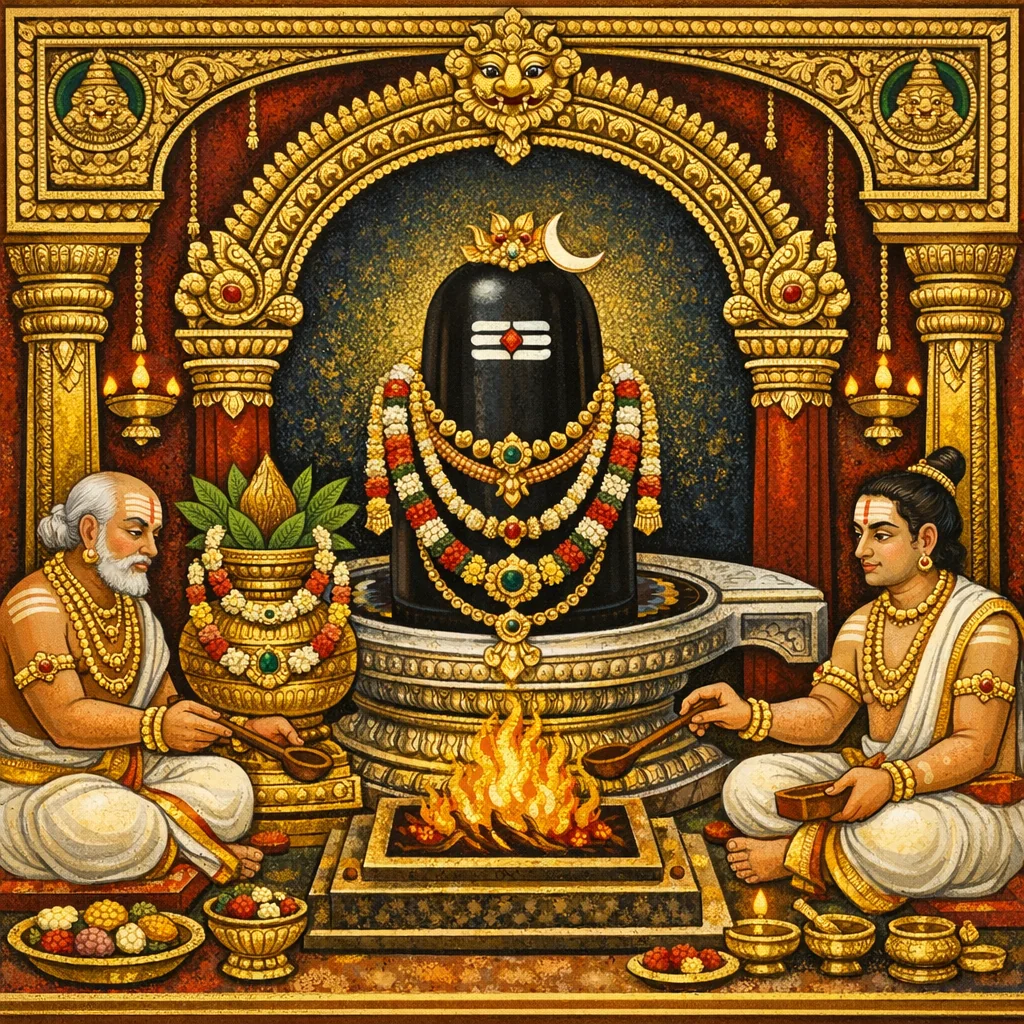
This chapter inaugurates the Pavitrārohaṇa rite (installing the sanctifying thread/garland), an Agamic completion-practice that “fills” omissions in worship and consecration. The Lord defines two modes (nitya and naimittika) and appoints calendrical windows (Āṣāḍha–Bhādrapada; bright/dark fortnights; the 14th and 8th tithis; or alternatively the Kārttikī observance). It then details materials (gold/silver/copper by yuga; in Kali, cotton/silk/lotus-fibre) and technical rules: thread counts, knot numbers, spacing, measures (aṅgula/hasta), and classes of granthi with named powers (Prakṛti, Pauruṣī, Vīrā, Aparājitā; Jayā/Vijayā, etc.). A full ritual sequence follows—space purification, doorway and dvārapāla worship through kalā-theology, Vāstu and bhūta-śuddhi, kalaśa/vardhanī installations, continuous root-mantra recitation, protective astra, homa series, bali offerings to rudras/kṣetrapālas/dikpālas, and expiatory vidhi-cchidra-pūraṇa to repair ritual breaches. The rite culminates in offering the pavitraka for universal protection—especially for Śiva, the guru, and the sacred text—followed by regulated vigil, purity disciplines, and rest in remembrance of Īśa.
Shlokas
Verse 1
इत्य् आदिमहापुराणे आग्नेये वास्तुपूजाकथनं नाम सप्तसप्ततितमो ऽध्यायः अथोष्टसप्ततितमो ऽध्यायः पवित्रारोहणकथनं ईश्वर उवाच पवित्रारोहणं वक्ष्ये क्रियार्चादिषु पूरणं नित्यं तन्नित्यमुद्दिष्टं नैमित्तिकमथापरं
Thus, in the Agni Purāṇa, the seventy-seventh chapter entitled “The Description of Vāstu-worship” concludes. Now begins the seventy-eighth chapter: “The Description of Pavitrārohaṇa (the installing of the sanctifying thread/garland).” The Lord said: “I shall explain Pavitrārohaṇa, the rite that brings ritual acts, worship (arcā), and the like to completion. It is of two kinds: the perpetual (nitya), enjoined as a regular observance, and the occasional (naimittika), performed on specific occasions.”
Verse 2
आषाढादिचतुर्दश्यामथ श्रावणभाद्रयोः सितासितासु कर्तव्यं चतुर्दश्यष्टमीषु तत्
Beginning with the fourteenth lunar day in Āṣāḍha, and likewise in Śrāvaṇa and Bhādrapada—during both the bright and dark fortnights—this observance should be performed on the fourteenth and the eighth lunar days.
Verse 3
कुर्याद्वा कार्त्तिकीं यावत्तिथौ प्रतिपादिके वह्निब्रह्माम्बिकेभास्यनागस्कन्दार्कशूलिनां
Alternatively, one should observe the Kārttikī vow up to (and including) the Pratipadā tithi, performing worship of Agni, Brahmā, Ambikā, the Elephant-faced Lord (Gaṇeśa), the Nāgas, Skanda, the Sun, and the Trident-bearing Lord (Śiva).
Verse 4
दुर्गायमेन्द्रगोविन्दस्मरशम्भुसुधाभुजां सौवर्णं राजतं ताम्रं कृतादिषु यथाक्रमं
For Durgā—and for Indra, Govinda (Viṣṇu), Smara (Kāma), Śambhu (Śiva), and Sudhābhuj (one who partakes of nectar, i.e., a divine form)—their images should be made of gold, silver, and copper respectively, in the Kṛta yuga and the subsequent yugas, in proper order.
Verse 5
कलौ कार्पासजं चापि पट्टपद्मादिसूत्रकं प्रणवश् चन्द्रमा वह्निर्ब्रह्मा नागो गुहो हरिः
In the Kali age, the (sanctifying thread) may also be made of cotton; likewise it may be made from silk, lotus-fibre, and other threads. (The divine designations employed are:) Praṇava (Oṃ), the Moon, Fire, Brahmā, the Nāga, Guha (Kārttikeya), and Hari (Viṣṇu).
Verse 6
सर्वेशः सर्वदेवाः स्युः क्रमेण नवतन्तुषु अष्टोत्तरशतान्यर्धं तदर्धं चोत्तमादिकं
In the nine Tantras, in proper sequence, Sarveśa and the groups called the Sarvadevas are to be placed/recited. Their number is half of one hundred and eight; and half of that again belongs to the “highest” group beginning with the Uttama class.
Verse 7
एकाशीत्याथवा सूत्रैस्त्रिंशताप्पष्टयुक्तया शरीरोन्मादवायव इति घ, चिह्नितपुस्तकपाठः स्वधाभुजामिति ख, घ, ङ, चिह्नितपुस्तकत्रयपाठः गुहो रविरिति ख, ग, घ, ङ, चिह्नितपुस्तकचतुष्टयपाठः सदेश इति ख, ग, घ, ङ, चिह्नितपुस्तकपाठः पञ्चाशता वा कर्तव्यं तुल्यग्रन्थ्यन्तरालकं
Either there should be eighty-one sūtras, or (alternatively) thirty sūtras together with sixty-five more. In the marked manuscript the reading is “śarīronmāda-vāyava” (labelled ‘gha’); in three marked manuscripts the reading is “svadhābhujām” (kha, gha, ṅa); in four marked manuscripts the reading is “guho raviḥ” (kha, ga, gha, ṅa); and in the marked manuscript the reading is “sadeśaḥ” (kha, ga, gha, ṅa). Or else it should be arranged into fifty units, with equal intervals between the textual knots/sections (granthi), that is, evenly spaced divisions.
Verse 8
द्वादशाङ्गुलमानानि व्यासादष्टाङ्गुलानि च लिङ्गविस्तारमानानि चतुरङ्गुलकानि वा
Its measures may be twelve aṅgulas; the diameter may be eight aṅgulas; and the prescribed measure for the liṅga’s breadth may also be four aṅgulas.
Verse 9
तथैव पिण्डिकास्पर्शं चतुर्थं सर्वदैवतं गङ्गावतारकं कार्यं सुजातेन सुधौतकं
Likewise, one should perform the rite of “touching the piṇḍikā” (the offered rice-ball); and, as the fourth act, make an offering to all the deities. One should also perform the rite of “bringing down the Gaṅgā” (invoking Gaṅgā’s purifying presence), through a well-born (qualified) person and with an implement or substance thoroughly purified (well washed).
Verse 10
ग्रन्थिं कुर्याच्च वामेन अघोरणाथ शोधयेत् रञ्जयेत् पुरुषेणैव रक्तचन्दनकुङ्कुमैः
One should make the ritual knot (granthi) with the left hand; purify it by the Aghora mantra; and then consecrate/dye it by the Puruṣa mantra, using red sandalwood and kuṅkuma (saffron).
Verse 11
कस्तूरीरोचनाचन्द्रैर् हरिद्रागैर् इकादिभिः ग्रन्थयो दश कर्तव्या अथवा तन्तुसङ्ख्यया
Using musk (kastūrī), gorocanā, camphor, turmeric, and similar ingredients, ten knots (or pellets/units) should be prepared; or else they may be prepared in a quantity measured by the standardized number of threads.
Verse 12
अन्तरं वा यथाशोभमेकद्विचतुरङ्गुलं प्रकृतिः पौरुषी वीरा चतुर्थी त्वपराजिता
The spacing (between the parts) should be arranged as is aesthetically fitting—of one, two, or four finger-breadths. The first is called Prakṛti; the second Pauruṣī; the third Vīrā; and the fourth is called Aparājitā.
Verse 13
जयान्या विजया षष्ठी अजिता च सदाशिवा मनोन्मनी सर्वमुखी ग्रन्थयो ऽभ्यधिकाः शुभाः
She is called Jayānyā and Vijayā; also Ṣaṣṭhī, Ajitā, and Sadāśivā; she is Manonmanī and Sarvamukhī. These sacred sections/formulae (granthayaḥ) are regarded as especially auspicious and superior.
Verse 14
कार्या वा चन्द्रवह्न्यर्कपवित्रं शिववद्धृदि एकैकं निजमूर्तौ वा पुप्तके गुरुके गणे
One should prepare the pavitraka (purificatory/protective cord) in the forms of the Moon, Fire, and the Sun, and—following the rite of Śiva—install them in the heart (by internal placement). Or else, one by one, place them upon one’s own sacred icon (mūrti), upon the manuscript/book (pustaka), upon the guru, and upon the gaṇa (attendant community/deities).
Verse 15
स्यादेकैकं तथा द्वारदिक्पालकलशादिषु हस्तादिनवहस्तान्तं लिङ्गानां स्यात्पवित्रकं
Likewise, there should be one pavitraka each for the doorway, the guardians of the directions (dikpāla), the ritual pots (kalaśa) and the like. For the liṅgas, the pavitraka is to be measured from one hasta up to nine hastas.
Verse 16
अष्टाविंशतितो युद्धं दशभिर्दशभिः क्रमात् द्व्यङ्गुलाभ्यन्तरास्तत्र क्रमादेकाङ्गुलान्तराः
From the twenty-eighth position onward, the battle-formation is to be arranged in successive groups of ten; there the inner spacing is two aṅgulas, and thereafter the intervals progressively become one aṅgula each.
Verse 17
ग्रन्थयो मानमप्येषां लिङ्गविस्तारसस्मितं सप्तम्यां वा त्रयोदश्यां कृतनित्यक्रियः शुचिः
Their prescribed measurements are also to be known: the liṅga is to be made according to the stated proportions and expansion; and on the seventh or the thirteenth lunar day, having performed the daily obligatory rites, one should be pure and then proceed with the observance.
Verse 18
भूषयेत् पुष्पवस्त्राद्यैः सायाह्ने यागमन्दिरं चण्डवह्न्यर्कपवित्रमिति ख, ग, ङ चिह्नितपुस्तकत्रयपाठः पुस्तके गुरवे गणो इति ख, ङ, चिह्नितपुस्तकपाठः कृत्वा नैमित्तिकीं सन्ध्यां विशेषेण च तर्पणं
In the evening, one should adorn the yāga-mandira (sacrificial hall) with flowers, cloth, and the like. Then, having performed the naimittika Sandhyā (occasional Sandhyā rite), one should in particular also perform tarpaṇa—water-libations offered as oblations. (Bracketed phrases and variant readings are manuscript/edition notes.)
Verse 19
परिगृहीते भूभागे पवित्रे सूर्यमर्चयेत् आचम्य सकलीकृत्य प्रणवार्घ्यकरो गुरुः
On a purified piece of ground that has been duly prepared and set apart, one should worship the Sun. Having performed ācamana (ritual sipping of water) and fully arranged the ritual materials, the officiating guru should offer the arghya (water-oblation) accompanied by the praṇava, the syllable Oṁ.
Verse 20
द्वाराण्यस्त्रेण सम्प्रोक्ष्य पूर्वादिक्रमतो ऽर्चयेत् हां शान्तिकलाद्वाराय तथा विद्याकलात्मने
Having thoroughly sprinkled the doorways with the protective weapon-mantra (astra), one should worship them in order beginning from the eastern door: uttering “hāṃ” to the doorway presided over by Śānti-kalā (the Kalā of pacification), and likewise to the doorway whose essence is Vidyā-kalā (the Kalā of sacred knowledge).
Verse 21
निवृत्तिकलाद्वाराय प्रतिष्ठाख्यकलात्मने तच्छाखयोः प्रतिद्वारं द्वौ द्वौ द्वाराधिपौ यजेत्
One should worship the doorway presided over by the Kalā called Nivṛtti, and also the doorway whose essence is the Kalā known as Pratiṣṭhā. At each door in the two subsidiary branches, one should worship two door-lords (Dvārapālas) at a time.
Verse 22
नन्दिने महाकालाय भृङ्गिणे ऽथ गणाय च वृषभाय च स्कन्दाय देव्यै चण्डाय च क्रमात्
In due order (kramāt), one should offer salutations or oblations to Nandin, to Mahākāla, to Bhṛṅgin; then also to Gaṇa, to Vṛṣabha (the Bull), to Skanda, to the Goddess (Devī), and to Caṇḍa.
Verse 23
नित्यं च द्वारपालादीन् प्रविश्य द्वारपश्चिमे इष्ट्वा वास्तुं भूतशुद्धिं विशेषार्घ्यकरः शिवः
And daily, after entering and worshipping the gate-guardians and the rest, in the western part of the doorway he should worship Vāstu (the deity of the site) and perform bhūta-śuddhi, the purification of the elements. Then, offering a special arghya, he becomes auspicious (śiva).
Verse 24
प्रोक्षणाद्यं विधायाथ यज्ञसम्भारकृन्नरः मन्त्रयेद्दर्भदूर्वाद्यैः पुष्पाद्यैश् च हृदादिभिः
Having first performed prokṣaṇa (ritual sprinkling) and the related preliminaries, the person who has arranged the sacrificial requisites should then consecrate kuśa-darbha grass, dūrvā grass, flowers, and the like, using the Hṛd and other aṅga mantras.
Verse 25
शिवहस्तं विधायेत्थं स्वशिरस्यधिरोपयेत् शिवो ऽहमादिः सर्वज्ञो मम यज्ञप्रधानता
Having thus formed the “Śiva-hand” (ritual hand-gesture), one should place it upon one’s own head. (One should affirm:) “I am Śiva—primordial and all-knowing; in me, sacrificial worship is foremost.”
Verse 26
अत्यर्थं भावयेद्देवं ज्ञानखद्गकरो गुरुः नैरृतीं दिशमासाद्य प्रक्षिपेदुदगाननः
Facing north, the teacher—whose hand bears the sword of knowledge—should intensely contemplate the Deity; then, having approached the Nairṛtī (south‑western) direction, he should cast there the prescribed offering or ritual projection.
Verse 27
अर्घ्याम्बु पञ्चगव्यञ्च समस्तान् मखमण्डपे चतुष्पथान्तसंस्कारैर् वीक्षणाद्यैः सुसंस्कृतैः
In the makha-maṇḍapa (sacrificial pavilion), all persons and ritual implements should be duly purified with arghya-water and pañcagavya, by the prescribed consecrations from the four directions to the terminal points, including sprinkling (vīkṣaṇa) and related purificatory acts, performed in proper form.
Verse 28
विक्षिप्य विकिरांस्तत्र कुशकूर्चोपसंहरेत् ए सूर्यमर्चयेदिति ख, ग, घ, ङ, चिह्नितपुस्तकचतुष्टयपाठः प्रोक्षणच्चेति ग, चिह्नितपुस्तकपाठः विधायैकमिति ङ, चिह्नितपुस्तकपाठः ब्राह्मणाद्यैर् इति ग, चिह्नितपुस्तकपाठः दशकूर्ञ्चोपसंहरेदिति ख, चिह्नितपुस्तकपाठः तानीशदिशि वर्धन्यामासनायोपकल्पयेत्
Having scattered the ritual offerings there, one should gather them together with a kuśa-grass bundle (kuśakūrca). Then, in the Īśāna (north‑eastern) direction, upon the consecrated platform (vardhanī), one should arrange those items as an āsana (seat) for worship.
Verse 29
नैरृते वास्तुगीर्वाणा द्वारे लक्ष्मीं प्रपूजयेत् पश्चिमाभिमुखं कुम्भं सर्वधान्योपरि स्थितं
At the south‑western doorway, O reciter of the Vāstu teachings, one should duly worship Lakṣmī. A ritual pot (kumbha) should be placed there facing west, set upon a heap of all kinds of grains.
Verse 30
प्रणवेन वृषारूढं सिंहस्थां वर्धनीन्ततः कुम्भे साङ्गं शिवन्देवं वर्धन्यामर्चयेत्
With the syllable Oṁ (praṇava), one should worship Lord Śiva—mounted upon the bull and (also) seated upon the lion—together with His attendant limbs/aspects (sāṅga), in the kumbha (ritual pot); and likewise one should worship Him in the vardhanī vessel placed within.
Verse 31
दिक्षु शक्रादिदिक्पालान् विष्णुब्रह्मशिवादिकान् वर्धनीं सम्यगादाय घटपृष्टानुगामिनीं
In the ten directions, one should contemplate and assign the guardians of the quarters beginning with Śakra, and also invoke deities such as Viṣṇu, Brahmā, and Śiva; then, having properly taken up the vardhanī (sprinkling ladle) that follows along the rear of the ritual pot (kalaśa), one should perform the rite.
Verse 32
शिवाज्ञां श्रावयेन्मन्त्री पूर्वादीशानगोचरं अविच्छिन्नपयोधारां मूलमन्त्रमुदीरयेत्
The mantra-officiant should proclaim Śiva’s command; facing from the eastern direction up to the Īśāna quarter, he should recite the root-mantra in an unbroken stream, like a continuous flow of milk.
Verse 33
समन्ताद् भ्रामयेदेनां रक्षार्थं शस्त्ररूपिणीं पूर्वं कलशमारोप्य शस्त्रार्थन्तस्य वामतः
For protection, one should whirl her in a circle on all sides, for she is of the form of a weapon. First, having installed her upon the consecrated ritual pot (kalaśa), one should place the weapon-implement to its left side.
Verse 34
समग्रासनके कुम्भे यजेद्देवं स्थिरासने वर्धन्यां प्रणवस्थायामायुधन्तदनु द्वयोः
One should worship the deity in the kumbha set upon the complete ritual seat (samagrāsana). The deity is to be worshipped upon a steady seat; upon the vardhanī with the Praṇava (Oṁ) established thereon; and thereafter the weapon-emblems are to be placed in the two adjacent positions.
Verse 35
भगलिङ्गसमायोगं विदध्याल्लिङ्गमुद्रया कुम्भे निवेद्य बोधासिं मूलमन्त्रजपन्तथा
One should perform the conjoining rite of Bhaga and the Liṅga by means of the Liṅga-mudrā; then, offering into the kumbha the empowered weapon called Bodhāsi, one should likewise proceed with the japa of the root-mantra.
Verse 36
तद्दशांशेन वर्धन्यां रक्षां विज्ञापयेदपि गणेशं वायवे ऽभ्यर्च्य हरं पञ्चामृतादिभिः
With one-tenth of that offering/fee, in the auspicious rite of increase (vardhanī), one should also formally proclaim and commission the protective charm (rakṣā). Having worshipped Gaṇeśa and offered to Vāyu, one should worship Hara (Śiva) with pañcāmṛta and related offerings.
Verse 37
स्नापयेत् पूर्ववत् प्रार्च्य कुण्डे च शिवपावकं ग, चिह्नितपुस्तकद्वयपाठः रक्षां च कारयेत् सदेति ग, चिह्नितपुस्तकपाठः पूर्ववत् स्नापयेत् प्रार्चेदिति ग, चिह्नितपुस्तकपाठः स्थापयेत् पूर्ववच्चाग्निमिति ङ, चिह्नितपुस्तकपाठः कुम्भे वा शिवमर्चयेदिति ग, चिह्नितस्पुस्तकपाठः विधिवच्च चरुं कृत्वा सम्पाताहुतिशोधितं
Having worshipped (Śiva) as before, one should perform the ritual bathing (snāpana) in the same manner; and in the fire-pit (kuṇḍa) one should likewise worship the auspicious Fire (Śiva’s fire). One should also arrange the protective rite (rakṣā). Or, according to an alternative reading, one should install the fire as before, or worship Śiva in a consecration-pot (kumbha). Then, having prepared the caru (ritual oblation) according to rule and purified it by the concluding “sampāta” offering, the rite proceeds.
Verse 38
देवाग्र्यात्मविभेदेन दर्ष्या तं विभजेत् त्रिधा दत्वा भागौ शिवाग्निभ्यां संरक्षेद्भागमात्मनि
By distinguishing the offering according to the respective shares of the foremost deity (Devāgrya), Śiva, and Agni, one should visibly divide it into three parts. Having given two portions to Śiva and Agni, one should retain and safeguard one portion for oneself.
Verse 39
शरेण चर्मणा देयं पूर्वतो दन्तधावनं तस्माद्घोरशिखाभ्यां वा दक्षिणे पश्चिमे मृदं
Tooth-cleaning should be performed facing east, using a twig for brushing and a piece of leather as an aid. After that, one should take cleansing earth (mud) with the index and middle fingers and apply it on the right side or on the western side, as prescribed.
Verse 40
साद्योजातेन च हृदा चोत्तरे वामनीकृतं जलं वामेन शिरसा ईशे गन्धान्वितं जलं
With the mantra Sādyojāta and with the heart-placement (hṛdaya-nyāsa), one should set the water to the north, turning it to the left. With the left side of the head, and with the mantra Īśa(na), one should use water mixed with fragrance.
Verse 41
पञ्चगव्यं पलाशादिपुटकं वै समन्ततः ऐशान्यां कुसुमं दद्यादाग्नेय्यां दिशि रोचनां
One should arrange pañcagavya and a puṭaka (a small packet or container made from palāśa and similar materials) all around; in the Īśāna (northeast) direction one should place flowers, and in the Āgneya (southeast) direction one should place rocanā (yellow pigment).
Verse 42
अगुरुं निरृताशायां वायव्यां च चतुःसमं होमद्रव्याणि सर्वाणि सद्योजातैः कुशैः सह
Agaru (aloeswood) is to be placed in the Nirṛti direction (southwest); and in the Vāyu direction (northwest) one should place an equal fourfold measure. All materials meant for the homa (fire‑offering) are to be arranged/handled together with fresh kuśa grass, in connection with Sadyajāta (mantra/aspect).
Verse 43
दण्डाक्षसूत्रकौपीनभिक्षापात्राणि रूपिणे कज्जलं कुङ्कुमन्तैलं शलाकां केशशोधनीं
For the embodied (ascetic) form, one should provide/depict a staff, a rosary, a loincloth (kaupīna), and a begging‑bowl; also kajjala (collyrium/kohl), kuṅkuma (saffron/red powder), oil, a small applicator‑stick (śalākā), and a hair‑cleaning implement.
Verse 44
ताम्बूलं दर्पणं दद्यादुत्तरे रोचनामपि आसनं पादुके पात्रं योगपट्टातपत्रकं
In the subsequent sequence, one should also give tāmbūla (betel‑leaf) and a mirror, and likewise rocanā (yellow pigment). One should also give a seat, a pair of sandals, a vessel, a yoga‑strap (yoga‑paṭṭa), and a parasol (ātapatra).
Verse 45
ऐशान्यामीशमन्त्रेण दद्यादीशानतुष्टये पूर्वस्याञ्चरुकं साज्यं दद्याद्गन्धादिकं नवे
In the northeastern quarter, one should offer with the Īśa‑mantra to please Īśāna. For the guardian of the east, one should offer a caru preparation mixed with ghee; and in the ninth placement, one should offer fragrances and the like.
Verse 46
पूर्वित्राणि समादाय प्रोक्षितान्यर्घ्यवारिणा संहितामन्त्रपूतानि नीत्वा पावकसन्निधिं
Taking up the ritual implements prepared beforehand—sprinkled with arghya-water and purified by the Saṃhitā mantras—one should carry them into the presence of the sacred fire (Pāvaka).
Verse 47
कृष्णाजिनादिनाअच्छाद्य स्मरन् संवत्सरात्मकं साक्षिणं सर्वकृत्यानां गोप्तारं शिवमव्ययं
Covering himself with a black antelope-skin and the like, he should meditate on Śiva—the imperishable protector—who is the very form of the year, the witness of all actions, and the guardian of all undertakings.
Verse 48
सद्योजातेन च हृदा चोत्तरे वामनीयकमिति ख, चिह्नितपुस्तकपाठः सद्योजातेन च हृदा चोत्तरे धाम निष्फलमिति ग, चिह्नितपुस्तकपाठः फलमिति ख, चिह्नितपुस्तकपाठः दण्डाक्षसूत्रकौपानतीर्थपात्राणि इति ङ, चिह्नितपुस्तकपाठः स्वेति हेति प्रयोगेण मन्त्रसंहितया पुनः शोधयेच्च पवित्राणि वाराणामेकविंशतिं
Using the mantras beginning with “Sadyojāta” and the “Hṛd(aya)” (heart-mantra), and then applying the subsequent purificatory formulae (as noted in variant manuscript readings: “vāmanīyaka”, or “dhāma”, and “(niṣ)phala”), one should again purify—by connected recitation of the mantra-collection—sacred items such as the staff, rosary-thread (akṣa-sūtra), loin-cloth (kaupīna), tīrtha-water for rites, and the ritual vessel; and likewise purify the pavitras (sacred rings/threads) for twenty-one repetitions.
Verse 49
गृहादि वेष्टयेत्सूत्रैर् गन्धाद्यं रवये ददेत् पूजिताय समाचम्य कृतन्यासः कृतार्घ्यकः
He should encircle the house and related spaces with ritual threads; he should offer sandalpaste and other offerings to Ravi (the Sun). Having worshipped, he should perform ācamana; having completed nyāsa and offered the arghya, the rite proceeds properly.
Verse 50
नन्द्यादिभ्यो ऽथ गन्धाख्यं वास्तोश्चाथ प्रविश्य च शस्त्रेभ्यो लोकपालेभ्यः स्वनाम्ना शिवकुम्भके
Then, beginning with Nandī and the others, one should place (invoke/assign) the deity called Gandha; and, having entered the Vāstu (maṇḍala/ritual space), one should likewise install the weapons and the Lokapālas (guardians of the directions)—each by its own name—into the Śiva-kumbha (Śiva’s ritual pot).
Verse 51
वर्धन्यै विघ्नराजाय गुरवे ह्य् आत्मने यजेत् अथ सर्वौषधीलिप्तं धूपितं पुष्पदूर्वया
One should worship Vardhanī, Vighnarāja (the Lord who removes obstacles), and the Guru—indeed, one’s own Ātman. Then the worship-material or image should be anointed with a paste of all medicinal herbs, fumigated with incense, and adorned/offered with flowers and dūrvā grass.
Verse 52
आमन्त्र्य च पवित्रं तत् विधायाञ्जलिमध्यगं ॐ समस्तविधिच्छिद्रपूरणे च विधिं प्रति
Having invoked that pavitra (purificatory rite/thread) and placing it within the hollow of the joined palms, one should apply the procedure with the mantra “Oṃ”, for the filling up and expiation of all defects and omissions in the ritual procedure.
Verse 53
प्रभवमन्त्रयामि त्वां त्वदिच्छावाप्तिकारिकां तत्सिद्धिमनुजानीहि यजतश्चिदचित्पते
I invoke you with the Prabhava-mantra, which brings about the attainment of what accords with your will. Grant and permit the successful accomplishment of that aim for this worshipper, O Lord of the sentient and the insentient.
Verse 54
सर्वथा सर्वदा शम्भो नमस्ते ऽस्तु प्रसीद मे आमन्त्रितो ऽसि देवेश सह देव्या गणेश्वरैः
O Śambhu, in every way and at all times, may salutations be to you; be gracious to me. O Lord of the gods, you are invited—together with the Goddess and the Gaṇeśvaras, the lords of the gaṇas.
Verse 55
मन्त्रेशैर् लोकपालैश् च सहितः परिचारकैः निमन्त्रयाम्यहन्तुभ्यं प्रभाते तु पवित्रकं
Along with the Lords of Mantras and the Guardians of the Worlds (Lokapālas), accompanied by their attendants, I invite you to the pavitraka rite at dawn.
Verse 56
नियमञ्च करिष्यामि परमेश तवाज्ञया इत्येवन्देवमामन्त्र्य रेचकेनामृतीकृतं
“I shall undertake the observances (niyamas) by Your command, O Supreme Lord (Parameśvara).” Thus having invoked the deity, he renders it ‘nectar-like’ (purified and vitalized) through exhalation (recaka).
Verse 57
शिवान्तं मूलमुच्चार्य तच्छिवाय निवेदयेत् ः पूजनार्थं समाचम्य इति ङ, चिह्नितपुस्तकपाठः रव्यादिभ्यो ऽथेति ग, चिह्नितपुस्तकपाठः गन्धाद्यमिति ङ, चिह्नितपुस्तकपाठः आमन्त्रणपवित्रमिति ख, चिह्नितपुस्तकपाठः परिवारकैविति ग, ङ, चिह्नितपुस्तकपाठः जपं स्तोत्रं प्रमाणञ्च कृत्वा शम्भुं क्षमापयेत्
Having recited the root-mantra (mūla-mantra) ending with “Śiva”, one should offer that (japa/oblation) to Śiva. Then, for the sake of worship, performing ācamana (ritual sipping of water) and the prescribed offerings to the Sun and the other deities, and offering fragrances and the rest—together with the consecrated invitation rite (āmantraṇa-pavitra) and worship of the attendant deities—having performed japa, hymn-recitation (stotra), and the due measure of the rite, one should seek forgiveness from Śambhu (Śiva).
Verse 58
हुत्वा चरोस्तृतीयांशं तद्दद्दीत शिवाग्नये दिग्वासिभ्यो दिगीशेभ्यो भूतमातृगणेभ्य उ
Having offered one third portion of the cooked oblation (caru) into the fire, one should then present that offering to the Śiva-fire (Śiva-agni), and distribute offerings to the direction-dwellers, the lords of the directions, and the hosts of beings (bhūta) and Mother-goddess groups (mātṛ-gaṇa).
Verse 59
रुद्रेभ्यो क्षेत्रपादिभ्यो नमः स्वाहा बलिस्त्वयं दिङ्नागाद्यैश् च पूर्वादौ क्षेत्राय चाग्नये बलिः
“Obeisance—svāhā—to the Rudras and to the guardians of the sacred ground (Kṣetrapāda/Kṣetrapāla). This offering (bali) is for you.” Likewise, beginning with the eastern direction and the other quarters—together with their ‘direction-elephants’ (dig-nāga) and related guardians—this bali is for the Kṣetra (Place/Field) and also for Agni.
Verse 60
समाचम्य विधिच्छिद्रपूरकं होममाचरेत् पूर्णां व्याहृतिहोमञ्च कृत्वा रुन्धीत पावकं
Having performed ācamana (ritual sipping of water), one should carry out a corrective, gap-filling homa (vidhicchidra-pūraka) to make good any omissions or flaws in the prescribed procedure; and, having completed the full oblation with the vyāhṛtis, one should then close and secure the sacred fire (pāvaka).
Verse 61
तत ओमग्नये स्वाहा स्वाहा सोमाय चैव हि ओमग्नीषोमाभ्यां स्वाहाग्नये स्विष्टकृते तथा
Then one should offer: “Oṃ, to Agni, svāhā”; “svāhā, to Soma also indeed”; “Oṃ, to Agni and Soma together, svāhā”; and likewise, “to Agni as Sviṣṭakṛt (the one who makes the offering well-accomplished), svāhā.”
Verse 62
इत्याहुतिचतुष्कन्तु दत्वा कुर्यात्तु योजनां वह्निकुण्डार्चितं देवं मण्डलाभ्यर्चिते शिवे
Thus, after offering the set of four oblations (āhuti), one should perform the “yojanā,” the concluding arrangement. In the Śiva-rite—where Śiva is worshipped by means of the maṇḍala—the deity is to be worshipped in the fire-pit (vahni-kuṇḍa).
Verse 63
नाडीसन्धानरूपेण विधिना योजयेत्ततः वंशादिपात्रे विन्यस्य अस्त्रञ्च हृदयन्ततः
Then, following the prescribed rite, he should apply (the mantra/energy) in the form of “nāḍī-saṃdhāna,” the joining of the subtle channels. Having placed it in a vessel such as a bamboo tube and the like, he should then install the Astra (weapon-mantra) beginning from the region of the heart onward.
Verse 64
अधिरोप्य पवित्राणि कलाभिर्वाथ मन्त्रयेत् षडङ्गं ब्रह्ममूलैर् वा हृद्धर्मास्त्रञ्च योजयेत्
Having placed (or superimposed) the pavitra, the consecrating cords/rings, one should then empower them with the divine kalās; and one should perform the ṣaḍaṅga-nyāsa, the six-limbed protection, either with the Brahma-mūla seed mantras, and also apply the Hṛdaya (Heart) mantra together with the Dharma-astra, the weapon-mantra of righteous protection.
Verse 65
विधाय सूत्रैः संवेष्ट्य पूजयित्वाङ्गसम्भवैः रक्षार्थं जगदीशाय भक्तिनम्रः समर्पयेत्
Having prepared it and wrapped it with protective threads, and having worshipped it with substances produced from (one’s consecrated) limbs, one should—bowed down in devotion—offer it to Jagadīśa, the Lord of the universe, for the sake of protection.
Verse 66
पूजिते पुष्पधूपाद्यैर् दत्वा सिद्धान्तपुस्तके गुरोः पादान्तिकं गत्वा भक्त्या दद्यात् पवित्रकं
After worshipping the guru with flowers, incense, and the like, and having presented the scripture-book of established doctrine (siddhānta), one should go near the guru’s feet and, with devotion, offer the pavitraka—the consecrated thread or garland used as a ritual purifier.
Verse 67
निर्गत्य वहिराचम्य गोमये मण्डलत्रये इति ख, चिह्नितपुस्तकपाठः भूतमातृगणेषु फडिति ङ, चिह्नितपुस्तकपाठः रुद्रेभ्यः क्षेत्रपालेभ्य इति ख, चिह्नितपुस्तकपाठः पूजयित्वा ततः शिवमिति ग, चिह्नितपुस्तकपाठः पूजयित्वाथ सञ्चरैर् इति ङ, चिह्नितपुस्तकपाठः पञ्चगव्यञ्चरुन्दन्तधावनञ्च क्रमाद् यजेत्
Going outside and then performing ācamana (ritual sipping for purification), one should mark three ritual circles with cow-dung; with the protective utterance “phaṭ” one should make offerings to the hosts of Bhūtas and the Mothers, then to the Rudras and to the Kṣetrapālas (guardian-deities of the place). Having thus worshipped, thereafter one should worship Śiva; and, in due sequence, offer pañcagavya, a caru oblation, and danta-dhāvana (tooth-cleaning sticks/rite).
Verse 68
आचान्तो मन्त्रसम्बद्धः कृतसङ्गीतजागरः स्वपेदन्तः स्मरन्नीशं बुभुक्षुर्दर्भसंस्तरे
Having performed ācamana, engaged in mantra-recitation, and having kept a wakeful vigil with devotional song, one should lie down on a bed of darbha-grass; and, even if hungry, one should fall asleep while remembering the Lord.
Verse 69
अनेनैव प्रकारेण मुमुक्षुरपि संविशेत् केवलम्भस्मशय्यायां सोपवासः समाहितः
In the very same manner, even a seeker of liberation (mumukṣu) should lie down to rest on a bed made solely of ashes, fasting, and steadily composed in mind.
Frequently Asked Questions
A sanctifying completion-rite using pavitra threads/garlands that repairs procedural omissions in worship and consecration, structured as nitya (regular) and naimittika (occasional) observances.
From Āṣāḍha onward and in Śrāvaṇa and Bhādrapada, in both fortnights, especially on caturdaśī (14th) and aṣṭamī (8th); alternatively as a Kārttikī observance up to Pratipadā.
Thread and knot specifications (e.g., 81 or 50 units; ten granthis; 1/2/4 aṅgula spacing), plus size standards in aṅgulas and hastas, including liṅga breadth and pavitraka length ranges.
It combines space and doorway purification, dvārapāla and Vāstu worship, kalasha/vardhanī installations, nyāsa (hṛd/ṣaḍaṅga), homa/bali protocols, and expiatory completion (vidhi-cchidra-pūraṇa) into a single protective consecration workflow.