Adhyaya 49
Chapter 49 — मत्स्यादिलक्षणवर्णनम् (Description of the Characteristics of Matsya and the Other Incarnations)
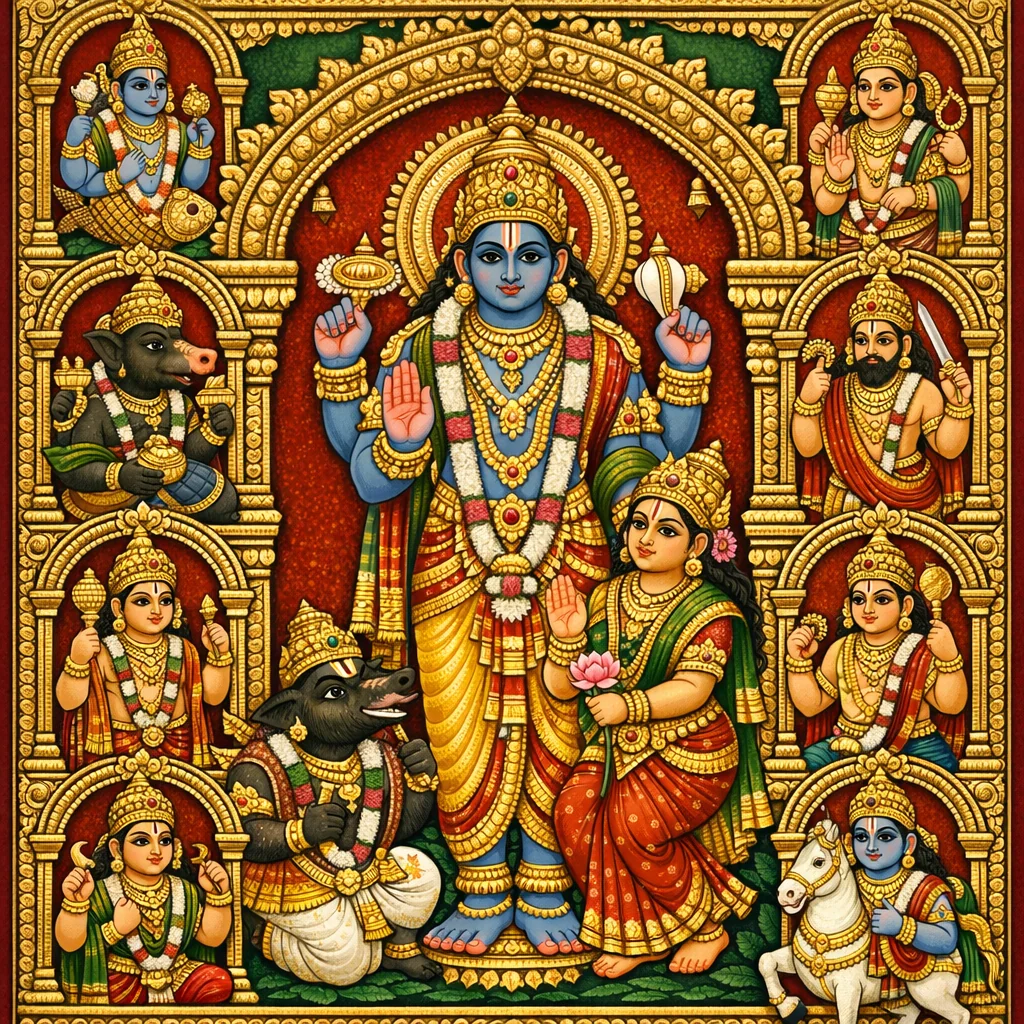
Lord Agni (as Bhagavān) presents a technical yet devotional account of pratima-lakṣaṇa—the canonical marks for identifying installable (pratiṣṭhā) images of the Daśāvatāra and related Vaiṣṇava forms within Vāstu and Īśāna-kalpa. The chapter treats each form in turn: Matsya and Kūrma by bodily type; Varāha with earth-lifting iconography, attendants (Kṣmā/Dharā, Ananta, Śrī), and promised worldly and spiritual fruits (sovereignty and crossing saṃsāra). Narasiṃha is defined in a dramatic narrative posture and also as a standard four-armed icon with emblems. Vāmana and multiple Rāma/Balarāma variants are given through weapon-placement schemes. Buddha and Kalki are described by demeanor, attire, and end-time function. The scope then widens to the Vāsudevādi ninefold group and allied forms (Brahmā, Viṣṇu on Garuḍa, Viśvarūpa, a Hayagrīva-like horse-headed Hari, Dattātreya, Viśvaksena), noting manuscript variants that reflect śāstric concern for accurate transmission alongside ritual usability.
Shlokas
Verse 1
इत्य् आदिमहापुराणे आग्नेये चतुर्विंशतिमूर्तिस्तोत्रं नाम अष्टाचत्वारिंशो ऽध्यायः अथोनपञ्चाशो ऽध्यायः मत्स्यादिलक्षणवर्णनं भगवानुवाच दशावतारं मत्स्यादिलक्षणं प्रवदामि ते मत्स्याकारस्तु मत्स्यः स्यात् कूर्मः कार्माकृलिर्भवेत्
Thus, in the Agni Purāṇa, the forty-eighth chapter entitled “The Hymn to the Twenty-Four Forms” ends. Now begins the forty-ninth chapter: “Description of the characteristics of Matsya and the other incarnations.” The Blessed Lord said: “I shall tell you the characteristics of the ten avatāras, beginning with Matsya. He who has the form of a fish is called Matsya; the Kūrma incarnation has the form of a tortoise.”}]}
Verse 2
शङ्खपद्मी इति ग, ङ, चिह्नितपुस्तकद्वयपाठः नराङ्गो वाथ कर्तव्यो भूवराहो गदादिभृत् दक्षिणे वामके शङ्खं लक्ष्मीर्वा पद्ममेव वा
In the reading of the two marked manuscripts (ga and ṅa), the name is given as “Śaṅkha-padmī.” The image should be fashioned with a human body, or as Varāha, the Boar who upholds the Earth, bearing the mace and other emblems. In the right hand and in the left, he should hold a conch; and there should be Lakṣmī, or else only a lotus.
Verse 3
श्रीवामकूर्परस्था तु क्ष्मानन्तौ चरणानुगौ वराहस्थापनाद्राज्यं भवाब्धितरणं भवेत्
Śrī (Lakṣmī) should be positioned on the left elbow; the Earth (Kṣmā) and Ananta should be shown attending upon the feet. By installing such a Varāha image, one attains sovereignty (royal dominion), and it becomes a means to cross the ocean of worldly existence.
Verse 4
नरसिंहो विवृत्तास्यो वामोरुक्षतदानवः तद्वक्षो दारयन्माली स्फुरच्चक्रगदाधरः
Narasimha, with his mouth wide open, struck down the demon with his left thigh; garlanded, he tore open that demon’s chest, while bearing the flashing discus (cakra) and mace (gadā).
Verse 5
छत्री दण्डी वामनः स्यादथवा स्याच्चतुर्भुजः रामश्चापेषुहस्तः स्यात् कड्गी परशुनान्वितः
Vāmana should be depicted holding an umbrella (chatra) and a staff (daṇḍa), as a dwarf, or else as four-armed. Rāma should be shown with bow and arrows in his hands; he may also be sword-bearing and equipped with an axe (paraśu).
Verse 6
रामश्चापी शरी खड्गी शङ्खी वा द्विभुजः स्मृतः गदालाङ्गलधारी च रामो वाथ चतुर्भुजः
Rāma is also described as two-armed (dvibhuja), bearing a bow, arrows, a sword, or a conch (śaṅkha). Alternatively, Rāma may be four-armed (caturbhuja), holding a mace (gadā) and a ploughshare (lāṅgala) as well.
Verse 7
वामोर्ध्वे लाङ्गलं दद्यादधः शङ्खं सुशोभनं मुषलं दक्षिणोर्ध्वे तु चक्रञ्चाधः सुशोभनं
On the upper left one should place the plough (lāṅgala); below it, the splendid conch (śaṅkha). On the upper right one should place the pestle (muṣala); and below it, the splendid discus (cakra).
Verse 8
शान्तात्मा लम्बकर्णश् च गौराङ्गश्चाम्बरावृतः ऊर्ध्वपद्मस्थितो बुद्धो वरदाभयदायकः
The Buddha is tranquil in spirit, long-eared, fair-limbed, and clad in a robe; seated upon a raised lotus, he bestows the boons of varada (granting) and abhaya (fearlessness).
Verse 9
धनुस्तूणान्वितः कल्की म्लेच्छोत्सादकरो द्विजः अथवाश्वस्थितः खड्गी शङ्खचक्रशरान्वितः
Kalki—born as a dvija (twice-born)—will be equipped with bow and quiver, bringing about the extermination of the mlecchas. Or else, mounted upon a horse, sword in hand, he will be furnished with conch, discus, and arrows.
Verse 10
लक्षणं वासुदेवादिनवकस्य वदामि ते दक्षिणोर्ध्वे गदा वामे वामोर्ध्वे चक्रमुत्तमं
I shall tell you the identifying marks of the group of nine beginning with Vāsudeva: in the upper right hand is the mace (gadā); in the upper left of the left hand is held the excellent discus (cakra).
Verse 11
ब्रह्मेशौ पार्श्वगौ नित्यं वासुदेवोस्ति पूर्ववत् शङ्खी स वरदो वाथ द्विभुजो वा चतुर्भुजः
Brahmā and Īśa (Śiva) are always to be placed at the sides; Vāsudeva is as described earlier. He bears the conch and may be shown as granting boons; he may be depicted either two-armed or four-armed.
Verse 12
लाङ्गली मुषली रामो गदापद्मधरः स्मृतः वामोरुहृतदानव इति ङ, चिह्नितपुस्तकपाठः गौराङ्गश्चायुधावृत इति ख, ग, चिह्नितपुस्तकद्वयपाठः धनुर्वाणान्वित इति ङ, चिह्नितपुस्तकपाठः प्रद्युम्नो दक्षिणे वज्रं शङ्खं वामे धनुः करे
Balarāma is remembered as bearing the plough and the muśala (club), and as holding the gadā (mace) and the lotus. (In one marked manuscript reading: “the demon removed from the left thigh”; in two other marked manuscript readings: “fair-bodied and surrounded by weapons”; and in another marked manuscript reading: “endowed with bow and arrows.”) Pradyumna holds a vajra (thunderbolt) in his right hand, a śaṅkha (conch) in his left, and a bow in his hand.
Verse 13
गदानाभ्यावृतः पीत्या प्रद्युम्नो वा धनुःशरी चतुर्भुजो निरुद्धः स्यात्तथा नारायणो विभुः
Pradyumna is to be meditated upon as encircled (at the navel) by a gadā (mace), shining with a yellow hue; and Aniruddha as the four-armed bearer of bow and arrows. Likewise one should contemplate Nārāyaṇa, the all-pervading Lord.
Verse 14
चतुर्मुखश् चतुर्बाहुर्वृहज्जठरमण्डलः लम्बकूर्चो जटायुक्तो व्रह्मा हंसाग्रवाहनः
Brahmā is four-faced and four-armed, with a broad, rounded belly; he has long, hanging locks and is adorned with jaṭā, matted hair. His foremost mount is the haṃsa (swan/goose).
Verse 15
दक्षिणे चाक्षसूत्रञ्च स्रुवो वामे तु कुण्डिका आज्यस्थाली सरस्वती सावित्री वामदक्षिणे
On the right should be the akṣasūtra (rosary); on the left, the sruva (ritual ladle) and the kuṇḍikā (water-pot). The ājyasthālī (ghee-vessel) is to be placed, and the goddesses Sarasvatī and Sāvitrī are to be positioned to the left and to the right.
Verse 16
विष्णुरष्टभुजस्तार्क्षे करे खड्गस्तु दक्षिणे गदाशरश् च वरदो वामे कार्मुकखेटके
Viṣṇu, eight-armed, is to be visualized as mounted upon Tārkṣya (Garuḍa). In his right hands is a sword; he also bears a gadā (mace) and an arrow; and with his left hands he bestows boons, while also holding a bow and a shield.
Verse 17
चक्रशङ्खौ चतुर्बाहुर् नरसिंहश् चतुर्भुजः शङ्खचक्रधरो वापि विदारितमहासुरः
Narasiṃha should be depicted as four-armed, bearing the discus (cakra) and the conch (śaṅkha); or else as the conch-and-discus bearer who has torn apart the great asura.
Verse 18
अचतुर्बाहुर्वराहस्तु शेषः पाणितले धृतः धारयन् बाहुना पृथ्वीं वाम्नेन कमलाधरः
Varāha (the Boar) is not four-armed; he holds Śeṣa upon the palm of his hand. With one arm he supports the Earth, and with the left he bears a lotus.
Verse 19
पादलग्ना धरा कार्या पदा लक्ष्मीर्व्यवस्थिता त्रैलोक्यमोहनस्तार्क्ष्ये अष्टबाहुस्तु दक्षिणे
Dharā (the Earth-goddess) should be fashioned as clinging to the feet; and Lakṣmī should be shown standing at the feet. Upon Tārkṣya (Garuḍa) should be depicted the ‘Enchanter of the Three Worlds’; and on the right side, the deity should be eight-armed.
Verse 20
चक्रं खड्गं च मुषलं अङ्कुशं वामके करे शङ्खशार्ङ्गगदापाशान् पद्मवीणासमन्विते
In the left hand (she bears) the discus, sword, pestle/club (muṣala), and goad (aṅkuśa); and she is furnished with the conch, Śārṅga (bow), mace (gadā), noose (pāśa), lotus, and vīṇā.
Verse 21
लक्ष्मीः सरस्वती कार्ये विश्वरूपो ऽथ दक्षिणे मुद्गरं च तथा पाशं शक्तिशूलं शरं करे
Lakṣmī and Sarasvatī are to be placed on the left side; and on the right side is Viśvarūpa. In his hand he is shown holding a mace/hammer (mudgara), likewise a noose (pāśa), a spear (śakti), a trident (śūla), and an arrow.
Verse 22
वामे शङ्खञ्च शार्ङ्गञ्च गदां पाशं च तोमरं दक्षिणे चक्रमिति ङ, चिह्नितपुस्तकपाठः गदी रत्यावृत इति ङ, चिह्नितपुस्तकपाठः लम्बभ्रुव इति ङ, चिह्नितपुस्तकपाटः धारयन्नाकुलां पृथ्वीं वामेन कमलामध इति ङ, चिह्नितपुस्तकपाठः लाङ्गलं परशुं दण्डं छुरिकां चर्मक्षेपकं
In the left hands are the conch (śaṅkha) and the Śārṅga bow, the mace (gadā), the noose (pāśa), and the javelin (tomara); in the right, the discus (cakra)—so reads a marked manuscript variant. Another marked reading has: “holding a mace, encompassed by Rati.” Another: “with long eyebrows.” Another: “bearing the troubled earth; with the left (hand) holding Lakṣmī below.” (Further weapons listed:) the plough, the axe, the staff, the dagger, and a leather-throwing weapon (a strap-cast implement/shield).
Verse 23
विंशद्बाहुश् चतुर्वक्त्रो दक्षिणस्थोथ वामके त्रिनेत्रे वामपार्श्वे न शयितो जलशाय्यपि
He is twenty-armed and four-faced; he is placed on the right, and likewise on the left. He is three-eyed; on the left side he is not depicted as reclining, even in the form of the “one who lies upon the waters” (jalāśāyī).
Verse 24
श्रिया धृतैकचरणो विमलाद्याभिरीडितः नाभिपद्मचतुर्वक्त्रो हरिशङ्करको हरिः
Hari—whose one foot is borne by Śrī (Lakṣmī), who is praised by Vimalā and the other goddesses, from whose navel-lotus the four-faced Brahmā arose, and who is the very source of both Hari and Śaṅkara—only that supreme Hari is to be revered.
Verse 25
शूलर्ष्टिधारी दक्षे च गदाचक्रधरो पदे रुद्रकेशवलक्ष्माङ्गो गौरीलक्ष्मीसमन्वितः
In his right hand he bears the trident (śūla) and the spear (aṣṭi); in his left hand he bears the mace (gadā) and the discus (cakra). His body bears the marks of Rudra and Keśava together with Lakṣmī, and he is accompanied by Gaurī and Lakṣmī.
Verse 26
शङ्खचक्रगदावेदपाणिश्चाश्वशिरा हरिः वामपादो धृतः शेषे दक्षिणः कूर्मपृष्ठगः
Hari, having the head of a horse, holds the conch, the discus, the mace, and the Veda in his hands; his left foot is supported by Śeṣa, while his right foot rests upon the back of the Tortoise (Kūrma).
Verse 27
दत्तात्रेयो द्विबाहुः स्याद्वामोत्सङ्गे श्रिया सह विश्वक्सेनश् चक्रगदी हली शङ्खी हरेर्गणः
Dattātreya should be depicted as two-armed, with Śrī (Lakṣmī) seated upon his left lap. And Viśvaksena—an attendant of Hari—should bear the discus and mace, the plough, and the conch.
Frequently Asked Questions
It codifies pratima-lakṣaṇa—precise iconographic markers (forms, arms, weapons, attendants, postures) for the Daśāvatāra and allied Vaiṣṇava forms, intended for correct visualization and installation.
For Varāha installation, the text states attainment of sovereignty (rājya) and a means to cross the ocean of worldly existence (bhavābdhi-taraṇa).
It gives weapon-by-weapon placement rules, alternative acceptable iconographic configurations (e.g., two-armed vs four-armed), and even records manuscript variants, indicating concern for standardization and transmission.
No. Narrative motifs (e.g., Narasiṃha tearing the demon) are translated into canonical visual specifications so that the myth becomes a reproducible ritual-visual form used in worship and consecration.