Adhyaya 63
Chapter 63 — सुदर्शनचक्रादिप्रतिष्ठाकथनं (Procedure for Consecrating the Sudarśana Discus and Other Divine Emblems)
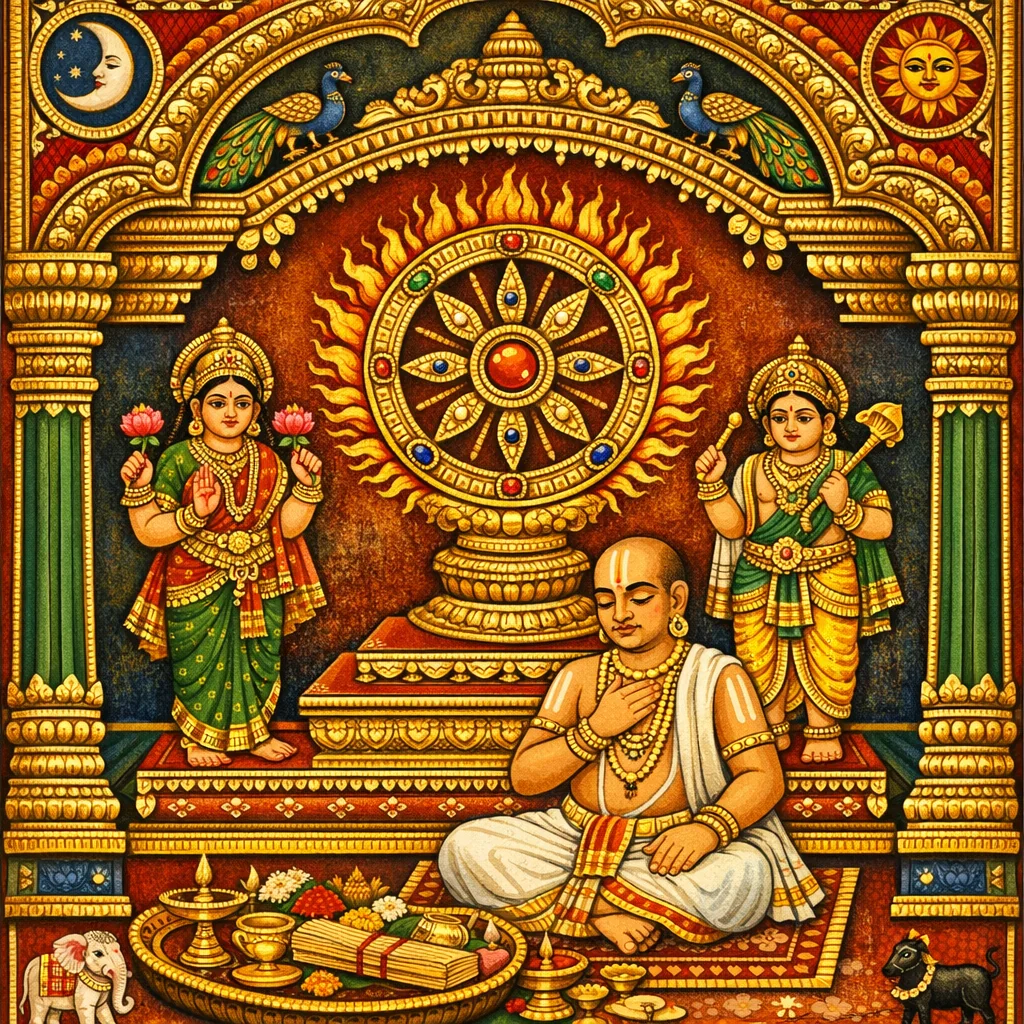
Bhagavān Agni extends Viṣṇu-pratiṣṭhā procedure to allied forms and emblems—Tārkṣya (Garuḍa), Sudarśana, Brahmā, and Narasiṃha—stating that each installation is done “as in the case of Viṣṇu,” yet enlivened by its own mantra. The chapter first gives a forceful Sudarśana-mantra for protection and combat, portraying the discus as śānta to the righteous and bhayaṅkara to the wicked, able to consume hostile spirits and counter inimical mantras. It then teaches an expansive Narasiṃha-vidyā called Pātāla, aimed at subduing netherworld/asuric powers and dissolving doubt and calamity through Hari’s fierce form. Iconographic rules follow for Trailokya-mohana, installed with corresponding “Trilokya-mohana” mantras, with specified attributes (mace; two or four arms) and an ensemble including chakra and Pāñcajanya, along with Śrī–Puṣṭi and Bala–Bhadrā. The scope widens to installations of many Viṣṇu-forms and avatāras, plus syncretic Śaiva-Śākta figures (Liṅga as Rudra-mūrti, Ardhanārīśvara, Hari-Śaṅkara, Mātṛkās) and solar/planetary deities with Vināyaka. The latter half uniquely details pustaka-pratiṣṭhā (book consecration): svastika-maṇḍala worship, honoring writing tools and manuscript, Nāgarī script, precious stylus/casket protocol, Īśāna-facing seating, mirror-darśana, sprinkling, “opening of eyes,” nyāsa (Pauruṣa-sūkta), enlivening (sajīvīkaraṇa), homa, procession, and continued veneration at recitation boundaries. It culminates by exalting vidyā-dāna (gifting manuscripts) as inexhaustible merit, ranking Sarasvatī/learning among supreme gifts and linking lasting merit to the manuscript’s material extent (leaves/letters), fusing ritual technology, iconography, and textual transmission into one dharmic economy.
Shlokas
Verse 1
इत्य् आदिमहापुराणे आग्नेये लक्ष्मीस्थापनं नाम द्विषष्टितमो ऽध्यायः अथ त्रिषष्टितमो ऽध्यायः सुदर्शनचक्रादिप्रतिष्ठाकथनं भगवानुवाच एवं तार्क्ष्यस्य चक्रस्य ब्रह्मणो नृहरेस् तथा प्रतिष्ठा विष्णुवत् कार्या स्वस्वमन्त्रेण तां शृणु
Thus, in the Agni Purāṇa, the sixty-second chapter entitled “The Installation of Lakṣmī” concludes. Now begins the sixty-third chapter: “The Procedure for Consecrating (pratiṣṭhā) the Sudarśana Discus and other divine emblems.” The Blessed Lord said: “In the same manner, the consecration of Tārkṣya (Garuda), of the Discus, and likewise of Brahmā and Narasiṃha should be performed as in the case of Viṣṇu—each with its own mantra. Hear that procedure.”
Verse 2
सुदर्शन महाचक्र शान्त दुष्टभयङ्कर च्छिन्द छिन्द भिन्द भिन्द विदारय विदारय परमन्त्रान् ग्रस ग्रस भक्षय भक्षय भूतान् त्रायस त्रायस हूं फट् सुदर्शनाय नमः अभ्यर्च्य चक्रं चानेन रणे दारयेते रिपून्
“O Sudarśana, great discus—peaceful to the righteous and terrifying to the wicked! Cut, cut; pierce, pierce; rend, rend; shatter, shatter. Swallow hostile spells; devour, devour; consume, consume malignant bhūtas. Protect, protect—hūṃ phaṭ! Homage to Sudarśana.” Having worshipped the discus with this mantra, one rends enemies in battle.
Verse 3
ॐ क्षौं नरसिंह उग्ररूप ज्वल ज्वल प्रज्वल प्रज्वल स्वाहा नरसिंहस्य मन्त्रोयं पातालाख्यस्य वच्मि ते ह शोषय शोषय निकृन्तय निकृन्तय तावद्यावन्मे वशमागताः पातालेभ्यः फट् असुरेभ्यः फट् मन्त्ररूपेभ्यः फट् मन्त्रजातिभ्यः फट् संशयान्मां भगवन्नरसिंहरूप विष्णो सर्वापद्भ्यः सर्वमन्त्ररूपेभ्यो रक्ष रक्ष ह्रूं फट् नमो ऽस्तु ते नरसिंहस्य विद्येयं हरिरूपार्थसिद्धिदा
“Oṃ kṣauṃ—O Narasiṃha of fierce form—blaze, blaze; blaze forth, blaze forth—svāhā! This is the Narasiṃha-mantra called ‘Pātāla’; I declare it to you: ‘Ha—dry up, dry up; cut down, cut down—until they come under my control—(strike) the beings of the netherworld: phaṭ; (strike) the asuras: phaṭ; (strike) the mantra-formed forces: phaṭ; (strike) the classes of mantras: phaṭ. From doubts, protect me, O Lord Viṣṇu in the form of Narasiṃha; from all calamities, from all hostile mantra-formed forces—protect, protect—hrūṃ phaṭ. Homage be to you.’ This Narasiṃha-vidyā bestows the accomplishment of intended aims through the form of Hari (Viṣṇu).
Verse 4
त्रिलोक्यमोहनैर् मन्त्रैः स्थाप्यस्त्रैलोक्यमोहनः गदो दक्षे शान्तिकरो द्विभुजो वा चतुर्भुजः
The deity called “Trailokya-mohana” is to be installed using the “Trilokya-mohana” mantras. In his right hand is a mace (gadā); he bestows pacification (śānti), and he may be depicted as either two-armed or four-armed.
Verse 5
वामोर्ध्वे कारयेच्चक्रं पाञ्चजन्यमथो ह्य् अधः श्रीपुष्टिसंयुक्तं कुर्याद् बलेन सह भद्रया
On the upper left portion one should depict the discus (Sudarśana); and below it, indeed, the Pāñcajanya conch. One should also arrange the figure accompanied by Śrī and Puṣṭi, together with Bala and Bhadrā.
Verse 6
प्रासादे स्थापयेद्विष्णुं गृहे वा मण्डपे ऽपि वा वामनं चैव वैकुण्ठं हयास्यमनिरुद्धकं
One should install an image of Viṣṇu in a temple, or in a house, or even in a ritual pavilion (maṇḍapa)—namely as Vāmana, and also as Vaikuṇṭha, Hayāsya (Hayagrīva), and Aniruddha.
Verse 7
स्थापयेज्जलशय्यास्थं मत्स्यादींश्चावतारकान् सङ्कर्षणं विश्वरूपं लिङ्गं वै रुद्रमूर्तिकं
One should install images of the Lord reclining upon the watery couch (jalashayya), as well as the incarnations beginning with Matsya; also Saṅkarṣaṇa, the Universal Form (Viśvarūpa), and indeed the Liṅga embodying Rudra.
Verse 8
अर्धनारीश्वरं तद्वद्धरिशङ्करमातृकाः भैरवं च तथा सूर्यं ग्रहांस्तद्विनायकम्
Likewise, one should invoke and worship Ardhanārīśvara; similarly Hari-Śaṅkara and the Mother-goddesses (Mātṛkās); and also Bhairava, the Sun (Sūrya), the Grahas (planetary deities), and Gaṇeśa (Vināyaka) in connection with them.
Verse 9
दर दर इति ख, ग, ङ, इति चिह्नितपुस्तकपाठः रक्ष रक्ष ॐ फट् इति ख, चिह्नितपुस्तकपाठः रक्ष रक्ष ह्रीं फडिति ग, चिह्नितपुस्तकपाठः हरिरूपा सुमिद्विदा इति ग, ङ, चिह्नितपुस्तकद्वयपाठः गौरीमिन्द्रादिकां लेप्यां चित्रजां च बलाबलां पुस्तकानां प्रतिष्ठां च वक्ष्ये लिखनतद्विधिं
In some marked manuscripts the reading is “dara dara”; in another marked manuscript it is “rakṣa rakṣa, oṃ phaṭ”; in another marked manuscript it is “rakṣa rakṣa, hrīṃ phaḍ”; and in two marked manuscripts it is “harirūpā sumidvidā.” Now I shall describe the rites concerning Gaurī, the anointing/daubing (lepa) connected with Indra and the other deities, the painted (diagrammatic) procedure, the rite regarding strength and weakness, and the consecration (pratiṣṭhā) of books—together with the method of writing them.
Verse 10
स्वस्तिके मण्डले ऽभ्यर्च्य शरपत्रासने स्थितं लेख्यञ्च लिखितं पुस्तं गुरुर्विद्यां हरिं यजेत्
Having worshipped Hari within a svastika-shaped maṇḍala, and with the deity seated upon a seat made of arrow-leaves, one should also venerate the writing implements and the written book; the teacher should worship Vidyā (Learning) and Hari.
Verse 11
यजमानो गुरुं विद्यां हरिं लिपिकृतं नरं प्राङ्मुखः पद्मिनीं ध्यायेत् लिखित्वा श्लोकपञ्चकं
Facing east, the patron of the rite (yajamāna) should meditate upon the Guru, upon Vidyā (Knowledge), upon Hari (Viṣṇu), upon the man appointed as scribe, and upon Padminī, after having written a set of five ślokas.
Verse 12
रौप्यस्थमस्या हैम्या च लेखन्या नागराक्षरं ब्राह्मणान् भोजयेच्छक्या शक्त्या दद्याच्च दक्षिणां
One should write this text in Nāgarī letters with a golden stylus and place it in a silver casket. To the extent of one’s capacity, one should feed Brāhmaṇas and also give the dakṣiṇā (sacrificial fee).
Verse 13
गुरुं विद्यां हरिं प्रार्च्य पुराणादि लिखेन्नरः पूर्ववन्मण्डलाद्ये च ऐशान्यां भद्रपीठके
Having first worshipped the Guru, Vidyā (sacred learning), and Hari (Viṣṇu), a person should write (copy) the Purāṇas and related works; and, as stated earlier, beginning with the maṇḍala and other preliminaries, he should do so seated on an auspicious seat (bhadra-pīṭha) placed in the north-east (Īśāna) direction.
Verse 14
दर्पणे पुस्तकं दृष्ट्वा सेचयेत् पूर्ववद् घटैः नेत्रोन्मीलनकं कृत्वा शय्यायां तु न्यसेन्नरः
Having seen the reflection of the sacred book in a mirror, one should perform the sprinkling with pots (ghaṭas) as prescribed earlier. Then, after performing the rite called “opening of the eyes,” the man should place it upon the bed (resting place).
Verse 15
न्यसेत्तु पौरुषं सूक्तं देवाद्यं तत्र पुस्तके कृत्वा सजीवीकरणं प्रार्च्य हुत्वा चरुं ततः
Then one should perform the nyāsa of the Pauruṣa-sūkta—beginning with the invocation of the deities—upon that book; having carried out the enlivening rite (sajīvīkaraṇa), one should first worship it, and thereafter offer a caru oblation into the fire.
Verse 16
सम्प्राश्य दक्षिणाभिस्तु गुर्वादीन् भोजयेद्द्विजान् रथेन हस्तिना वापि भ्राम्येत् पुस्तकं नरैः
Having eaten, and together with honoraria (dakṣiṇā), one should feed the gurus and other venerable persons, as well as the twice-born (brāhmaṇas). One should also have the book ceremonially carried about by men—on a chariot or even on an elephant.
Verse 17
गृहे देवालयादौ तु पुस्तकं स्थाप्य पूजयेत् वस्त्रादिवेष्टितं पाठादादावन्ते समर्चयेत्
In one’s home, or first of all in a temple, one should place the sacred book and worship it. Wrapped in cloth and the like, it should be duly honored at the beginning and at the end of the recitation.
Verse 18
त्वा च प्रदापयेत् ब्राह्मणान् भोजयेच्छक्त्या शक्त्यादद्याच्च दक्षिणामिति ग, चिह्नितपुस्तकपाठः पूर्वमण्डपपार्श्वे इति ङ, चिह्नितपुस्तकपाठः पुस्तकं नर इति ख, चिह्नितपुस्तकपाठः अन्ते सदार्चयेदिति ख, ग, चिह्नितपुस्तकपाठः जगच्छान्तिञ्चावधार्य पुस्तकं वाचयेन्नरः अध्यायमेकं कुम्भाद्भिर्यजमानादि सेचयेत्
He should also have that bestowed. He should feed the brāhmaṇas according to his capacity and, according to his means, give a priestly fee (dakṣiṇā). Having ascertained the ‘peace of the world’ (jagacchānti), a man should have the book recited and one chapter read. Then, with water from the ritual pots (kumbhas), he should sprinkle (consecrate) the sacrificer (yajamāna) and the others.
Verse 19
द्विजाय पुस्तकं दत्वा फलस्यान्तो न विद्यते त्रीण्याहुरतिदानानि गावः पृथ्वीं सरस्वती
Having given a book to a twice-born (learned brāhmaṇa), the fruit of that gift has no end. They declare three gifts to be supremely great: cows, land, and Sarasvatī—that is, sacred learning and knowledge.
Verse 20
विद्यादानफलं दत्वा मस्यन्तं पत्रसञ्चयं यावत्तु पत्रसङ्ख्यानमक्षराणां तथानघ
O sinless one, when the fruit of the gift of knowledge is bestowed—namely, a manuscript collection written in ink—the merit endures in proportion to the number of its leaves, and likewise to the number of its letters.
Verse 21
तावद्वर्षसहस्राणि विष्णुलोके महीयते पञ्चरात्रं पुराणानि भारतानि ददन्नरः कुलैकविंशमुद्धृत्य परे तत्त्वे तु लीयते
Whoever, for five nights, gives away the Pañcarātra teachings, the Purāṇas, and the Bhārata is honored in Viṣṇu’s world for thousands of years; having uplifted twenty-one generations of his lineage, he finally dissolves into the Supreme Reality.
Frequently Asked Questions
It emphasizes mantra-specific consecration (each deity/emblem installed like Viṣṇu but with its own mantra), precise iconographic placement (chakra and Pāñcajanya with attendant deities), and a full pustaka-pratiṣṭhā protocol including Nāgarī script, Īśāna-direction seating, mirror-darśana, netronmīlana, nyāsa (Pauruṣa-sūkta), and sajīvīkaraṇa.
By treating images, emblems, and even manuscripts as living loci of dharma through consecration, it converts technical acts—writing, installing, protecting, and gifting knowledge—into sādhana that purifies intention, stabilizes communal worship, and accrues enduring merit culminating in Viṣṇu-loka and final absorption into the Supreme Reality.