Adhyaya 47
Chapter 47 — शालग्रामादिपूजाकथनं (Teaching the Worship of Śālagrāma and Related Sacred Forms)
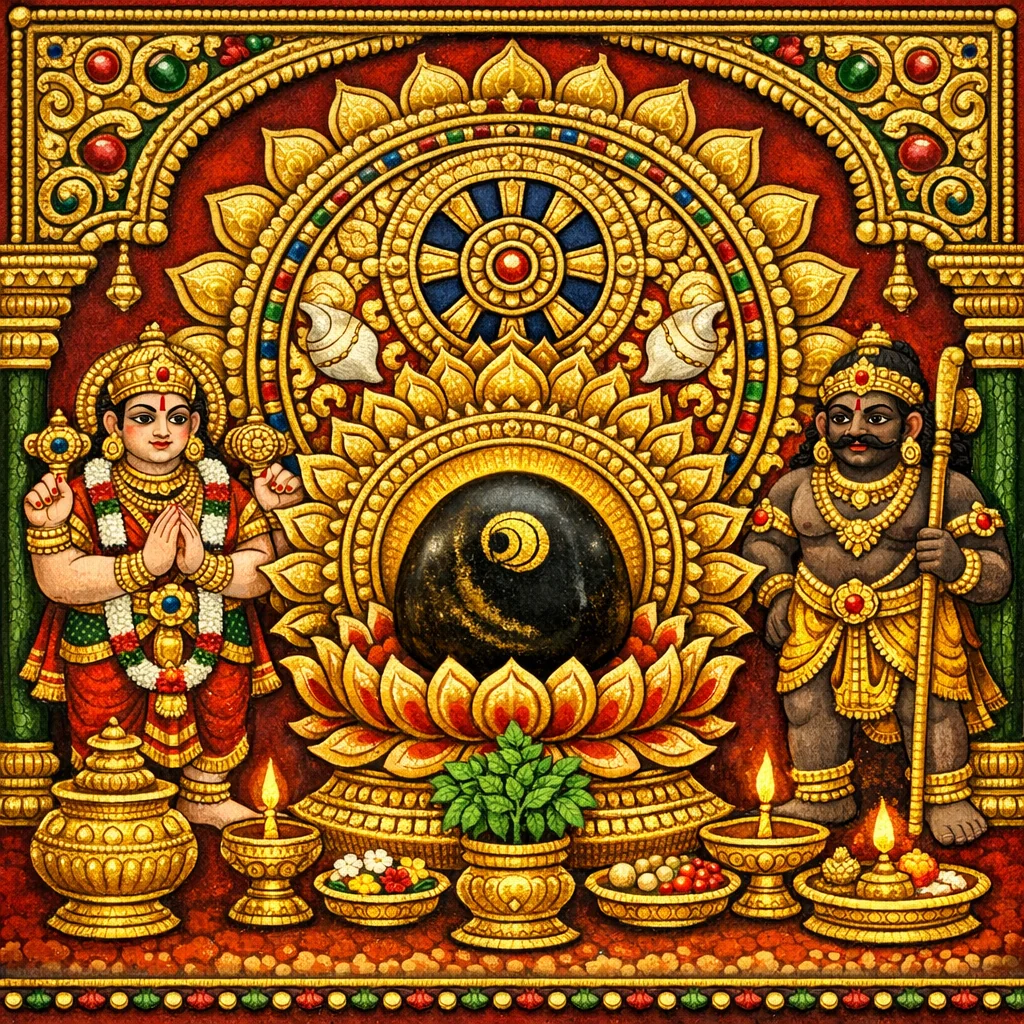
Bhagavān Agni sets forth a structured ritual science for worship of Śālagrāma and cakra-marked forms of Hari, classifying worship as kāmya (desire-motivated), akāmya (obligatory/desireless), and mixed (ubhayātmikā). He links specific form-classes (beginning with Mīna) to intended results, notes emblematic signs such as a cakra with a subtle bindu, and connects worship to liberative aims associated with Varāha, Narasiṃha, and Vāmana. The chapter then turns from taxonomy to procedure: mandala geometry (a cakrābja within a square; later sixteen-spoked and eight-petalled designs), installation of the praṇava in the heart, ṣaḍaṅga-nyāsa on hands and body, and the proper sequence of mudrās. Directional worship is laid out as a protective perimeter—Guru, Gaṇa, Dhātṛ, Vidhātṛ/Kartṛ/Hartṛ, Viśvaksena, and Kṣetrapāla—followed by establishing Vedic supports, cosmic layers (ādhāra-anantaka, bhū, pīṭha, padma), and solar-lunar-fire mandalas. It stresses that without first honoring Viśvaksena/Cakra/Kṣetrapāla, Śālagrāma worship becomes “fruitless,” affirming that āgamic correctness joined to inner disposition is the basis of siddhi and dharmic efficacy.
Shlokas
Verse 1
इत्य् आदिमहापुराणे आग्नेये शालग्रामादिमूर्तिलक्षणं नाम षट्चत्वारिंशो ऽध्यायः अथ सप्तचत्वारिंशो ऽध्यायः शालग्रामादिपूजाकथनं भगवानुवाच शालग्रामादिचक्राङ्कपूजाः सिद्ध्यै वदामि ते त्रिविधा स्याद्धरेः पूजा काम्याकाम्योभयात्मिका
Thus, in the Ādi-Mahāpurāṇa, in the Agneya section, the forty-sixth chapter entitled “Characteristics of Śālagrāma and other sacred forms” concludes. Now begins the forty-seventh chapter, “The teaching of worship of Śālagrāma and related forms.” The Blessed Lord said: “For the attainment of siddhi, I shall explain to you the worship of Śālagrāma and other forms marked with the cakra. The worship of Hari is of three kinds: kāmya (desire-motivated), akāmya (desireless/obligatory), and mixed in nature (ubhayātmikā).”
Verse 2
मीनादीनान्तु पञ्चानां काम्याथो वोभयात्मिका मध्यचक्राधः सूक्ष्मविन्दुक इति ङ, चिह्नितपुस्तकपाठः काम्यार्थेवोभयात्मकेति घ, चिह्नितपुस्तकपाठः वराहस्य नृसिंहस्य वामनस्य च मुक्तये
For the five (forms/mantras) beginning with Mīna, the intended result is kāmya (wish-fulfilling) and also of a dual nature (ubhayātmikā). Below the central cakra there is a subtle bindu (seed-point)—so reads one marked manuscript tradition; another marked reading has: “for the kāmya purpose, (it is) of dual nature.” (This is prescribed) for the liberation (mukti) associated with Varāha, Narasiṃha, and Vāmana.
Verse 3
चक्रादीनां त्रयाणान्तु शालग्रामार्चनं शृणु उत्तमा निष्फला पूजा कनिष्ठा सफलार्चना
Now hear the worship of the Śālagrāma in connection with the three (Viṣṇu-emblems) beginning with the cakra. The “highest” worship is fruitless (when lacking the proper inner disposition), whereas even “inferior” worship—when performed as true arcana—becomes fruitful.
Verse 4
मध्यमा मूर्तिपूजा स्याच्चक्राब्जे चतुरस्रके प्रणवं हृदि विन्यस्य षडङ्गङ्करदेहयोः
The “middling” mode of image-worship is performed in a cakrābja (wheel-lotus) set within a square. Having installed the Praṇava (Oṁ) in the heart, one should perform the six-limbed (ṣaḍaṅga) nyāsa upon the hands and the body.
Verse 5
कृतमुद्रात्रयश् चक्राद् वहिः पूवे गुरुं यजेत् आप्ये गणं वायवे च धातारं नैरृते यजेत्
After performing the three mudrās, one should worship—outside the chakra (maṇḍala)—the Guru in the eastern quarter; Gaṇa in the watery (western) quarter; Dhātṛ in the quarter of Vāyu (north-west); and again Dhātṛ in the Nairṛta (south-west) quarter.
Verse 6
विधातारञ्च कर्तारं हर्तारं दक्षसौम्ययोः विश्वक्सेनं यजेदीशे आग्नेये क्षेत्रपालकम्
In the southern and northern directions one should worship (respectively) Vidhātṛ (the Ordainer), Kartṛ (the Creator/Doer), and Hartṛ (the Remover). In the north-east one should worship Viśvaksena, and in the south-east one should worship the Kṣetrapālaka (guardian of the sacred site).
Verse 7
ऋगादिवेदान् प्रागादौ आधारानन्तकं भुवं पीठं पद्मं चार्कचन्द्रवह्न्याख्यं मण्डलत्रयं
At the outset, beginning from the eastern side, one should place the Ṛg and the other Vedas; then establish the supporting base called Ādhāra-Anantaka, the Bhū (earth) layer, the pīṭha (seat-platform), the padma (lotus), and the triad of maṇḍalas known as Arka (Sun), Candra (Moon), and Vahni (Fire).
Verse 8
आसनं द्वादशार्णेन तत्र स्थाप्य शिलां यजेत् अस्तेन च समस्तेन स्ववीजेन यजेत् क्रमात्
Having established the ritual seat (āsana) with the twelve-syllabled mantra, one should then install the sacred stone there and worship it. Thereafter, in due sequence, one should perform worship with the astra-mantra, with the complete set of mantras, and with one’s own bīja (seed) mantra.
Verse 9
पूर्वादावथ वेदाद्यैर् गायत्रीभ्यां जितादिना प्रणवेनार्चयेत् पञ्चान्मुद्रास्तिस्रः प्रदर्शयेत्
Beginning from the east, then with the invocatory opening portions of the Veda, with the two Gāyatrī mantras, with the mantra beginning “Jita…”, and with the Praṇava (Oṃ), one should perform worship; and one should display the three mudrās as well as the five mudrās.
Verse 10
विश्वक्सेनस्य चक्रस्य क्षेत्रपालस्य दर्शयेत् शालग्रामस्य प्रथमा पूजार्थो निष्फलोच्यते
One should first offer due indication of reverence to Viśvaksena, the Sudarśana Cakra, and the Kṣetrapāla, guardian of the sacred precinct. Worship of the Śālagrāma performed without this preliminary honouring is declared fruitless.
Verse 11
पूर्ववत् षोडशारञ्च सपद्मं मण्डलं लिखेत् शङ्खचक्रगदाखड्गैर् गुर्वाद्यं पूर्ववद्यजेत्
As before, one should draw a maṇḍala with sixteen spokes together with a lotus; and, with the emblems of conch, discus, mace, and sword, one should worship—beginning with the Guru—exactly as previously prescribed.
Verse 12
पूर्वे सौम्ये धनुर्वाणान् वेदाद्यैर् आसनं ददेत् शिलां न्यसेद् द्वादशार्णैस्तृतीयं पूजनं शृणु
In the auspicious eastern direction, one should place the bow and arrows and offer the āsana (ritual seat) with Vedic formulas and the like. One should install the sacred stone (śilā) by means of a twelve-syllabled mantra. Now hear the third procedure of worship.
Verse 13
अष्टारमब्जं विलिखेत् गुर्वाद्यं पूर्ववद्यजयेत् चतुर्भिः पूर्ववद्यजेदिति ङ, चिह्नितपुस्तकपाठः गन्धाद्यैर् इति ङ, चिह्नितपुस्तकपाठः अष्टार्णेनासनं दत्वा तेनैव च शिलां न्यसेत् पूजयेद्दशधा तेन गायत्रीभ्यां जितं तथा
One should draw an eight-petalled lotus diagram. Beginning with the Guru, one should worship as previously prescribed; and with the four items/parts one should likewise worship in the earlier manner (as indicated by the marked manuscript reading). With fragrances and the like (as per the marked reading), having offered the āsana with the eight-syllabled mantra, one should place the sacred stone (śilā) by that very mantra. One should then worship in ten modes by that mantra; thus it is also accomplished by the two Gāyatrīs.
Frequently Asked Questions
The chapter emphasizes ritual sequencing and ritual-geometry: constructing specific maṇḍalas (cakrābja-in-square; sixteen-spoked; eight-petalled), performing praṇava-hṛdaya installation and ṣaḍaṅga-nyāsa, and completing directional worship—especially Viśvaksena, Sudarśana Cakra, and Kṣetrapāla—as mandatory preliminaries for efficacious Śālagrāma arcana.
It ties external correctness (mantra, nyāsa, mudrā, maṇḍala, and dikpūjā) to inner disposition (bhāva), warning that even ‘highest’ worship can be fruitless without proper orientation, while disciplined arcana—though ‘inferior’ in form—becomes fruitful, aligning siddhi, protection, and devotion toward dharma and mukti.