Adhyaya 91
Chapter 91 — विविधमन्त्रादिकथनम् (Teaching of Various Mantras and Related Matters)
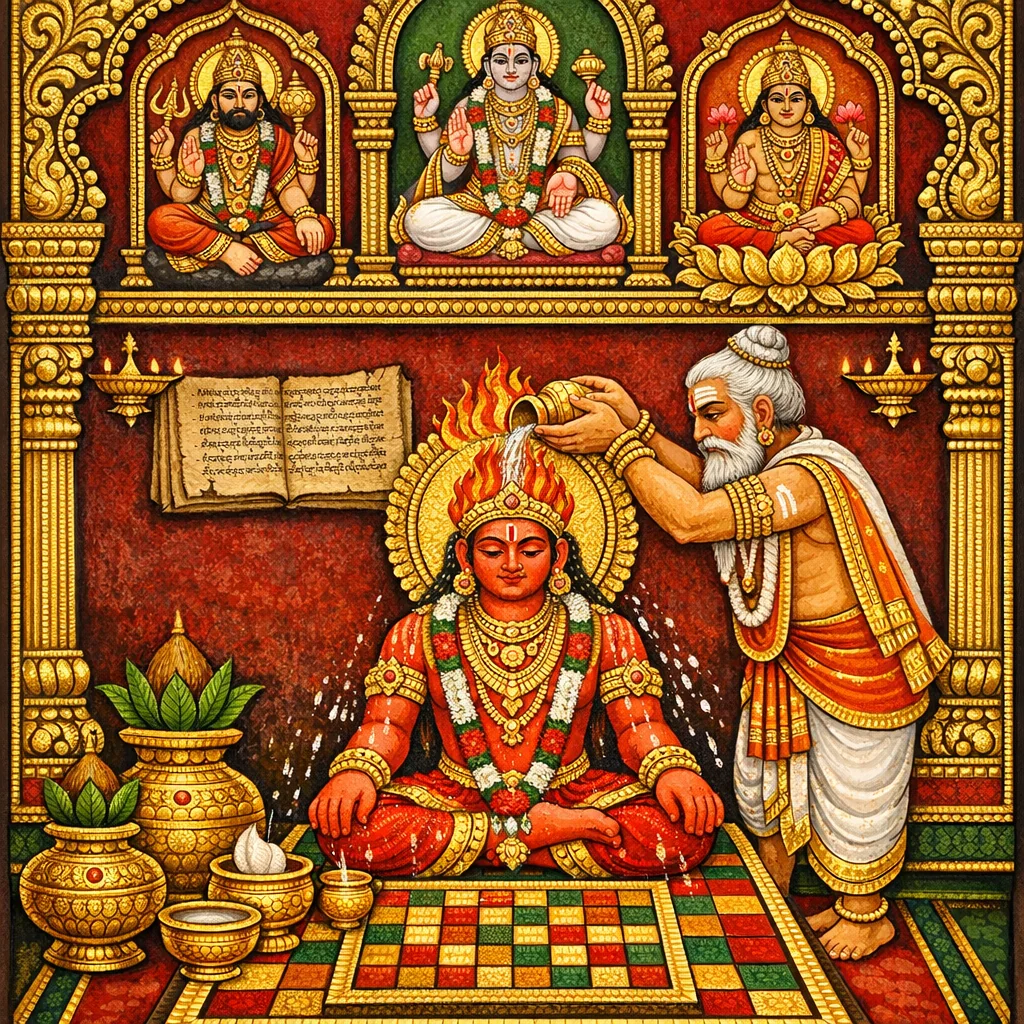
After completing the prior teaching on abhiṣeka, the chapter links consecration to ongoing worship: amid auspicious instrumental music, the practitioner bathes the deity with pañcagavya and performs pūjā to Śiva, Viṣṇu, Sūrya, and allied deities. It then turns from rite to vidyā, promising merit for direct study of the marked/annotated sacred text, and presenting ritual offerings—especially ghee and sandal—as purifying and status-elevating. A compact technical core follows with mantric/divinatory analytics: triads and tetrads encode jīva, mūladhātu, and knowledge-categories; auspicious and inauspicious results are read through positional ends and middles; number-clusters and birch-bark inscriptions are prescribed with deity-mantras. The chapter also outlines line-drawing sequences, a 64-fold scheme tied to marut/vyoma categories, and metrical groupings (samā, hīnā, viṣamā). It culminates in mantra-śāstra proper: Tripurā name-mantras derived from vowels and ka-series phonemes, bīja syllables for major deities, and a concluding discipline of japa/maṇḍala counts (360 per cycle) for Ravi, Īśa, Devī, and Viṣṇu, integrated with meditation and guru-led dīkṣā—thus uniting Vāstu-pratiṣṭhā ritual authority with īśāna-kalpa mantra practice.
Shlokas
Verse 1
इत्य् आदिमहापुराणे आग्नेये अभिषेकादिकथनं नाम नवतितमो ऽध्यायः अथैकनवतितमो ऽध्यायः विविधमन्त्रादिकथनं ईश्वर उवाच अभिषिक्तः शिवं विष्णुं पूजयेद्भास्करादिकान् शङ्खभेर्यादिनिर्घोषैः स्नापयेत् पञ्चगव्यकैः
Thus, in the Agni Purāṇa, the ninetieth chapter entitled “The Description of Abhiṣeka and Related Rites” concludes. Now begins the ninety-first chapter, “The Teaching of Various Mantras and Related Matters.” The Lord said: “Having performed the consecratory bath (abhiṣeka), one should worship Śiva and Viṣṇu, and also Sūrya and the other deities; and, amid the resounding of conches, kettle-drums, and similar instruments, one should bathe (the deity) with the pañcagavya (the five products of the cow).”
Verse 2
स्वयं वीक्ष्येति ग, चिह्नितपुस्तकपाठः यो देवान्देवलोकं स याति स्वकुलमुद्धरन् वर्षकोटिसहस्रेषु यत् पापं स्मुपार्जितं
He who, having personally beheld (the sacred text) and recited from a marked or annotated book, reaches the world of the gods; and, uplifting his own lineage, he destroys the sin accumulated over tens of thousands of crores of years.
Verse 3
घृताभ्यङ्गेन देवानां भस्मीभवति पावके आढकेन घृताद्यैश् च देवान् स्नाप्य सुरो भवेत्
By anointing the deities with ghee, the offering becomes ash in the sacred fire. And by bathing the deities with an āḍhaka measure of ghee and the like, one becomes a deva (attains divine status).
Verse 4
चन्दनेनानुलिप्याथ गन्धाद्यैः पूजयेत्तथा अल्पायासनं स्तुतिभिस्तुता देवास्तु सर्वदा
Then, after anointing (the deity) with sandalpaste, one should likewise worship with fragrances and the other offerings. With a simple seat and with hymns of praise, may the gods—praised—be ever present and propitious.
Verse 5
अतीतानागतज्ञानमन्त्रधीभुक्तिमुक्तिदाः गृहीत्वा प्रश्नसूक्ष्मार्णे हृते द्वाभ्यां शुभाशुभं
Having taken up (these teachings) in the subtle ocean of interrogative divination, one grasps by means of the two (methods) what is auspicious and inauspicious—teachings that bestow knowledge of past and future, mantra-powered insight, worldly enjoyment, and liberation.
Verse 6
त्रिभिर्जीवो मूलधातुश् चतुर्भिर्ब्राह्मणादिधीः यञ्चादौ भूततत्त्वादि शेषे चैवं जपादिकं
With three (syllabic units) is indicated the “jīva” (the living self); with four, the “mūladhātu” (the primal basis/element). With four (again) are indicated the cognitions beginning with “brāhmaṇa” (i.e., the Vedic/śāstric knowledges). And at the beginning, “bhūta-tattva” and related principles are taught; in the remainder, in this manner, (instructions on) japa and allied practices (are given).
Verse 7
एकत्रिकातित्रिकान्ते पदे द्विपमकान्तके अशुभं मध्यमं मध्येष्विन्द्रस्त्रिषु नृपः शुभः
At the end-point of a single triad or a triple-triad, and at the end of the second pair in the sequence of steps (pada), the result is inauspicious. In the middle positions the result is middling; in the central ones it is “Indra” (i.e., excellent). In sets of three, the “king” (nṛpa) is auspicious.
Verse 8
सङ्ख्यावृन्दे जीविताब्दं यमो ऽब्ददशहा ध्रुवं सूर्येभास्येशदुर्गाश्रीविष्णुमन्त्रैर् लिखेत् कजे
In a cluster (array) of numbers, one should write (the terms) “jīvitābda” (life-years), “yama” (death), “abdadaśahā” (the destroyer of ten years), and “dhruva” (the fixed/polar one); and one should inscribe (them) on birch-bark, using the mantras of Sūrya, Bhāskara, Īśa (Śiva), Durgā, Śrī, and Viṣṇu.
Verse 9
कठिन्या जप्तया स्पृष्टे गोमूत्राकृतिरेखया आरभ्यैकं त्रिकं यावत्त्रिचतुष्कावसानकं
When (the rite/object) has been touched with the mantra of “Kaṭhinī” duly recited, one should begin the line-drawing in the form of a “cow-urine” curve; starting with a single (stroke/mark), then in groups of three, continuing until the sequence ends with groups of three and four.
Verse 10
मरुद् व्योम मरुद्वीजैश् चतुःषष्टिपदे तथा अक्षाणां पतनात् स्पर्शाद्विषमादौ शुभादिकं
In the sixty-fourfold scheme—classified as ‘marut’ (wind), ‘vyoma’ (sky), and also ‘marud-bīja’ (wind-seeds)—one determines auspiciousness and the like from the dice (akṣa): their falling and their touching, beginning with the irregular (unfavourable) outcomes.
Verse 11
एकत्रिकादिमारभ्य अन्ते चाष्टत्रिकं तथा ध्वजाद्यायाः समा हीना विषमाः शोभनादिदाः
Beginning with the ‘eka-trika’ group and ending likewise with the ‘aṣṭa-trika’ group, the metres starting from Dhvaja are of three kinds: samā (even), hīnā (deficient), and viṣamā (uneven), beginning with the class called Śobhanā and so on.
Verse 12
आइपल्लवितैः काद्यैः षोडशस्वरपूर्वगैः आद्यैस्तैः सस्वरैः काद्यैस्त्रिपुरानाममन्त्रकाः
The mantra-formulas that constitute Tripurā’s names are formed from the ka-series consonants (ka-varga), expanded by the vowel ‘ai’, and preceded by the sixteen vowels—namely, those initial ka-series syllables endowed with their vowels.
Verse 13
ह्रीं वीजाः प्रणवाद्याःस्पुर् नमो ऽन्ता यत्र पूजने मन्त्रा विंशतिसाहस्राः शतं षष्ठ्यधिकं ततः
The seed-syllables (bīja) are headed by the Pranava (Oṃ); they shine forth, and in worship they terminate with the salutation “namaḥ”. The mantras used there are twenty thousand, and in addition to that, a further one hundred and sixty.
Verse 14
शोभनादिकाः इति ङ, चिह्नितपुस्तकपाठः आं ह्रीं मन्त्राः सरस्वत्याश् चण्डिकायास्तथैव च तथा गौर्याश् च दुर्गाया आं श्रीं मन्त्राः श्रियस् तथा
“Śobhanādikāḥ”—so reads the marked manuscript. The seed-mantras ‘āṃ’ and ‘hrīṃ’ belong to Sarasvatī and likewise to Caṇḍikā; and for Gaurī and Durgā, the seed-mantras are ‘āṃ’ and ‘śrīṃ’; similarly, these apply to Śrī (Lakṣmī) as well.
Verse 15
तथाक्षौं क्रौं मन्त्राः सूर्यस्य आं हौं मन्त्राःशिवस्य च आं गं मन्त्रा गणेशस्य आं मन्त्राश् च तथा हरेः
Likewise, the mantras of Sūrya are “kṣauṃ” and “krauṃ”; the mantras of Śiva are “āṃ” and “hauṃ”; the mantra of Gaṇeśa is “āṃ gaṃ”; and similarly, the mantra of Hari (Viṣṇu) is “āṃ”.
Verse 16
शतार्धैकाधिकैः काद्यैस् तथा षोडशभिः खरैः काद्यैस्तैः सस्वरैसाद्यैः कान्तैर् मन्त्रास् तथाखिलाः
All mantras, in their entirety, are constituted from the ka-series and the remaining consonants—amounting to a hundred and one when counted by halves—together with the sixteen vowels; that is, from the consonants beginning with “ka”, endowed with vowels and beginning with “a”.
Verse 17
रवीशदेवीविष्णूनां स्वाब्धिदेवेन्द्रवर्तनात् शतत्रयं षष्ट्यधिकं प्रत्येकं मण्डलं क्रमात् अभिषिक्तो जपेद् ध्यायेच्छिष्यादीन् दीक्षयेद्गुरुः
For Ravi (the Sun), Īśa (Śiva), Devī, and Viṣṇu—following the respective cycles of one’s own svābdhi, the deity, and Indra—each maṇḍala, in due order, is to be completed with three hundred and sixty recitations. Having been consecrated by abhiṣeka, one should perform japa and meditation; and the Guru should confer dīkṣā upon disciples and others.
Frequently Asked Questions
Post-abhiṣeka worship: pūjā of Śiva and Viṣṇu (with Sūrya and others), accompanied by conch and drum sounds, and a pañcagavya bath for the deity as a purification and consecratory continuation.
It treats consecration as the gateway to mantra-technology: after ritual bathing and upacāras, it systematizes bīja-mantras, phonemic construction rules, divinatory number schemes, and fixed japa/maṇḍala counts under guru-led dīkṣā—binding temple-rite authority to Īśāna-oriented mantra discipline.
Sarasvatī and Caṇḍikā (āṃ, hrīṃ), Gaurī and Durgā (āṃ, śrīṃ), Śrī/Lakṣmī (āṃ, śrīṃ), Sūrya (kṣauṃ, krauṃ), Śiva (āṃ, hauṃ), Gaṇeśa (āṃ gaṃ), and Hari/Viṣṇu (āṃ).
It prescribes 360 recitations per maṇḍala, in due order, for Ravi (Sun), Īśa (Śiva), Devī, and Viṣṇu, integrated with meditation and the guru’s initiation of disciples.