Adhyaya 79
पवित्रारोहणविधिः (The Rite of Raising/Placing the Pavitra)
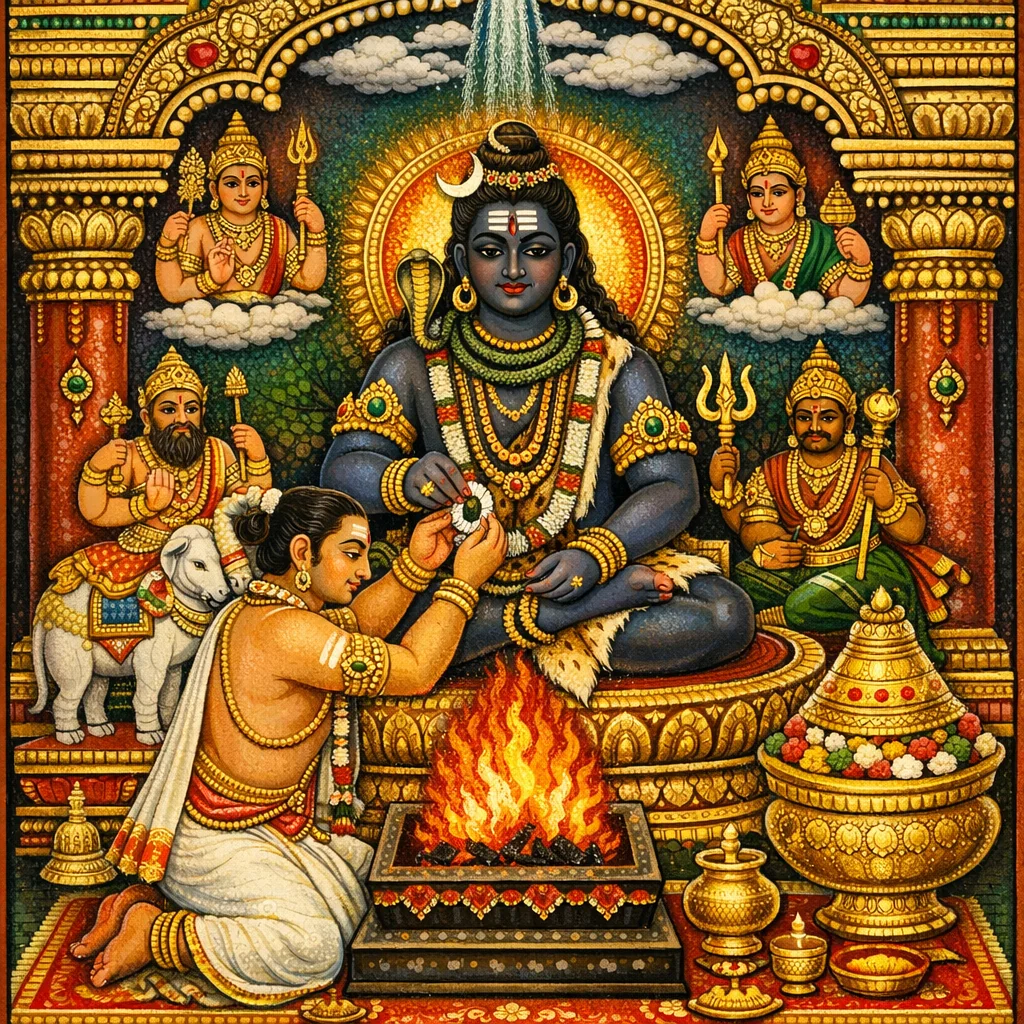
This chapter teaches the pavitrārohaṇa—the raising/placing of the pavitra (purificatory ring/cord)—as a rite that completes and corrects deficiencies in Vāstu-pratiṣṭhā and Īśāna-kalpa. After morning purity (snāna, sandhyā), the officiant enters the maṇḍapa and sets the pavitras in a clean vessel in the Īśāna (north-east) quarter without dismissing the invoked presence. Following formal dismissals and purification, it unfolds into elaborate naimittika worship of Sūrya (Bhānu/Āditya), gate-deities, dikpālas, Kumbheśa/Īśāna, Śiva, and Agni, culminating in mantra-tarpaṇa, prāyaścitta-homa, 108 oblations, and pūrṇāhuti. The central arc is confession of lapses in mantra, kriyā, and dravya, prayer for completion, and the “Gaṅgā-avatāraka” descent-prayer that gathers all errors into a single thread of divine command. The chapter then prescribes fourfold homas (vyāhṛti and Agni/Soma sequences), offerings to dikpālas with pavitra, guru-pūjā as Śiva-pūjā, feeding of dvijas, and final dismissals/mergings (including nāḍī-yoga internalization), ending with Caṇḍeśvara worship and the assurance that the pavitra-rite requires guru-sannidhi even at a distance.
Shlokas
Verse 1
इत्य् आदिमहापुराणे आग्नेये पवित्राधिवासनविधिर्नाम अष्टसप्ततितमो ऽध्यायः : अथैकोनाशीतितमो ऽध्यायः पवित्रारोहणविधिः ईश्वर उवाच अथ प्रातः समुत्थाय कृतस्नानः समाहितः कृतसन्ध्यार्चनो मन्त्री प्रविश्य मखमण्डपं
Thus, in the Agni Purāṇa, the seventy-ninth chapter entitled “The Rite of Consecrating (Adhivāsana) the Pavitra” concludes. Now begins the eighty-first chapter, “The Rite of Raising/Placing the Pavitra.” The Lord said: Then, rising early in the morning, having bathed, being composed, and having performed the Sandhyā worship, the officiating priest, endowed with mantra, enters the sacrificial pavilion (maṇḍapa).
Verse 2
समादाय पवित्राणि अविसर्जितदैवतः ऐशान्यां भाजने शुद्धे स्थापयेत् कृतमण्डले
Having taken up the sacred pavitras (purificatory rings/threads), and without dismissing the invoked deity, one should place them in a clean vessel set in the north-eastern (Īśāna) quarter, within the prepared maṇḍala.
Verse 3
ततो विसर्ज्य देवेशं निर्माल्यमपनीय च पूर्ववद् भूतले शुद्धेकृत्वाह्निकमथ द्वयं
Thereafter, having formally dismissed the Lord of the gods and also removed the (used) offerings and floral remnants, one should, as before, perform the two daily observances (morning and evening rites) on a purified spot on the ground.
Verse 4
आदित्यद्वारदिक्पालकुम्भेशानौ शिवे ऽनले नैमित्तिकीं सविस्तरां कुर्यात् पूजां विशेषतः
For a special-occasion (naimittika) rite, one should perform an especially elaborate worship, in due order, of Āditya, the gate-deities, the guardians of the directions, Kumbheśa, Īśāna, Śiva, and Agni.
Verse 5
मन्त्राणां तर्पणं प्रायश्चित्तहोमं शरात्मना अष्टोत्तरशतं कृत्वा दद्यात् पूर्णाहुतिं शनैः
Having performed the satiatory offerings (tarpaṇa) for the mantras and the expiatory fire-offering (prāyaścitta-homa)—offering with the śarā-substance—one should complete one hundred and eight oblations, and then, slowly, offer the final full oblation (pūrṇāhuti).
Verse 6
आदित्यद्वारदिक्पालान् स्कन्देशानौ शिवे ऽनले इति ङ, चिह्नितपुस्तकपाठः शराणुनेति घ, ङ, चिह्नितपुस्तकद्वयपाठः पवित्रं भानवे दत्वा समाचम्य ददीत च द्वारमालादिदिक्पालकुम्भवर्धनिकादिषु
Having offered the pavitra (purifying sacred thread/garland) to Bhānu (the Sun), and then performing ācamana (ritual sipping for purification), one should make the prescribed offerings to the door-deities and the Dikpālas (guardians of the directions) at the ritual placements: the doorway-garland (dvāra-mālā), the Dikpāla pots (kumbhas), the vardhanī-vessels, and the other related stations. (Variant readings are noted: “āditya–dvāra–dikpālān … skanda–īśa–anau–śive ’nale …” / alternatively “śarāṇunā …”.)
Verse 7
सन्निधाने ततः शम्भोरुपविश्य निजासने पवित्रमात्मने दद्याद्गणाय गुरुवह्नये
Then, in the presence of Śambhu (Śiva), seated upon one’s own seat, one should offer the pavitra (sanctifying thread/ring) for oneself, and also offer it to Gaṇa (Gaṇeśa), to the Guru, and to the sacred Fire.
Verse 8
ॐ कालात्मना त्वया देव यद्दिष्टं मामके विधौ कृतं क्लिष्टं समुत्सृष्टं कृतं गुप्तञ्च यत्कृतं
Om. O God whose very nature is Time—whatever you have ordained within my prescribed observances: whatever I have done with distress and error, whatever I have done negligently or left incomplete, and whatever I have done in secret—may all of it be taken into account.
Verse 9
तदस्तु क्लिष्टमक्लिष्टं कृतं क्लिष्टमसंस्कृतं सर्वात्मनामुना शम्भो पवित्रेण त्वदिच्छया
O Śambhu, by your will, may whatever has been done—whether with hardship or without, whether imperfectly done or left unrefined—be purified through this pavitra, with my whole being.
Verse 10
ॐ पूरयमखव्रतं नियमेश्वराय स्वाहा आत्मतत्त्वे प्रकृत्यन्ते पालिते पद्मयोनिना
Oṁ. Svāhā to the Lord of discipline (Niyameśvara): may this offering fulfill the vow of the sacrifice; this is within the principle of the Self, at the termination of Prakṛti, preserved/established by the Lotus-born (Brahmā).
Verse 11
मूलं लयान्तमुच्चार्य पवित्रेणार्चयेच्छिवं विद्यातत्त्वे च विद्यान्ते विष्णुकारणपालिते
Having uttered the root-mantra together with the terminating (laya) syllable, one should worship Śiva using a consecrated pavitra. This rite is to be understood within the principle of sacred knowledge (vidyā-tattva) and at the culmination of knowledge—preserved by Viṣṇu, the causal ground.
Verse 12
ईश्वरान्तं समुच्चार्य पवित्रमधिरोपयेत् शिवान्ते शिवतत्त्वे च रुद्रकारणपालिते
Having recited the mantra ending with “Īśvara,” one should install the pavitra, the consecrated purifying thread. This is done in conclusion with “Śiva,” within the Śiva-tattva, safeguarded by the Rudra-principle as the causal ground.
Verse 13
शिवान्तं मन्त्रमुच्चार्य तस्मै देयं पवित्रकं सर्वकारणपालेषु शिवमुच्चार्य सुव्रतः
Having uttered the mantra ending with the word “Śiva,” one should give him the pavitraka, the consecrated purifying thread or ring. The man of good observance, uttering “Śiva,” should offer it to all the guardians and presiding protectors of the ritual causes (the officiants and protective deities connected with the rite).
Verse 14
मूलं लयान्तमुच्चार्य दद्याद्गङ्गावतारकं आत्मविद्याशिवैः प्रोक्तं मुमुक्षूणां पवित्रकं
Having pronounced the root-mantra ending with the syllable “laya,” one should bestow the “Gaṅgā-avatāraka,” the formula or rite that brings down the Gaṅgā. It is taught by the Śivas of the doctrine of Self-knowledge, and it serves as a purifier for those seeking liberation.
Verse 15
विनिर्दिष्टं बुभुक्षूणां शिवतत्त्वात्मभिः क्रमात् स्वाहान्तं वा नमो ऽन्तं वा मन्त्रमेषामुदीरयेत्
For those who desire to partake of the offered oblations, one should recite—according to the prescribed sequence—the specified mantra in forms identified with the Śiva-tattva, ending either with “svāhā” or with “namaḥ.”
Verse 16
सर्वतत्त्वेषु सुव्रत इति ख, ग, ङ, चिह्नितपुस्तकत्रयपाठः दद्यादङ्गावतारकमिति ख, चिह्नितपुस्तकपाठः ॐ हां विद्यातत्त्वाधिपतये शिवाय स्वाहा ॐ हौं शिवतत्त्वाधिपतये शिवाय स्वाहा ॐ हौं सर्वतत्त्वाधिपतये शिवाय स्वाहा नत्वा गङ्गावतारन्तु प्रार्थयेत्तं कृताञ्जलिः त्वङ्गतिः सर्वभूतानां संस्थितिस्त्वञ्चराचरे
“(Reading variants: some manuscripts read ‘sarvatattveṣu suvrata’; some read ‘dadyād aṅgāvatārakam’.) One should offer the oblation with these mantras: ‘Oṃ hāṃ—unto Śiva, the Lord of the principle of knowledge (vidyā-tattva), svāhā’; ‘Oṃ hauṃ—unto Śiva, the Lord of the Śiva-principle (śiva-tattva), svāhā’; ‘Oṃ hauṃ—unto Śiva, the Lord of all principles (sarva-tattva), svāhā.’ Then, having bowed down, with joined palms one should pray for the descent of Gaṅgā: ‘You are the refuge and goal of all beings; you are the sustaining station in both the moving and the unmoving (creation).’
Verse 17
अन्तश्चारेण भूतानां द्रष्टा त्वं परमेश्वर कर्मणा मनसा वाचा त्वत्तो नान्या गतिर्मम
O Supreme Lord, as the inner indweller moving within all beings, You are the witness. By my actions, by my mind, and by my speech—apart from You there is no other refuge for me.
Verse 18
मन्त्रहीनं क्रियाहीनं द्रव्यहीनञ्च यत् कृतं जपहोमार्चनैर् हीनं कृतं नित्यं मया तव
Whatever I have performed for You each day—deficient in mantra, deficient in proper procedure, and deficient in the requisite materials; and whatever has been done lacking japa, homa, and formal worship—may You accept it and forgive it.
Verse 19
अकृतं वाक्यहीनं च तत् पूरय महेश्वरं सुपूतस्त्वं परेशान पवित्रं पापनाशनं
O Maheśvara, whatever has been left undone and whatever has been rendered deficient in words—please complete that. O Pareśāna, You are perfectly pure, the Purifier, the Destroyer of sins.
Verse 20
त्वया पवित्रितं सर्वं जगत् स्थावरजङ्गमं खण्डितं यन्मया देव व्रतं वैकल्पयोगतः
By You, O Deva, the entire world—both the immovable and the moving—has been sanctified. Yet the vow I undertook has been violated, due to the application of an alternative procedure (vaikalpa).
Verse 21
एकीभवतु तत् सर्वं तवाज्ञासूत्रगुम्फितं जपं निवेद्य देवस्य भक्त्या स्तोत्रं विधाय च
May all of that become one, strung together on the thread of Your command. Having offered the mantra-recitation (japa) to the Deity, and having also composed/recited a hymn (stotra) with devotion, one should proceed accordingly.
Verse 22
नत्वा तु गुरुणादिष्टं गृह्णीयान्नियमन्नरः चतुर्मासं त्रिमासं वा त्र्यहमेकाहमेव च
Having bowed to the teacher, a man should undertake the prescribed observance as instructed by the guru—whether for four months, for three months, or even for three days, or for a single day.
Verse 23
प्रणम्य क्षमयित्वेशं गत्वा कुण्डान्तिकं व्रती पावकस्थे शिवे ऽप्येवं पवित्राणां चतुष्टयं
Having bowed down and sought forgiveness from the Lord, the observant votary should go near the fire-altar (kuṇḍa); and thus—before Śiva as well, who abides in the fire—he should arrange/undertake the set of four sacred pavitras.
Verse 24
समारोप्य समभ्यर्च्य पुष्पधूपाक्षतादिभिः अन्तर्बलिं पवित्रञ्च रुद्रादिभ्यो निवेदयेत्
Having installed the deity and duly worshipped with flowers, incense, unbroken rice (akṣata) and the like, one should offer the inner oblation (antar-bali) and the consecrated pavitra (sacred thread/cord) to Rudra and the other deities.
Verse 25
प्रविश्यान्तः शिवं स्तुत्वा सप्रणामं क्षमापयेत् अन्तश् चर त्वं भूतानामिति ग, चिह्नितपुस्तकपाठः परिपूर्णं करो तु मे इति ग, चिहितपुस्तकपाठः अमृतस्त्वं परेशान इति ग, चिह्नितपुस्तकपाठः प्रायश्चित्तकृतं होमं कृत्वा हुत्वा च पायसं
Having entered within, one should praise Śiva and, with a reverential bow, seek forgiveness. (In some marked manuscript readings, the following formulas are added: “Move within the beings,” “Make it complete for me,” and “You are nectar, O Supreme Lord.”) Having then performed the expiatory fire-offering (prāyaścitta-homa), one should also offer rice-pudding (pāyasa) as an oblation.
Verse 26
शनैः पूर्णाहुतिं दत्वा वह्निस्थं विसृजेच्छिवं होमं व्याहृतिभिः कृत्वा रुन्ध्यान्निष्ठुरयानलं
Having slowly offered the final oblation (pūrṇāhuti), he should dismiss Śiva who is stationed in the fire. Having performed the fire-offering with the sacred utterances (vyāhṛtis), he should then restrain and check the fierce fire.
Verse 27
अग्न्यादिभ्यस्ततो दद्यादाहुतीनां चतुष्टयं दिक्पतिभ्यस्ततो दद्यात् सपवित्रं वहिर्बलिं
Thereafter one should offer a set of four oblations, beginning with the offering to Agni. Then one should present the external bali-offering, together with the pavitra (the sanctifying ring of darbha-grass), to the Lords of the Directions (Dikpālas).
Verse 28
सिद्धान्तपुस्तके दद्यात् सप्रमाणं पवित्रकं ॐ हां भूः स्वाहा ॐ हां भुवः स्वाहा ॐ हां स्वः स्वाहा ॐ हां भूर्भुवः स्वः स्वाहा होमं व्याहृतिभिः कृत्वा दत्वाअहुतिचतुष्टयं
One should then place into the Siddhānta-text the pavitraka (the consecrated protective thread/ring), made in the proper measure. Having performed a homa with the Vyāhṛtis—“Oṃ hāṃ bhūḥ svāhā; Oṃ hāṃ bhuvaḥ svāhā; Oṃ hāṃ svaḥ svāhā; Oṃ hāṃ bhūr-bhuvaḥ svaḥ svāhā”—one should offer the set of four oblations.
Verse 29
ॐ हां अग्नये स्वाहा ॐ हां सोमाय स्वाहा ॐ हां अग्नीषोमाभ्यां स्वाहा ॐ हां अग्नये स्विष्टकृते स्वाहा गुरुं शिवमिवाभ्यर्च्य वस्त्रभूषादिविस्तरैः समग्रं सफलं तस्य क्रियाकाण्डादि वार्षिकं
“Oṃ hāṃ—unto Agni, svāhā. Oṃ hāṃ—unto Soma, svāhā. Oṃ hāṃ—unto Agni-and-Soma together, svāhā. Oṃ hāṃ—unto Agni as Sviṣṭakṛt (the perfecter of the offering), svāhā.” Having worshipped the Guru as one would worship Śiva, with ample offerings such as garments and ornaments, his annual observances—beginning with the ritual section (kriyā-kāṇḍa) and the rest—become complete and fruitful.
Verse 30
यस्य तुष्टो गुरुः सम्यगित्याह परमेश्वरः इत्थं गुरोः समारोप्य हृदालम्बिपवित्रकं
For the one with whom the guru is fully pleased, the Supreme Lord declares, “So it is indeed.” Thus, having placed (or conferred) the heart-hanging pavitraka upon the guru, the rite proceeds.
Verse 31
द्विजातीन् भोजयित्वा तु भक्त्या वस्त्रादिकं ददेत् दानेनानेन देवेश प्रीयतां मे सदा शिवः
Having fed the twice-born (Brāhmaṇas) with devotion, one should give garments and the like. By this gift, O Lord of the gods, may Śiva ever be pleased with me.
Verse 32
भक्त्या स्नानादिकं प्रातः कृत्वा शम्भोः समाहरेत् पवित्राण्यष्टपुष्पैस्तं पूजयित्वा विसर्जयेत्
In the morning, having devoutly performed bathing and the other preliminary rites, one should gather the materials for Śambhu; then, having worshipped Him with consecrated offerings (pavitra) and eight flowers, one should formally conclude the rite by the ritual dismissal (visarjana) of the deity.
Verse 33
नित्यं नैमित्तिकं कृत्वा विस्तरेण यथा पुरा पवित्राणि समारोप्य प्रणम्याग्नौ शिवं यजेत्
Having performed the daily and the occasional rites (nitya and naimittika) in full detail as taught earlier, and having installed the pavitras (consecrating threads/rings), one should bow down and worship Śiva in the sacred fire (agni).
Verse 34
प्रायश्चित्तं ततो ऽस्त्रेण हुत्वा पूर्णाहुतिं यजेत् दिक्पालेभ्यस्ततो दत्वेति ख, चिह्नितपुस्तकपाठः ततो ऽस्त्रेण कृत्वेति घ, चिह्नितपुस्तकपाठः भुक्तिकामः शिवायाथ कुर्यात् कर्मसमर्पणं
Thereafter, having performed the expiatory rite (prāyaścitta) and offered oblations with the protective ‘astra’ mantra, one should complete the sacrifice with the final full offering (pūrṇāhuti). Then, having made offerings to the Guardians of the Directions (dikpāla)—as read in certain marked manuscripts—the seeker of worldly enjoyment should thereafter perform the dedication of the rite, formally consigning the entire act to Śiva (karmasamarpana).
Verse 35
त्वत्प्रसादेन कर्मेदं मास्तु फलसाधकं मुक्तिकामस्तु कर्मेदं मास्तु मे नाथ बन्धकं
By your grace, may this act not become a means to worldly results. Seeking liberation, O Lord, may this act of mine not become a cause of bondage for me.
Verse 36
वह्निस्थं नाडीयोगेन शिवं संयोजयेछिवे हृदि न्यस्याग्निसङ्घातं पावकं च विसर्जयेत्
O Goddess (Śive), by the discipline of nāḍī-yoga one should unite Śiva with the inner fire; having placed the gathered fire-energy (agni-saṅghāta) in the heart, one should then release and dismiss (visarjana) the fire-visualization (pāvaka) as well.
Verse 37
समाचम्य प्रविश्यान्तः कुम्भानुगतसंवरान् शिवे संयोज्य साक्षेपं क्षमस्वेति विसर्जयेत्
Having performed ācamana and entered within, one should ritually unite into Śiva the restrained presences placed in and following the consecration-pot (kumbha); then, with a concluding offering/act of casting, one should dismiss them, saying, “Forgive me.”
Verse 38
विसृज्य लोकपालादीनादायेशात् पवित्रकं सति चण्डेश्वरे पूजां कृत्वा दत्वा पवित्रकं
Having dismissed the Lokapālas and the other deities, one should take back the pavitraka from Īśa (Śiva); then, after performing worship at Caṇḍeśvara, one should offer/place the pavitraka.
Verse 39
तन्निर्माल्यादिकं तस्मै सपवित्रं समर्पयेत् अथवा स्थण्डिले चण्डं विधिना पूर्ववद्यजेत्
One should offer to him such items as the nirmālya (consecrated remnants of worship), together with the pavitra (purificatory ring/thread). Alternatively, on a prepared earthen altar (sthaṇḍila), one should worship Caṇḍa in the same manner as previously prescribed, according to the rule.
Verse 40
यत् किञ्चिद्वार्षिकं कर्म कृतं न्यूनाधिकं मया तदस्तु परिपूर्णं मे चण्ड नाथ तवाज्ञया
Whatever annual rite I have performed—whether deficient or excessive—let it become complete for me, O Caṇḍa, O Lord, by your command and sanction.
Verse 41
इति विज्ञाप्य देवेशं नत्वा स्तुत्वा विसर्जयेत् त्यक्तनिर्माल्यकः शुद्धः स्नापयित्वा शिवं यजेत् पञ्चयोजनसंस्थो ऽपि पवित्रं गुरुसन्निधौ
Thus, having made a formal submission to the Lord of the gods, one should bow, praise him, and then perform the rite of dismissal (visarjana). Having cast off the nirmālya (used garlands and other worship-remnants) and become purified, one should bathe Śiva and then worship him. Even if one is situated five yojanas away, the pavitra rite (with the consecrated purificatory thread) is to be undertaken in the presence of the guru.
Frequently Asked Questions
The chapter emphasizes precise ritual sequencing and spatial logic: the pavitra is kept in a clean vessel in the Īśāna quarter within a prepared maṇḍala, followed by structured naimittika worship, 108 oblations, vyāhṛti-homa sets, dikpāla-bali with pavitra, and formal visarjana/merging protocols.
It converts ritual imperfection into a disciplined surrender: explicit confession of mantra/kriyā/dravya deficiencies, prāyaścitta-homa, and dedication of results to Śiva ensure the act does not bind the mumukṣu, aligning technical performance with inner purification and liberation-oriented intention.