Adhyaya 94
Chapter 94 — शिलाविन्यासविधानम् (The Procedure for Laying the Foundation Stones)
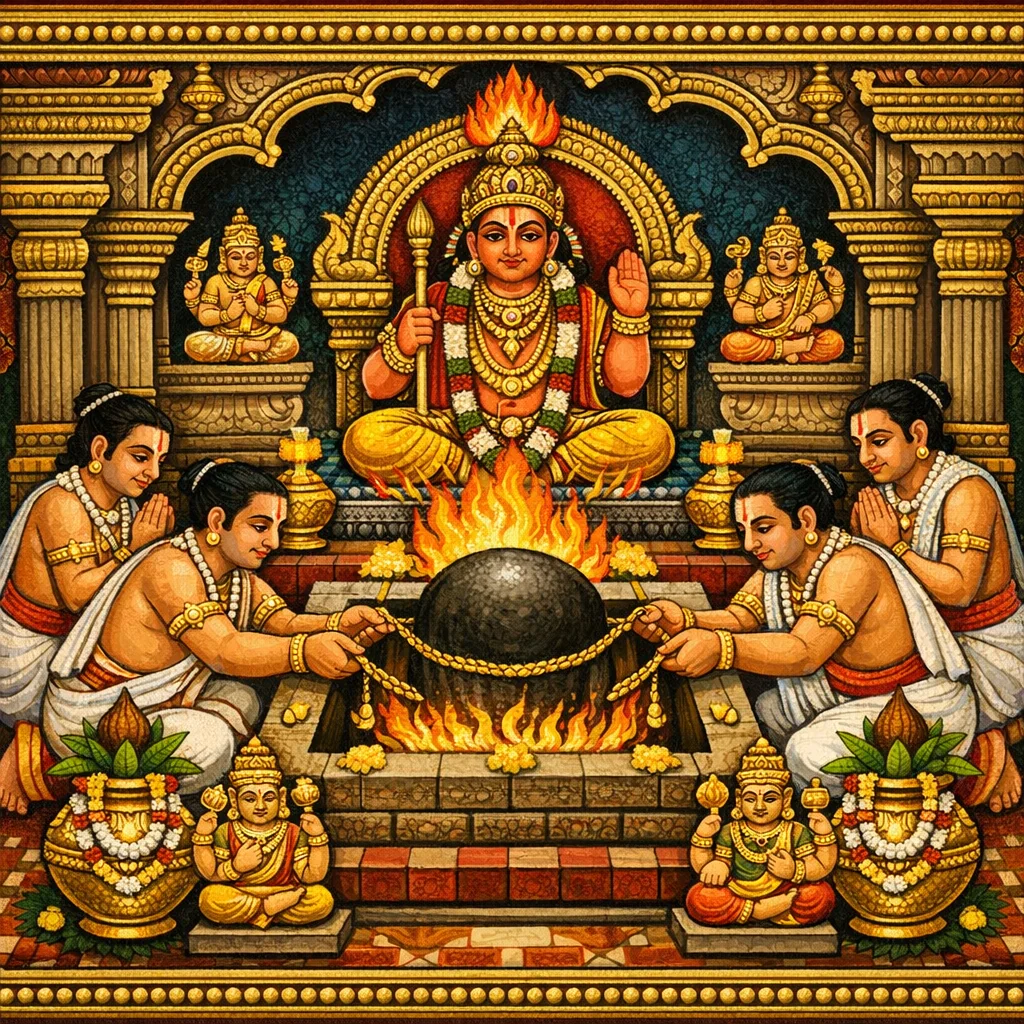
Lord Īśvara teaches the śilā-vinyāsa rite (laying the foundation stones) in ordered stages, continuing the earlier Vāstu-pūjā. It opens with external worship of Īśa and related deities (including the Carakya group), offering three oblations to each in sequence. At an auspicious lagna, bhūta-bali is given to harmonize elemental and liminal forces; then Śakti is placed on the central cord-line (madhya-sūtra) together with a kumbha and Ananta. A stone is steadied in the pot by a mantra-root linked to the syllable “na,” and eight kumbhas (beginning with Subhadrā/Sabhadrā) are arranged by direction from the East. Nyāsa is performed with Lokapāla portions/selves; Śaktis are installed in pits; Ananta is assigned near or at the end depending on recension; and Nandā with allied powers is established upon the stones. Śambara measuring-cords locate presiding deities at wall-centers, while Dharma and related principles are apportioned corner-to-corner. Visualization culminates with Brahmā above and Maheśvara as all-pervading, with ādhāna in the vyoma-prasāda. Obstacles are removed by bali and the Astra-mantra; the pūrṇa-śilā is set at the center, and the rite concludes with sky-meditation, tattva-traya nyāsa, an expiatory offering, and formal dismissal of the sacrifice.
Shlokas
Verse 2
इत्य् आदिमहपुराणे आग्नेये वास्तुपूजाकथनं नाम त्रिनवतितमो ऽध्यायः अथ चतुर्णवतितमो ऽध्यायः शिलाविन्यासविधानं ईश्वर उवाच ईशादिषु चरक्याद्याः पूर्ववत् पूजयेद्वहिः आहुतित्रितयं दद्यात् प्रतिदेवमनुक्रमात्
Thus, in the Agni Purāṇa of the Ādi-Mahāpurāṇa, the ninety-third chapter entitled “The Account of Vāstu-Pūjā” concludes. Now begins the ninety-fourth chapter, “The Procedure for Laying the Foundation Stones.” Īśvara said: “For Īśa and the other deities—beginning with (the deity/group called) Carakya—one should worship outside as before, and offer three oblations (āhuti) to each deity, in proper sequence.”
Verse 3
दत्वा भूतबलिं लग्ने शिलान्यासमनुक्रमात् मध्यसूत्रे न्यसेच्छक्तिं कुम्भञ्चानन्तमुत्तमं
Having offered the bhūta-bali at the auspicious moment, one should then perform the foundation-laying (śilānyāsa) in proper sequence. Upon the central cord-line (madhya-sūtra) one should place the Śakti, and also the excellent, auspicious ritual pot (kumbha) and Ananta.
Verse 4
नकारारूढमूलेन कुम्भे ऽस्मिन् धारयेच्छिलां कुम्भानष्टौ सभद्रादीन् दिक्षु पूर्वादिषु क्रमात्
With the root-mantra mounted on the syllable “na”, one should place (or steady) a stone in this kumbha. Then one should arrange eight ritual pots—beginning with the one named Sabhadrā—in the directions starting from the East, in due order.
Verse 5
लोकपालाणुभिर्न्यस्य श्वभ्रेषु न्यस्तशक्तिषु ब्रह्माद्या इति ग मध्ये श्वभ्र इति घ कुम्भञ्चानन्तमन्तिकमिति घ , छ च कुम्भञ्चानन्तमन्तिममिति ङ लोकपालात्मभिर्न्यस्येदिति ख , छ च लोकपालाणुभिर्न्यस्येदिति ङ सूत्रेष्विति क कुम्भेष्विति ग शिलास्तेष्वथ नन्दाद्याः क्रमेण विनियोजयेत्
Having performed nyāsa with the subtle portions (aṇu-bhāga) of the Lokapālas (directional guardians), one should place the Śaktis in the prepared pits (śvabhra). (Some recensions prescribe placing “Brahmā and the others”; another says “the pit is in the middle”.) One should also assign Ananta near the kumbha (ritual pot) (variant: “at the end/last”). (Further variants prescribe nyāsa “with the very selves (ātman) of the Lokapālas” or again “with their subtle portions”.) (Some readings specify “on the cord (sūtra)”; others “in the pots (kumbha)”.) Then, upon those stones, one should arrange Nandā and the others in due order.
Verse 6
शम्बरैर् मूर्तिनाथानां यथा स्युर्भित्तिमध्यतः तासु धर्मादिकानष्टौ कोणात् कोणं विभागशः
Using measuring-cords (śambara), one should lay out the presiding deities of the images so that they fall at the middle of the wall-spaces; within those divisions, the eight principles beginning with Dharma are to be assigned, in ordered portions, from corner to corner.
Verse 7
सुभद्रादिषु नन्दाद्याश् चतस्रो ऽग्न्यादिकोणगाः अजिताद्याश् च पूर्वादिजयादिष्वथ विन्यसेत्
Among the deities beginning with Subhadrā, one should place the four goddesses beginning with Nandā in the corner-directions starting from the Agni-corner (south-east). Likewise, the deities beginning with Ajitā should then be installed in the eastern and other directions, in the positions beginning with Jayā, in due order.
Verse 8
ब्रह्माणं चोपरि मस्य व्यापकं च महेश्वरं चिन्तयेदेषु चाधानं व्योमप्रसादमध्यगं
One should visualize Brahmā above oneself, and Maheśvara as the all-pervading Lord; and in these stations one should perform the ādhāna (ritual placement), establishing it in the midst of the celestial palace (vyoma-prāsāda).
Verse 9
बलिन्दत्त्वा जपेदस्त्रं विघ्नदोषनिवारणं शिलापञ्चकपक्षे ऽपि मनागुद्दिश्यते यथा
Having offered a bali (ritual oblation), one should recite the Astra-mantra that removes obstacles and faults; even during the period called the “five-stone fortnight,” it may be prescribed in the proper manner, with due (though minimal) specification.
Verse 10
मध्ये पूर्णशिलान्यासः सुभद्रकलशे ऽर्धतः पद्मादिषु च नन्दाद्याः कोणेष्वग्न्यादिषु क्रमात्
In the center one should perform the placement of the pūrṇa-śilā (the ‘complete’ ritual stone/deposit). Half of it is to be placed in the auspicious consecration pot, the subhadrā-kalaśa. Upon the lotus-diagrams and the like, the śakti-deities beginning with Nandā are to be installed in due order in the corners, starting from the Agni (Fire) corner.
Verse 11
मध्यभावे चतस्रो ऽपि मातृवद्भावसम्मताः ॐ पूर्णे त्वं महाविश्वे सर्वसन्दोहलक्षणे
In the central contemplative placement, the four (powers) too are to be regarded as mother-like in disposition. “Oṃ—O Pūrṇā (the Complete One), You are the Great Universe, characterized as the total compendium (aggregate) of all existences.”
Verse 12
सर्वसम्पूर्णमेवात्र कुरुष्वाङ्गिरसः सुते ॐ नन्दे त्वं नन्दिनी पुंसां त्वामत्र स्थापयाम्यहं
“O son of Aṅgiras, make everything here wholly complete. Oṃ. O Nandā, you are the giver of joy to men; I hereby establish you here.”
Verse 13
प्रासादे तिष्ठ सन्तृप्ता यावच्चन्द्रार्कतारकं आयुः कामं श्रियन्नन्दे देहि वासिष्ठ देहिनां
Remain in the palace, fully content, as long as the moon, the sun, and the stars endure. O Nandā, grant to embodied beings long life, the fulfillment of desires, and prosperity; O Vāsiṣṭhā, bestow these boons upon the living.
Verse 14
उ चेति ग ब्रह्माणं चोपविन्यस्येति ख , घ , ङ , छ , च विघ्नदोषनिवारकमिति ग पूर्वशिलान्यास इति घ मध्याभावे इति ख , ग च महाभागे इति ग देहि मामिति ख , छ च देहि न इति घ अस्मिन् रक्षा सदा कार्या प्रासादे यत्नतस्त्वया ॐ भद्रे त्वं सर्वदा भद्रं लोकानां कुरु काश्यपि
In this temple, protection must always be performed by you with careful effort. O Bhadrā, ever-auspicious one, make the worlds auspicious, O Kāśyapī. (The preceding clusters are manuscript-variant notes tied to the rite, including nyāsa placements and the removal of obstacles and defects.)
Verse 15
आयुर्दा कामदा देवि श्रीप्रदा च सदा भव ॐ जये ऽत्र सर्वदा देवि श्रीदाअयुर्दा च सदा भव
O Goddess, be ever the giver of long life, the fulfiller of desires, and the bestower of prosperity. Oṃ—victory here! O Goddess, abide here always as the giver of prosperity and the giver of long life.
Verse 16
ॐ जये ऽत्र सर्वदा देवि तिष्ठ त्वं स्थापिता मय नित्यञ्जयाय भूत्यै च स्वामिनी भव भार्गवि
Om. O Goddess Jaya, abide here always; you have been installed by me. For unceasing victory and for prosperity, become our sovereign Lady, O Bhārgavī.
Verse 17
ॐ रिक्ते ऽतिरिक्तदोषघ्ने सिद्धिमुक्तिप्रदे शुभं सर्वदा सर्वदेशस्थे तिष्ठास्मिन् विश्वरूपिणि
Oṃ. O Rikta—destroyer of the fault of deficiency and excess, bestower of success (siddhi) and liberation (mokṣa), auspicious one—ever present in all places, abide here, O you of the universal form.
Verse 18
गगनायतनन्ध्यात्वा तत्र तत्त्वत्रयं न्यसेत् प्रायश्चित्तन्ततो हुत्वा विधिना विसृजेन्मखं
Having meditated on the sky as the subtle abode (āyatana), one should place there the nyāsa of the triad of principles (tattva-traya). Thereafter, having offered the expiatory oblation (prāyaścitta-homa) according to rule, one should duly conclude and dismiss the sacrifice (makha).
Frequently Asked Questions
Directional and geometric precision: the madhya-sūtra (central cord-line), eight directionally placed kumbhas, Lokapāla-nyāsa in pits, and measured placement of presiding deities at wall-centers using śambara-cords.
It sacralizes construction as sādhana: bhūta-bali, nyāsa, visualization of Brahmā and all-pervading Maheśvara, and obstacle-removing mantras convert architectural acts into dharmic alignment, supporting both worldly stability (bhukti) and inner purification oriented to mukti.
Śakti at the madhya-sūtra, Ananta associated with the kumbha, Lokapālas via nyāsa, and Śakti-deities such as Nandā, Bhadrā, Jayā, and Rikta through installation formulas; Dharma and allied principles are distributed within the measured divisions.
It is recited after offering bali to remove vighna (obstacles) and doṣa (ritual/structural faults), ensuring the foundation rite is protected and ritually faultless.