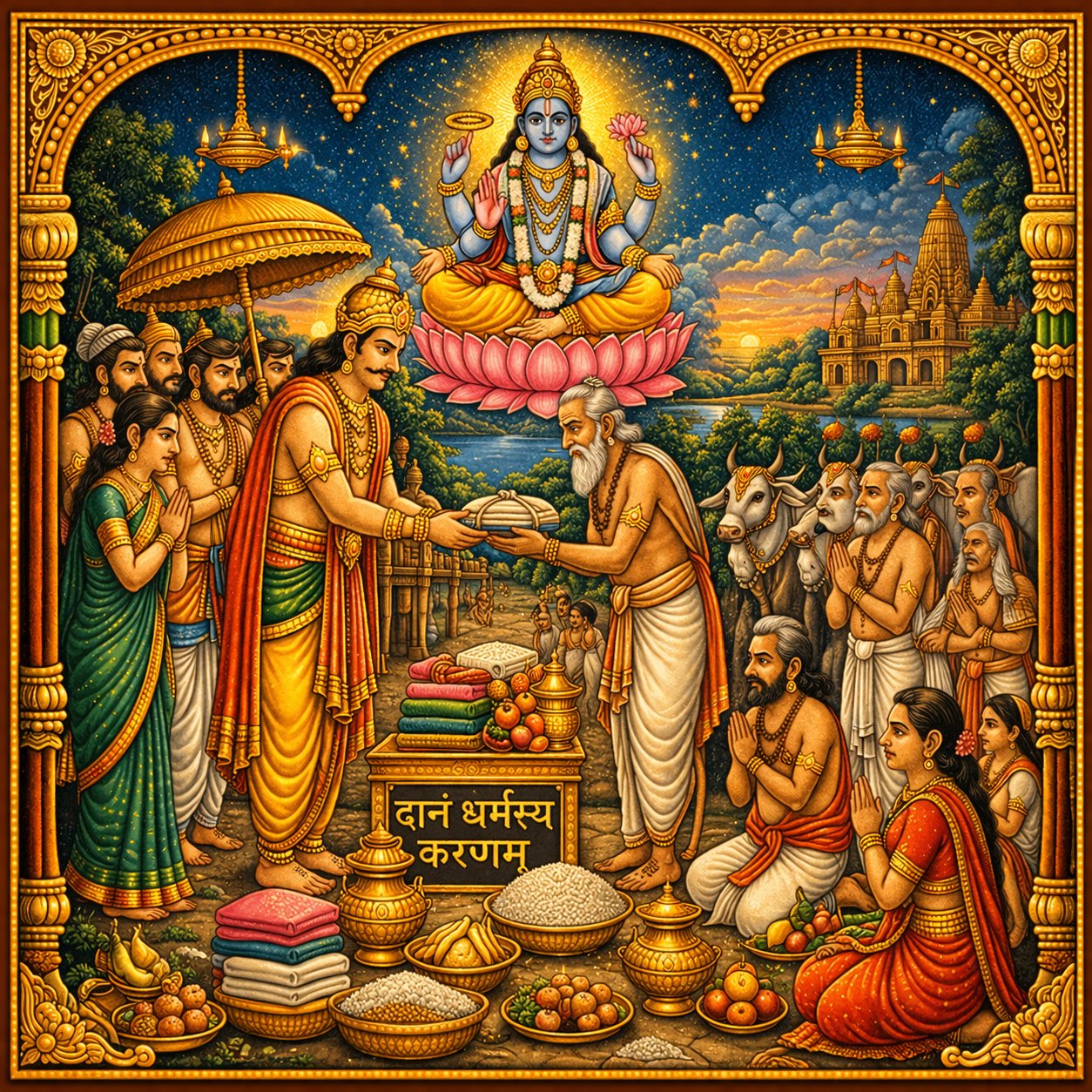
Dana-mahatmya
The Glory of Charity
The greatness and merit of various forms of charity (dana) including go-dana, anna-dana, vidya-dana, and their fruits in this life and beyond.
Adhyayas in Dana-mahatmya
Adhyaya 209
Asamuccaya (असमुच्चयः) — Non-conjunction / Non-accumulation (Recensional title-variants noted)
This chapter heading serves as a transitional rubric, marking a doctrinal turn toward dāna-śāstra style instruction. It notes recensional variants in the subtitle (readings that stress “good fortune,” paired either with “a good pair of benefits” or with “right understanding”). In the Agni Purana’s encyclopedic method, such headings often signal a shift from thematic praise to procedural definition. Here it prepares the reader for the next chapter’s formal taxonomy of charity—iṣṭa and pūrta—by placing the discussion in a disciplined interpretive frame: dāna is not an indiscriminate accumulation of acts, but rule-governed dharma whose fruit depends on the proper conjunction of place, time, recipient, and intention. Thus the chapter functions as an “index node” in the Dana-mahatmya layer, aligning devotional motive (śraddhā) with shastric precision.
Adhyaya 210
Mahā-dānāni (The Great Gifts) — Ṣoḍaśa Mahādāna, Meru-dāna, and Dhenū-dāna Procedure
Agni moves from defining dāna to a systematic account of Mahādāna, stressing the canonical sixteen “great gifts” beginning with Tulāpuruṣa and Hiraṇyagarbha. He lists emblematic donations—cosmic models (Brahmāṇḍa), wish-fulfilling symbols (Kalpavṛkṣa/Kalpalatā), vast transfers like go-sahasra, and crafted golden forms such as Kāmadhenu, horse, and chariots—culminating in ritual offerings like Viśvacakra and the seven-oceans model. The chapter then prescribes Meru-dāna as “mountain gifts” (grain, salt, jaggery, gold, sesame, cotton, ghee, silver, sugar), graded by exact measures (droṇa, bhāra, pala, tulā) and performed in a maṇḍapa and maṇḍala after deity-worship, with final donation to a qualified brāhmaṇa. Next come ten dhenū-gifts (guḍa-, ghṛta-, tila-, jala-, kṣīra-, madhu-dhenū, etc.), with construction rules (pots vs heaps), orientation (cow east-facing, feet northward), and detailed iconography of the guḍa-dhenū. Lakṣmī-centered mantras seal the rite, identifying the cow-form goddess with Svāhā/Svadhā and cosmic powers, after which the gift is formally presented. The chapter closes with promised merits: heavenly reward, uplift of lineage through the Kapilā cow, and the Vaitaraṇī cow-gift near death as an aid for passage at Yama’s gate, linking ritual precision to soteriological assurance.
Adhyaya 211
Mahādānas — The Great Gifts (महादानानि)
This chapter serves as a closing colophon and transition into the Dana-mahātmya sequence: it concludes the unit on the “great gifts” (mahādāna) and readies the reader for a more detailed catalogue of charitable acts (nānā-dānas). The text preserves variant readings and alternate sub-titles (e.g., one linked with “Kṛṣṇā Vaitaraṇī”), pointing to scribal lineages and the circulation of dana material with ritual sub-classifications. In the Agneya method, mahādāna is not mere moral exhortation but a technical dharma-technology—named gift-forms, assumed eligibility, and promised fruits. Its placement reinforces the Purāṇa’s encyclopedic pedagogy: moving from high-level categories (mahādānas) to operational detail (nānā-dānas) while keeping the overarching aim—purification, benefit to ancestors through śrāddha, and the alignment of social generosity with soteriological progress.
Adhyaya 212
Meru-dānāni (Meru-Donations) — Kāmya-dāna, Month-wise Offerings, and the Twelvefold Meru Rite
Lord Agni moves from the prior chapter’s list of gifts to a structured teaching on kāmya-dāna—votive giving for specific aims—rooted in steady month-by-month worship and culminating in a grand year-end rite. He details monthly offerings (some made as dough effigies) with their stated fruits, then presents the central Meru-vrata: a twelvefold Meru-dāna in Kārttika promising both bhukti and mukti. The chapter reads as a manual of ritual architecture: Meru is built in graded measures from precious substances, installed within a lotus-diagram with Brahmā–Viṣṇu–Īśa on the central axis, and encircled by named mountains in directional order. Agni prescribes donation protocols (mantras, gotra-addressed gifting, avoidance of financial deceit), auspicious times (saṅkrānti, ayana, eclipses), and many Meru-variants (gold, silver, horses, cows, cloth, ghee, grain, sesame, khaṇḍa-meru). The rite is sealed with hymns identifying Meru as Viṣṇu’s form and a devotional nivedana aimed at purity, uplift of lineage, heavenly worlds, and final approach to Hari.
Adhyaya 213
Chapter 213 — पृथ्वीदानानि (Gifts of the Earth)
Lord Agni begins a structured teaching on pṛthvī-dāna (the gift of Earth/land), presenting dāna as both an imitation of cosmic order and a ritual technology. He first defines the Earth by graded measures mapped up to Jambūdvīpa, and prescribes constructing an ideal “earth-model” with specified weights (e.g., bhāras of gold), using kūrma (tortoise) and padma (lotus) designs to signify cosmic support and auspicious unfolding. He then states the merit: the donor reaches Brahmaloka and rejoices with the Pitṛs, while Viṣṇu-centered gifting yields Kāmadhenu as a paradigmatic reward. The text extols go-dāna as the comprehensive gift (sarva-dāna) and adds high-merit donations—offering a kapilā cow before Viṣṇu for lineage deliverance, gifting an adorned woman for Aśvamedha-equivalent merit, and donating fertile land, villages, cities, or market-towns for prosperity and happiness. The chapter closes with the Kārttika bull-release (vṛṣotsarga) as a lineage-liberating rite, completing the arc from cosmic symbolism to social-economic dharma.
Adhyaya 214
मन्त्रमाहात्म्यकथनम् (Account of the Greatness of Mantras)
After concluding the topic of land-gifts, Lord Agni turns to a technical yogic teaching that draws the merit of dāna inward, into discipline of mantra and prāṇa. He describes the nāḍī-cakra arising from the kanda below the navel, counting 72,000 channels and ten chief nāḍīs (including iḍā, piṅgalā, and suṣumṇā). He then defines the ten vital winds—five primary (prāṇa, apāna, samāna, udāna, vyāna) and five subsidiary (nāga, kūrma, kṛkara, devadatta, dhanañjaya)—linking them to bodily functions and to the day–night polarity of prāṇa and apāna. Calendrical and symbolic correspondences (saṅkrānti, viṣuva, ayana, adhīmāsa, ṛṇa, ūnarātra, dhana) are integrated with physiological signs, suggesting that cosmic time may be read through breath and symptom. Practical prāṇāyāma is taught through pūraka (filling), kumbhaka (retention), and an upward-directed release, culminating in ajapā-japa (Gāyatrī as the spontaneous mantra) and haṃsa practice. The chapter expands into subtle-body theology—Kuṇḍalinī in the heart-region, contemplation of amṛta, and deity-loci within the body (Brahmā in the heart, Viṣṇu in the throat, Rudra in the palate, Maheśvara in the forehead). Finally, mantra is presented as an architectonic “prāsāda” (mantric palace) with phonetic measures (short/long/pluta), ritual applications (phaṭ for māraṇa; heart-mantra for ākṛṣṭi), japa-homa counts, the doctrine of tri-śūnya, and the qualifications of an ācārya/guru grounded in mastery of Oṁ, Gāyatrī, and Rudra-knowledge.
Adhyaya 215
सन्ध्याविधिः (Sandhyā-vidhi) — The Rite of Twilight Worship
Lord Agni explains sandhyā (twilight worship) in both procedure and metaphysics, establishing the praṇava Oṁ as the essence and completion-sign of all mantra rites. He exalts the triad—Oṁ, the mahāvyāhṛtis (bhūḥ, bhuvaḥ, svaḥ), and the Sāvitrī/Gāyatrī—as Brahman’s chief “mouth,” enjoining sustained study and disciplined japa as a direct means to purification and Brahman-attainment. Graded japa counts (7/10/20/108/1,000/100,000/10,000,000) are mapped to spiritual fruits and expiations, and japa is paired with homa (especially tila-homa) and fasting to remedy sins. The chapter adds technical ritual layers: ṛṣi–chandas–devatā declarations, viniyoga lists for deva-upanaya/japa/homa, nyāsa placements on body-points, dhyāna color-forms of Gāyatrī, and offering substances aligned to aims (śānti, āyus, śrī, vidyā, etc.). It closes by integrating prāṇāyāma, mārjana, aghamarṣaṇa, and Vedic verses (āpo hi ṣṭhā, drupadādīni, pavāmānī) into a coherent sandhyā purification workflow—an Agneya synthesis of mantra, breath, and rite.
Adhyaya 216
Gāyatrī-nirvāṇa (The Liberative/Concluding Doctrine of Gāyatrī)
After completing the Sandhyā-vidhi, Agni teaches that one should conclude the rite with Gāyatrī-japa and smaraṇa, stressing mantra as protection (rakṣā) and inner discipline. A philological-theological exegesis follows: Gāyatrī is called Sāvitrī because she illumines, and Sarasvatī because she is Savitṛ’s speech-form (vāc). Bharga is explained from roots of shining and purifying “burning/cooking,” linking radiance with transformative refinement. Vareṇyam is set forth as the supreme, choosable state sought by aspirants of heaven and liberation, while dhīmahi is glossed as sustained mental retention and contemplation. Sectarian readings are reconciled by presenting the mantra’s light as one reality variously recited as Viṣṇu, Śiva, Śakti, Sūrya, or Agni, yet affirming a unitive Brahman at the Veda’s beginning. A ritual cosmology then shows that oblation to Agni supports the Sun and yields rain, food, and beings, so mantra-ritual sustains the world. The climax is advaitic: the supreme light in the solar orb is the turīya reality and the Viṣṇu-parama-pada; through meditation one destroys birth and death and threefold suffering, culminating in the identity statement, “I am Brahman… that Solar Person am I, the Infinite (Oṃ).”
Adhyaya 217
Gāyatrī-nirvāṇa (गायत्रीनिर्वाणम्) — Śiva-Liṅga Stuti as a Path to Yoga and Nirvāṇa
Agni teaches that praising Śiva in His Liṅga-form leads to the attainment of yoga through the Gāyatrī, and that Vasiṣṭha and other sages received from Śaṅkara the supreme Brahman called Nirvāṇa. The chapter unfolds as a compact liṅga-stotra, saluting Śiva as golden, Vedic, supreme, sky-like, thousand-formed, fiery, primordial, and proclaimed by śruti. The hymn progressively identifies the liṅga with cosmological and Sāṃkhya categories—pātāla and brahma, the unmanifest (avyakta), intellect (buddhi), ego (ahaṅkāra), elements (bhūtas), senses (indriyas), subtle essences (tanmātras), puruṣa, bhāva, and the tri-guṇas—culminating in yajña and tattva as His emblem. A prayer follows for highest yoga, worthy progeny, imperishable Brahman, and supreme peace. Agni closes with an origin account: on Śrīparvata, Śiva, pleased by Vasiṣṭha’s praise, granted unbroken lineage and unwavering dharmic resolve, then disappeared—establishing the stotra as both metaphysical teaching and boon-bestowing practice.