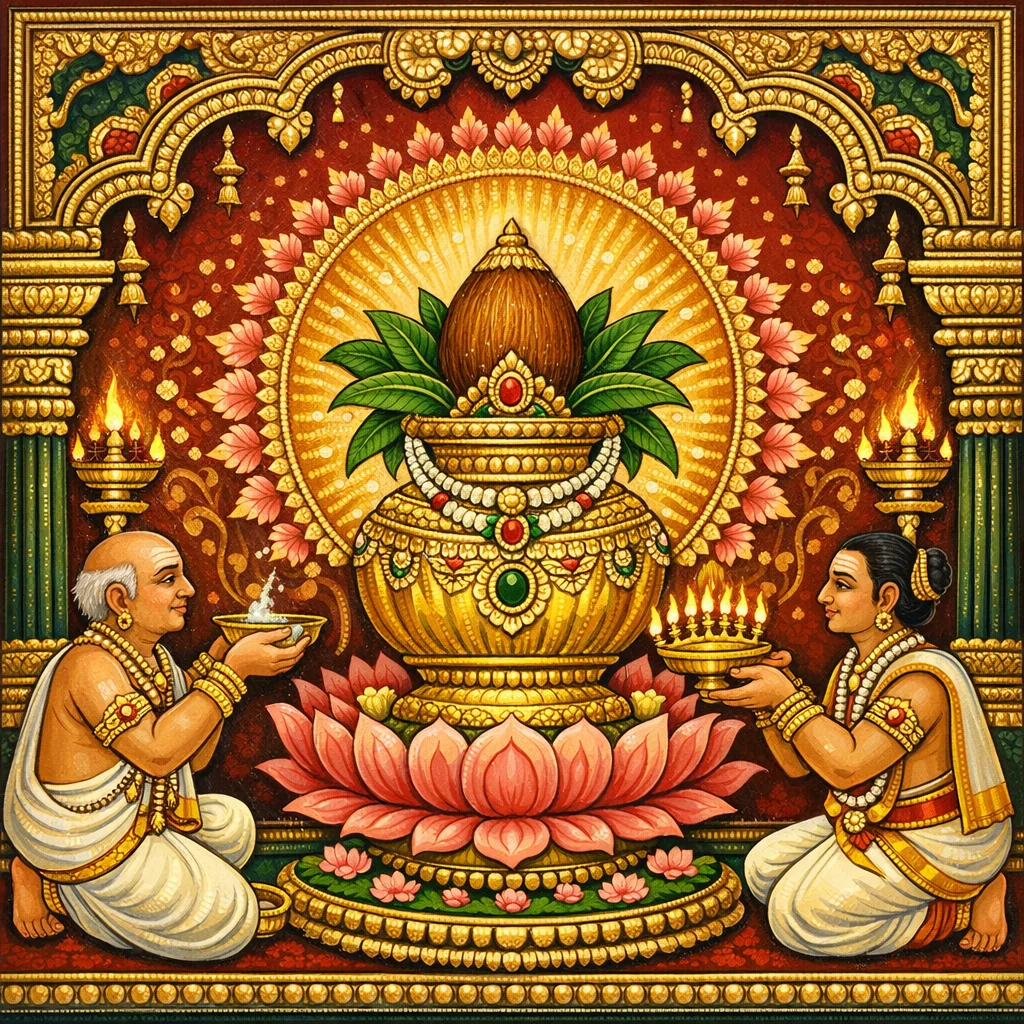
Adhyaya 57
Chapter 57 — कुम्भाधिवासविधिः (Kumbhādhivāsa-vidhi: Rite of Installing/Consecrating the Ritual Jar)
Lord Agni sets forth a stepwise Āgamic procedure for preparing the ritual ground and installing the kalaśa(s) used for abhiṣeka in Vāstu-Pratiṣṭhā. It begins with bhūmi-parigraha (ritual taking of the site), protective scattering of rice and mustard, and rākṣoghna purification through the Nārasiṃha-mantra and pañcagavya sprinklings. Worship then moves from the ground to the pot, to Hari with aṅga-rites, and to auxiliary vessels by the Astra-mantra, stressing unbroken consecratory flow (acchinna-dhārā) and circumambulation. A śayyā (bed) is installed within the maṇḍala with the “yoge yoge” mantra; Viṣṇu forms are assigned by direction in the snāna-maṇḍapa, with Īśāna given special placement. Multiple kumbhas are set for bathing and anointing, and a detailed inventory of leaves, woods, clays, herbs, grains, metals, gems, waters, and lamps is arranged by prescribed directions for arghya, pādya, ācamana, nīrājana, and related offerings. The chapter exemplifies Agneya Vidyā as ritual engineering, stabilizing sacred presence through calibrated substances, spatial order, mantra, and sequence.
Shlokas
Verse 1
इत्य् आदिमहापुराणे आग्नेये दिक्पतियागो नाम षट्पञ्चाशत्तमोध्यायः अथ सप्तपञ्चाशोध्यायः कुम्भाधिवासविधिः भगवानुवाच भूमेः परिग्रहं कुर्यात् क्षिपेद्ब्रीहींश् च सर्षपान् नारसिंहेन रक्षोघ्नान् प्रोक्षोघ्नान् प्रोक्षयेत् पञ्चगव्यतः
Thus, in the Agni Purāṇa, the fifty-sixth chapter entitled “Worship of the Lords of the Directions (Dikpati-yāga)” is concluded. Now begins the fifty-seventh chapter, “The Rite of Installing/Consecrating the Ritual Jar (Kumbhādhivāsa-vidhi).” The Blessed Lord said: “One should ritually take possession of (consecrate) the ground; then scatter rice-grains and mustard-seeds. With the Nārasiṃha (mantra/rite) one should perform protective sprinklings that destroy hostile forces; and one should sprinkle (the site and articles) with pañcagavya for purification.”
Verse 2
भूमिं घटे तु सम्पूज्य सरत्ने साङ्गकं हरिं अस्त्रमन्त्रेण करकं तत्र चाष्टशतं यजेत्
After duly worshipping the ground and then the ritual pot (kalaśa), one should worship Hari together with the prescribed aṅga-rites in the gem-adorned vessel/setting. Then, by means of the Astra-mantra, one should worship the karaka (water-/offerings-vessel) there, performing eight hundred offerings.
Verse 3
अच्छिन्नधारया सिञ्चन् ब्रीहीन् संस्कृत्य धारयेत् अस्त्रमन्त्रेण कवचमिति ङ, चिह्नितपुस्तकपाठः प्रदक्षिणं परिभ्राम्य कलशं विकिरोपरि
Sprinkling with an unbroken stream (of consecrated water), one should purify the rice-grains (brīhi) and hold them in the hand. Then the protective rite (kavaca) is to be performed with the Astra-mantra—so reads the marked manuscript. Having circumambulated to the right (pradakṣiṇa), one should scatter those grains upon/over the kalaśa (water-pot).
Verse 4
सवस्त्रे कलशे भूयः पूजयेदच्युतं श्रियं योगे योगेति मन्त्रेण न्यसेच्छय्यान्तु मण्डले
Again, in a cloth-covered consecration pot (kalaśa), one should worship Acyuta (Viṣṇu) together with Śrī (Lakṣmī). With the mantra “yoge yoge”, one should then place (install) the bed within the maṇḍala.
Verse 5
कुशोपरि तूलिकाञ्च शय्यायां दिग्विदिक्षु च विद्याधिपान् यजेद्विष्णुं मधुघातं त्रिविक्रमं
Placing a cushion upon kuśa-grass on the bed, and having arranged worship in the directions and intermediate directions, one should worship the Lords of the sciences; and worship Viṣṇu as Madhughāta (slayer of Madhu) and Trivikrama (of the three strides).
Verse 6
वामनं दिक्षु वाय्वादौ श्रीधरञ्च हृषीकपं पद्मनाभं दामोदरमैशान्यां स्नानमण्डपे
In the bathing pavilion (snāna-maṇḍapa), one should assign (the names of) Vāmana in the directions beginning with Vāyu (the northwest), and also Śrīdhara and Hṛṣīkeśa; and Padmanābha and Dāmodara in the Īśāna (northeast) direction.
Verse 7
अभ्यर्च्य पश्चादैशान्यां चतुष्कुम्भे सवेदिके स्नानमण्डषके सर्वद्रव्याण्यानीय निक्षिपेत्
After performing worship, then in the Īśāna (northeast) quarter, in a bath-pavilion furnished with a small altar and four water-pots, one should bring all the required ritual materials and place them there.
Verse 8
स्नानकुम्भेषु कुम्भांस्तांश् चतुर्दिक्ष्वधिवासयेत् कलशाः स्थापनीयास्तु अभिषेकार्थमादरात्
He should ritually install those water-pots in the bathing-vessels, placing them in the four directions; and, with due care, the consecration pitchers (kalaśas) are to be set up for the purpose of the abhiṣeka (ritual anointing).
Verse 9
वटोदुम्बरकाश्वत्थांश् चम्पकाशोकश्रीद्रुमान् पलाशार्जुनप्लक्षांस्तु कदम्बवकुलाम्रकान्
Banyan, cluster fig, and sacred fig; champaka, aśoka, and śrī-trees; also palāśa, arjuna, and plakṣa; as well as kadamba, vakula, and mango trees.
Verse 10
पल्लवांस्तु समानीय पूर्वकुम्भे विनिक्षिपेत् पद्मकं रोचनां दूर्वां दर्भपिञ्जलमेव च
Having brought fresh leafy sprigs, one should place them into the previously prepared ritual water-pot (kumbha); likewise one should also put in padmaka, rocanā (yellow pigment), dūrvā grass, and tawny-colored darbha grass.
Verse 11
जातीपुष्पं कुन्दपुष्पचन्दनं रक्तचन्दनं सिद्धार्थं तगरञ्चैव तण्डुलं दक्षिणे न्यसेत्
On the right (southern/right-hand side), one should place jasmine (jāti) flowers, kunda flowers, sandalwood, red sandalwood, siddhārtha (white mustard seed), tagara (a fragrant root), and rice grains.
Verse 12
सवर्णं रजतञ्चैव कूलद्वयमृदन्तथा नद्याः समुद्रगामिन्या विशेषात् जाह्नवीमृदं
Gold and silver, as well as earth taken from both banks of a river that flows to the sea—especially the earth of the Jāhnavī (Gaṅgā)—are prescribed as particularly efficacious substances.
Verse 13
गोमयञ्च यवान् शालींस्तिलांश् चैवापरे न्यसेत् विष्णुपर्णीं श्यामलतां भृङ्गराजं शतावरीं
One should also place cow-dung, barley (yava), śāli rice, and sesame seeds; and likewise set down viṣṇuparṇī, śyāmalatā, bhṛṅgarāja, and śatāvarī.
Verse 14
दिक्षु वह्न्यादाविति ङ, चिह्नितपुस्तकपाठः चतुस्तम्भे इति ग, चिह्नितपुस्तकपाठः पद्मकाशोकश्रीद्रुमानिति ग, चिह्नितपुस्तकपाठः पर्णकुम्भ इति ङ, चिह्नितपुस्तकपाठः सहदेवां महादेवीं बलां व्यघ्रीं सलक्ष्मणां ऐशान्यामपरे कुम्भे मङ्गल्यान्विनिवेशयेत्
In the other pitcher placed in the north-east (Īśāna) quarter, one should install the auspicious goddesses—Sahadevī, Mahādevī, Balā, Vyāghrī, and Salakṣmaṇā. (The preceding phrases record marked manuscript variant readings.)
Verse 15
वल्मीकमृत्तिकां सप्तस्थानोत्थामपरे न्यसेत् जाह्नवीवालुकातोयं विन्यसेदपरे घटे
Alternatively, one should place earth taken from an anthill, gathered from seven distinct locations. Or, in another pot, one should place the water together with sand from the Jāhnavī (Gaṅgā).
Verse 16
वराहवृषनागेन्द्रविषाणोद्धृतमृत्तिकां मृत्तिकां पद्ममूलस्य कुशस्य त्वपरे न्यसेत्
One should place, for ritual use, the clay lifted up by the tusk or horn of a boar, a bull, or the lord of elephants; and separately one should place the clay from the root of a lotus and the clay associated with kuśa-grass.
Verse 17
तीर्थपर्वतमृद्भिश् च युक्तमप्यपरे न्यसेत् नागकेशरपुष्पञ्च काश्मीरमपरे न्यसेत्
Some prescribe applying the paste or sacred mark even when compounded with clays from holy fords and from mountains; others prescribe adding nāgakeśara flowers, and others again prescribe adding saffron (kāśmīra).
Verse 18
चन्दनागुरुकर्पूरैः पुष्पं चैवापरे न्यसेत् वैदूर्यं विद्रुमं मुक्तां स्फटिकं वज्रमेव च
Others should place flowers as offerings together with sandalwood, aguru, and camphor; and should also offer cat’s-eye gem (vaidūrya), coral, pearl, crystal (sphaṭika), and diamond.
Verse 19
एतान्येकत्र निक्षिप्य स्थापयेद्देवसत्तम नदीनदतडागानां सलिलैर् अपरं न्यसेत्
Having deposited these items together, O best of gods, one should duly establish them; thereafter one should place another set, consisting of waters drawn from rivers, streams, and ponds.
Verse 20
एकाशीतिपदे चान्यान्मण्डपे कलशान् न्यसेत् गन्धोदकाद्यैः सम्पूर्णान् श्रीसूक्तेनाभिमन्त्रयेत्
At the eighty-first position as well, one should set additional kalaśa pots in the maṇḍapa, completely filled with scented water and the like, and consecrate them by reciting the Śrī-sūkta.
Verse 21
यवं सिद्धार्थकं गन्धं कुशाग्रं चाक्षतं तथा तिलान् फलं तथा पुष्पमर्घ्यार्थं पूर्वतो न्यसेत्
For the arghya-offering, one should place in front, toward the east, barley (yava), white mustard (siddhārthaka), fragrant substances, the tips of kuśa grass, unbroken rice (akṣata), sesame, fruit, and flowers.
Verse 22
पद्मं श्यामलतां दूर्वां विष्णुपर्णीं कुशांस्तथा पाद्यार्थं दक्षिणे भागे मधुपर्कं तु दक्षिणे
Place a lotus, śyāmalatā (a dark-green sacred creeper), dūrvā grass, viṣṇuparṇī (a Viṣṇu-favoured leaf or herb), and kuśa grass as the materials for the pādya (foot-washing offering) on the right-hand side; and place the madhuparka offering on the right as well.
Verse 23
कक्कोलकं लवङ्गञ्च तथा जातीफलं शुभं उत्तरे ह्य् आचमनाय अग्नौ दूर्वाक्षतान्वितं
Offer kakkolaka, clove, and the auspicious jātīphala (nutmeg); and in the northern direction, for ācamana (ritual sipping for purification), it should be performed by the fire, accompanied by dūrvā grass and unbroken rice (akṣata).
Verse 24
पात्रं नीराजनार्थं च तथोद्वर्तनमानिले गन्धपुष्पान्वितं पात्रमैशान्यां पात्रके न्यसेत्
One should place the vessel meant for nīrājana (waving of lights) and likewise the vessel for udvartana (powder-unction), together with the wind-fan, and a vessel furnished with fragrances and flowers, in the Īśāna (north-east) position among the ritual vessels.
Verse 25
सहदेवां सिंहपुच्छीमिति ख, चिह्नितपुस्तकपाठः सहदेवां जवां सिंहीमिति ङ, चिह्नितपुस्तकपाठः मधुपर्कन्तु पश्चिमे इति ङ, चिह्नितपुस्तकपाठः मुरामांसी चामलकं सहदेवां निशादिकं षष्टिदीपान्न्यसेदष्टौ न्यसेन्नीराजनाय च
([Textual variants note:] Some manuscripts read “sahadevī and siṃhapucchī,” others “sahadevī, javā, and siṃhī”; and another variant adds, “madhuparka should be placed in the west.”) For the rite of nīrājana (ceremonial offering and waving of lights), one should set out murā (a fragrant resin, guggulu-like), māṃsī (jatāmāṃsī), āmalaka (āmalakī), sahadevī, niśā, and the rest; one should arrange sixty lamps, and additionally place eight (special) lamps for the nīrājana.
Verse 26
शङ्खं चक्रञ्च श्रीवत्सं कुलिशं पङ्कजादिकं हेमादिपात्रे कृत्वा तु नानावर्णादिपुष्पकं
Having placed (representations of) the conch, the discus, the Śrīvatsa mark, the vajra, and the lotus and the like in a vessel made of gold and the like, one should also arrange flowers of various colors and other offerings.
Frequently Asked Questions
The chapter stresses sequential ritual engineering: bhūmi-parigraha and rākṣoghna protection, continuous-stream sprinkling (acchinna-dhārā), Astra-mantra applications (including kavaca), and precise directional placement of kumbhas, vessels, and offerings for abhiṣeka and upacāras.
By sacralizing space through disciplined sequence, mantra, and pure substances, the rite externalizes inner purification: ordered Vāstu and consecrated vessels become supports for dharma, devotion, and stabilized worship conducive to sāttvika transformation.