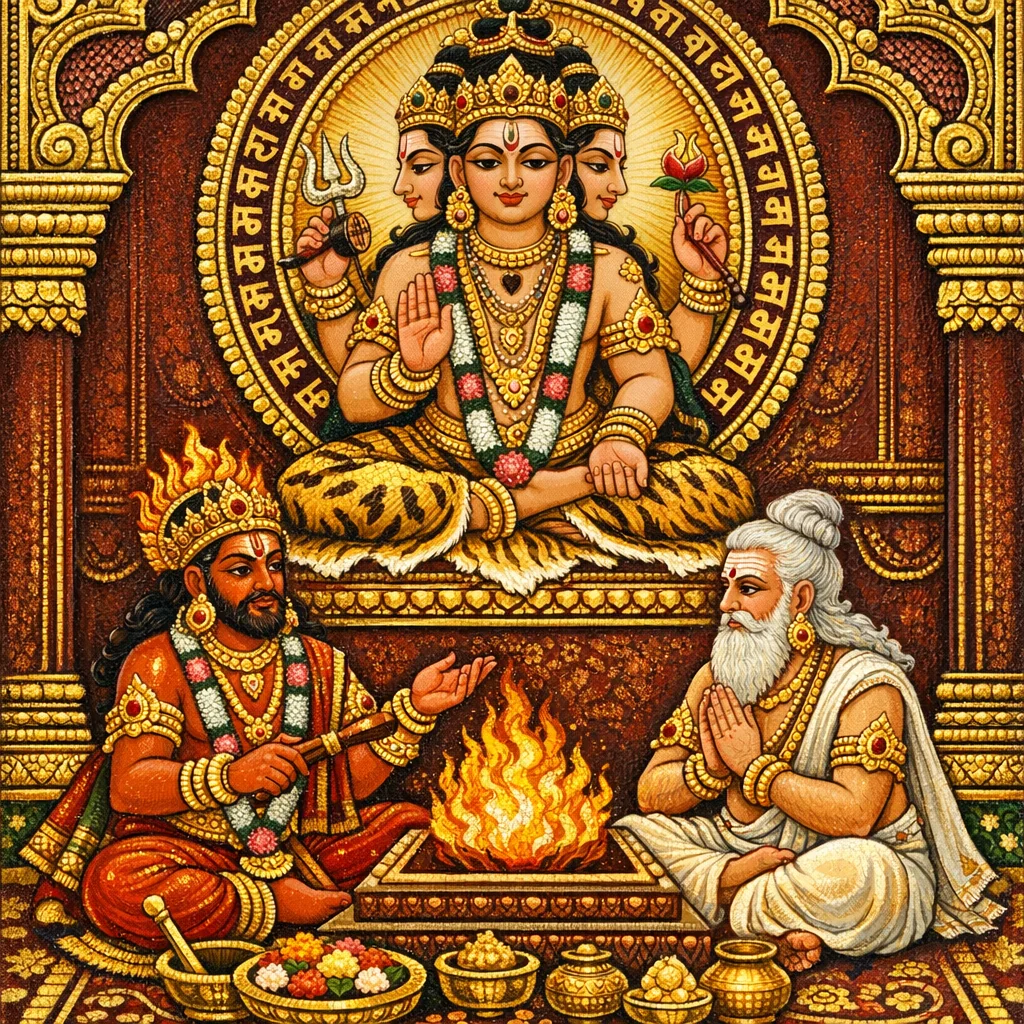
Adhyaya 87
Śānti-Śodhana-Kathana (Instruction on the Purification of Śānti) — Agni Purāṇa, Adhyāya 87
Continuing the Nirvāṇa-dīkṣā sequence, Lord Īśvara teaches that Vidyā (mantric discipline) must be conjoined with Śānti (the pacificatory rite) according to rule, showing the doctrinal dissolution of the dual principles Bhāveśvara and Sadāśiva within the Śānti-state. The chapter then maps phonemic and cosmic correspondences—especially the letters ha and kṣa—and enumerates Rudra-forms established for the Śānti operation. A twelve-pāda Puruṣa formulation is given as a litany of Śiva’s all-pervasiveness, with ritual supports such as kavaca/mantra pairings, bīja notions, nāḍī and vāyu references, and sense–object correlations. The practitioner is instructed in tāḍana (impulsion), bheda (splitting), praveśa (insertion), and viyojana (separation), followed by internalization and depositing a kalā into the kuṇḍa. The rite includes formal petition (vijñāpanā), installation of caitanya, ‘womb’ implantation into Devī, nyāsa-like applications for bodily generation and purification, loosening and severing pāśa (bondage) through japa and homa, Astra-mantras, fee-offerings (śulka) symbolized by buddhi and ahaṅkāra, and concludes with bestowal of amṛta-bindu and the pūrṇā completion offering—emphasizing purification accomplished without affliction.
Shlokas
Verse 1
इत्य् आदिमहापुराणे आग्नेये निर्वाणदीक्षायां विद्याविशोधनं नाम षडशीतितमो ऽध्यायः अथ सप्ताशीतितमो ऽध्यायः शान्तिशोधनकथनं ईश्वर उवाच सन्दध्यादधुना विद्यां शान्त्या सार्धं यथाविधि शान्तौ तत्त्वद्वयं लीनं भावेश्वरसदाशिवौ
Thus, in the Agni Purāṇa, within the topic of Nirvāṇa-dīkṣā, the eighty-sixth chapter entitled “Purification of the Vidyā (mantric discipline)” is concluded. Now begins the eighty-seventh chapter: “Instruction on the Purification of Śānti (pacificatory rite).” The Lord said: “Now, according to rule, one should properly unite the Vidyā together with Śānti. In Śānti, the two principles are dissolved—Bhāveśvara and Sadāśiva.”
Verse 2
छेदनं भेदनं तेषां बहुलीकरणन्तथा इति ग, चिह्नितपुस्तकपाठः हकारश् च क्षकारश् च द्वौ वर्णौ परिकीर्तितौ रुद्राः समाननामानो भुवनैः सह तद्यथा
“Their operations are described as cutting (chedaṇa), splitting (bhedana), and also multiplication/expansion (bahulīkaraṇa)”—so reads the marked book-variant. The letters ‘ha’ and ‘kṣa’ are declared to be two distinct phonemes. The Rudras, bearing identical names along with the worlds, are as follows:
Verse 3
प्रभवः समयः क्षुद्रो विमलः शिव इत्य् अपि घनौ निरञ्जनाकारौ स्वशिवौ दीप्तिकारणौ
He is called Prabhava (the Source), Samaya (the Regulating Order), Kṣudra (the Subtle/Minute), Vimala (the Stainless), and also Śiva (the Auspicious). Dense yet all-pervading, he is of the form of the taintless Nirañjana; self-established as Śiva, he is the cause of radiance (illumination).
Verse 4
त्रिदशेश्वरनामा च त्रिदशः कालसज्ज्ञकः सूक्ष्माम्बुजेश्वरश्चेति रुद्राः शान्तौ प्रतिष्ठिताः
The Rudras established for the Śānti (appeasement/peace rite) are: one named Tridaśeśvara, another Tridaśa, one known as Kāla, and another Sūkṣmāmbujeśvara. These Rudras are established in Śānti.
Verse 5
व्योमव्यापिने व्योमव्याप्यरूपाय सर्वव्यापिने शिवाय अनन्ताय अनाथाय अनाश्रिताय ध्रुवाय शाश्वताय योगपीठसंस्थिताय नित्ययोगिने ध्यानाहारायेति द्वादशपादानि पुरुषः कवचौ मन्त्रौ वीजे विन्दूपकारकौ अलम्बुषायसानाड्यौ वायू कृकरकर्मकौ
“Obeisance to Śiva who pervades the sky, whose very form is all-pervasive like the sky, who pervades everything; to the Endless, the Protector of the helpless, the Undependent, the Immutable, the Eternal; to him who is established on the Yogic Seat (Yogapīṭha), the Ever-yoked (nitya-yogin), whose ‘nourishment’ is meditation (dhyāna).” These are the twelve ‘feet’ (pādas) of the Puruṣa. Two are to be used as kavacas and mantras; the two seed-syllables (bīja) are said to be “bindu” and “upakāraka”. He further teaches the two nāḍīs, Alambuṣā and Yaśā, and the two vāyus, (Prāṇa) and Kṛkara, with their respective functions.
Verse 6
इन्द्रिये त्वक्करावस्या स्पर्शस्तु विषयो मतः गुणौ स्पर्शनिनादौ द्वावेकः कारणमीश्वरः
For this sense-faculty—namely the skin (tvak)—the object (viṣaya) is held to be touch. Its qualities are two: tactile contact and sound; while the single ultimate cause is the Lord (Īśvara).
Verse 7
तुर्म्यावस्थेति शान्तिस्थं सम्भाव्य भुवनादिकं विदध्यात्ताडनं भेदं प्रवेशञ्च वियोजनं
Having contemplated the mantric state called “turmyā-avasthā” as abiding in Śānti (pacification), and having mentally projected the worlds and related domains (bhuvana-ādika), one should then perform the operative rites of tāḍana (striking/impelling), bheda (splitting/causing dissension), praveśa (entry/insertion or possession), and viyojana (separation/disjunction).
Verse 8
आकृष्य ग्रहणं कुर्याच्छान्तेर्वदनसूत्रतः आत्मन्यारोप्य सङ्गृह्य कलां कुण्डे निवेशयेत्
Having drawn it toward oneself, one should seize it in accordance with the mouth-mantra (vadanā-sūtra) of the Śānti rite; then, placing it upon oneself and gathering it, one should deposit that kalā (subtle portion/energy) into the fire-pit (kuṇḍa).
Verse 9
ईशं तवाधिकारे ऽस्मिन् मुमुक्षुं दीक्षयाम्यहं भव्यं त्वयानुकूलेन कुर्यात् विज्ञापनामिति
“O Lord (Īśa), within your jurisdiction in this matter, I initiate this seeker of liberation (mumukṣu) by dīkṣā. Let the auspicious rite be performed with your favor; this is the formal petition.”
Verse 10
आवाहनादिकं पित्रोः शिष्यस्य ताडनादिकं अपाठः व्योमव्यापकरूपाय इति ख, चिह्नितपुस्तकपाठः व्योमरूपायेति ग, चिह्नितपुस्तकपाठः ध्यायपरायेति ख, चिह्नितपुस्तकपाठः व्यानाहारायेति ग, चिह्नितपुस्तकपाठः भाव्यं त्वया च शुद्धेन इति ग, ङ, चिह्नितपुस्तकपाठः विधायादाय चैतन्यं विधिनाअत्मनि योजयेत्
After performing the prescribed rites such as invocation (āvāhana) and the rest, and observing the proper discipline between teacher and disciple as laid down, one should, in due ritual order, ‘take up and install’ the principle of consciousness (caitanya) and unite it within oneself (ātman).
Verse 11
पूर्ववत् पितृसंयोगं भावयित्वोद्भवाख्यया हृत्सम्पुटात्मवीजेन देवीगर्भे नियोजयेत्
As before, having contemplated union with the Father-principle (pitṛ), one should—by the (mantra/force) called “Udbhavā,” and by the self-seed (ātma-bīja) placed within the heart-lotus enclosure—implant that potency into the womb of the Goddess (Devī).
Verse 12
देहोत्पत्तौ हृदा पञ्च शिरसा जन्महेतवे शिखया वाधिकाराय भोगाय कवचाणुना
For the manifestation of the body, (the mantra) should be applied five times with the heart; with the head, for the cause of birth; with the crown-lock (śikhā), for authority; with the armour-mantra (kavaca), for legitimate enjoyment; and with the weapon-mantra (astra), for protection.
Verse 13
लयाय शस्त्रमन्त्रेण श्रोतःशुद्धौ शिवेन च तत्त्वशुद्धौ हृदा ह्य् एवं गर्भाधानादि पूर्ववत्
For dissolution (laya), one should employ the Śastra-mantra; for purification of the channels (śrotaḥ-śuddhi), the Śiva-mantra; and for purification of the principles (tattva-śuddhi), the Hṛd(-mantra). Thus the rites beginning with conception (garbhādhāna) are to be performed as previously described.
Verse 14
वर्मणा पाशशैथिल्यं निष्कृत्यैवं शतं जपेत् मलशक्तितिरोधने शस्त्रेणाहुतिपञ्चकं
With the protective Varma-mantra, one should loosen the bonds of the noose (pāśa); then, as an expiatory act (prāyaścitta), one should recite it a hundred times. To veil or ward off impure forces (mala-śakti), one should offer five oblations (āhuti), employing the Śastra as the ritual implement.
Verse 15
एवं पाशवियोगे ऽपि ततः सप्तास्त्रजप्तया छिन्द्यादस्त्रेण कर्तर्या पाशान्वीजवता यथा
Thus, even in the procedure for release from bonds (pāśa-viyoga), after reciting the weapon-mantra (astra) seven times, one should cut the nooses with the ‘scissors/cutter’ weapon, just as one would cut with a swift, sharp implement.
Verse 16
ॐ हौं शान्तिकलापाशाय हः हूं फट् विसृज्य वर्तुलीकृत्य पाशमन्त्रेण पूर्ववत् घृतपूर्णे श्रुवे दत्वा कलास्त्रेणैव होमयेत्
Uttering, “Oṃ hauṃ—unto the Śānti-kalā Pāśa—haḥ hūṃ phaṭ,” one should project the mantra-force and form it into a circle; then, as before, employing the Pāśa-mantra, having placed ghṛta (clarified butter) into the śruva ladle filled with ghee, one should perform the homa oblations by means of the Kalāstra (mantra-weapon) itself.
Verse 17
अस्त्रेण जुहुयात् पञ्च पाशाङ्कुशनिवृत्तये प्रायश्चित्तनिषेधाय दद्यादष्टाहुतीरथ
One should offer five oblations (āhuti) with the Astra-mantra in order to remove the binding noose (pāśa) and the goad (aṅkuśa); and then, to avert the need for further expiatory rites, one should offer eight oblations.
Verse 18
ॐ हः अस्त्राय हूं फट् हृदेश्वरं समावाह्य कृत्वा पूजनतर्पणे विदधीत विधानेन तस्मै शुल्कसमर्पणं
Reciting the mantra “Oṃ haḥ—unto the Astra (Weapon)—hūṃ phaṭ,” one should invoke (āvāhya) Hṛdeśvara; and, having performed worship and tarpaṇa (libation-offering), one should, according to the prescribed rite, present to Him the due offering-fee (śulka).
Verse 19
ॐ हां ईश्वर बुद्ध्यहङ्कारौ शुल्कं गृहाण स्वाहा निःशेषदग्धपाशस्य पशोरस्येश्वर त्वया न स्थेयं बन्धकत्वेन शिवाज्ञां श्रावयेदिति
“Oṃ, hāṃ. O Lord (Īśvara), accept the fee (śulka) consisting of intellect (buddhi) and ego-sense (ahaṅkāra); svāhā. O Lord, for this sacrificial ‘beast’ (paśu) whose bonds (pāśa) have been completely burnt away, you should not remain as a binder; rather, proclaim the command of Śiva.”
Verse 20
एकं पाशवियोगार्थमिति ग, घ, चिह्नितपुस्तकपाठः ॐ ह्य् ऐमिति क, ङ, चिह्नितपुस्तकपाठः ॐ ओमिति ग, चिह्नितपुस्तकपाठः ॐ यैमिति घ, चिह्नितपुस्तकपाठः विसृजेदीश्वरन्देवं रौद्रात्मानं नियोजयेत् ईषच्चन्द्रमिवात्मानं विधिनाअत्मनि योजयेत्
‘One (syllable/formula) is for the severance of pāśa (bondage)’—so read certain marked manuscripts; others read ‘Oṃ hy aiṃ’, some ‘Oṃ’, and some ‘Oṃ yaiṃ’. Having thus recited, one should release (visṛje) the Lordly Deity and then direct the rite toward the Rudra-nature. In due procedure, one should unite the self within the Self, like the faint rising moon.
Verse 21
सूत्रे संयोजयेदेनं शुद्धयोद्भवमुद्रया दद्यात् मूलेन शिष्यस्य शिरस्यमृतविन्दुकं
He should fasten (the consecrated element/amulet) onto the ritual thread (sūtra), using the Śuddhayodbhava-mudrā; then, by means of the root-mantra (mūla-mantra), he should bestow upon the disciple’s head a drop of nectar (amṛta-bindu).
Verse 22
विसृज्य पितरौ वह्नेः पूजितौ कुसुमादिभिः दद्यात् पूर्णां विधानज्ञो निःशेषविधिपूरणीं
After respectfully dismissing the two ancestral beings from the sacred fire—once they have been worshipped with flowers and the like—the knower of ritual procedure should present the pūrṇā (the “completion offering”), which fully completes all the prescribed rites without remainder.
Verse 23
अस्यामपि विधातव्यं पूर्ववत्ताडनादिअकं स्ववीजन्तु विशेषः स्याच्छुद्धिः शान्तेरपीडिता
In this rite too, acts such as striking (tāḍana) and the rest should be performed as before; however, the distinctive feature is the use of one’s own bīja (mantric seed-syllable). By this pacificatory rite, purification is accomplished without causing affliction.
Frequently Asked Questions
Śānti—the pacificatory rite itself—is purified through a structured sequence of mantra, visualization, operative actions (tāḍana/bheda/praveśa/viyojana), homa, and concluding completion offerings, framed within Nirvāṇa-dīkṣā.
By ritually loosening and cutting pāśa (bondage), installing caitanya, and integrating Śiva-command (śivājñā) into the disciple’s transformation; the rite symbolically burns residual binding factors and culminates in completion (pūrṇā), supporting liberation-oriented initiation.
The chapter specifies tāḍana (impelling/striking), bheda (splitting), praveśa (insertion/entry), and viyojana (separation), followed by kalā collection and deposition into the kuṇḍa, plus japa/homa counts (e.g., 100 japa; five and eight oblations) for pāśa-viyoga.