Adhyaya 62
Chapter 62 — Lakṣmīpratiṣṭhāvidhiḥ (The Procedure for Installing Lakṣmī)
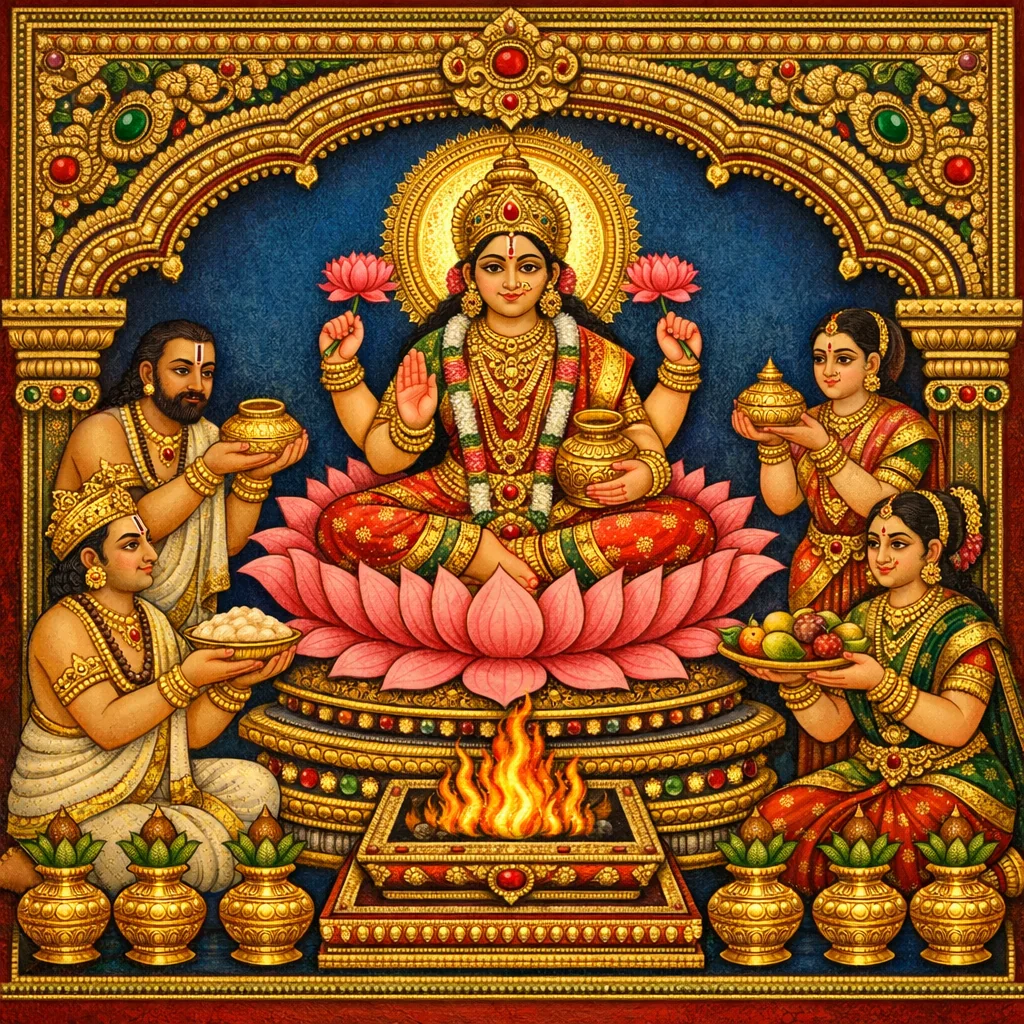
Lord Agni instructs Vasiṣṭha in an integrated (samudāyena) sequence of deity-installation, beginning with Lakṣmī and extending to the full assemblage of goddesses. After the pavilion and ablution preliminaries, Śrī is placed on a bhadra-seat and eight kalaśas are set up. Consecration proceeds by anointing and pañcagavya bathing, netronmīlana (opening of the eyes), and offerings such as madhuratraya, with manuscript variants noted for certain ritual phrases and placements. Directional sprinklings follow with distinct mantras for each quarter, culminating in an Īśāna-focused head-bath measured as eighty-one pitchers, after which the water is released to the earth. The rite is intensified through consecrated fragrance and flowers, identity/absorption via tanmayāvaha, and recitation of the ‘Ānanda’ ṛk. Presence is stabilized by Śāyantīya nyāsa on the bed, Śrī-sūkta for sānnidhya, and Lakṣmī-bīja to awaken cicchakti, followed by homa offerings (lotus or karavīra) in prescribed counts. The chapter closes with consecration of implements and temple, piṇḍikā formation, verse-by-verse Śrī-sūkta recitation, guru/brāhmaṇa dāna, and meditation on fruits such as heaven—showing ritual precision as a technology of auspiciousness and dharma.
Shlokas
Verse 1
इत्य् आदिमहापुराणे आग्नेये ध्वजारोहणं नाम एकषष्टितमो ऽध्यायः अथ द्विषष्टितमो ऽध्यायः लक्ष्मीप्रतिष्ठाविधिः भगवानुवाच समुदायेन देवादेः प्रतिष्ठां प्रवदामि ते लक्ष्म्याः प्रतिष्ठा प्रथमं तथा देवीगणस्य च
Thus, in the Agni Purāṇa, the sixty-first chapter is entitled “Raising of the Flag (Dhvajārohaṇa).” Now begins the sixty-second chapter, “The Procedure of Pratiṣṭhā (Installation/Consecration) of Lakṣmī.” The Blessed Lord said: “I shall explain to you, in an integrated sequence, the rite of installation for the deities and the rest—first the installation of Lakṣmī, and likewise that of the assemblage of goddesses.”
Verse 2
पूर्ववत् सकलं कुर्यान्मण्डपस्नपनादिकं भद्रपीठे श्रियं न्यस्य स्थापयेदष्ट वै घटान्
As previously prescribed, one should perform the entire sequence—beginning with the maṇḍapa rites, the snāpana (ablution) ceremony, and related acts. Having installed Śrī upon the bhadra-seat (bhadrapīṭha), one should then set up eight ritual water-pots (kalaśas).
Verse 3
घृतेनाभ्यज्य मूलेन स्नपयेत् पञ्चगव्यकैः हिरण्यवर्णा हरिणी नेत्रे चोन्मीलयेच्छ्रियाः
Having anointed the base (the root portion) with ghee, one should bathe it with the five products of the cow (pañcagavya). Then, for the sake of prosperity (Śrī), one should perform the rite of “opening of the eyes” (netronmīlana), invoking or visualizing the golden-hued doe (hariṇī).
Verse 4
मण्डलस्नपनादिकमिति ङ, चिह्नितपुस्तकपाठः स्थापयेद्वरुणे घटानिति घ, ङ, चिह्नितपुस्तकपाठः तन्म आवह इत्य् एवं प्रदद्यान्मधुरत्रयम् अश्वपूर्वेति पूर्वेण तां कुम्भेनाभिषेचयेत्
“(Perform) the maṇḍala-bath and related rites”—so reads the marked manuscript. “He should place the water-pots for Varuṇa”—so read the gha- and ṅa-marked manuscripts. Then, reciting ‘tan ma āvaha’ in this manner, one should offer the ‘three sweet substances’ (madhuratraya). Thereafter, by the preceding mantra beginning with ‘aśvapūrva…’, one should consecrate by abhiṣeka, bathing with the kumbha (ritual pitcher).
Verse 5
कामोस्मितेति याम्येन पश्चिमेनाभिषेचयेत् चन्द्रं प्रभासामुच्चार्यादित्यवर्णेति चोत्तरात्
Reciting the mantra “kāmosmi”, one should sprinkle the consecratory water from the southern and western directions. Uttering “candraṃ prabhāsām”, and also “ādityavarṇa”, one should sprinkle from the northern direction.
Verse 6
उपैतु मेति चाग्नेयात् क्षुत्पिपासेति नैरृतात् गन्धद्वारेति वायव्यां मनसः काममाकृतिम्
From the south-east (Agneya quarter) one should recite “upaitu me”; from the south-west (Nairṛta quarter), “kṣutpipāse”; from the north-west (Vāyavya quarter), “gandhadvāre”; and thereby one brings about the mind’s desired form (the intended mental manifestation).
Verse 7
ईशानकलशेनैव शिरः सौवर्णकर्दमात् एकाशीतिघटैः स्नानं मन्त्रेणापः सृजन् क्षितिम्
Using the Īśāna water-pot alone, one should bathe the head with water measured by eighty-one pitchers, drawn from the golden basin; and, while uttering the mantra, one should release the waters onto the ground.
Verse 8
आर्द्रां पुष्करिणीं गन्धैर् आर्द्रामित्यादिपुष्पकैः तन्मयावह मन्त्रेण य आनन्द ऋचाखिलं
He should ritually moisten and perfume the lotus-pond with fragrances, and offer flowers consecrated by the mantra beginning “ārdrām…”. With the “tanmayāvaha” mantra he should bring about absorption—identity with the deity; and the entire Vedic ṛk called “Ānanda” is to be employed/recited.
Verse 9
शायन्तीयेन शय्यायां श्रीसूक्तेन च सन्निधिम् लक्ष्मीवीजेन चिच्छक्तिं विन्यस्याभ्यर्चयेत् पुनः
By the mantra called “Śāyantīya” one should perform nyāsa upon the bed; by the “Śrī-sūkta” establish the deity’s presence (sannidhi); and by Lakṣmī’s seed-mantra (bīja) install the power of consciousness (cicchakti). Having thus placed these, one should worship again.
Verse 10
श्रीसूक्तेन मण्डपेथ कुण्डेष्वब्जानि होमयेत् करवीराणि वा हुत्वा सहस्रं शतमेव वा
Reciting the “Śrī-sūkta”, one should perform homa in the maṇḍapa by offering lotuses into the fire-pits (kuṇḍas); or else, having offered karavīra (oleander) flowers, one should make either a thousand oblations or at least a hundred.
Verse 11
गृहोपकरणान्तादि श्रीसूक्तेनैव चार्पयेत् ततः प्रासादसंस्कारं सर्वं कृत्वा तु पूर्ववत्
He should offer (consecrate) everything—beginning with the household/temple implements and so forth—using the “Śrī-sūkta” alone. Thereafter, having performed the entire consecration (saṃskāra) of the prāsāda (temple) as previously prescribed.
Verse 12
मन्त्रेण पिण्डिकां कृत्वा प्रतिष्ठानं ततः श्रियः श्रीसूक्तेन च सान्निध्यं पूर्ववत् प्रत्यृचं जपेत्
Having formed a piṇḍikā, a small ritual lump, with the prescribed mantra, one should then perform the pratiṣṭhā—the installation of Śrī (Lakṣmī). Thereafter, to invoke her presence, one should recite the “Śrī-sūkta”, chanting each individual ṛc (verse) in japa as previously instructed.
Verse 13
चिच्छक्तिं बोधयित्वा तु मालात् सान्निध्यकं चरेत् तकपाठः मन्त्रेण चासृजत् क्षितिमिति ख, चिह्नतपुस्तकपाठः य आनन्देति वाससमिति ङ, चिह्नितपुस्तकपाठः मन्त्रेण पिण्डिकां कृत्वा प्रतिमां स्थापयन् श्रिय इति ङ, चिह्न्तपुस्तकपाठः प्रत्यृचं यजेदिति ङ, चिह्नितपुस्तकपाठः भूस्वर्णवस्त्रगोन्नादि गुरवे ब्रह्मणेर्पयेत् एवं देव्यो ऽखिलाः स्थाप्यावाह्य स्वर्गादि भावयेत्
Having first awakened the power of consciousness (cicchakti), one should perform the sānnidhyaka rite—establishing nearness/presence—by means of the garland (mālā). With the mantra—(in some readings) “and he created the earth”—and (in certain marked manuscript readings) “ya ānanda…” for the garment, and (elsewhere) “śriyaḥ…” while forming the piṇḍikā and installing the image (pratimā), and (elsewhere) “one should worship each ṛc individually (pratyṛcam)”—one should offer to the guru and to the brāhmaṇa land, gold, cloth, cows, grain, and the like. Thus, having installed and invoked all the goddesses, one should meditate upon the fruits, such as heaven and other results.
Frequently Asked Questions
A stepwise Lakṣmī-pratiṣṭhā protocol: maṇḍapa/snāpana preliminaries, bhadrapīṭha placement, kalaśa arrangement, pañcagavya purification, netronmīlana, quarter-wise abhiṣeka mantras, Īśāna-kalaśa head-bath (81 pitchers), Śrī-sūkta-based sānnidhya, and homa with specified floral offerings.
It treats consecration as a dhārmic technology of presence: precise materials, directions, mantra-nyāsa, and homa cultivate auspicious order (bhukti) while aligning mind and intention toward sacrality and higher fruits (mukti-oriented discipline).
Śrī-sūkta for sānnidhya and worship/homa, Lakṣmī-bīja for cicchakti installation, Śāyantīya for bed-nyāsa, and additional abhiṣeka/directional mantras including tanmayāvaha and the ‘Ānanda’ ṛk.
The chapter records marked readings that adjust specific ritual instructions (e.g., phrasing of snāpana lines, attribution of pots to Varuṇa, and placement of ‘ya ānanda…’ for garments), indicating a living ritual tradition with localized recensional differences.