Adhyaya 54
Liṅga-māna-ādi-kathana (Measurements and Related Particulars of the Liṅga)
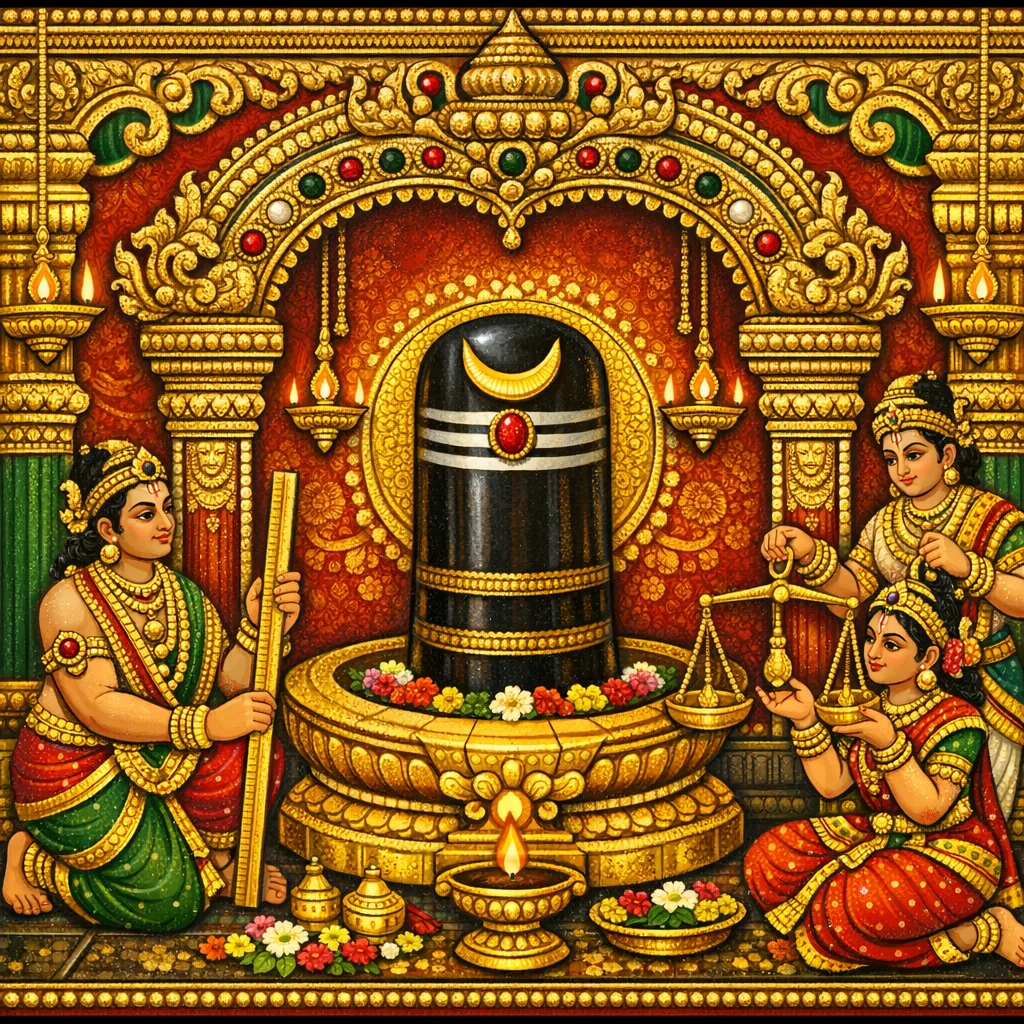
Lord Agni continues the Pratiṣṭhā-focused teaching, moving from general liṅga-lakṣaṇa to a technical canon of dravya (materials), māna (measure), and vidhi (procedure). The chapter first ranks liṅgas by substance—from cloth and clay (baked preferred) through wood and stone to metals and precious media (pearl, iron, gold; also silver, copper, brass, tin, and rasa-liṅga)—and explicitly links certain materials with bhukti–mukti results. It then sets out placement logic and modular measurement: household liṅgas are scaled in aṅgulas (1–5), while shrine worship uses ratios derived from the doorway and garbha-gṛha, forming a taxonomy of measures (36×3 and their synthesis into 108). Portable (cala) classes are defined (1–5, 6–10, 11–15 aṅgulas), along with proportional “sūtra” (cord/guide-line) systems and hasta-based expansions. The latter half turns to iconometric geometry and auspicious diagnostics (remaining aṅgulas as omens; dhvaja/siṃha/vṛṣa classes; auspiciousness by svara), then enumerates structural forms and sectional theology (Brahmā–Viṣṇu–Śiva distribution), culminating in mukha-liṅga and head-form typologies with proportional directives for facial features and projections.
Shlokas
Verse 1
इत्य् आदिमहापुराणे आग्नेये लिङ्गलक्षणं नाम त्रिपञ्चाशत्तमोध्यायः अथ चतुःपञ्चाशत्तमोध्यायः लिङ्गमानादिकथनं भगवानुवाच वक्ष्याम्यन्यप्रकारेण लिङ्गमानादिकं शृणु वक्ष्ये लवणजं लिङ्गं घृतजं बुद्धिवर्धनम्
Thus, in the Agni Purāṇa—within the primordial Mahāpurāṇa—ends the fifty-third chapter entitled “Characteristics of the Liṅga.” Now begins the fifty-fourth chapter, “An account of the measurements and related details of the Liṅga.” The Blessed Lord said: “Hear, as I shall explain in another manner, the measurements and related particulars of the Liṅga. I shall describe the salt-made Liṅga and the ghee-made Liṅga, which increases intelligence.”
Verse 2
भूतये वस्त्रलिङ्गन्तु लिङ्गन्तात्कालिकं विदुः पक्वापक्वं मृण्मयं स्यादपक्वात् पक्वजं वरं
For prosperity (bhūti), a liṅga made of cloth is prescribed; scholars know a liṅga made of paste/compounded material (kālika) to be superior to the cloth-liṅga. A liṅga may also be made of clay, either baked or unbaked; among these, the baked one is better than the unbaked.
Verse 3
ततो दारुमयं पुण्यं दारुजात् शैलजं वरं शैलाद्वरं तु मुक्ताजं ततो लौहं सुवर्णजं
Thereafter, an icon made of wood is meritorious; superior to wood is one made of stone; superior to stone is one made of pearl; thereafter (superior still) is one made of iron; and (highest) is one made of gold.
Verse 4
राजतं कीर्तितं ताम्रं पैत्तलं भुक्तिमुक्तिदं रङ्गजं रसलिङ्गञ्च भुक्तिमुक्तिप्रदं वरं
Silver has been described; copper and brass are said to bestow both worldly enjoyment and liberation. So too are tin and the rasa-liṅga (alchemical emblem/liṅga) declared excellent, granting enjoyment and liberation.
Verse 5
रसजं रसलोहादिरत्नगर्भन्तु वर्धयेत् मानादि नेष्टं सिद्धादि स्थापितेथ स्वयम्भुवि
One should increase (i.e., potentiate) the product born of rasa (mercury)—namely the rasa-metal and the gem-essence. The measured quantities and the rest are not to be altered; the perfected preparation and the like should be established (consecrated) in the Svayambhū (self-manifest) liṅga.
Verse 6
वामे च स्वेच्छया तेषां पीठप्रासादकल्पना पूजयेत् सूर्यविम्बस्थं दर्पणे प्रतिविम्बितं
And on the left, as one prefers, one should arrange for them a ritual seat (pīṭha) and a shrine (prāsāda); one should worship the Sun’s image as reflected in a mirror—the solar disc appearing as a replica within the mirror.
Verse 7
पूज्ये हरस्तु सर्वत्र लिङ्गे पूर्णार्चनं भवेत् हस्तोत्तरविधं शैलं दारुजं तद्वदेव हि
When Hara (Śiva) is to be worshipped, complete worship (pūrṇa-arcana) should be performed for every liṅga, everywhere; and the same prescribed procedure applies to stone (śaila) and wooden (dāruja) forms as well—indeed, exactly in that manner.
Verse 8
प्रवक्ष्ये ऽहं प्रकारेणेति ग चिह्नितपुस्तकपाठः रत्नजमिति ख, चिह्नितपुस्तकपाठः हस्ते तु विविधं शैलमिति ग चिह्नितपुस्तकपाठः चलमङ्गुलमानेन द्वारगर्भकरैः स्थितम् अङ्गुलाद् गृहलिङ्गं स्याद्यावत् पञ्चशाङ्गुलं
“I shall explain the procedure” (so reads one marked manuscript). Another reading has “made of jewels,” and another, “in the hand, of various stones.” Using the movable aṅgula-measure, the household liṅga is to be set in the inner recess of the doorway/threshold, according to the ‘door-womb’ measurements; the household liṅga should measure from one aṅgula up to five aṅgulas (in size/height).
Verse 9
द्वारमानात् त्रिसङ्ख्याकं नवधा गर्भमानतः नवधा गर्भमानेन लिङ्गन्धाम्नि च पूजयेत्
From the measure of the doorway, one should compute the triad of proportions. From the measure of the garbha-gṛha (sanctum), divide it into nine parts; and by that same ninefold measure, one should worship the liṅga in the sacred shrine (dhāman).
Verse 10
एवं लिङ्गानि षट्त्रिंशत् ज्ञेयानि ज्येष्ठमानतः मध्यमानेन षट्त्रिंशत् षट्त्रिंशदधमेन च
Thus, the liṅgas are to be understood as thirty-six (types) according to the superior (jyeṣṭha) measure; thirty-six according to the middle (madhyama) measure; and thirty-six also according to the inferior (adhama) measure.
Verse 11
इत्थमैक्येन लिङ्गानां शतमष्टोत्तरं भवेत् एकाङ्गुलादिपञ्चान्तं कन्यसञ्चलमुच्यते
Thus, by combining (these measures) into a single scheme, the total set of liṅga-measures becomes one hundred and eight. The range from one aṅgula up to five aṅgulas is called ‘kanyasañcala,’ the smallest and least movable class.
Verse 12
षद्वादिदशपर्यन्तञ्चलं लिङ्गञ्च मध्यमं एकादशाङ्गुलादि स्यात् ज्येष्ठं पञ्चदशान्तकम्
A movable (portable) liṅga measuring from six up to ten aṅgulas is classed as ‘medium.’ The ‘largest’ (jyeṣṭha) begins from eleven aṅgulas and extends up to fifteen.
Verse 13
षडङ्गुलं महारत्नै रत्नैर् अन्यैर् नवाङ्गुलम् रविभिर्हेमभारोत्थं लिङ्गं शेषैस्त्रिपञ्चभिः
A liṅga made with great gems should measure six aṅgulas; with other gems, nine aṅgulas. A liṅga produced from a weight of gold reckoned as ‘ravi’ is prescribed; with the remaining metals, it should be twenty-five aṅgulas.
Verse 14
षोडशांशे च वेदांशे युगं लुप्त्वोर्ध्वदेशतः द्वात्रिंशत्षोडशांशांश् च कोणयोस्तु विलोपयेत्
In a division into sixteen parts, and likewise into four parts, one should remove the pair of portions from the upper region; and at the corners one should also eliminate the portions measured as thirty-second and sixteenth parts.
Verse 15
चतुर्निवेशनात् कण्ठो विंशतिस्त्रियुगैस् तथा पार्श्वाभ्यां तु विलुप्ताभ्यां चललिङ्गं भवेद्वरं
When the (upper) neck portion is set with four inlaid bands, and also bears the measure of twenty (units) in three successive tiers, and when the lateral sides are left unobstructed, without projections—then it becomes an excellent movable liṅga (cala-liṅga), fit for installation and ritual use.
Verse 16
धाम्नो युगर्तुनागांशैर् द्वारं हीनादितः क्रमात् लिङ्गद्वारोच्छ्रयादर्वाग् भवेत् पादोनतः क्रमात्
The doorway should be laid out by successively reducing the measure from the overall shrine dimension (dhāmna), according to the prescribed fractional parts called yuga-, ṛtu-, and nāga-aṃśas. Further, the height of the liṅga-shrine doorway should be made progressively lower, step by step, by a quarter (pāda) from the standard doorway height.
Verse 17
गर्भार्धेनाधमं लिङ्गं भूतांशैः स्यात् त्रिभिर्वरं तयोर्मध्ये च सूत्राणि सप्त सम्पातयेत् समं
A liṅga made to the measure of half the prescribed garbha is inferior; the excellent measure is that increased by three bhūta-aṃśas. Between those two reference measures, one should lay out seven equal guideline-threads (sūtras), evenly dividing the interval.
Verse 18
आठः द्वात्रिंशत्षोडशार्धञ्चेति ग, घ, ङ, चिह्नितपुस्तकत्रयपाठः विंशतिस्त्रिगुणैस्तथेति घ, चिह्नितपुसुतकपाठः वनलिङ्गं भवेद्वरमिति ग, घ, चिह्नितपुस्तकपाठः चललिङ्गं भवेद् ध्रुवमिति ख, चिह्नितपुस्तकपाठः एवं स्युर्नव सूत्राणि भूतसूत्रैश् च मध्यमं द्व्यन्तरो वामवामञ्च लिङ्गानां दीर्घता नव
Thus there are nine measuring-cords (sūtras). The middle one is called the bhūta-sūtra, the central reference line. There are two intermediate cords, as well as the left and the further-left (lateral) cords. By these, the length and proportioning of liṅgas are determined in nine standard ways. (Variant manuscripts also cite proportion-numbers such as 8, 32, and 16½, and describe the liṅga as “excellent” or “stable” according to type.)
Verse 19
हस्ताद्विवर्धते हस्तो यावत्स्युर् नव पाणयः हीनमध्योत्तमं लिङ्गं त्रिविधं त्रिविधात्मकम्
Beginning from one hasta, the measure increases by one hasta at a time, up to nine hands in total. Thus the liṅga is of three grades—inferior, middling, and superior—being threefold in its constitution.
Verse 20
एकैकलिङ्गमध्येषु त्रीणि त्रीणि च पादशः लिङ्गानि घटयेद्धीमान् षट्सु चाष्टोत्तरेषु च
In the spaces between each principal liṅga, the wise officiant should arrange three liṅgas in each pāda (quarter); and this same triad-arrangement is to be made in the sixfold and in the eight-plus-one (ninefold) divisions as well.
Verse 21
स्थिरदीर्घप्रमेयात्तु द्वारगर्भकरात्मिका भागेशञ्चाप्यमीशञ्च देवेज्यन्तुल्यसंज्ञितं
From the fixed (standard) long measure, the unit is understood to be of the nature of dvāra, garbha, and kara; it is also termed bhāgeśa and amīśa, and is designated by the synonymous name devejyantulya.
Verse 22
चत्वारि लिङ्गरूपाणि विष्कम्भेण तु लक्षयेत् दीर्घमायान्वितं कृत्वा लिङ्गं कुर्यात् त्रिरूपकं
One should distinguish the four forms of the liṅga by its diameter. Having made it elongated and furnished with the proper proportional measures, one should fashion the liṅga as “three-formed”, that is, with three distinct sections.
Verse 23
चतुरष्टाष्टवृत्तञ्च तत्त्वत्रयगुणात्मकं लिङ्गानामीप्सितं दैर्घ्यं तेन कृत्वाङ्गुलानि वै
The liṅga should be fashioned in the prescribed circular form, with the 4–8–8 proportions, embodying the qualities of the three tattvas. Having fixed the desired length of the liṅgas, one should then compute it in aṅgulas (finger-breadths).
Verse 24
ध्वजाद्यायैः सुरैर् भूतैः शिखिभिर्वा हरेत् कृतिं तान्यङ्गुलानि यच्छेषं लक्षयेच्च शुभाशुभं
If the prepared figure (kṛti) is carried off by a banner (or similar portent), by gods, by spirits (bhūtas), or by birds, one should note the remaining aṅgula measures; from what remains, one should determine whether the outcome is auspicious or inauspicious.
Verse 25
ध्वजाद्या ध्वजसिंहेभवृषाः ज्येष्ठाः परे शुभाः स्वरेषु षड्जगान्धारपञ्चमाः शुभदायकाः
Among the classes beginning with “dhvaja”, those termed dhvaja, siṃha, and vṛṣa are foremost; the others too are auspicious. Among the musical notes (svaras), ṣaḍja, gāndhāra, and pañcama bestow good fortune.
Verse 26
भूतेषु च शुभा भूः स्यादग्निष्वाहवनीयकः उक्तायामस्य चार्धांशे नागांशैर् भाजिते क्रमात्
Among the elemental classes, Earth (bhū) is auspicious; among the fires, the Āhavanīya—the oblation-fire—is declared auspicious. Further, when the previously stated measure (āyāma) is halved and then successively divided according to the “nāga” portions, the required sequence is obtained.
Verse 27
रसभूतांशषष्ठांशत्र्यंशाधिकशरैर् भवेत् आढ्यानाढ्यसुरेज्यार्कतुल्यानाञ्चतुरस्रता
A square plan (caturasratā) is obtained by taking the “arrows/diagonals” (śara) increased by one-third, together with one-sixth parts corresponding to ‘rasa’ and ‘bhūta’. Such squareness is said to be comparable in correctness to that of the wealthy (āḍhya), the not-wealthy (anāḍhya), the lord of gods (surejya/Indra), and the Sun (arka).
Verse 28
पञ्चमं वर्धमानाख्यं व्यासान्नाहप्रवृद्धितः द्विधा भेदा बहून्यत्र वक्ष्यन्ते विश्वकर्मतः
The fifth type of temple/structure is called Vardhamāna, marked by an increase in breadth and height. Here its many subdivisions, in a twofold classification, will be explained according to Viśvakarman, the authoritative architect.
Verse 29
आढ्यादीनां त्रिधा स्थौल्याद्यवधूतं तदष्टधा अन्तरे वामवामे चेति ङ, चिह्नितपुस्तकपाठः स्थौल्याद् यववृद्ध्या तदष्टधा इति ख, चिह्नितपुस्तकपाठः त्रिधा हस्ताज्जिनाख्यञ्च युक्तं सर्वसमेन च
Among the bodily types beginning with the “āḍhya” (well-nourished/prosperous), there is a threefold division. On the basis of corpulence and the like, the “avadhūta” (wasted/debilitated) type is further divided eightfold—(in one recension) into “intermediate,” “left,” and “far-left” subtypes; (in another) from corpulence, by increments measured in barley-grains (yava), it becomes eightfold. Likewise, the measure called “jinākhya” is threefold in terms of the hasta (hand-unit), and it is to be applied with complete proportional equivalence (sarva-samatā).
Verse 30
पञ्चविंशतिलिङ्गानि नाद्ये देवार्चिते तथा पञ्चसप्तभिरेकत्वाज्जिनैर् भक्तैर् भवन्ति हि
Twenty-five liṅgas are counted as “one,” and likewise when the deity is worshipped at the sacred bathing-place (nāḍya). Through the unity produced by the groupings of five and seven, they indeed become “one” for devoted worshippers who have conquered the senses (jin).
Verse 31
चतुर्दशसहस्राणि चतुर्दशशतानि च एवमष्टाङ्गुलविस्तारो नवैककरगर्भतः
Fourteen thousand and fourteen hundred (in number/measure); thus the breadth is eight aṅgulas, measured with nine (or) one kara (hand-span) taken as the standard module (garbha).
Verse 32
तेषां कोणार्धकोणस्थैश्चिन्त्यात् कोणानि सूत्रकैः विस्तारं मध्यमः कृत्वा स्थाप्यं वा मध्यतस्त्रयं
For those divisions/figures, the corners should be determined by measuring cords (sūtraka) placed at the corner and half-corner points; taking the middle measure as the breadth, one should then establish the “three” (principal lines/points) from the center.
Verse 33
विभागादूर्ध्वमष्टास्रो द्व्यष्टास्रःस्याच्छिवांशकः पादाज्जान्वन्तको ब्रह्मा नाभ्यन्तो विष्णुरित्यतः
Above the (central) division it should be eight-cornered; the upper sixteen-cornered portion is assigned as Śiva’s share. From the feet up to the knees is Brahmā’s extent; from the navel inward (the central region) is said to be Viṣṇu’s.
Verse 34
मूर्ध्वान्तो भूतभागेशो व्यक्ते ऽव्यक्ते च तद्वति पञ्चलिङ्गव्यवस्थायां शिरो वर्तुलमुच्यते
In the fivefold classification of the liṅga, the upper terminal portion is called Bhūtabhāgeśa; and in both the manifest and the unmanifest types, the head (śiras) is said to be circular.
Verse 35
छत्राभं कुक्कुटाभं वा बालेन्दुप्रतिमाकृतिः एकैकस्य चतुर्भेदैः काम्यभेदात् फलं वदे
Whether the mark/form is umbrella-like, cock-like, or shaped like the young moon—each of these has four sub-types. I shall state the results according to the differences in the intended kāmya (desired) purpose.
Verse 36
लिङ्गमस्तकविस्तारं वसुभक्तन्तु कारयेत् आद्यभागं चतुर्धा तु विस्तारोच्छ्रायतो भजेत्
One should construct the breadth of the liṅga’s top (mastaka) by dividing it into eight equal parts. The foremost portion should then be apportioned into four parts, in accordance with the liṅga’s breadth and height.
Verse 37
चत्वारि तत्र सूत्राणि भागभागानुपातनात् , चिह्नितपुस्तकपाठः बालेन्दुत्रपुषाकृतिरिति ख, ग, घ, चिह्नितपुस्तकपाठः चतुर्भागैर् इति ख, चिह्नितपुस्तकपाठः अन्त्यभागमिति ग, घ, चिह्नितपुस्तकपाठः चत्वारि तत्र छत्राणि इति ग, घ, ङ, चिह्नितपुस्तकचतुष्ट्यपाठः पुण्डरीकन्तु भागेन विशालाख्यं विलोपनात्
Here there are four “sūtras” (threads/units), determined by the proportional falling from part to part (bhāga to bhāga). (In some marked manuscripts it is read: “its form is like a young moon and a lotus,” while others read: “by four parts,” or “the final part,” and some read: “here there are four umbrellas.”) But according to the four-marked-manuscript reading: “Puṇḍarīka (the ‘lotus’ pattern) is obtained by one part; and by elision (vilopa) it is called Viśālā.”}]}}json.dumps({
Verse 38
त्रिशातनात्तु श्रीवत्सं शत्रुकृद्वेदलोपनात् शिरः सर्वसमे श्रेष्ठं कुक्कुटाभं सुराह्वये
From the triśātana mark (a threefold cut or strike) arises the Śrīvatsa sign; from the mark that breeds enemies and brings about loss of Vedic merit or knowledge, the head-sign is recognized. Among all such marks, the best is that which, in the assembly of the gods, is shaped like a cock’s comb (kukkuṭa-like).
Verse 39
चतुर्भागात्मके लिङ्गेत्रपुषं द्वयलोपनात् अनाद्यस्य शिरः प्रोक्तमर्धचन्द्रं शिरः शृणु
In a liṅga conceived as consisting of four parts, by omitting two portions of the upper trapuṣa segment, the head-form called “Anādya” is described. Now hear of the head-form called “Ardhacandra” (Half-moon).
Verse 40
अंशात् प्रान्ते युगांशैश् च त्वेकाहान्यामृताक्षकं पूर्णबालेन्दुकुमुदं द्वित्रिवेदक्षयात् क्रमात्
At the end of a solar degree, and also by the fractional parts of a yuga, one should compute the increment of a single day; thereby the auspicious count called “nectar-eyed” is obtained. The full state, the young-moon state, and the “moon-lotus” (kumuda) state are determined in due order by successive stepwise reductions of two and three “Vedas” (i.e., reductions reckoned in sets of four).
Verse 41
चतुस्त्रिरेकवदनं मुखलिङ्गमतः शृणु पूजाभागं प्रकर्तव्यं मूर्त्यग्निपदकल्पितं
Hear the teaching on the facial marks (mukha-liṅga): the icon of Agni is described as having four faces, three faces, or even a single face. The ritual “share” (portion of worship and offerings) is to be assigned according to the rank and form of the embodied Agni (mūrti-Agni).
Verse 42
अर्कांशं पूर्ववत् त्यक्त्वा षट् स्थानानि विवर्तयत् शिरोन्नतिः प्रकर्तव्या ललाटं नासिका ततः
Having set aside the arkāṃśa (the solar angle/segment) as previously described, one should successively adjust (turn and align) the six points. The head is to be raised; then align the forehead, and thereafter the nose.
Verse 43
वदनं चिवुकं ग्रीवा युगभागैर् भुजाक्षिभिः कराभ्यां मुकुलीकृत्य प्रतिमायाः प्रमाणतः
In accordance with the canonical measurements of an icon, the face, chin, and neck are to be proportioned by yuga-units; likewise the arms and the eyes. The hands are to be formed in a bud-like (mukula, closed) configuration, in keeping with the icon’s proper proportions.
Verse 44
मुखं प्रति समः कार्यो विस्तारादष्टमांशतः चतुर्मुखं मया प्रोक्तं त्रिमुखञ्चोच्यते शृणु
In relation to the face, the corresponding measure should be made equal; and from the overall breadth it should be taken as one-eighth. I have explained the four-faced form; now hear also the description of the three-faced form.
Verse 45
कर्णपादाधिकास्तस्य ललाटादीनि निर्दिशेत् भुजौ चतुर्भिर्भागैस्तु कर्तव्यौ पश्चिमोर्जितं
One should set out the forehead and the other facial features of that image as exceeding (in measure) the ear and the foot. The arms, however, are to be made in four proportional parts, with the posterior portion rendered firm and powerful.
Verse 46
विस्तरादष्टमांशेन मुखानां प्रतिनिर्गमः एकवक्त्रं तथा कार्यं पूर्वस्यां सौम्यलोचनं
The forward projection of the faces should be one-eighth of the breadth. Likewise, a single-faced image should be made facing east, with gentle, auspicious eyes.
Verse 47
ललाटनासिकावक्त्रग्रीवायाञ्च विवर्तयेत् तकपाठः द्वैकहान्या सुताह्वयमिति ख, चिह्नितपुस्तकपाठः ऋत्वग्निपदकल्पितमिति ख, चिह्नितपुस्तकपाठः, मुखभागं प्रकर्तव्यं मूलाग्निपदकल्पितमिति ङ, चिह्नितपुस्तकपाठः कर्णाभ्यां कुण्डलीकृत्वेति ग, चिह्नितपुस्तकपाठः भुजाच्च पञ्चमांशेन भुजहीनं विवर्तयेत्
One should shape the forehead, the nose, the face, and the neck in accordance with the prescribed rule. Further, by taking one-fifth from the arm-measure, one should form the part termed ‘arm-less’—that is, reduced by one-fifth relative to the arm measure—according to the established canon of proportions.
Verse 48
विस्तारस्य षडंशेन मुखैर् निर्गमनं हितं सर्वेषां मुखलिङ्गानां त्रपुषं वाथ कुक्कुटं
For a swelling or accumulation that has spread, expulsion through the mouths/openings is beneficial, in the measure of one-sixth of its extent. For all conditions marked by “mouth/orifice” signs, use trapuṣa (cucumber) or else kukkuṭa (cock/rooster).
Frequently Asked Questions
A standardized iconometric system: material hierarchy for liṅga construction, aṅgula/hasta-based size classes (including household 1–5 aṅgulas), proportional rules derived from dvāra and garbha measures, and a formal enumeration of 36×3 measures synthesized into 108.
By treating correct making (māna), right substance (dravya), and complete worship (pūrṇa-arcana) as dharmic disciplines that stabilize sacred presence; the chapter explicitly frames certain liṅgas and metals as bhukti–mukti-prada, linking technical precision with puruṣārtha fulfillment.
Cala-liṅgas are classified by aṅgula: 1–5 (kanyasañcala/small), 6–10 (medium), and 11–15 (jyeṣṭha/large), with further proportional refinement via sūtra (guideline-cord) schemes.
The chapter ties liṅga scaling and worship to architectural modules: dvāra (doorway) and garbha-gṛha measures are subdivided (notably ninefold) to determine proportional placement and ritual alignment within the dhāman (shrine).