Ayurveda
The Medical Science
A compendium of Ayurvedic medicine covering diagnosis, treatment, herbal remedies, surgical principles, and preventive healthcare.
Adhyayas in Ayurveda
Adhyaya 279
Chapter 279 — सिद्धौषधानि (Siddhauṣadhāni, “Perfected Medicines”) — Colophon/Closure
This chapter serves as the formal closure (colophon) of the preceding medical section titled Siddhauṣadhāni (“Perfected Medicines”). In purāṇic composition, this ending marker is not merely editorial: it signals the completed transmission of a distinct Ayurvedic vidyā within the wider Agneya encyclopedic curriculum. By naming the chapter and sealing its end, the text frames medicine as a teachable, preservable śāstra to be carried forward as authoritative knowledge. It then immediately prepares the transition to the next module on “Medicines that Remove All Diseases,” shifting from specialized perfected remedies toward more universal, preventive, and harmonizing measures. In the Agni Purāṇa’s samanvaya approach, medical knowledge is presented as both practical and sacred—supporting bodily stability so the mind may be steadied for dharma and devotion.
Adhyaya 280
Chapter 280 — रसादिलक्षणम् / सर्वरोगहराण्यौषधानि (Characteristics of Taste and Related Factors; Medicines that Remove All Diseases)
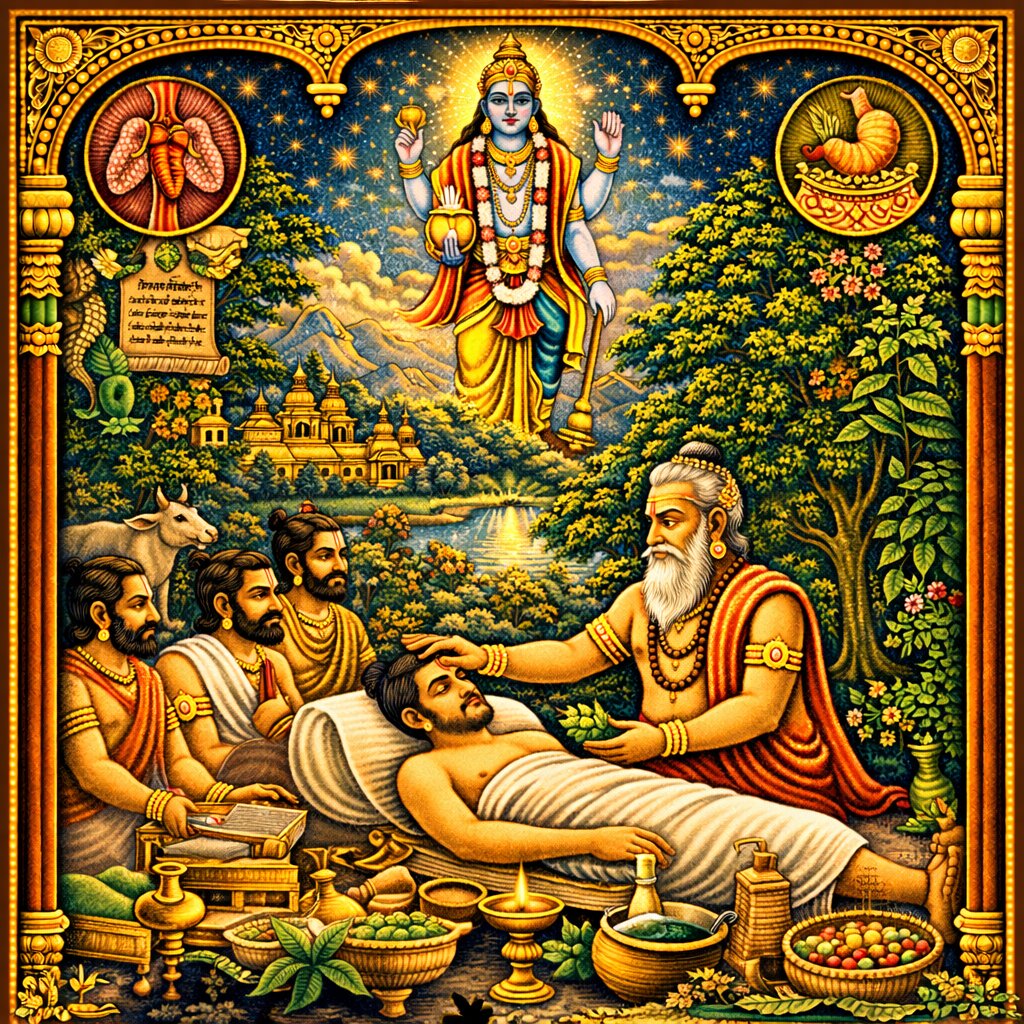
This chapter presents Ayurveda as a protective royal science: Dhanvantari teaches that mastery of rasa (taste), vīrya (potency), and vipāka (post-digestive effect), along with discernment of prabhāva (a specific, sometimes indescribable action), enables a physician to safeguard kings and society. It classifies the six tastes by Soma- and Agni-origins, defines vipāka as threefold and vīrya as hot/cold, and explains exceptions—such as honey being sweet in rasa yet pungent in vipāka—through prabhāva. The text then turns to pharmacy: standard reduction ratios for kaṣāya/kvātha decoctions, principles for snehapāka (medicated fats) and lehya (electuaries), and individualized dosing by age, season, strength, digestive fire (agni), region, substance, and disease. Finally it expands into regimen and prevention: the upastambha triad (food, sleep, sexual conduct), nourishing versus depleting therapies, seasonal rules for massage and exercise, and dietary purity as the root support of agni and human strength—uniting medical technique with disciplined dharmic living.
Adhyaya 281
Vṛkṣāyurveda (The Science of Plant-Life) — Tree Placement, Muhūrta, Irrigation, Spacing, and Plant Remedies
This chapter turns from the discussion of tastes (rasa) to Vṛkṣāyurveda, presenting horticulture as a dhārmic science. Dhanvantari teaches auspicious tree placement by direction—plakṣa to the north, vaṭa to the east, mango to the south, aśvattha to the west/waterside—warns against thorny growth on the southern side, and prescribes remedial planting of sesame or flowering plants. Planting is to be done with consecratory worship: honoring a brāhmaṇa, the Moon, fixed stars, the directions, and specific divine aspects, choosing proper nakṣatras, and carefully tending the roots. For the site’s prosperity, water management is ritualized by channeling streams and building a lotus-pond, with favorable lunar mansions listed for beginning reservoirs. Practical guidance follows on seasonal irrigation, optimal and medium spacing, limits on transplanting, and pruning to prevent fruitlessness. The chapter ends with plant-therapeutic recipes—vidanga mixed with ghee as a paste, grain/legume adjuncts, milk-and-ghee irrigation, dung and flour amendments, fermented meat-water, and fish-water—to restore vigor, check disease, and promote flowering and fruiting.
Adhyaya 282
Chapter 282 — नानारोगहराण्यौषधानि (Medicines that Remove Various Diseases)
Set within the Agneya encyclopedic frame and credited to Dhanvantari’s medical authority, this chapter compiles handbook-style remedies for many diseases. It opens with pediatric care—decoctions and linctuses for infant diarrhea, milk-related disorders, cough, vomiting, and fever—then adds medhya (intellect-promoting) tonics and anti-krimi (anti-helminthic) recipes. It proceeds through key Ayurvedic routes of administration: nasya for epistaxis and cervical swellings, ear-filling for otalgia, kavala/gargles for tongue and mouth disorders, and external therapies (udvartana, lepa, wick dressings, medicated oils) for skin disease and wounds. Systemic conditions addressed include prameha, vāta-śoṇita (gout-like), grahaṇī, pāṇḍu with kāmala, raktapitta, kṣaya, vidradhi, bhagandara, dysuria and urinary stones, edema, gulma, and visarpa. The closing verses turn to triphalā-centered longevity claims in a rasāyana vein and to siddhi-oriented ritual-technical notes (fumigation, marvel displays, ṣaṭkarman), reflecting the Purāṇa’s characteristic synthesis of medicine, ritual power, and the puruṣārthas.
Adhyaya 283
Chapter 283 — Mantras as Medicine (मन्त्ररूपौषधकथनम्)
Spoken by Dhanvantari, this adhyāya recasts medicine as mantra-cikitsā, presenting sacred sound as a direct remedy for āyus (lifespan), ārogya (freedom from disease), and protection in specific life-situations. Oṃ is proclaimed the supreme mantra, and Gāyatrī is praised for granting both bhukti (worldly enjoyment) and mukti (liberation), establishing that health and liberation are allied fruits. The chapter then emphasizes Viṣṇu/Nārāyaṇa mantras and selected divine names for nāma-japa as context-sensitive medicines: for victory, learning (vidyā), removal of fear, relief of eye-disease, safety in battle, crossing water, protection from nightmares, and help in dangers such as burning. A key doctrinal turn declares benevolence toward beings and dharma itself to be the “great medicine,” making ethical conduct integral to healing. It concludes that even a single divine name, rightly applied, can accomplish the intended therapeutic or protective aim.
Adhyaya 284
मृतसञ्जीवनीकरसिद्धयोगः (Mṛtasañjīvanī-kara Siddha-yogaḥ) — Perfected Formulations for Revivification and Disease-Conquest
This chapter formally shifts from mantra-formed medicines to an Ayurvedic compendium of siddha-yogas (perfected formulations) attributed to Ātreya and re-taught by Dhanvantari. Encyclopedic and practical in aim, it catalogs treatment protocols for major disease clusters—jvara (fever), kāsa-śvāsa-hikka (cough, dyspnea, hiccup), arocana (loss of appetite), chardi-tṛṣṇā (vomiting and thirst), kuṣṭha and visphoṭa (skin diseases and eruptions), vraṇa and nāḍī/bhagandara (wounds and fistula/ano-rectal abscess), āmavāta and vāta-śoṇita, śotha (edema), arśas (hemorrhoids), atīsāra (diarrhea), kṣaya (consumption), women’s disorders, and eye diseases. Formulas are arranged by dosage forms and procedures: kvātha (decoction), cūrṇa (powder), ghṛta (medicated ghee), taila (medicated oil), lepa (paste), guṭikā (pills), añjana (collyrium), nasya, seka (affusion), and the cleansing therapies of vamana and virecana. The chapter concludes by exalting purgation—especially the ‘Nārāca’ formulation—as foremost, and by affirming (as Suśruta attests) these siddha-yogas as universal destroyers of disease, preserving life in accord with dharma and sustaining one’s capacity for sādhanā.
Adhyaya 285
Kalpasāgara (Ocean of Formulations) — Mṛtyuñjaya Preparations and Rasāyana Regimens
This chapter notes the completion of the prior adhyāya on Mṛtasañjīvanī (“Reviver-from-death”) and introduces the present section as Kalpasāgara, an “ocean” of medical formulations. Speaking as Dhanvantari, the archetypal physician, it sets forth Mṛtyuñjaya-type preparations for āyurdāna (bestowing longevity) and rogaghna (destroying disease). Rasāyana routines are emphasized: Triphalā in graduated doses; nasya (nasal instillation) with bilva oil, sesame oil, and kaṭutumbī oil over prescribed periods; and long-term ingestion regimens using vehicles such as honey, ghee, and milk. Numerous botanicals and mineral/metal medicines are listed (nirguṇḍī, bhṛṅgarāja, aśvagandhā, śatāvarī, khadira, neem-pañcaka; plus calcined copper and sulphur with kumārikā), often bound to strict diet-frames (milk or milk-rice). The chapter culminates with options for administering Yogarājaka and explicit mantra-empowerment (“oṃ hrūṃ sa”), and closes by declaring these kalpas revered even by gods and sages, leading onward to the wider Ayurvedic tradition, including Pālakāpya’s gaja-āyurveda.
Adhyaya 286
अध्यायः २८६ — गजचिकित्सा (Elephant Medicine)
This chapter formally transitions from the previous adhyāya and introduces gaja-cikitsā (elephant medicine) as a specialized Ayurvedic science vital to royal stables and battlefield success. Speaking as Pālakāpya to Lomapāda, it defines auspicious, service-worthy elephant marks (lakṣaṇa)—nail count, musth seasonality, tusk asymmetry, voice quality, ear breadth, and skin speckling—while rejecting dwarfish or malformed types. It then ties elephant management to rājadharma and military victory, stressing that conquest depends on disciplined war-elephants and orderly camp regulation. Treatment is presented in practical order: preparing a draft-free, oleation-ready space; topical procedures (shoulder therapies, massage); internal medicines (ghee/oil preparations, decoctions, milk, meat-broth); and targeted remedies for specific disorders—pāṇḍu-like pallor, ānāha distension, fainting, headache (including nasya), foot ailments, tremors, diarrhea, ear swelling, throat obstruction, urinary retention, skin disease, worm disorders, consumption-like states, colic, and abscess care (incision through oleation/enema). Diet and regimen conclude the medical teaching (grain hierarchy, strength-promoting feeds, seasonal sprinkling), alongside a martial-ritual layer: victory fumigation, eye-washes and collyrium, and mantra-linked empowerment of the eyes—showing the Agni Purāṇa’s characteristic fusion of medicine, warfare science, and sacred efficacy.
Adhyaya 287
अश्ववाहनसारः (Aśvavāhana-sāra) — Essentials of Horses as Mounts (and Horse-Treatment)
Spoken by Dhanvantari, this chapter treats the horse as a dharmic means of prosperity and protection: acquiring and maintaining horses supports dharma, kāma, and artha. It begins with auspicious timing for initiating and employing horses—nakṣatras Aśvinī, Śravaṇa, Hasta, and the three Uttarās, and the favorable seasons Hemanta, Śiśira, and Vasanta—then turns to ethical, practical handling: avoid cruelty and dangerous terrain, and train gradually through controlled rein-work rather than sudden striking. A substantial middle section blends martial riding with ritual safeguarding, including nyāsa-like deity placements on the body and specific mantra-use for disturbances such as inauspicious neighing and the condition called sādī. The latter portion systematizes training mechanics—seat, rein coordination, turning, restraint methods, and named techniques—along with early veterinary measures (topical paste for fatigue and insect bites; feeding gruel for certain breeds). It concludes with horse typologies (Bhadra, Manda, Mṛgajaṅgha, Saṅkīrṇa), auspicious and inauspicious signs, and a promise to teach equine characteristics in the Śālihotra tradition.
Adhyaya 288
Chapter 288 — अश्वचिकित्सा (Aśva-cikitsā) | Horse-Medicine (Śālihotra to Suśruta)
This chapter records Śālihotra’s teaching to Suśruta on equine science within Ayurveda. It opens with aśva-lakṣaṇa—judging auspicious and inauspicious horses by bodily marks, coat-color types, and the placement of hair-whorls (āvarta), with cautions about malignant influences (graha/rākṣā). It then turns to cikitsā, giving remedies and procedures for common equine disorders: colic, diarrhea/atisāra, fatigue, koṣṭha ailments treated with venesection, cough, fever, swelling, throat constriction (galagraha), tongue stiffness, itching, traumatic wounds, and genito-urinary diseases (including raktameha). Therapies include decoctions, pastes (lepa/kalka), medicated oils, nasya, basti, leeching, sprinkling/irrigation, and dietary regulation. The chapter concludes with seasonal regimen (ṛtu-caryā): post-drinks (pratipāna), seasonal use of ghee/oil/yamaka, restrictions after oleation, watering and bathing schedules, stable management, and feeding—linking animal welfare to dhārmic order and auspicious results.
Adhyaya 289
Aśvāyurveda (Medical Science of Horses)
This chapter serves as a heading and bridge into the specialized Ayurvedic field of veterinary medicine, marking the section as Aśvāyurveda within the Agni Purana’s encyclopedic curriculum. In the Agneya Vidyā framework, the care of horses is not merely practical; it is affirmed as a legitimate science that upholds dharma by safeguarding livelihood, mobility, and royal or communal stability. Its placement indicates that Purāṇic medical knowledge extends beyond human therapy to species-specific health management, preparing the reader for subsequent procedural and pacificatory methods. In the Purana’s systematic pedagogy, technical instruction is framed as sacred knowledge—where right practice, right timing, and right intention harmonize bodily welfare with cosmic order.
Adhyaya 290
Chapter 290 — गजशान्तिः (Gaja-śānti: Elephant-Pacification Rite)
Following the close of Aśva-śānti, this chapter sets out Śālihotra’s gaja-śānti, an applied Ayurvedic-veterinary and royal-protective rite to quell elephant diseases and avert inauspicious results. It begins with choosing the proper time (pañcamī) and a full cycle of invocations—Viṣṇu and Śrī, major deities, cosmic regulators, and Nāga lineages. A lotus mandala is then laid out with exact placements of deities, astras (divine weapons), directional gods, and elements, with outer circles for ṛṣis, sūtra-authors, rivers, and mountains, joining cosmology to therapeutic intent. Ritual implements (kumbhas with four streams, banners, toranas) and offerings (herbs and ghee oblations—hundreds per deity) are prescribed, followed by dismissal and dakṣiṇā, including payment to specialist veterinarians. Mantra-recitation while mounting a female elephant, a royal consecratory sequence, and a protective address to the “Śrīgaja” establish the elephant as the king’s dharmic guardian in battle, travel, and home. The chapter ends with courtly arrangements: honoring elephant officers and attendants, and sounding the ḍiṇḍima (kettledrum) as an auspicious public signal.
Adhyaya 291
Chapter 291 — Śāntyāyurveda (Ayurveda for Pacificatory Rites): Go-śānti, Penance-Regimens, and Therapeutics (incl. Veterinary Care)
This chapter turns from the close of Gaja-śānti to a cow-centered Śānti-Ayurveda, treating bovine welfare as a king’s moral duty and a cosmological support of the worlds. Dhanvantari affirms the sanctity of cows and the purifying power of pañcagavya-type substances (urine, dung, milk, curd, ghee, and kuśa-water) to remove misfortune, evil dreams, and impurity. It then sets out graded expiations—one-night fasting, Mahā-sāntapana, and kṛcchra variants (taptakṛcchra/śītakṛcchra)—along with the Govrata vow that aligns daily conduct with bovine rhythms, culminating in merit directed toward Goloka. After praising cows as ritual infrastructure (havis, agnihotra, refuge of beings), the text moves into therapeutics (cikitsā): remedies for horn disease, earache, toothache, throat obstruction, vāta disorders, diarrhea, cough/dyspnoea, fractures, kapha conditions, blood disorders, calf nourishment, and anti-graha/anti-poison fumigation. It concludes with calendrical śānti worship of Hari, Rudra, Sūrya, Śrī, and Agni, gifts and release of cows, and a lineage note on specialized veterinary āyurvedas for horses and elephants.
Adhyaya 292
Mantra-paribhāṣā (Technical Definitions and Operational Rules of Mantras)
Agni defines mantra-science as a discipline yielding both bhukti (worldly enjoyment) and mukti (liberation), and opens with a structural taxonomy: bīja-mantras versus longer mālā-mantras, including the syllable-count thresholds that bear siddhi. He then classifies mantras by grammatical gender and by energetic type (Agneya/fiery vs Saumya/gentle), explaining how endings such as “namaḥ” and “phaṭ” can alter a mantra’s operative force for pacificatory or coercive rites (including uccāṭana and binding contexts) under stated restrictions. The chapter turns to praxis—wakeful states, auspicious phonetic beginnings, and omens/arrangements involving script (lipi) and nakṣatra ordering—and stresses that mantra-perfection arises through disciplined sādhanā (japa, pūjā, homa, abhiṣeka) received by proper dīkṣā and guru-transmission, with strict ethical qualifications for both guru and disciple. Finally it codifies applied ritual mechanics: proportional japa counts and homa fractions, modes of recitation from loud to mental, orientation and place-selection, tithi/weekday deities, and detailed nyāsa (lipi-nyāsa, aṅga-nyāsa, mātṛkā-nyāsa), culminating in Vāgīśī/Lipi-devī as the empowering principle by which all mantras become siddhi-giving.
Adhyaya 293
Mantra-paribhāṣā (मन्त्रपरिभाषा) — Colophon/Closure
This adhyaya serves as the formal colophon closing the instructional unit “Mantra-paribhāṣā,” marking the completion of a technical exposition on mantra terms and definitions within the Agneya system of practice. In the wider encyclopedic movement of the Agni Purana, such closures are not merely scribal: they signal a transition from mantra-śāstra (the theory and correct use of sacred speech) to an applied sphere where mantra, timing, and diagnosis meet embodied crisis-management (āyurveda and viṣa-cikitsā). The text thus preserves continuity between proper linguistic/ritual method and its pragmatic deployment for protection and healing—an Agneya hallmark in which śabda (mantra) becomes an instrument of dharma in worldly emergencies.
Adhyaya 294
Daṣṭa-cikitsā (Treatment for Bites) — Mantra-Dhyāna-Auṣadha Protocols for Viṣa
Lord Agni opens a specialized Ayurveda section on daṣṭa-cikitsā (treatment of bites and stings), teaching a threefold therapy of mantra (sacred recitation), dhyāna (meditative visualization), and auṣadha (medicinal administration). He first grounds clinical urgency in devotional power: japa of “Oṃ namo bhagavate Nīlakaṇṭhāya” is said to lessen poison and safeguard life, then viṣa is classified as jaṅgama (mobile, animal-origin—snakes, insects) and sthāvara (immobile, plant/mineral-origin). Agni then details a ritual-therapeutic system centered on the Viyati/Tārkṣya (Garuḍa) mantra, including tonal/phonetic distinctions, kavaca and astra-mantras, yantra/maṇḍala visualization (the mātṛkā-lotus), and precise nyāsa on fingers and bodily joints. Five-element schemata (earth, water, fire, wind, ether) with colors, forms, and presiding deities support a controlled “reversal/interchange” logic to immobilize, transfer, and destroy poison. The chapter concludes with Garuḍa and Rudra/Nīlakaṇṭha mantras, ear-whisper recitation (karṇa-jāpa), protective binding (upānahāva), and Rudra-vidhāna worship, framing anti-venom practice as both medical treatment and dhārmic rite.
Adhyaya 295
Pañcāṅga-Rudra-vidhāna (The Fivefold Rudra Rite)
After the prior medical discussion on treating bites and stings, Lord Agni teaches the Pañcāṅga-Rudra-vidhāna, a fivefold Rudra rite said to bestow results universally yet aimed specifically at protection from poison and disease. It defines Rudra’s “five limbs” in ritual-technical terms—hṛdaya (heart/hymn), śiva-saṅkalpa, śiva-mantra, sūkta, and pauruṣa—and grounds the practice in nyāsa and sequential japa. The chapter then maps mantra components scholastically: naming the ṛṣi, the chandas (Triṣṭubh, Anuṣṭubh, Gāyatrī, Jagatī, Paṅkti, Vṛhatī), and devatā assignments, including liṅga-based devatā selection and anuvāka-wise Rudra typologies (Eka-Rudra, Rudra/Rudras). It culminates in therapeutic uses: trailokya-mohana as suppression of enemy/poison/disease, followed by 12- and 8-syllabled Viṣṇu–Narasiṃha mantras proclaimed destroyers of visha-vyādhi. Further named mantras (Kubjikā, Tripurā, Gaurī, Candrikā, Viṣahāriṇī) and a “Prasāda-mantra” are given to enhance longevity and health, extending the Ayurveda layer through mantra-based prophylaxis.
Adhyaya 296
Chapter 296 — Viṣa-cikitsā: Mantras and Antidotes for Poison, Stings, and Snake-bite
In this Ayurveda chapter, Lord Agni teaches Vasiṣṭha a compact toxicology regimen (viṣa-cikitsā) that unites mantra-prayoga with urgent clinical measures and herbal preparations. The opening verses give poison-neutralizing mantras for artificial or administered poisons, varied toxins, and envenomation, pictured as drawing out “cloud-like darkness” (spreading venom) and sealing/retaining it at the mantra’s close. A second formula is presented as sarvārtha-sādhaka, blending bīja-mantras with Vaiṣṇava emblems and an invocation of Kṛṣṇa. A third, the “Pātāla-kṣobha” mantra to Rudra as lord of preta-hosts, is prescribed for swift neutralization in stings and snake-bites, even sudden contact poisoning. The chapter then turns to applied treatment: excision or cautery of the bite-mark, followed by antidotal compounds featuring śirīṣa, arka latex, pungent spices, and multi-route use (drink, paste, collyrium, and nasya).
Adhyaya 297
Vishahṛn Mantrauṣadham (Poison-Removing Mantra and Medicinal Remedy) — Colophon and Transition
This chapter ends with a formal colophon identifying the subject as a poison-removing system that unites mantra and medicine. In the Agni–Vasiṣṭha dialogue, technical knowledge is authenticated as revelation, preparing the reader for the next, more detailed therapeutic chapter. The transition serves as an encyclopedic hinge, moving from general antidotal principles to creature-specific protocols, especially for serpent envenomation. The framing affirms that Agneya Vidyā is a single continuum of dharma-guided healthcare—mantric authority, correct procedure, and applied pharmacology together.
Adhyaya 298
Bala-graha-hara Bāla-tantram (बालग्रहहर बालतन्त्रम्) — Pediatric protection and graha-affliction management
Lord Agni opens a pediatric bāla-tantra on bala-grahas—harmful “seizing” forces believed to afflict infants from birth. The chapter sets out a diagnostic and procedural order: (1) note signs such as restless limbs, anorexia, neck-twisting, abnormal cries, breathing distress, discoloration, foul odor, spasms, vomiting, fear, delirium, and blood-tinged urine; (2) determine the specific graha or time-marker (tithi/day-count, monthly and annual stages) linked to symptom clusters; and (3) apply integrated measures—ointments/pastes (lepa), fumigations (dhūpa), bathing (snāna), lamps and incense, direction- or site-based rites (e.g., under a karañja tree in Yama’s direction), and bali offerings with prescribed foods/substances (fish, meat, liquor, pulses, sesame preparations, sweets) or, for certain classes, “foodless” foul offerings. It culminates in protective mantras to Cāmuṇḍā as universal (sarva-kāmika) safeguards during bali-dāna, showing Agni’s methodical transmission of applied Ayurveda interwoven with ritual prophylaxis to restore child health and household security within dharma.
Adhyaya 299
Chapter 299 — ग्रहहृन्मन्त्रादिकम् (Grahahṛn-Mantras and Allied Procedures)
Lord Agni moves from child-protective graha-expulsion rites to a broader clinical-ritual manual on graha afflictions, detailing causes, vulnerable places, diagnostic signs, and integrated remedies. Certain mental disturbances and disease states are traced to emotional excess and dietary incompatibility, while insanity-like conditions are classified by doṣic origin, sannipāta, and āgantuka factors linked to divine or teacher displeasure. The chapter maps graha habitats—rivers, confluences, empty houses, broken thresholds, solitary trees—and warns that social-ritual transgressions and ominous conduct heighten risk. Symptom clusters such as agitation, burning pain, head pain, compulsive begging, and sensual craving serve as markers. Therapeutically, Agni gives graha-crushing Caṇḍī mantras (e.g., Mahāsudarśana) and a detailed ritual technology: solar-disc visualization, sunrise arghya, bīja-nyāsa, astra purification, pīṭha and śakti placements, and directional protections. The medical layer concludes with practical formulations—nasya/añjana with goat’s urine, medicated ghee and decoctions—for fever, dyspnea, hiccup, cough, and apasmāra, presenting Agneya Vidyā as mantra-chikitsā integrated with Ayurveda.
Adhyaya 300
Chapter 300 — सूर्यार्चनम् (Worship of Sūrya)
Lord Agni teaches a concentrated upāsanā of Sūrya (Sūrya-arcana) as a siddhi-yielding discipline that pacifies graha influences, giving a condensed bīja-formula (piṇḍa) said to accomplish comprehensive aims. He explains bīja-construction (limb-components and completion by bindu) and incorporates Gaṇeśa’s five bīja-sets as universal preliminaries: directional worship, mūrti placements, mudrā sealing, iconographic marks (red form, implements, hand-configuration), and observances such as Caturthī. The rite expands into a solar–graha matrix—bathing, arghya offerings, worship of the nine grahas with nine mantra-consecrated water-pots, and specific offerings (a lamp for Caṇḍā; gorocanā, saffron, red perfume, sprouts; grains and hibiscus-linked gifts). Stated results include graha-śānti, victory in conflict, correction of lineage/seed defects, and influence-rites through mantra-installed touch and charged substances (e.g., vetiver). Nyāsa from head to feet and self-identification with Ravi complete the practice, while color-coded visualizations align intentions such as stambhana/māraṇa, puṣṭi, enemy-striking, and mohana. Thus Sūrya worship is presented as a bridge between devotion and applied efficacy within Agneya Vidyā.