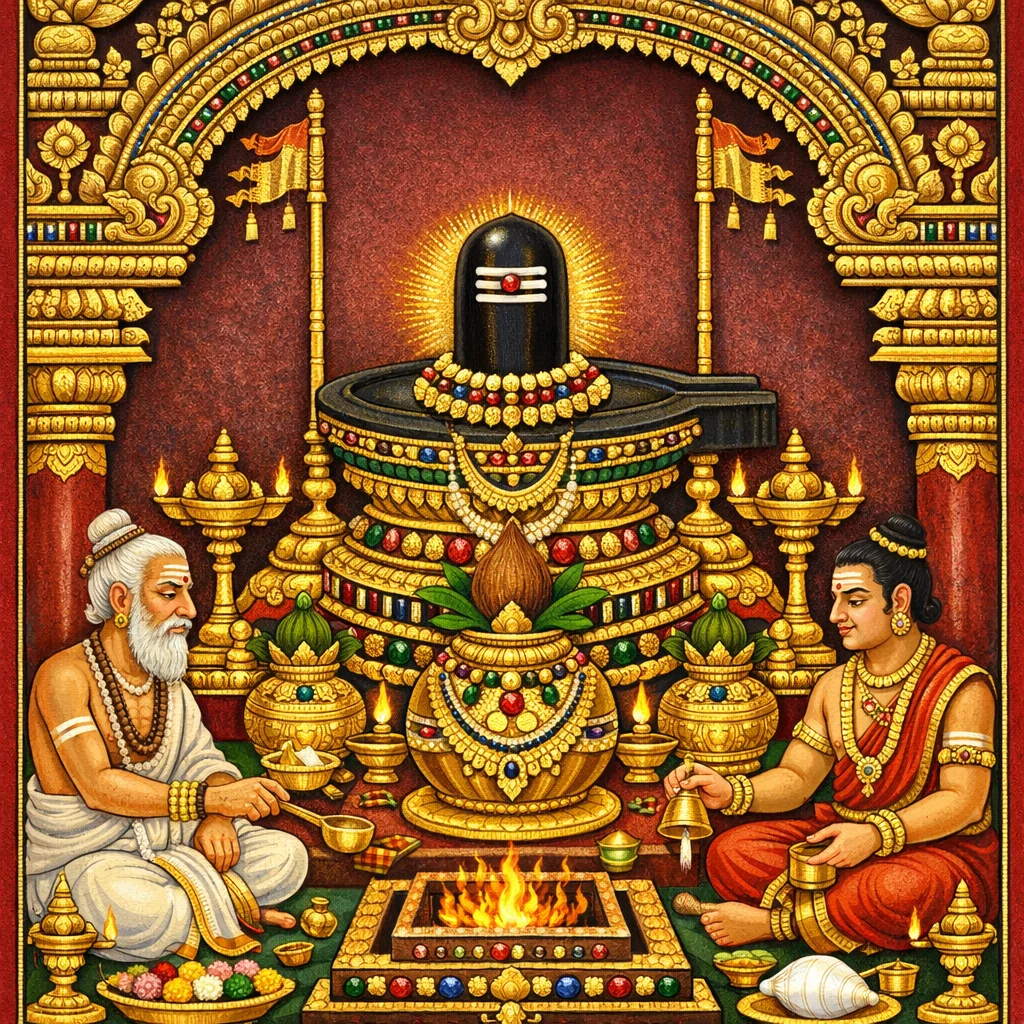
Adhyaya 95
Pratiṣṭhā-sāmagrī-vidhāna — Prescription of Materials and Conditions for Consecration
In this chapter, Īśvara teaches the pratiṣṭhā of installing the Liṅga in a temple as a rite that bestows both worldly enjoyment and liberation, when performed on an auspicious “divine day” under supportive astrological conditions. It first fixes ritual timing: a Māgha-based five‑month window (excluding Caitra), suitable tithis, rules of avoidance, and favored nakṣatras and lagnas. It then explains planetary placements, aspects, and house-based beneficence, linking success to jyotiṣa diagnostics. Next it moves from time to space: auxiliary land allotment, maṇḍapa layout, the square vedī with its post, and the number, placement, shapes, and measurements of kuṇḍas and mekhalās, including the yoni feature and its directional orientation. Finally it catalogs consecration materials (sāmagrī): toraṇas, banners, poles, sacred earths, astringents, waters, medicinal roots, protective and cleansing substances, kumbhas and their arrangements, homa implements, offerings, gifts to the ācārya, and lists of gems, metals, minerals, and grains—presenting consecration as an integrated technology of sanctity across cosmos, site, and substance.
Shlokas
Verse 1
इत्य् आदिमहापुराणे आग्नेये शिलान्यासकथनं नाम चतुर्णवतितमो ऽध्यायः अथ पञ्चनवतितमो ऽध्यायः प्रतिष्ठा सामग्रीविधानं ईश्वर उवाच वक्ष्ये लिङ्गप्रतिष्ठां च प्रासादे भुक्तिमुक्तिदां ताश् चरेत् सर्वदा मुक्तौ भुक्तौ देवदिने सति
Thus, in the Agni Purāṇa, within the primordial Mahāpurāṇa, ends the ninety-fourth chapter entitled “The account of laying the foundation-stone (śilānyāsa).” Now begins the ninety-fifth chapter: “The prescription of the materials for consecration (pratiṣṭhā).” The Lord (Īśvara) said: “I shall explain the installation of the Liṅga in a temple, an act that bestows both worldly enjoyment and liberation. These rites should always be performed when an auspicious divine day is present, for the attainment of both enjoyment and release.”
Verse 2
विना चैत्रेण माघादौ प्रतिष्ठा मासपञ्चके रक्तातिरक्तदोषघ्न इति छ रक्तात्रिरक्तदोषघ्ने इति ख सन्तिष्ठास्मिन्नीशरूपिणीति घ शर्परूपिणीति ज तत्त्वे तत्त्वत्रयमिति घ सर्वदा मुक्तौ देवादेवे ग्रहे सतीति घ सर्वदा मुक्त्यै भुक्त्यै दैवदिने सतीति ङ गुरुशुक्रोदये कार्या प्रथमे करणेत्रये
Excluding the month of Caitra, the consecratory installation (pratiṣṭhā) is to be performed within the five-month period beginning with Māgha. It should be undertaken when the astrological defect called “Rakta/Ati-rakta” has been neutralized. One should establish (the deity) here in the form of Īśa (Śiva)—or, according to a variant reading, in the form of Śarpa (serpent). In the tattva doctrine, the triad of principles is to be contemplated. For liberation it is always auspicious when benefic or divine planets are present; and for both liberation and worldly enjoyment, when it falls on a “divine day” (deva-dina). The rite should be carried out at the rising of Jupiter and Venus, and in the first three karaṇas.
Verse 3
शुक्लपक्षे विशेषेण कृष्णे वा पञ्चमन्दिनं चतुर्थीं नवमीं षष्ठीं वर्जयित्वा चतुर्दशीं
Especially in the bright fortnight (śukla-pakṣa)—or also in the dark fortnight (kṛṣṇa-pakṣa)—the rite should be observed on the fifth lunar day (pañcamī), avoiding the fourth, the sixth, the ninth, and also the fourteenth.
Verse 4
शोभनास्तिथयः शषाः क्रूरवारविवर्जिताः शतभिषा धनिष्ठार्द्रा अनुरोधोत्तरत्रयं
The auspicious lunar days (tithis) are six, excluding the so-called cruel weekdays (krūra-vāra). The auspicious nakṣatras are Śatabhiṣā, Dhaniṣṭhā, Ārdrā, Anurādhā, and the three Uttaras (Uttara-traya).
Verse 5
रोहिणी श्रवणश्चेति स्थिरारम्भे महोदयाः लग्नञ्च कुम्भसिंहालितुलास्त्रीवृषधन्विनां
For commencing works that are stable and enduring, the nakṣatras Rohiṇī and Śravaṇa are greatly auspicious; likewise the ascendants (lagnas) of Aquarius, Leo, Libra, Virgo, Taurus, and Sagittarius are favorable.
Verse 6
शस्तो जीवो नवर्क्षेषु सप्तस्थानेषु सर्वदा बुधः षडष्टदिक्सप्ततुर्येषु विनर्तुं शितः
Jupiter is auspicious in the ninth sign and is ever benefic in the seventh place; Mercury is auspicious in the sixth and the eighth; and Venus, being radiant, is to be understood as auspicious with respect to the directions—namely in the seventh and the fourth.
Verse 7
सप्तर्तुत्रिदशादिस्थः शशाङ्कोबलदः सदा रविर्दशत्रिषट्संस्थो राहुस्त्रिदशषड्गतः
The Moon, stationed in the seventh place and at the beginning of the thirtieth division, ever bestows strength. The Sun is situated in the tenth, third, and sixth positions; and Rāhu occupies the thirtieth and the sixth.
Verse 8
षट्त्रिस्थानगताः शस्ता मन्दाङ्गारार्ककेतवः शुभ्राः क्रूरश् च पापाश् च सर्व एकादशस्थिताः
Saturn, Mars, the Sun, and Ketu are deemed auspicious when placed in the sixth and the third positions; and all planets—whether benefic, cruel, or malefic—are also spoken of as operating with reference to the eleven positions (i.e., the eleven houses/conditions).
Verse 9
एषां दृष्टिर्मुनौ पूर्णा त्वार्धिकी ग्रहभूतयोः पादिकी रामदिक्स्थाने चतुरष्टौ पादवर्जिता
For these forces, the aspect (dṛṣṭi) upon the seventh place (muni) is complete; for the grahas and the bhūtas it is half. When situated in the quarter called the Rāma-direction, it becomes a quarter-aspect; and at the fourth and the eighth it lacks one pāda, that is, it is reduced by a quarter.
Verse 10
पादान्यूनचतुर्नाडी भोगः स्यान्मीनमेषयोः वृषकुम्भौ च भुञ्जाते चतस्रः पादवर्जिताः
For Pisces and Aries, the measure of bhoga is four nāḍīs minus one pāda (a quarter). Taurus and Aquarius likewise have a bhoga of four nāḍīs, lacking one pāda.
Verse 11
मकरो मिथुनं पञ्च चापालिहरिकर्कटाः पादीनाः षट् तुलाकन्ये घटिकाः सार्धपञ्च च
For Capricorn and Gemini there are five (units). For Sagittarius, Aries, Leo, and Cancer there are six pādas. For Libra and Virgo there are five and a half ghaṭikās (5½).
Verse 12
इक्सप्तषड् विनेति ख सप्तायत्रिदशादिस्थ इति ख छ च बुधः षडष्टदिगित्यादिः, बलदः सदा इत्य् अन्तः पाठो ग पुस्तके नास्ति एवं दृष्टिवले पूर्णादिति छ एवं दृष्टिवले पूर्णेति ख वस्वष्टौ इति ख, छ च केशरी वृषभः कुम्भः स्थिराः स्युः सिद्धिदायकाः चरा धनुस्तुलामेषा द्विःस्वभावास्तृतीयकाः
Leo, Taurus, and Aquarius are fixed signs and are said to bestow siddhi—accomplishment and success. Sagittarius, Libra, and Aries are movable signs. The third group is of dual nature (the dual signs).
Verse 13
शुभः शुभग्रहैर् दृष्टः शस्तो लग्नःशुभाश्रितः गुरुशुक्रबुधे युक्तो लग्नो दद्याद्बलायुधी
An ascendant (lagna) is auspicious when it is aspected by benefic planets, and it is commendable when it rests in an auspicious sign. When the ascendant is conjoined with Jupiter, Venus, and Mercury, that lagna bestows strength and the power of weapons (martial prowess).
Verse 14
राज्यं शौर्यं बलं पुत्रान् यशोधर्मादिकं बहु प्रथमः सप्तमस्तुर्यो दशमः केन्द्र उच्यते
Sovereignty (rājya), heroism, strength, sons, fame, dharma, and many other such outcomes are indicated through the kendras; the 1st, 4th, 7th, and 10th houses are declared to be kendras (angular houses).
Verse 15
गुरुशुक्रबुधास्तत्र सर्वसिद्धिप्रसादकाः त्र्येकादशचतुर्थस्था लग्नात् पापग्रहाः शुभाः
There, Jupiter (Guru), Venus (Śukra), and Mercury (Budha) bestow the grace that grants every accomplishment. Even malefic planets, when placed in the 3rd, 11th, or 4th house from the lagna (ascendant), become benefic.
Verse 16
अतोप्यनीचकर्माथं योज्यास्तिथ्यादयो बुधैः धाम्नः पञ्चगुणां भूमिं त्यक्त्वा वा धानसम्मितां
Moreover, for works of a lower (subsidiary) kind, the learned should lay out the auxiliary parts beginning with the “sthiti” (the fixed/standing component). Either one should leave aside a plot five times the extent of the main building, or else leave land measured by the standard unit called dhāna.
Verse 17
हस्ताद् द्वादशसोपानात् कुर्यान्मण्डमग्रतः चतुरस्रं चतुर्द्वारं स्नानार्थन्तु तदर्धतः
In front of the twelve-stepped stairway, beginning from the measure of one hasta, one should construct a maṇḍapa (pavilion/platform). It should be square and furnished with four entrances. For bathing purposes, however, it should be made to half that measure.
Verse 18
एकास्यं चतुरास्यं वा रौद्र्यां प्राच्युत्तरेथवा हास्तिको दशहस्तो वै मण्डपोर्ककरो ऽथवा
It may be fashioned with one face or with four faces; in a fierce raudra form, facing east or north. It may be elephant-headed, or indeed ten-armed; or else holding a maṇḍapa (pavilion) or the sun’s radiance (arka).
Verse 19
द्विहस्तोत्तरया वृद्ध्या शेषं स्यान्मण्डपाष्टकं , घ , छ च त्यक्त्वा वा चापसम्मितामिति ख त्यक्त्वा वा रामसम्मितामिति छ हस्ताद्वा दशसोपानादिति ख हस्तान् वा दश सोपानादिति ख स्नानार्हं चेति ङ प्राच्युतरे तथेति ङ द्विहस्तोत्तरयावृत्त्या इति घ वेदी चतुष्करा मध्ये कोणस्तम्भेन संयुता
With an increment of two hastas each time, the remaining prescribed set constitutes the “eightfold” series of maṇḍapas (maṇḍapa-aṣṭaka) in their measurements. The vedī (altar-platform) is to be square, and in its middle it is to be furnished with a corner-pillar/angled post (koṇa-stambha) as a structural member.
Verse 20
वेदीपादान्तरं त्यक्त्वा कुण्डानि नव पञ्च वा एकं वा शिवकाष्ठायां प्राच्यां वा तद्गुरोः परं
Leaving a clear interval between the feet (supports) of the altar-platform, one should arrange the fire-pits (kuṇḍas)—nine, or five, or even a single one—upon an auspicious, ritually pure wooden ground, or else on the eastern side, in accordance with the direction given by one’s guru.
Verse 21
मुष्टिमात्रं शतार्धे स्याच्छते चारत्रिमात्रकं हस्तं सहस्रहोमे स्यान्नियुते तु द्विहास्तिकं
For half of a hundred (50) oblations, the offering-measure is a fistful (mūṣṭi). For a hundred (100), it is the measure of “one night.” For a thousand-homa, it should be one hasta; and for a niyuta (ten thousand), it is two hastas.
Verse 22
लक्षे चतुष्कारं कुण्डं कोटिहोमे ऽष्टहस्तकं भगाभमग्नौ खण्डेन्दु दक्षे त्र्यस्रञ्च नैरृते
For a rite involving one lakh (100,000) oblations, the fire-pit (kuṇḍa) should be four-cornered (square). For a koṭi-homa (ten million oblations), it should measure eight hastas. In the Agni (southeast) quarter it should be shaped as bhagākāra; in the Dakṣiṇa (south) quarter as a khaṇḍendu (“broken moon”); and in the Nairṛta (southwest) quarter it should be triangular.
Verse 23
षडस्रं वायवे पद्मं सौम्ये चाष्टास्रकं शिवे तिर्यक्पातशिवं खातमूर्ध्वं मेखलया सह
For Vāyu, one should draw a lotus with six corners; for Saumya, an eight-cornered diagram; and for Śiva, a diagram with a transverse descent (tiryakpāta). It is to be drawn with a hollowed center and an upward-pointing head, together with a surrounding mekhalā (encircling band).
Verse 24
तद्वहिर्मेखलास्तिस्रो वेदवह्नियमाङ्गुलैः अङ्गुलैः षड्भिरेका वा कुण्डाकारास्तु मेखलाः
Outside that fire-pit, there should be three mekhalās (enclosing bands), measured according to the prescribed aṅgula (finger-unit) standards for the altar and the fire; or alternatively, there may be a single band of six aṅgulas. The mekhalās should conform to the shape of the kuṇḍa.
Verse 25
तासामुपरि योनिः स्यान्मध्ये ऽश्वत्थदलाकृतिः उच्छ्रायेणाङ्गुलं तस्माद्विस्तारेणाङ्गुलाष्टकं
Above the preceding features there should be a yoni; in its middle it is to be shaped like an aśvattha (sacred fig) leaf. Its height is one aṅgula, and its breadth eight aṅgulas.
Verse 26
दैर्घ्यं कुण्डार्धमानेन कुण्डकण्ठसमो ऽधरः पूर्वाग्नियाम्यकुण्डानां योनिः स्यादुत्तरानना
Its length should be measured as half the measure of the main fire‑pit; the lower (rear) part should be equal to the pit’s neck (narrow section). For the eastern, southeastern (Agni), and southern (Yāmya) fire‑pits, the yoni should face north.
Verse 27
पूर्वानना तु शेषाणामैशान्ये ऽन्यतरा तयोः इति ङ द्विहस्तकमिति ख खद्गाभमग्नौ इति ख , ग , ङ , छ च पद्मे इति ख , घ च तिर्यक् पातसममूर्ध्वमिति ख , ग , घ च वेदवह्नियवाङ्गुलैर् इति घ तस्य विस्तरेणाङ्गुलाष्टकमिति घ कुण्डानां यश् चतुर्विंशो भागः सोङ्गुल इत्य् अतः
For the remaining types, the mouth/opening is to face east; in the Īśāna (north‑east) quarter, one of the two alternatives is adopted, as stated in the recension marked “ṅa”. The measure is two hastas (as in “kha”). For the sword‑shaped (khaḍga‑ābha) fire‑pit this is prescribed in the Agni‑rite (according to kha, ga, ṅa, and cha), and likewise for the lotus‑shaped (padma) pit (according to kha and gha). Its upward rise is to be equal to the lateral fall/slope (according to kha, ga, and gha). The measures are to be set out by veda‑, vahni‑, yava‑, and aṅgula‑units (as in gha); and its breadth, in detail, is eight aṅgulas (as in gha). Hence, for fire‑pits, one twenty‑fourth part is called an aṅgula.
Verse 28
प्लक्षोदुम्वरकाश्वत्थवटजास्तोरणाः क्रमात् शान्तिभूतिबलारोग्यपूर्वाद्या नामतः क्रमात्
Door‑garlands (toraṇas) made, in order, from plakṣa, udumbara, kāśvattha (aśvattha), and vaṭa are respectively known—by name and in sequence—as: Śānti (peace), Bhūti (prosperity), Bala (strength), and Ārogya (health).
Verse 29
पञ्चषट्सप्तहस्तानि हस्तखातस्थितानि च तदर्धविस्तराणि स्युर्युतान्याम्रदलादिभिः
They should be made five, six, or seven hastas in length, and set in a trench one hasta deep. Their breadth should be half of that, and they should be joined or covered with mango leaves and the like.
Verse 30
इन्द्रायुधोपमा रक्ता कृष्णा धूम्रा शशिप्रभा शुक्लाभा हेमवर्णा च पताका स्फाटिकोपमा
A banner may be like Indra’s rainbow, red, black, smoky, moon-bright, white-shining, or golden-hued; and the pennon too may appear crystal-like.
Verse 31
पूर्वादितोब्जजे रक्ता नीलानन्तस्य नैरृते पञ्चहस्तास्तदर्धाश् च ध्वजा दीर्घाश् च विस्तराः
From the eastern direction onward the banners are to be red; in the south-west (Nairṛta) they are to be blue. Their length should be five hastas, and their breadth half of that; thus the banners are prescribed as long with proportionate width.
Verse 32
हस्तप्रदेशिता दण्डा ध्वजानां पञ्चहस्तकाः वल्मीकाद्दन्तिदन्ताग्रात्तथा वृषभशृङ्गतः
The staff (pole) is to be measured by the span of the hand; for flags, the pole should be five hastas long. (Such measuring standards are to be taken) from an anthill, from the tip of an elephant’s tusk, and likewise from a bull’s horn.
Verse 33
पद्मषण्डाद्वराहाञ्च गोष्ठादपि चतुष्पथात् मृत्तिका द्वादश ग्राह्या वैकुण्ठेष्टौ पिनाकिनि
From a lotus-grove, from a place associated with Varāha, from a cow-pen, and also from a four-way crossroads—(from such prescribed pure sites) twelve portions of purificatory earth are to be collected, O beloved of Vaikuṇṭha, O bearer of the Pināka (bow).
Verse 34
न्यग्रोधोदुम्वराश्वत्थचूतजम्वुत्वगुद्भवं कषायपञ्चकं ग्राह्यमार्तवञ्च फलाष्टकं
The five astringents (kaṣāya-pañcaka) are to be taken from bark-derived substances of nyagrodha (banyan), udumbara (cluster fig), aśvattha (sacred fig), cūta (mango), and jambū (rose-apple). One should also take the ‘fruit-octad’ (phalāṣṭaka) and the ingredient known as ārtava.
Verse 35
तीर्थाम्भांसि सुगन्धीनि तथा सर्वौषधीजलं शस्तं पुष्पफलं वक्ष्ये रत्नगोशृङ्गवारि च
Sacred waters from tīrthas (pilgrimage-sites), fragrant waters, and likewise water infused with all medicinal herbs are commended; I shall also describe the use of flowers and fruits, as well as water connected with gems and water taken by means of a cow’s horn.
Verse 36
स्नानायापाहरेत् पञ्च पञ्चगव्यामृतं तथा पिष्टनिर्मितवस्त्रादिद्रव्यं निर्मञ्जनाय च
For bathing, one should procure the five products of the cow—pañcagavya—and also the mixture called pañcagavyāmṛta; and for cleansing by rubbing/ablution (nirmañjana), substances such as cloth and the like prepared from a paste (piṣṭa).
Verse 37
वल्मीकाद्धस्तिदन्ताग्रात्तयेति छ तीर्थतोयसुगन्धीनि इति ङ वर्गे गोशृङ्गवारि चेति छ स्नानायोपहरेदिति ख , छ , घ च पिष्टनिर्मितरुद्रादिद्रव्यं निर्मञ्जनायेति ग पिष्टनिर्मितवज्रादिकं निर्मथनायेति ज सहस्रशुषिरं कुम्भं मण्डलाय च रोचना शतमोषधिमूलानां विजया लक्ष्मणा बला
One should procure ritual requisites such as earth from an anthill (valmīka) and the tip of an elephant’s tusk; fragrant waters from sacred bathing-places (tīrthas); and water taken by means of a cow’s horn—these are to be brought for bathing. A paste-made (piṣṭa-nirmita) Rudra and similar sacred substances are prescribed for cleansing by rubbing (nirmañjana), and a paste-made vajra and the like for churning/producing (nirmathana). For drawing the maṇḍala, a kumbha (pot) with a thousand perforations is to be used, along with the yellow pigment rocanā; and one should also prepare the roots of a hundred medicinal herbs, such as vijayā, lakṣmaṇā, and balā.
Verse 38
गुडूच्यतिबला पाठा सहदेवा शतावरी ऋद्धिः सुवर्चसा वृद्धिः स्नाने प्रोक्ता पृथक् पृथक्
For bathing, as medicated bath-additives, Gudūcī, Atibalā, Pāṭhā, Sahadevī, Śatāvarī, Ṛddhi, Suvarcasā, and Vṛddhi are prescribed, each separately (each may be used individually).
Verse 39
रक्षायै तिलदर्भौघो भस्मस्नानन्तु केवलं यवगोधूमविल्वानां चूर्णानि च विचक्षणः
For protection, one should employ a mass of sesame and darbha-grass; and bathing with ash alone is also prescribed. The discerning person should moreover use the powders of barley, wheat, and bilva.
Verse 40
विलेपनं सकर्पूरं स्नानार्थं कुम्भगण्डकान् खट्वाञ्च तूलिकायुग्मं सोपधानं सवस्त्रकं
One should offer fragrant unguent mixed with camphor; for bathing, a water-pot (kumbha) and a soap-like bathing ball; and also a bed with a pair of mattresses, together with a pillow and with cloth (garments or sheets).
Verse 41
कुर्याद्वित्तानुसारेण शयने लक्ष्यकल्पने घृतक्षौद्रयुतं पात्रं कुर्यात् स्वर्णशलाकिकां
According to one’s means, in arranging the gifted bed and preparing the prescribed adjuncts, one should provide a vessel containing ghee mixed with honey, and also supply a small golden rod (probe).
Verse 42
वर्धनीं शिवकुम्भञ्च लोकपालघटानपि एकं निद्राकृते कुम्भं शान्त्यर्थं कुण्डसङ्ख्यया
One should also set up the vardhanī-vessel, the Śiva-kumbha, and the jars of the Lokapālas; additionally, one kumbha is to be arranged for the rite of inducing sleep, and for pacification the kumbhas are to be placed in a number equal to the fire-pits (kuṇḍas).
Verse 43
द्वारपालादिधर्मादिप्रशान्तादिघटानपि वस्तुलक्ष्मीगणेशानां कलशानपरानपि
One should also prepare and place the ritual pots (ghaṭas) for the Dvārapālas (door-guardians), for Dharma and the others, and for Praśānta and the others; likewise, one should arrange other kalaśas belonging to Vāstu, Lakṣmī, and Gaṇeśa as well.
Verse 44
धान्यपुञ्जकृताधारान् सवस्त्रान् स्रग्विभूषितान् कुम्भमण्डकानिति ख कुम्भगड्डुकानिति घ कुम्भगुण्डुकानिति ङ कुम्भसण्डकानिति छ कुम्भखण्डकानिति ज प्रायेण लक्ष्यकल्पने इति ग शयने लक्ष्यकं परे इति ज कुण्डसन्मितमिति ज सर्वांश्चेति घ , ज च सहिरण्यान् समालब्धान् गन्धपानीयपूरितान्
He should arrange the kumbhas upon supports made as heaps of grain, clothed and adorned with garlands. In different recensions these vessels are called kumbha-maṇḍaka, kumbha-gaḍḍuka, kumbha-guṇḍuka, kumbha-saṇḍaka, or kumbha-khaṇḍaka. Generally they are to be set up as the ritual ‘targets/marks’ (lakṣya) for the arrangement; some authorities say they serve as the lakṣya in connection with the bed-rite (śayana). In some readings they are said to be of the measure of a kuṇḍa (fire-pit). All of them should be accompanied by gold, ritually touched as part of consecration, and filled with scented water suitable for offerings.
Verse 45
पूर्णपात्रफलाधारान् पल्लवाद्यान् सलक्षणान् वस्त्रैर् आच्छादयेत् कुम्भानाहरेद्गौरसर्षपान्
One should cover with cloth the properly marked ritual pots (kumbhas), furnished with supports bearing full vessels and fruits, and with sprigs of sacred leaves and the like; and one should bring pale (white/yellow) mustard seeds.
Verse 46
विकिरार्थन्तथा लाजान् ज्ञानखड्गञ्च पूर्ववत् सापिधानां चरुस्थालीं दर्वीं च ताम्रनिर्मितां
Likewise, for the scattering of offerings, one should take parched rice (lāja) and, as stated earlier, the “sword of knowledge”; also a lidded vessel for cooking caru and a ladle—both made of copper.
Verse 47
घृतक्षौद्रान्वितं पात्रं पादाभ्यङ्गकृते तथा विष्टरांस्त्रिशतादर्भदलैर् बाहुप्रमाणकान्
Likewise, one should provide a vessel containing ghee and honey for anointing the feet; and prepare three hundred darbha-leaf seats (viṣṭara), each measuring an arm’s length.
Verse 48
चतुरश् चतुरस्तद्वत् पालाशान् परिधीनपि तिलपात्रं हविःपात्रमर्धपात्रं पवित्रकं
Likewise, one should prepare four (items) and four (more) in the same manner, and also the enclosing sticks (paridhi) of Palāśa wood. One should further provide a sesame vessel, an oblation (havis) vessel, a half-vessel, and the purifier (pavitraka).
Verse 49
फलविंशाष्टमानानि घटो धूपप्रदानकं श्रुक्श्रुवौ पिटकं पीठं व्यजनं शुष्कमिन्धनं
Twenty-eight fruits; a water-pot; an incense-offering vessel; the ladle and spoon (śruk and śruva) for oblations; a basket; a seat or stand (pīṭha); a fan; and dry fuel (firewood).
Verse 50
पुष्पं पत्रं गुग्ग्लञ्च घृतैर् दौपांश् च धूपकं अक्षतानि त्रिसूत्रीञ्च गव्यमाज्यं यवांस्तिलान्
Flowers, leaves, guggulu (fragrant resin), lamps fed with ghee, incense, unbroken rice-grains (akṣata), the threefold sacred thread, cow’s ghee, barley, and sesame seeds—these are the prescribed ritual materials.
Verse 51
कुशाः शान्त्यै त्रिमधुरं समिधो दशपर्विकाः बाहुमात्रश्रुवं हस्तम् अर्कादिग्रहशान्तये
For pacification rites (śānti), one should use kuśa-grass; the sweet oblation called the “three sweets” (trimadhura); and fuel-sticks (samidh) having ten joints. A ladle (śruva) of forearm length, and the hand (as the offering-measure), are prescribed for pacifying the Sun and the other planets.
Verse 52
समिधो ऽर्कपलाशोत्थाः खादिरामार्गपिप्पलाः उदुम्वरशमीदूर्वाकुशोत्थाः शतमष्ट च
The fuel-sticks (samidh) are obtained from arka and palāśa; from khādira, apāmārga, and pippala; and from udumbara, śamī, dūrvā, and kuśa—also numbering one hundred and eight (108).
Verse 53
तदभावे यवतिला गृहोपकरणं तथा स्थालीदर्वीपिधानादि देवादिभ्यो ऽंशुकद्वयं
If those prescribed gifts are unavailable, then barley and sesame may be given, and likewise household implements—such as a cooking pot (sthālī), ladle (darvī), lid, and the like; and to the deities and other recipients, a pair of cloths should be offered.
Verse 54
मुद्रामुकुटवासांसि हारकुण्डलकङ्कणान् ज च कुर्वीत ताम्रनिर्मितामिति ख दलैर् बाहुमात्रप्रमाणत इति ग घण्टाधूपप्रदानकमिति घ , छ च बाहुमात्रां स्रुचं हस्तानामिति छ खादिरापाङ्गपिप्पला इति ख , छ , च खादिरापामार्कपिप्पला इति घ कुर्यादाचार्यपूजार्थं वित्तशाठ्यं विवर्जयेत्
For worship of the preceptor (ācārya), one should prepare ritual insignia and adornments—mudrās, a crown, garments, and ornaments such as a necklace, earrings, and bangles—made of copper, measured to a forearm’s length (bāhumātra), and also provide bell and incense. One should likewise make a forearm-length ritual ladle (sruc) for the hand, from prescribed woods such as khādira, pāṅga, and pippalā—or khādira, apāmārga, and pippalā—according to the stated variants. One should avoid deceit or stinginess regarding wealth in this worship.
Verse 55
तत्पादपादहीना च मूर्तिभृदस्त्रजापिनां पूजा स्याज्जापिभिस्तुल्या विप्रदैवज्ञशिल्पिनां
Even if the icon lacks its feet, the worship performed by those who bear the image and recite weapon-mantras is regarded as equal to the japa practiced by Brahmins, astrologer–diviners, and artisans.
Verse 56
वज्रार्कशान्तौ नीलातिनीलमुक्ताफलानि च पुष्पपद्मादिरागञ्च वैदूर्यं रत्नमष्टमं
Diamond, sunstone, and śānta-gems; sapphire and deep-blue sapphire; pearls; red gems such as puṣparāga and padmarāga; and vaidūrya (cat’s-eye)—these make up the eightfold set of precious gems.
Verse 57
उषीरमाधवक्रान्तारक्तचन्दनकागुरुं श्रीखण्डं सारिकङ्कुष्ठं शङ्क्षिनी ह्योषधीगुणः
The medicinal substances (and their properties) include uśīra (vetiver), mādhavakrāntā, red sandalwood, aguru (aloeswood), śrīkhaṇḍa (sandalwood), sārikā, kuṣṭha (costus), and śaṅkṣiṇī—these indeed are items of materia medica.
Verse 58
हेमताम्रमयं रक्तं राजतञ्च सकांस्यकं शीसकञ्चेति लोहानि हरितालं मनःशिला
Gold, copper, red copper, silver, bell-metal, and lead—these are the metals; also (included are) haritāla (orpiment) and manaḥśilā (realgar).
Verse 59
गैरिकं हेममाक्षीकं पारदो वह्निगैरिकं गन्धकाभ्रकमित्यष्टौ धातवो ब्रीहयस् तथा
Gairika (red ochre), hema (gold), mākṣīka (pyrite), pārada (mercury), vahni-gairika (fire-ochre, i.e., calcined ochre), gandhaka (sulphur), and abhraka (mica)—these are said to be eight mineral substances (dhātavaḥ); likewise, the classification continues with grains such as brīhi (rice).
Verse 60
गोधूमान् सतिलान्माषान्मुद्गानप्याहरेद्यवान् नीवारान् श्यामकानेवं ब्रीहयो ऽप्यष्ट कीर्तिताः
One should also procure wheat, grains mixed with sesame, black gram (māṣa), green gram (mudga), barley, wild rice (nīvāra), and śyāmaka millet; thus, eight varieties of rice/grain are also enumerated.
Frequently Asked Questions
It emphasizes a combined jyotiṣa–vāstu protocol: precise selection of months/tithis/nakṣatras/lagnas and detailed spatial metrics (hasta, aṅgula, nāḍī, ghaṭikā) for maṇḍapa, vedī, and kuṇḍa design—including mekhalā bands and yoni orientation by direction.
By defining Liṅga-pratiṣṭhā as a disciplined synthesis of time, space, and substance, it frames technical correctness as dharma-in-action—so the temple act becomes a sacramental bridge where bhukti (order, prosperity, efficacy) supports mukti (liberation) through consecrated alignment with cosmic law.