Veda-vidhana & Vamsha
Vedic Ordinances & Lineages
The arrangement of the Vedas, their branches (shakhas), transmission lineages, and the genealogies of the great royal and sage dynasties.
Adhyayas in Veda-vidhana & Vamsha
Adhyaya 259
अध्याय १ — यजुर्विधानम् (Agni Purana, Chapter 259: Yajur-vidhāna)
This chapter shifts from Ṛg-vidhāna to Yajur-vidhāna as Puṣkara teaches Rāma that Yajur-based ritual ordinances bestow both bhukti (worldly enjoyment and success) and mukti (liberation), beginning with the primacy of Oṃ and the great Vyāhṛtis. It then serves as a compact ritual encyclopedia, prescribing homa-dravyas (ghee, barley, sesame, grains, curd, milk, pāyasa), samidh (udumbara, apāmārga, palāśa, etc.), and mantra-sets for specific aims—śānti (pacification), pāpa-nāśa (sin-removal), puṣṭi (nourishment), ārogya (health), dhana/lakṣmī (wealth), vaśya/vidveṣa/uccāṭana (influence, hostility, expulsion), victory in battle, protection of weapons and chariots, rainmaking, and warding off thieves, serpents, rākṣasa-forces, and sorcery (abhicāra). The chapter stresses numerical discipline (thousand-fold and lakh/crore homas), timed observances (such as during a lunar eclipse), and domestic/public uses (removing house vāstu-doṣa, pacifying village or regional epidemics, offerings at crossroads). It concludes by affirming Gāyatrī’s Vaiṣṇavī nature as Viṣṇu’s supreme station, placing these pragmatic rites within a purificatory path that upholds dharma and supports ultimate spiritual attainment.
Adhyaya 260
Sāma-vidhāna (Procedure of the Sāman Hymns)
Puṣkara turns from the completed Yajur-vidhāna to the Sāma-vidhāna, presenting Sāma practice as a workable ritual technology for śānti (pacification), protection, and desired attainments. The chapter links specific Saṃhitā-japa (Vaiṣṇavī, Chāndasī, Skandī, Paitryā) and gaṇa-homas (Śāntātīya, Bhaiṣajya, Tri-saptīya, Abhaya, Āyuṣya, Svastyayana, Vāstoṣpati, Raudra, etc.) to results: peace, disease-removal, release from sin, fearlessness, victory, prosperity, fertility, safe travel, and averting untimely death. It notes mantra-variant readings across recensions while prescribing practical adjuncts—ghee offerings, mekhalā-bandha, newborn amulets, the śatāvarī gem, cow-attendance observances, and substances for śānti/puṣṭi and for abhicāra. The chapter closes by affirming procedural orthodoxy: correct viniyoga must specify ṛṣi, devatā, and chandas, and in hostile rites thorny samidh is enjoined, uniting mantra authority with technical execution.
Adhyaya 261
Sāmavidhāna (Procedure concerning the Sāma Veda) — Colophon and Closure
This unit serves as the formal chapter-colophon, declaring the completion of the Sāmavidhāna section in the Agni Mahāpurāṇa by explicitly naming the chapter and its subject. It highlights a methodical, śāstra-like arrangement in which procedures are taught in discrete, thematically bounded modules. The closure also prepares a transition from one Vedic procedural corpus to another, implying continuity in Agni’s instruction: the same commitment to correct vidhāna that governed Sāman usage will now extend to the Atharvan (Atharva Veda) tradition. Within the wider arc of Agneya Vidyā, such colophons affirm that ritual knowledge is not diffuse mythic matter but a structured discipline aimed at dharmic efficacy and inner refinement.
Adhyaya 262
Utpāta-śānti (Pacification of Portents)
This chapter shifts from the earlier Atharva-vidhāna material to a focused manual of utpāta-śānti, prescribing rites to neutralize ominous disturbances affecting kingship, society, and personal welfare. Puṣkara teaches that prosperity and stability are fostered through Vedic hymnology: the Śrīsūkta (with prativeda) is taught as Lakṣmī-vivardhana, supported by Yajurvedic and Sāmavedic Śrī-invocations. It then lays out practical observances—japa, homa, purificatory bathing, charity, and offerings to Viṣṇu—highlighting the Pauruṣa Sūkta as a universal giver and purifier, even for great sins. Next come śānti classifications and three named pacifications (Amṛtā, Abhayā, Saumyā), including deity-linked gem amulets (maṇi) and their mantra consecration. Finally, portents are grouped as celestial, atmospheric, and terrestrial (meteors, halos, abnormal rains, earthquakes, icon phenomena, fire anomalies, tree omens, water corruption, abnormal births, animal inversions, eclipses), with targeted remedies—worship of Prajāpati/Agni/Śiva/Parjanya-Varuṇa—concluding that honoring Brahmins and deities, along with japa and homa, are the core pacifiers.
Adhyaya 263
Devapūjā, Vaiśvadeva Offering, and Bali (देवपूजावैश्वदेवबलिः)
This chapter shifts from utpāta-śānti (the pacifying of portents) to a structured household ritual regimen centered on Viṣṇu. Puṣkara lays out a mantra-governed sequence: ritual bathing with the «Āpo hi ṣṭhā» verses, arghya to Viṣṇu, and specific mantras for pādya, ācamanā, and abhiṣecana. It then consecrates common upacāras—fragrance, cloth, flowers, incense, lamp, madhuparka, and naivedya—showing how offerings are sacralized through Vedic formulas, including the Hiraṇyagarbha set. A homa follows, with purified preparation and a deity-wise order of oblations: Vāsudeva; key Vedic deities (Agni, Soma, Mitra, Varuṇa, Indra); the Viśvedevas; Prajāpati; Anumati; Rāma; Dhanvantari; Vāstoṣpati; the Devī; and Sviṣṭakṛt Agni; thereafter bali is distributed by direction to cosmic regulators and attendant beings. The chapter also integrates bhūta-bali, daily piṇḍa offerings to the pitṛs, symbolic feedings for crows and the two dogs of Yama’s lineage, honoring guests and aiding the needy, and concludes with avayajana expiation mantras—presenting daily worship as social ethics and metaphysical protection.
Adhyaya 264
Chapter 264 — Dikpālādi-snāna (Bathing rites for the Dikpālas and associated deities)
Agni teaches Vasishtha an all-purpose, shanti-producing snana (ritual bath) to be performed at auspicious sites—riverbank, lake, home, temple, or tīrtha—while invoking Vishnu and the Grahas. The chapter links the rite’s efficacy to context-specific aims: relief from fever and graha-afflictions (especially Vinayaka-graha), support for students, success for those seeking victory, and remedies for reproductive misfortune—bathing in a lotus-pond to counter miscarriage, and bathing near an Ashoka tree to end repeated neonatal loss. It prescribes calendrical choice (a Vaishnava day when the Moon is in Revati or Pushya) and a seven-day preparatory cleansing (utsadana). A detailed dravya-vidhi follows: powdered botanicals and aromatics, pañcagavya with barley-flour for udvartana, and herbs infused in a kumbha. The rite culminates in constructing snana-mandalas in the directions and intermediates, inscribing deities (Hara; Indra and the dikpala set with weapons and retinues), worship of Vishnu and a brahmana, and homa with specified offerings, kalasha-names, and invoked deity-groups. The closing exemplum—Indra’s consecration leading to victory over the Daityas—frames the snana as a dharmic technology for auspicious success, especially at the outset of conflict.
Adhyaya 265
Vināyaka-snāna (The Vinayaka Bath) — Obstacle-Removal and Consecratory Bathing Rite
This chapter teaches a specialized snāna/snāpana-vidhi to cure affliction by Vināyaka, a power linked with karmic obstacles and the disruption of successful outcomes. It first lists diagnostic dream-omens and lived symptoms: disturbing visions, irrational fear, repeated failure of undertakings, impediments to marriage and progeny, loss of pedagogical efficacy, and even political instability for rulers. The rite is then set out with strict ritual logistics—auspicious nakṣatras (Hasta, Puṣya, Aśvayuj, Saumya), a Vaiṣṇava occasion, and a bhadrapīṭha seat—showing how cosmic timing supports dharmic action. The procedure includes mustard-and-ghee unction, herbal and fragrant head-anointing, four kalaśa pourings with purifying substances gathered from liminal/powerful locations (stables, anthill, confluence, lake), and mantra-led consecration invoking Varuṇa, Bhaga, Sūrya, Bṛhaspati, Indra, Vāyu, and the Saptarṣis. A bali offering at a crossroads—using named invocations (Mita, Sammita, Śālaka, Kaṇṭaka, Kuṣmāṇḍa, Rājaputra) and diverse food items—completes the appeasement. Worship of Vināyaka’s Mother and Ambikā, followed by brāhmaṇa-feeding and gifts to the guru, seals the rite, promising śrī (prosperity) and karmaphala (verified success).
Adhyaya 266
Māheśvara-snāna: Lakṣa/Koṭi-homa, Protective Baths, Unguents, and Graha-Śānti
This chapter transitions from the prior Vināyaka-snāna and teaches the Māheśvara bath as a victory-enhancing rite for kings and leaders, traced to Uśanā’s instruction to Bali. Before dawn one bathes the pedestal/deity with pots of water, reciting a mantra that breaks the force of disputes and a protection formula invoking fierce solar power and Śiva as Tripurāntaka, like the saṃvartaka fire. Afterward sesame and rice oblations are offered; pañcāmṛta bathing and worship of Śūlapāṇi follow. The text then classifies snāna substances—ghee, cow products, milk/curd, kuśa-water, śatamūla, horn-sanctified water, and botanical/medicinal mixtures—assigning results such as āyuḥ, lakṣmī, pāpa-kṣaya, rakṣā, and medhā. It exalts Viṣṇu-pāda-udaka as supreme, adds solitary Arka worship with amulet-binding, and prescribes therapeutic offerings and unctuous baths for pitta, atisāra, vāta, and kapha. The chapter culminates in large-scale lakṣa/koṭi-homa in a square kuṇḍa with specified offerings, and a graha-pūjā using the Gāyatrī for progressive, comprehensive śānti.
Adhyaya 267
Nīrājana-vidhiḥ (Procedure of Nīrājana / Auspicious Lamp-Waving and Royal Propitiation)
This chapter sets forth a calendrically ordered royal cycle of rites centered on nīrājana (auspicious lamp-waving) as a śānti observance that appeases misfortune and brings victory. Puṣkara prescribes annual and monthly worship—especially on one’s birth-asterism and at each saṅkrānti—and places key seasonal rites: Agastya’s rising with Cāturmāsya worship of Hari, and a five-day festival at Viṣṇu’s awakening. The observance then expands into an Indra-centered public ceremony: raising Indra’s banner, worship of Śacī and Śakra, fasting and tithi-based acts, and recitation of victory-invoking praises that enumerate broad classes of deities. It further weaves in martial and royal symbolism—worship of weapons, royal insignia, and Bhadrakālī for triumph—then details the nīrājana circuit (beginning from the Īśāna quarter), toraṇa installations, and a structured roster of deities including grahas and the eight elephants. Finally it prescribes homa materials for priests, bathing of horses and elephants, procession rules through gateways, distribution of bali, triple circumambulation with the quarters illuminated, and closure as a kingdom-protecting rite that increases prosperity and crushes enemies.
Adhyaya 268
Mantras for the Parasol and Other Royal/Worship Emblems (छत्रादिमन्त्रादयः)
This chapter shifts from the prior topic (nīrājana) to a practical guide for mantra-empowerment of royal and martial emblems—parasol, horse, banner, sword, armor, and war-drum—treating them as ritually enlivened instruments of rājadharma. Puṣkara teaches formulas invoking Brahmā’s truthful power and the deities Soma and Varuṇa, then extends protection and victory through solar radiance, Agni’s potency, Rudra’s discipline, and Vāyu’s speed. Ethical admonition is woven in (the kṣatriya’s duty and the sin of falsehood for land), alongside prayers for battlefield stability and auspiciousness. The chapter further sacralizes war-technology by linking military success to divine agencies: Garuḍa’s epithets, Indra on Airāvata, the guardians of directions, and hosts of beings invoked for comprehensive protection. It concludes with procedural instruction: these emblems are to be regularly worshipped with mantras, used in victory-rites, and integrated into annual consecrations, including the king’s abhiṣeka performed by a learned purohita skilled in daiva-jñāna.
Adhyaya 269
Viṣṇu-Pañjara (विष्णुपञ्जरम्) — The Protective Armor of Viṣṇu
This chapter teaches the “Viṣṇu-Pañjara” (kavaca) as an authoritative rite of protection: before Śiva’s cosmic battle to slay Tripura, Brahmā prescribes this armor for Śaṅkara, showing that even the highest deities act through ordained protective vidhi. Puṣkara explains protection by mapping Viṣṇu’s forms and weapons onto space—discus in the east, mace in the south, bow in the west, sword in the north—extending guardianship to intermediate directions, bodily apertures, earth as Varāha, and sky as Narasiṁha. It details the apotropaic power of Sudarśana, the blazing gadā, and the thunderous Śārṅga to repel and destroy hostile beings (rākṣasas, bhūtas, piśācas, ḍākinīs, pretas, vināyakas, kuṣmāṇḍas) and other dangers, including animals and serpents. The chapter concludes by linking protection with inner well-being—health of intellect, mind, and senses—through kīrtana of Vāsudeva, and by affirming Viṣṇu as Supreme Brahman whose truthful name-recitation destroys the “threefold inauspiciousness” (trividha aśubha), uniting ritual protection with nondual theistic metaphysics.
Adhyaya 270
Vedaśākhā-dikīrtana (Enumeration of the Vedic Branches) and Purāṇa-Vaṃśa (Lineages of Transmission)
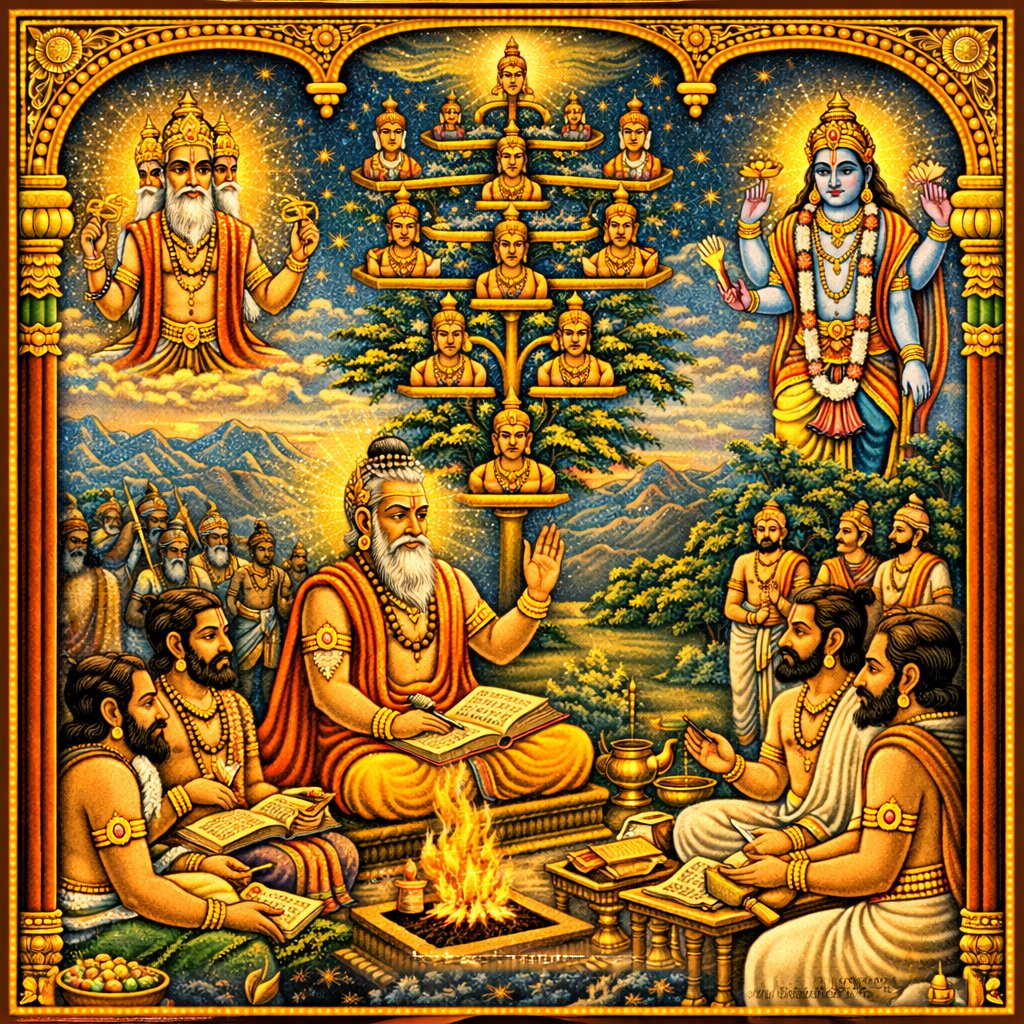
The chapter begins by affirming the universal beneficence of mantra as a means to accomplish the four puruṣārthas, thus presenting Vedic study as both liberative and practically efficacious. It then sets out Veda-vidhāna through enumerations: mantra totals, major śākhā divisions (especially within Ṛg and Yajus), and named recensions linked to Brahminical groups. The Sāma tradition is outlined via key recensions and chant-classifications, while the Atharva stream is anchored in teacher-names and a striking claim about the number of Upaniṣads. The discourse then turns from taxonomy to vaṃśa: Vyāsa is portrayed as the divine instrument who systematizes śākhā-bheda and related categories, ultimately grounded in Viṣṇu as the source of Veda, Itihāsa, and Purāṇa. Finally, it traces Purāṇic transmission from Vyāsa to Lomaharṣaṇa (Sūta) and onward through disciples who compile Purāṇa-saṃhitās, culminating in a devotional-philosophical exaltation of the Agneya Purāṇa as the Veda-essence that grants worldly attainments and mokṣa.
Adhyaya 271
Dānādi-māhātmya — The Glory of Gifts, Manuscript-Donation, and Purāṇic Transmission
This chapter, following the close of the discussion on Vedic branches, turns to dāna as a chief instrument of dharma and as a means of preserving revelation through lines of transmission. Puṣkara sets out merit-bearing gifts keyed to calendrical markers—full-moon days, months, nakṣatras, equinoxes, and ayana. A distinctive stress falls on “knowledge as gift”: having sacred teachings written out and properly presented, especially Itihāsa and Purāṇa texts. The teaching interweaves symbolic dhenu-gifts (water-cow, jaggery-cow, sesame-cow) and emblematic golden forms (lion, tortoise, fish, haṃsa, garuḍa) with references to Purāṇic corpora, their verse-counts, and their revelatory lineages (e.g., Agni to Vasiṣṭha; Bhava to Manu; Sāvarṇi to Nārada). It culminates in a ritual model for honoring reciters and manuscripts during Bhārata recitation cycles, prescribing feeding, honoring, and repeated gifting. The theological throughline is that preserving, transmitting, and generously patronizing dharma-literature yields worldly well-being (āyuḥ, ārogya) and the highest ends (svarga, mokṣa).
Adhyaya 272
Sūryavaṃśa-kīrtana (Proclamation of the Solar Dynasty)
Lord Agni begins a systematic mapping of dynasties—Solar, Lunar, and royal lineages—starting from the cosmic genealogy (Hari → Brahmā → Marīci → Kaśyapa → Vivasvān). The chapter then unfolds the Solar line through Vivasvān’s consorts and offspring (Manu, Yama–Yamunā, the Aśvins, Śani, etc.), establishing Vaivasvata Manu as the pivotal transmitter of social order and rāja-dharma. From Manu, the account branches to early rulers and peoples (the Ikṣvāku line; the Śakas; and regional polities such as Utkala, Gayāpurī, Pratiṣṭhāna, Ānarta/Kuśasthalī). The Kakudmī–Raivata episode links cosmic time-dilation with earthly dynastic change, culminating in Dvāravatī and Revatī’s marriage to Baladeva, thus tying vaṃśa to pan-Indian sacred history. The Ikṣvāku succession proceeds through emblematic kings (Māndhātā, Hariścandra, Sagara, Bhagīratha) and reaches the Raghu line, Daśaratha, and Rāma, whose story is acknowledged as Vālmīki’s composition from what he heard of Nārada. The chapter closes with post-Rāma successors (from Kuśa onward) and a terminal genealogy (to Śrutāyus), explicitly naming them as upholders of the Solar dynasty, anchoring royal duty, regional memory, and epic exemplars within a single revealed lineage-schema.
Adhyaya 273
Somavaṁśa-varṇanam (Description of the Lunar Dynasty)
Lord Agni begins a sin-destroying recitation of the Somavaṁśa (Lunar Dynasty), tracing the line from the cosmic origin of Brahmā—born from Viṣṇu’s navel—through Atri and the earliest descendants. Soma’s royal consecration (rājasūya) establishes his sovereignty, yet desire disrupts order: divine women, afflicted by Kāma, take mortal consorts, and Soma’s own transgressive longing culminates in the abduction of Tārā, wife of Bṛhaspati. This sparks the catastrophic Tārakāmaya war, checked only by Brahmā’s intervention, after which the radiant child Budha is born from Soma. The genealogy then turns to kingship history: Budha begets Purūravas, whose union with Urvāśī yields multiple royal heirs. From Āyu arise Nahuṣa and his sons, including Yayāti; Yayāti’s marriages to Devayānī and Śarmiṣṭhā generate the major progenitor lines—Yadu, Turvasu, Druhyu, Anu, and Pūru—establishing Yadu and Pūru as the principal expanders of dynastic tradition. Thus the chapter binds royal ritual, moral causality, and lineage transmission into a single dharmic narrative arc.
Adhyaya 274
Somavaṃśa-saṃkṣepaḥ (Conclusion of the Lunar Dynasty Description)
This closing verse formally concludes the Somavaṃśa (Lunar Dynasty) account within the Agni Purāṇa’s vaṃśa framework. The editorial colophon serves as a structural hinge, sealing the prior lineage as a complete unit of dharmic memory and readying the listener for the next dynastic stream. In the Agni–Vasiṣṭha pedagogical mode, genealogy is affirmed as a śāstric instrument that orders sacred history into intelligible successions supporting rājadharma, ritual authority, and recognition of avatāra contexts. The closure also reflects the Purāṇa’s encyclopedic method: even in dynastic material, the underlying aim is instruction in dharma through exemplars, continuity, and consequence.
Adhyaya 275
Chapter 275 — द्वादशसङ्ग्रामाः (The Twelve Battles)
Agni continues the vaṁśa-based account by rooting Kṛṣṇa’s birth in a cosmic genealogy: Kaśyapa manifests as Vasudeva and Aditi as Devakī, so that Hari appears through tapas to protect dharma and remove adharma. The chapter lists Kṛṣṇa’s queens and descendants, stressing Yādava protection and succession (Pradyumna → Aniruddha → Vajra and others), linking divine incarnation with dynastic continuity and social order. From this genealogical frame it turns doctrinal and epic: Hari is born as a human to establish karma-vyavasthā—the ordered performance of duties and rites—and to relieve human afflictions. It then enumerates the “twelve battles/manifestations” in the devas–asuras conflict, with brief proofs: Narasiṃha, Vāmana, Varāha, the amṛta-manthana, Tārakāmaya, the burning of Tripura, Andhaka’s slaying, Vṛtra’s death, Paraśurāma’s campaigns, the halāhala crisis, and the defeat of Kolāhala, concluding that all such agents—kings, sages, and gods—are Hari’s avatāras, named or unnamed.
Adhyaya 276
Chapter 276 — राजवंशवर्णनम् (Description of Royal Lineages)
In the Agni–Vasiṣṭha transmission, this chapter turns from earlier cosmological and heroic narration to vamśa-vidyā: the ordered remembrance of royal lineages and the naming of janapadas. Agni traces descent from Turvasu through successive kings—Varga, Gobhānu, Traiśāni, Karaṇdhama, Marutta, Duṣmanta, Varūtha, Gāṇḍīra—and then extends genealogy into cultural geography by listing powerful territorial peoples: Gāndhāra, Kerala, Cola, Pāṇḍya, and Kola, showing how dynastic memory and regional identity interlock. The account continues through Druhyu’s line (Vabhrusetu, Purovasu, Dharma, Ghṛta, Viduṣ, Pracetas and a hundred sons), onward to Sṛñjaya/Jā-Sṛñjaya and Janamejaya, and into Uśīnara-linked branches that yield named regions through Śivi’s sons (Pṛthudarbha, Vīraka, Kaikeya, Bhadraka). It then consolidates an Aṅga dynasty sequence (Aṅga → Dadhivāhana → Diviratha → … → Karṇa → Vṛṣasena → Pṛthusena) and signals a transition to the Puru lineage next. The dharmic purpose is to ground Rajadharma in sacred continuity: kingship, territory, and social order are presented as parts of a divinely remembered world-system.
Adhyaya 277
Description of the Royal Dynasties (राजवंशवर्णनम्) — Chapter Colophon and Transition
This unit serves as a formal closure and a textual hinge. The Agni Purāṇa declares the completion of the chapter “Description of the Royal Dynasties,” and immediately turns to the next genealogical section. A notable philological remark is preserved: some recensions record an alternate reading—“Dadhivāmana came into being”—showing manuscript variation and the living transmission of the text. In narrative intent, dynastic catalogues (vaṃśa) are not mere historical lists but dharma-indexes linking kingship, lineage continuity, and moral order. The colophon’s shift prepares the reader for a focused descent into the Puru line, bridging Purāṇic genealogy with epic memory (Bhārata/Kuru traditions).
Adhyaya 278
अध्याय २७८: सिद्धौषधानि (Siddha Medicines / Perfected Remedies)
This chapter turns from vaṃśa narration to applied sacred science. Agni announces an exposition of Āyurveda—the life-restoring mṛtasañjīvanī taught by Yama to Suśruta and revealed through the divine Dhanvantari. Suśruta asks for therapies and mantras that can heal humans and animals and even revive life. Dhanvantari delivers a practical medical compendium focused on diet and procedures: fever care through fasting, gruels, bitter decoctions, and staged treatment; a directional rationale for choosing emesis versus purgation; and disease-specific pathya (wholesome foods) for diarrhea, gulma, jaṭhara, kuṣṭha, meha, rājayakṣmā, śvāsa-kāsa, grahaṇī, arśas, dysuria, vomiting, thirst, visarpa, and vāta-śoṇita. It also includes ENT and eye measures (nasya, ear-filling, collyria, lepas), rasāyana/vājīkaraṇa guidance (night honey-ghee, śatāvarī preparations), wound care, postpartum protection, and antidotes for snake, scorpion, and dog poison. The chapter ends with a concise pañcakarma hierarchy—trivṛt for purgation, madana for emesis—and the best vehicles (oil, ghee, honey) according to predominant doṣa.