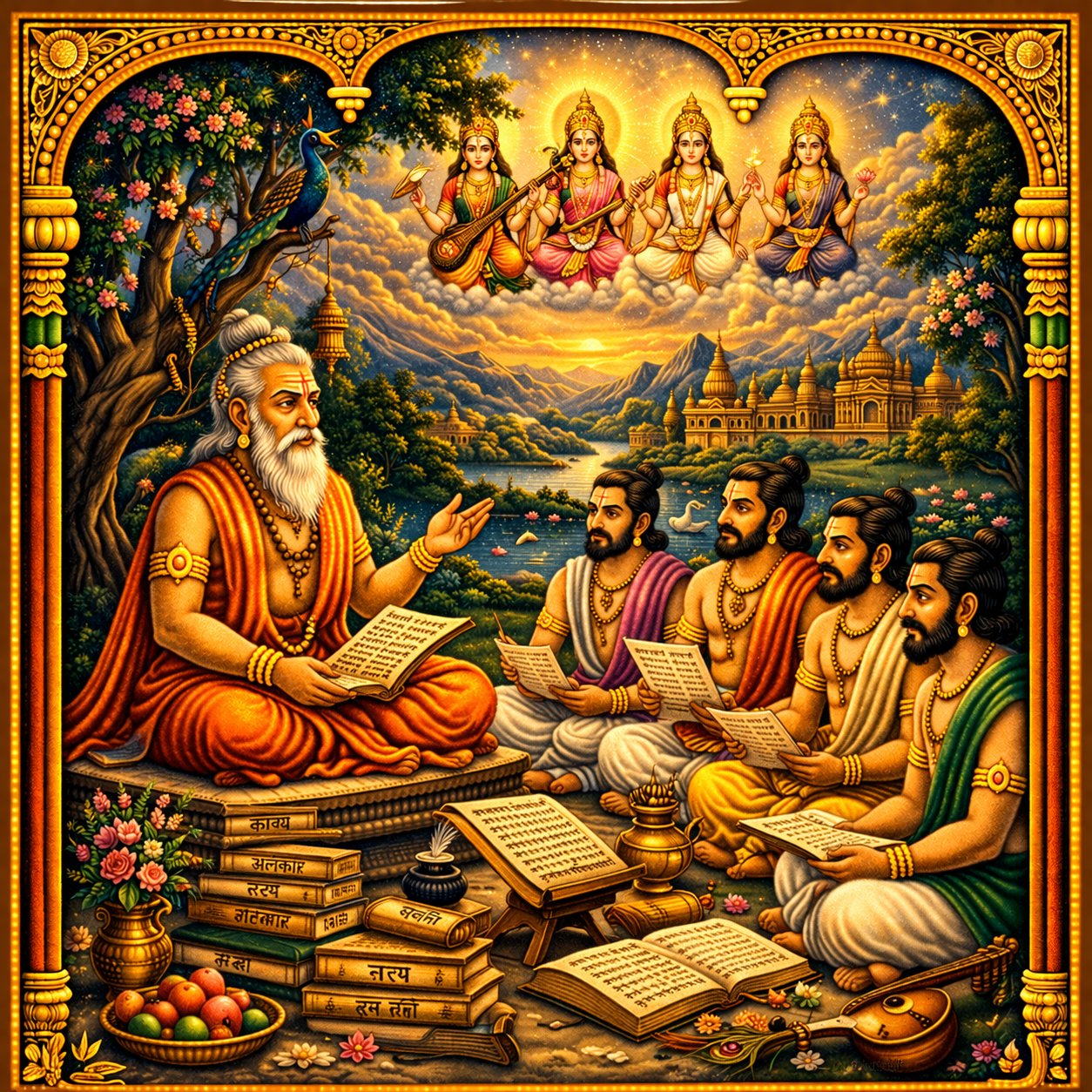
Sahitya-shastra
The Science of Poetics
Literary theory covering rasa, alamkara (figures of speech), riti (literary styles), dhvani (suggestion), and the aesthetics of Sanskrit literature.
Adhyayas in Sahitya-shastra
Adhyaya 336
Chapter 336 — काव्यादिलक्षणम् (Definitions of Poetry and Related Arts)
Lord Agni begins a systematic exposition of Sahitya-śāstra by defining the building blocks of vāṅmaya (verbal/literary expression): dhvani (sound), varṇa (phoneme), pada (word), and vākya (sentence). He distinguishes śāstra and itihāsa by their communicative priority—verbal formulation versus settled purport—and frames poetry through the primacy of abhidhā (denotation), stressing the rarity of true learning, poetic power, and discernment. Moving from linguistic foundations (inflections, sentence delimitation) to evaluative poetics, he states that kāvya is adorned with alaṅkāra, endowed with guṇas, and free from doṣas, drawing authority from both Veda and loka (usage). Agni then classifies composition by language register and by form (prose, verse, mixed), detailing prose sub-styles and the five gadyakāvya genres: ākhyāyikā, kathā, khaṇḍakathā, parikathā, kathānikā. The latter half introduces metrics (chandas) and major verse-forms, culminating in mahākāvya-lakṣaṇa: the great epic is enriched by rīti and rasa, with rasa declared the life of poetry even when verbal ingenuity dominates—uniting technical craft with aesthetic-spiritual purpose.
Adhyaya 337
Nāṭaka-nirūpaṇam (Exposition of Drama / Dramatic Genres and Plot-Structure)
Lord Agni begins a systematic teaching on nāṭya by listing the accepted dramatic and performative‑literary genres (rūpaka and allied forms), thereby establishing drama’s taxonomy as a śāstric discipline. He then distinguishes general and particular application in lakṣaṇā (indicative sense) and in dramaturgical rules, clarifying the constituents common to all drama—rasa, bhāva, vibhāva–anubhāva, abhinaya, aṅka, and dramatic progression (sthiti). Next he presents pūrvaraṅga as the procedural foundation of performance, including nāndī elements, salutations and blessings, and the formal entry of the sūtradhāra, with attention to lineage‑praise and authorial competence. The chapter defines prologue/opening devices (āmukha/prastāvanā, pravṛttaka, kathodghāta, prayoga, prayogātiśaya) and establishes itivṛtta (plot) as the “body” of drama, divided into siddha (traditional) and utprekṣita (poet‑created). Finally, it details plot design through five arthaprakṛtis and five sandhis, emphasizing the need to specify time and place for coherent narrative unfolding.
Adhyaya 338
Chapter 338 — शृङ्गारादिरसनिरूपणम् (Exposition of the Rasas beginning with Śṛṅgāra)
Lord Agni opens by rooting aesthetics in metaphysics: the Imperishable Brahman is the one light of consciousness, whose innate bliss manifests as rasa (aesthetic savor). From primordial transformation (ahaṅkāra and abhimāna), the emotional seed rati ripens into Śṛṅgāra when supported by transitory states and expressive factors. The chapter then maps the generation of rasas—Śṛṅgāra, Hāsya, Raudra, Vīra, Karuṇa, Adbhuta, Bhayānaka, Vībhatsa—and notes the place of Śānta, stressing that poetry without rasa is tasteless and that the poet functions as a creator shaping the poetic universe. It affirms the inseparability of rasa and bhāva, classifies enduring states (sthāyins) and many transitory states (vyabhicārins) with brief definitions and bodily/mental symptoms, and introduces dramaturgical tools: vibhāva (ālambana/uddīpana), anubhāva, nāyaka hero-types and aides. It concludes with a taxonomy of speech-initiatives (vāgārambha) and the triad of rīti, vṛtti, and pravṛtti as divisions of effective poetic communication.
Adhyaya 339
Rīti-nirūpaṇam (Explanation of Poetic Style)
Continuing the Alaṅkāra (poetics) curriculum, Lord Agni moves from rasa-theory to rīti, presenting “style” as a formal element of vāk-vidyā (the science of speech). He classifies rīti into four regional-textural modes—Pāñcālī, Gauḍī (Gauḍadeśīyā), Vaidarbhī, and Lāṭī—distinguished by the density of ornament (upacāra), syntactic linkage (sandarbha), and structural extension (vighraha). The discussion then shifts from poetic style to dramaturgical style (vṛtti), describing four action-based modes—Bhāratī, Ārabhaṭī, Kauśikī, and Sāttvatī—thus integrating kāvya-theory with nāṭya principles. Bhāratī is portrayed as diction-forward and natural in speech, tied to Bharata’s tradition, and its limbs and allied dramatic forms (such as vīthī and prahasana) are outlined, including lists of vīthī-aṅga. Finally, prahasana is defined as comic farce, while Ārabhaṭī is marked by energetic scenes (magic, battle) and brisk stage-action, showing how aesthetic technique serves disciplined expression within dharmic culture.
Adhyaya 340
Chapter 340 — नृत्यादावङ्गकर्मनिरूपणम् (Explanation of Bodily Actions in Dance and Performance)
Lord Agni moves from earlier alaṅkāra topics into nāṭya technique, defining bodily expression (aṅgakarma) as arising from (1) specific kinds of movement and (2) the actions of major limbs (aṅga) and minor limbs (pratyaṅga), grounded in an initial supportive stance. He lists refined, often feminine/śṛṅgāra-coded modes of expression—līlā, vilāsa, vicchitti, vibhrama, kilakiñcita, moṭṭāyita, kuṭṭamita, vivvoka, lalita—clarifying subtypes such as kiñcid-vilāsa and kilakiñcita (a blend of affective cues like laughter and crying). The chapter then maps expression anatomically—head, hands, chest, sides, hips/waist, feet—distinguishing spontaneous limb/sub-limb activity from deliberate effort. A technical catalogue follows: 13 head movements, 7 eyebrow actions, gaze/dṛṣṭi typologies linked to rasa and bhāvas (including a 36-fold subdivision and an 8-fold set), 9 ocular/tārakā operations, 6 nasal, 9 breathing, and lists of facial/neck defects. Finally, it classifies hand gestures into single and joined (13 joined, e.g., Añjali, Kapota, Karkaṭa, Svastika), names many hasta forms (Patāka, Tripatāka, Kartarīmukha, etc.), notes textual variants, and concludes with torso/abdomen/flank/leg/foot action taxonomies for dance and drama—presenting embodied aesthetics as a precise śāstric vidyā within dharma.
Adhyaya 341
Explanation of Abhinaya and Related Topics (अभिनयादिनिरूपणम्) — Agni Purana, Chapter 341
Lord Agni defines abhinaya as the disciplined means by which meaning is made directly present to an audience, and classifies it into four foundations: sāttvika (emotion-born involuntary expression), vācika (speech), āṅgika (bodily gesture), and āhārya (costume and ornament). He then explains the purposeful use of rasa and allied poetic factors, stressing authorial intention as the regulator of meaningful expression. The chief rasas are outlined with internal divisions: śṛṅgāra as union and separation, with vipralambha further divided into pūrvānurāga, pravāsa, māna, and karuṇātmaka; hāsa with graded types of smile and laughter; and notes on karuṇa, raudra, vīra, bhayānaka, and vībhatsa, including their generating causes and bodily signs. The chapter then turns from rasa to the beautifiers of kāvya—alaṅkāras—especially śabdālaṅkāras, listing and defining devices such as chāyā (imitative “shadow” styles), mudrā/śayyā, ukti with six statement-types, yukti (contrived linkage of word and meaning), gumphanā (compositional weaving), and vākovākya (dialogue), including vakrokti and kākū. Throughout, Agni’s method is taxonomic: aesthetic practice is taught as a śāstra whose structure and intention safeguard dharma while refining artistic power.
Adhyaya 342
Chapter 342: शब्दालङ्काराः (Verbal/Sound-based Ornaments)
Lord Agni begins the teaching on shabda-alankara (sound-ornaments) by defining anuprasa as the patterned recurrence of phonemes across words and sentences, and cautions that ornament must be measured, not excessive. He then classifies single-phoneme predominance into five vrittis—madhura, lalita, praudha, bhadra, and parusha—stating phonetic constraints (limits by varga, effects of conjuncts, and the harshening of anusvara/visarga) that govern euphony and syllabic weight (laghu/guru). The chapter extends to multi-unit repetition as yamaka, distinguishing avyapeta (contiguous) and vyapeta (separated) forms, and listing principal subtypes up to a tenfold scheme with further variants. It next surveys citra-kavya in social settings (questions, riddles, hidden or displaced constructions), explaining how concealment and structural displacement yield secondary meanings. Finally it turns to bandha (pattern/shape poetry), describing famed visual layouts—sarvatobhadra, lotus (ambuja) designs, cakra and muraja patterns—together with technical placement rules and nomenclature, showing phonetics, meter, and visual arrangement converging as a disciplined art within dharma.
Adhyaya 343
Arthālaṅkāras (Ornaments of Meaning): Definitions, Taxonomy, and the Centrality of Upamā
After completing the discussion of śabdālaṅkāras (verbal ornaments), Lord Agni begins a systematic account of arthālaṅkāras (ornaments of meaning), declaring that word-beauty without meaning-ornament is finally uncharming—like Sarasvatī without adornment. The chapter first sets ‘svarūpa/svabhāva’ (intrinsic nature) as a foundational lens and distinguishes natural (sāṃsiddhika) and occasion-based (naimittika) modes. It then foregrounds sādṛśya (resemblance) and unfolds an expansive typology of upamā (simile): markers of comparison, compound and non-compound forms, and analytic expansion into many subtypes, culminating in an 18-fold clarity. Specialized similes are listed—reciprocal, inverted, restricted/unrestricted, contrastive, multiple, garlanded, transformative, marvellous, illusory, doubtful/certain, sentence-sense, self-comparative, and progressive (gagana-upamā)—along with five pragmatic modes (praise, blame, imagined, actual, partial). The chapter then defines rūpaka (metaphor) and sahokti (co-statement), explains arthāntaranyāsa (support by a subsequent analogous statement), utprekṣā (poetic supposition within experiential bounds), atiśaya (possible/impossible hyperbole), viśeṣokti (unexpected cause), vibhāvanā and saṅgatīkaraṇa (inferred naturalness and rational reconciliation), virodha (contradictory reason), and hetu (cause) as kāraka/jñāpaka, with notes on vyāpti (invariable concomitance).
Adhyaya 344
Chapter 344: Ornaments of Word-and-Meaning (शब्दार्थालङ्काराः)
Lord Agni continues the Sahitya-śāstra (poetics) by defining ornaments that beautify both expression (śabda) and sense (artha) at once, like a single necklace adorning neck and breasts together. He lists six active excellences of composition: praśasti (eulogic excellence), kānti (charm), aucitya (propriety), saṃkṣepa (brevity), yāvad-arthatā (exact sufficiency of meaning), and abhivyakti (lucid manifestation). Praśasti is speech that “melts” the listener’s inner core, distinguished as affectionate address and formal praise; kānti is the mind-delighting harmony between what can be said and what is conveyed. Aucitya arises when rīti (style), vṛtti (mode), and rasa (aesthetic relish) fit the subject, balancing vigor and gentleness. The chapter then turns technical: abhivyakti includes śruti (direct primary meaning) and ākṣepa (suggested meaning), introducing conventions and definitions, primary and secondary signification (mukhya/upacāra), and lakṣaṇā as indicated meaning arising through relation, proximity, or inherence. Finally, it links ākṣepa and allied figures (samāsokti, apahnuti, paryāyokta) to dhvani (suggestion), placing implied sense as a central engine of poetic power.
Adhyaya 345
काव्यगुणविवेकः (Examination of the Qualities of Poetry)
Lord Agni continues the Sahitya-śāstra teaching by turning from ornamentation (alaṅkāra) to the foundational guṇas that make poetry truly pleasing. He states that ornament without guṇa is burdensome, and distinguishes vācya (direct statement) from guṇa/doṣa by locating aesthetic effect in bhāva. The chapter introduces chāyā (poetic aura) arising from guṇas, classifies it as sāmānya (universal) and vaiśeṣika (particular), and maps universals across word, meaning, or both. It lists key word-based qualities—śleṣa, lālitya, gāmbhīrya, saukumārya, udāratā—along with notes on truthfulness and etymological fitness. It then defines meaning-based guṇas—mādhurya, saṃvidhāna, komalatva, udāratā, prauḍhi, sāmayikatva—and explains parikara (supporting factors), yukti (mature reasoning), contextual signification, and the twofold excellence of naming. Finally it elaborates prasāda (lucidity), pāka (ripening) in four types, sarāga (aesthetic coloring) through practice, and concludes by classifying “rāga” into three hues and identifying the particular (vaiśeṣika) by its own defining mark.
Adhyaya 346
Discrimination of the Qualities of Poetry (Kāvya-guṇa-viveka) — Closing Verse/Colophon Transition
The opening line serves as a textual hinge: it closes the prior adhyāya on the qualities (guṇas) of kāvya and immediately opens the next adhyāya on poetic faults (doṣas). In the Agni–Vasiṣṭha teaching sequence, this transition reflects the śāstric method of paired analysis—first defining poetic excellence, then identifying what disturbs aesthetic relish and learned reception. The colophon highlights the Purāṇa’s encyclopedic ordering: poetics is treated as a rigorous vidyā alongside other technical sciences, and the move from guṇa to doṣa frames poetry as a disciplined practice governed by grammar, convention, and intelligibility. Poetic judgment is thus not merely subjective; it is grounded in cultivated audiences (sabhya), correct linguistic science (śabda-śāstra), and normative usage (samaya), aligning literary craft with dharma and the refinement of mind.
Adhyaya 347
Chapter 347: One-syllable Appellations (एकाक्षराभिधानम्)
Lord Agni opens the chapter by declaring an exposition of ekākṣara—single-syllable appellations—taught together with the Mātr̥kā (phonemic set). It first assigns meanings and divine referents to vowels and consonantal syllables, forming a compact lexicon for poetic diction, mantra-encoding, and symbolic reading. The discussion then turns to ritual mantra-use: specific bīja-like syllables and short formulas are linked to deities (e.g., Narasiṃha/Hari through kṣo) and to aims of protection and prosperity. Devotional practice is further woven in by naming the Nine Durgās and their attendants (vaṭukas), prescribing worship in a lotus-diagram, giving a Durgā Gāyatrī-style mantra with ṣaḍaṅga-nyāsa sequencing, and outlining Gaṇapati’s root mantra, iconographic attributes, and many epithets for svāhā-ended worship and homa. The chapter closes with a note on mantra arrangement and a grammatical remark transmitted through Kātyāyana, reaffirming the Agni Purāṇa’s hallmark: sacred speech as linguistic science and as a technology of liberation.