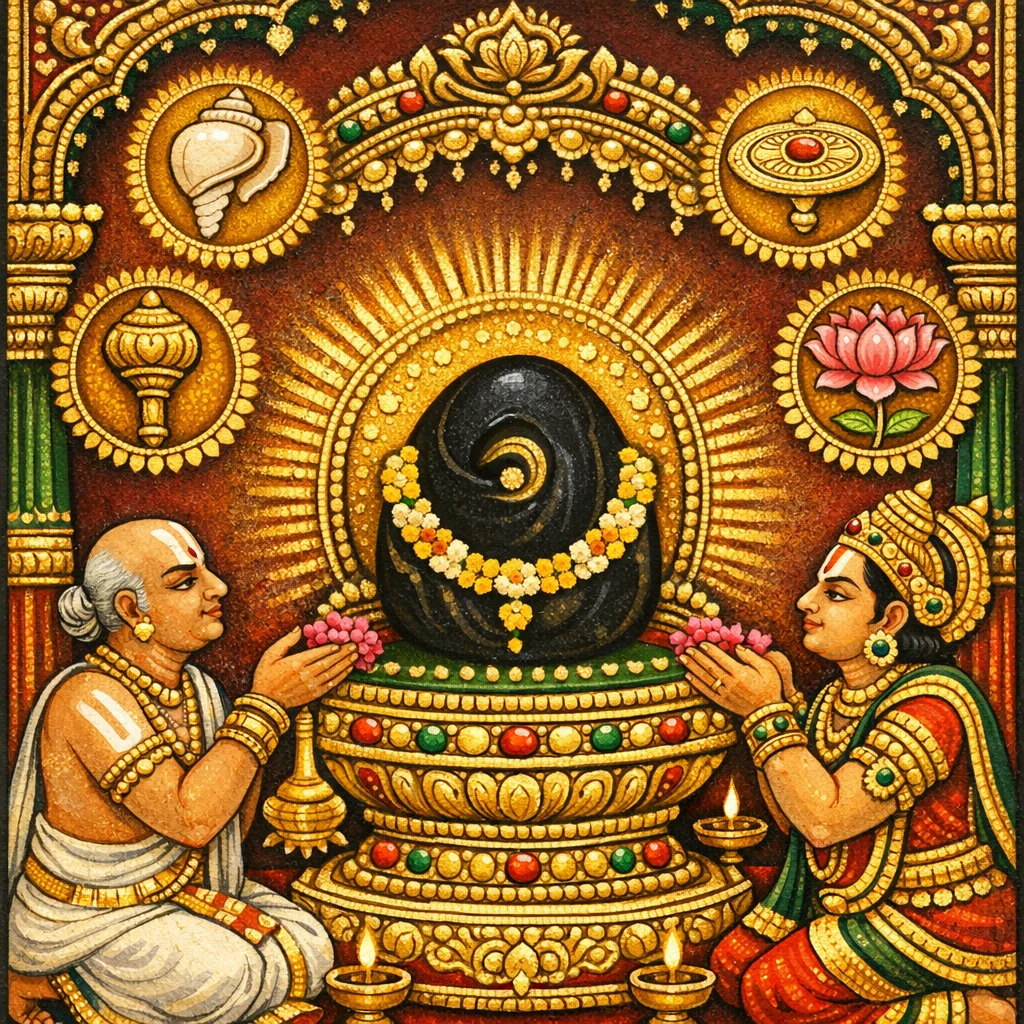
Adhyaya 46
Chapter 46 — शालग्रामादिमूर्तिलक्षणकथनं (Exposition of the Characteristics of Śālagrāma and Other Sacred Forms)
Continuing the Vāstu–Pratiṣṭhā and Īśāna-kalpa stream, Lord Agni expounds Pratimā-Lakṣaṇa through a diagnostic reading of Śālagrāma (sacred stone forms) and allied mūrti-signatures. These forms are framed as bhukti-mukti-pradā—bestowing worldly well-being while guiding the devotee toward liberation—thus placing iconographic taxonomy within soteriology. A sequence of divine identifications (Vāsudeva, Saṅkarṣaṇa, Pradyumna, Aniruddha, Nārāyaṇa, Viṣṇu, Narasiṃha, Varāha, Kūrma, Hayagrīva, Vaikuṇṭha, Matsya, Śrīdhara, Vāmana, Trivikrama, Ananta, Sudarśana, Lakṣmī-Nārāyaṇa, Acyuta, Janārdana, Puruṣottama) is mapped to observable markers—cakra counts, hue, lines (rekhā), dots (bindu), perforations (chidra/śuṣira), whorls (āvarta), and emblem-shapes such as gadā-ākṛti. The chapter is both liturgical and classificatory: correct recognition supports correct worship and consecratory handling, aligning sacred material media with dharmic intention.
Shlokas
Verse 1
इत्य् आदिमहापुराणे आग्नेये पिण्डिकालक्ष्मादिलक्षणं नाम पञ्चचत्वारिंशो ऽध्यायः अथ षट्चत्वारिंशो ऽध्यायः शालग्रामादिमूर्तिलक्षणकथनं भगवानुवाच शालग्रामादिमूर्तेश् च वक्ष्येहं भुक्तिमुक्तिदाः वासुदेवो ऽसितो द्वारे शालग्रामद्विचक्रकः
Thus, in the Agni Purāṇa, the forty-fifth chapter entitled “The characteristics of Piṇḍikā-Lakṣmī and others” comes to an end. Now begins the forty-sixth chapter, “The exposition of the characteristics of Śālagrāma and other sacred forms.” The Blessed Lord said: “Here I shall describe the forms beginning with Śālagrāma—those that bestow worldly enjoyment (bhukti) and liberation (mukti). Vāsudeva is dark-hued; at the ‘opening’ (dvāra) it bears the marks of two discus-wheels—this is the two-cakra Śālagrāma.”}]}}
Verse 2
ज्ञेयः सङ्कर्षणो लग्नद्विचक्रो रक्त उत्तमः सूक्ष्मचक्रो बहुच्छिद्रः प्रद्युम्नो नीलदीघवः
Know that the discus marked with two attached wheels is called Saṅkarṣaṇa—red and excellent. The fine-edged discus, having many perforations, is called Pradyumna—blue and long in form.
Verse 3
पीतो निरुद्धः पद्माङ्गो वर्तुलो द्वित्रिरेखवान् कृष्णो नारायणो नाभ्युन्नतः शुषिरदीर्घवान्
He is yellow-hued as Aniruddha, lotus-limbed, round in form, bearing two or three auspicious lines; dark-complexioned as Nārāyaṇa, with a raised navel and a deep, elongated navel-cavity.
Verse 4
परमेष्ठो साब्जचक्रः पृष्ठच्छिद्रकश् च विन्दुमान् स्थूलचक्रो ऽसितो विष्णुर्मध्ये रेखा गदाकृतिः
Parameṣṭhin’s discus is lotus-marked; it has a perforation on the reverse and bears a central dot. Viṣṇu’s discus is thick-rimmed and dark-hued; in its middle there is a line shaped like a mace (gadā).
Verse 5
नृसिंहः कपिकः स्थूलवक्रः स्यात् पञ्चविन्दुकः वराहः शक्तिलिङ्गः स्यात् तच्चक्रौ विषमौ सृतौ
For (the emblem of) Narasiṃha, it should be “kapika”—thick and curved—and also bearing five dots. For (the emblem of) Varāha, it should be a śakti-liṅga; and those two discs (cakras) are to be made unequal and set in their proper courses/positions.
Verse 6
इन्द्रनीलनिभः स्थूलस्त्रिरेखालाञ्छितः शुभः कूर्मस्तथोन्नतः पृष्ठे वर्तुलावर्तको ऽसितः
He is sapphire-blue in hue, large and auspicious, marked with three lines; tortoise-like and raised, and on the back there is a dark, circular whorl.
Verse 7
हयग्रीवोङ्कुशावाररेखो नीलः सविन्दुकः पृथुश्च्च्छिद्रश्चेति ङ, चिह्नितपुस्तकपाठः वैकुण्ठः एकचक्रो ऽब्जी मणिभिः पुच्छरेखकः
Hayagrīva is described as bearing the mark of an aṅkuśa (elephant-goad) with protective lines; he is dark-blue, marked with a bindu, broad, and also having a perforation or cleft—these are the auspicious signs. Vaikuṇṭha is described as bearing the sign of a book and of recitation/reading; he bears a single discus and a lotus, and his terminal “tail-line” is marked with gem-like spots.
Verse 8
मत्स्यो दीर्घस्त्रिविन्दुः स्यात् काचवर्णस्तु पूरितः श्रीधरो वनमालाङ्कः पञ्जरेखस्तु वर्तुलः
The “fish” mark should be elongated and bear three bindu-dots; it should be of a glass- or crystal-like hue and appear well-filled. This is (the sign of) Śrīdhara, adorned with the vanamālā, the forest-garland; the lines upon the ribs/chest are to be circular.
Verse 9
वामनो वर्तुलश्चातिह्रस्वो नीलः सविन्दुकः श्यामस्त्रिविक्रमो दक्षरेखो वामेन विन्दुकः
Vāmana is round in form and very short; he is dark-blue, bearing a distinct bindu-mark. Trivikrama is dark-complexioned; he bears a line on the right and a bindu-mark on the left.
Verse 10
अनन्तो नागभोगाङ्गो नैकाभो नैकमूर्तिमान् स्थूलो दामोदरो मध्यचक्रो द्वाःसूक्ष्मविन्दुकः
He is Ananta, the Infinite, whose body is formed of the coils of the Nāga; of manifold radiance and manifold forms; vast in presence. He is Dāmodara, with the sacred cord or mark encircling the waist; bearing the central discus (chakra); and marked by two subtle bindu-signs.
Verse 11
सुदर्शनस्त्वेकचक्रो लक्ष्मीनारायणो द्वयात् त्रिचक्रश्चाच्युतो देवस्त्रिचक्रको वा त्रिविक्रमः
The one bearing a single discus is called Sudarśana; the one with two (disci) is Lakṣmī-Nārāyaṇa. The one with three disci is the god Acyuta; or else, the three-disced one is called Trivikrama.
Verse 12
जनार्दनश् चतुश् चक्रो वासुदेवश् च पञ्चभिः षट्वक्रश् चैव प्रद्युम्नः सङ्कर्षणञ्च सप्तभिः
Janārdana is praised with four (names/epithets); Catuścakra (the Lord bearing four discs) with five; likewise Ṣaṭvakra with six; and Pradyumna and Saṅkarṣaṇa with seven (each).
Verse 13
पुरुषोत्तमोष्टचक्रो नवव्यूहो नवाङ्कितः दशावतारो दशभिर्दशैकेनानिरुद्धकः द्वादशात्मा द्वादशभिरत ऊर्ध्वमनन्तकः
He is Puruṣottama (the Supreme Person), bearing the eightfold discus-forms; He is arranged as the nine Vyūhas and marked by nine distinctive signs. He is the Lord of the ten Avatāras; among the ten and the one (beyond the ten), He is Aniruddha. He is of twelvefold essence, and beyond the twelve He is the Endless, Ananta.
Frequently Asked Questions
Śālagrāma/mūrti identification via physical lakṣaṇas—cakra number and type, hue, rekhā (lines), bindu (dots), chidra/śuṣira (perforations/cavities), and emblematic shapes (e.g., gadā-ākṛti)—each mapped to specific divine names/forms.
By teaching correct recognition and handling of sacred forms used in worship and pratiṣṭhā, it safeguards ritual accuracy and supports devotion; the text explicitly frames these forms as bhukti–mukti-giving, making technical discernment part of sādhanā.
The chapter assigns identities by cakra number, including: one-cakra (Sudarśana), two (Lakṣmī-Nārāyaṇa), three (Acyuta/Trivikrama), and extended enumerations culminating in Puruṣottama and higher-order groupings (vyūha/avatāra-style counts).