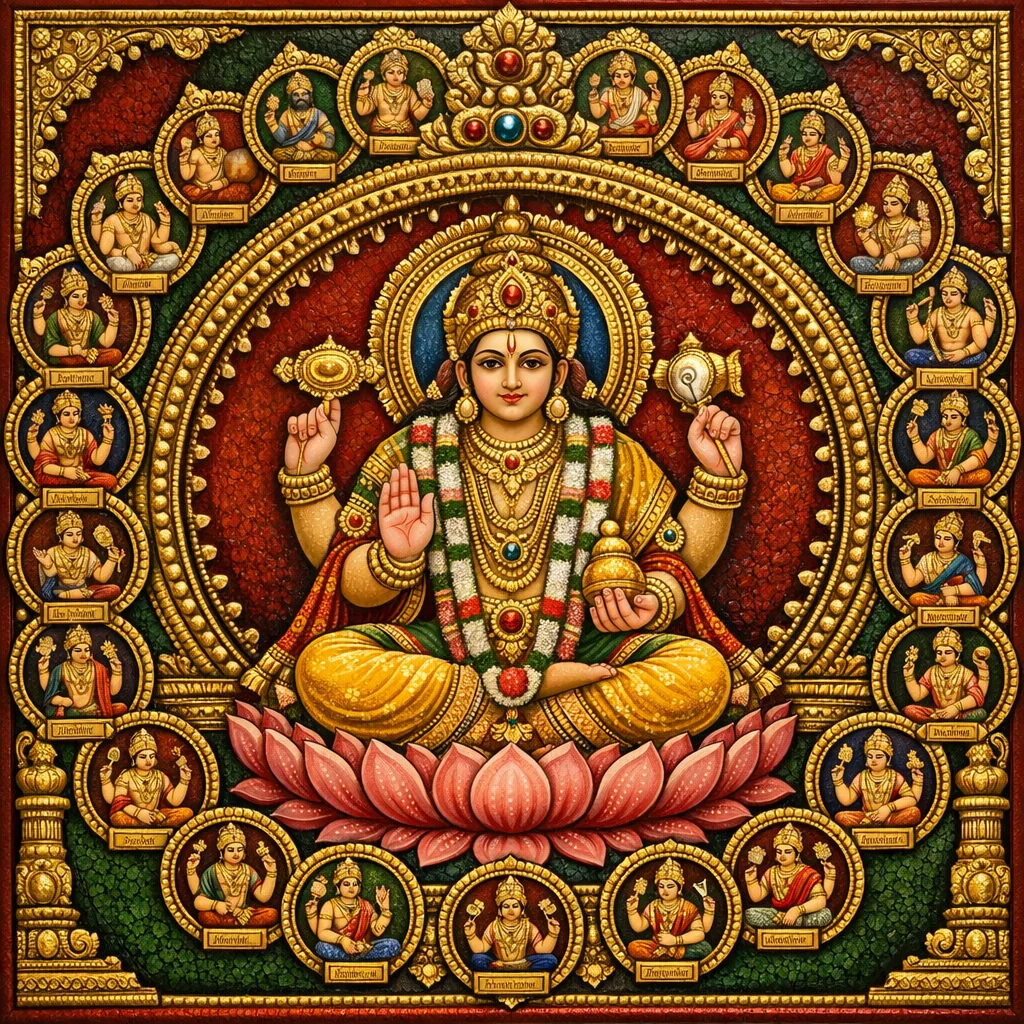
Adhyaya 48
Chapter 48 — Account of the Hymn to the Twenty-Four Forms (Caturviṁśati-mūrti-stotra-kathana)
In the Vāstu-pratiṣṭhā and Īśāna-kalpa setting, Lord Agni (speaking as Bhagavān in the transmitted frame) enumerates the twenty-four Vaiṣṇava forms beginning with Keśava and Nārāyaṇa, defining each by the ordered arrangement of divine emblems—padma (lotus), śaṅkha (conch), cakra (discus), and gadā (mace), with occasional mention of Śārṅga and Kaumodakī. The chapter serves as a practical iconographic key (pratimā-lakṣaṇa) and a ritual recitation unit: each name is tied to a recognizable emblem-sequence fit for worship, circumambulation, and protective invocation. It then grounds the theology in the vyūha doctrine (Vāsudeva → Saṅkarṣaṇa → Pradyumna → Aniruddha), aligning mantra-recitation with cosmological emanation. The text concludes by identifying the hymn as a Dvādaśākṣara-linked stotra embodying the twenty-four forms, declaring that recitation or even hearing brings purification and complete attainment—presenting iconographic precision as a sādhanā granting both bhukti (protection, enjoyment, sustenance) and mukti (liberative purity).
Shlokas
Verse 1
इत्य् आदिमहापुराणे आग्नेये शालग्रामादिपूजाकथनं नाम सप्तचत्वारिंशो ऽध्यायः अथाष्टाचत्वारिंशो ऽध्यायः चतुर्विंशतिमूर्तिस्तोत्रकथनं भगवानुवाच ओंरूपः केशवः पद्मशङ्खचक्रगदाधरः नारायणः शङ्खपद्मगदाचक्री प्रदक्षिणं
Thus, in the Agni Purāṇa, the forty-seventh chapter entitled “Account of the worship of Śālagrāma and other sacred forms” is concluded. Now begins the forty-eighth chapter, “Account of the hymn to the Twenty-Four Forms (of Viṣṇu).” The Blessed Lord said: “Keśava is of the form of Oṃ, bearing the lotus, conch, discus, and mace. Nārāyaṇa bears the conch, lotus, mace, and discus, and is to be worshipped with circumambulation (pradakṣiṇa).”
Verse 2
ततो गदो माधवोरिशङ्खपद्मी नमामि तं चक्रकौमोदकीपद्मशङ्खी गोविन्द ऊर्जितः
Thereafter (I praise) Mādhava, who bears the mace, the conch, and the lotus. I bow to mighty Govinda, who bears the discus, the Kaumodakī mace, the lotus, and the conch.
Verse 3
भोक्षदः श्रीगदी पद्मी शङ्खी विष्णुश् च चक्रधृक् शङ्खचक्राब्जगदिनं मधुसूदनमानमे
I bow to Madhusūdana—Viṣṇu, the giver of enjoyment and sustenance—who bears the auspicious mace, the lotus, the conch, and the discus; whose emblems are the conch, discus, lotus, and mace.
Verse 4
भक्त्या त्रिविक्रमः पद्मगदी चक्री च शङ्ख्यपि शङ्खचक्रगदापद्मी वामनः पातु मां सदा
May Trivikrama protect me always, through devotion—He who bears the lotus, the mace, the discus, and also the conch; that Vāmana who is adorned with the conch, discus, mace, and lotus as His emblems.
Verse 5
गदितः श्रीधरः पद्मी चक्रशार्ङ्गी च शङ्ख्यपि हृषीकेशो गदाचक्री पद्मी चक्रशङ्खी च पातु नः
May the Lord protect us—He who is called Śrīdhara, the bearer of the lotus, the wielder of the discus and the Śārṅga bow, and also the conch-holder; Hṛṣīkeśa, the bearer of mace and discus, the lotus-bearer, and the bearer of discus and conch—may He safeguard us.
Verse 6
वरदः पद्मनाभस्तु शङ्खाब्जारिगदाधरः दामोदरः पद्मशङ्खगदाचक्री नमामि तं
I bow to Him—Varada, the giver of boons; Padmanābha, lotus-naveled; bearer of the conch, lotus, discus, and mace; Dāmodara, adorned with lotus, conch, mace, and discus as His divine emblems.
Verse 7
तेने गदी शङ्खचक्री वासुदेवोब्जभृज्जगत् सङ्कर्षणो गदी शङ्खी पद्मी चक्री च पातु वः
May Vāsudeva—bearing the mace, conch, and discus, and holding the lotus—protect the world; and may Saṅkarṣaṇa—bearing the mace and conch, and also bearing the lotus and discus—protect you.
Verse 8
जितं तत इति ख, ग, ङ, चिह्नितपुस्तकत्रयपाठः चक्री गद्यथ शङ्ख्यपि इति ङ, चिह्नितपुस्तकपाठः गदी चक्री शङ्खगदी प्रद्युम्नः पद्मभृत् प्रभुः अनिरुद्धश् चक्रगदी शङ्खी पद्मी च पातु नः
May the Lord Pradyumna—mighty, bearing the lotus, armed with the mace and the discus, and holding the conch—protect us; and may Aniruddha also protect us, bearing the discus and the mace, holding the conch, and carrying the lotus.
Verse 9
सुरेशोर्यब्जशङ्खाढ्यः श्रीगदी पुरुषोत्तमः अधोक्षजः पद्मगदी शङ्खी चक्री च पातु वः
May the Supreme Person—Adhokṣaja, Puruṣottama—adorned with lotus and conch, bearing the auspicious mace, and bearing the lotus-mace, the conch, and the discus—protect you.
Verse 10
देवो नृसिंहश् चक्राब्जगदाशङ्खी नमामि तम् अच्युतः श्रीगदी पद्मी चक्री शङ्खी च पातु वः
I bow to the divine Narasiṃha, who bears the discus, lotus, mace, and conch. May Acyuta (Viṣṇu)—bearing the auspicious mace, lotus, discus, and conch—protect you.
Verse 11
बालरूपी शङ्खगदी उपेन्द्रश् चक्रपद्म्यपि जनार्दनः पद्मचक्री शङ्खधारी गदाधरः
He is of childlike form; He bears the conch and the mace; He is Upendra; He also bears the discus and the lotus. He is Janārdana—lotus-and-discus-bearing, the bearer of the conch, the wielder of the mace.
Verse 12
शङ्खी पद्मी च चक्री च हरिः कौमोदकीधरः कृष्णः शङ्खी गदी पद्मी चक्री मे भुक्तिमुक्तिदः
May Hari—Kṛṣṇa—who bears the conch, the lotus, and the discus, and who holds the mace Kaumodakī—(that) conch-bearing, mace-bearing, lotus-bearing, discus-bearing Lord—grant me both bhukti (worldly enjoyment) and mukti (liberation).
Verse 13
आदिमूत्तिर्वासुदेवस्तस्मात् सङ्कर्षणोभवत् सङ्कर्षणाच्च प्रद्युम्नः प्रद्युम्नादनिरुद्धकः
The primordial manifestation is Vāsudeva; from him arose Saṅkarṣaṇa. From Saṅkarṣaṇa arose Pradyumna, and from Pradyumna arose Aniruddha.
Verse 14
केशवादिप्रभेदेन ऐकैकस्य त्रिधा क्रमात् द्वादशाक्षरकं स्तोत्रं चतुर्विंशतिमूर्तिमत् यः पठेच्छृणुयाद्वापि निर्मलः सर्वमाप्नुयात्
By the differentiation beginning with Keśava—each name/form arranged successively in a threefold sequence—this is the Dvādaśākṣara hymn, embodying the twenty-four forms (of Viṣṇu). Whoever recites it, or even hears it, becomes purified and attains all desired results.
Frequently Asked Questions
The chapter specifies each Vaiṣṇava form by the ordered arrangement of emblems (śaṅkha, cakra, gadā, padma), enabling precise pratimā-lakṣaṇa for worship, recognition, and ritual deployment in Vāstu-pratiṣṭhā contexts.
It turns iconographic precision into sādhanā: recitation/hearing purifies (śuddhi), invokes protection (rakṣā), and aligns devotion with the vyūha cosmology—explicitly promising both bhukti (worldly welfare) and mukti (liberative purity).
They function as canonical identifiers (cihna) for distinct forms and as contemplative anchors in worship, ensuring the deity’s form (rūpa) and function (protection, sustenance, boon-giving) are invoked without ambiguity.