Adhyaya 103
जीर्णोद्धारः (Jīrṇoddhāra) — Renovation and Ritual Handling of Defective Liṅgas and Old Shrines
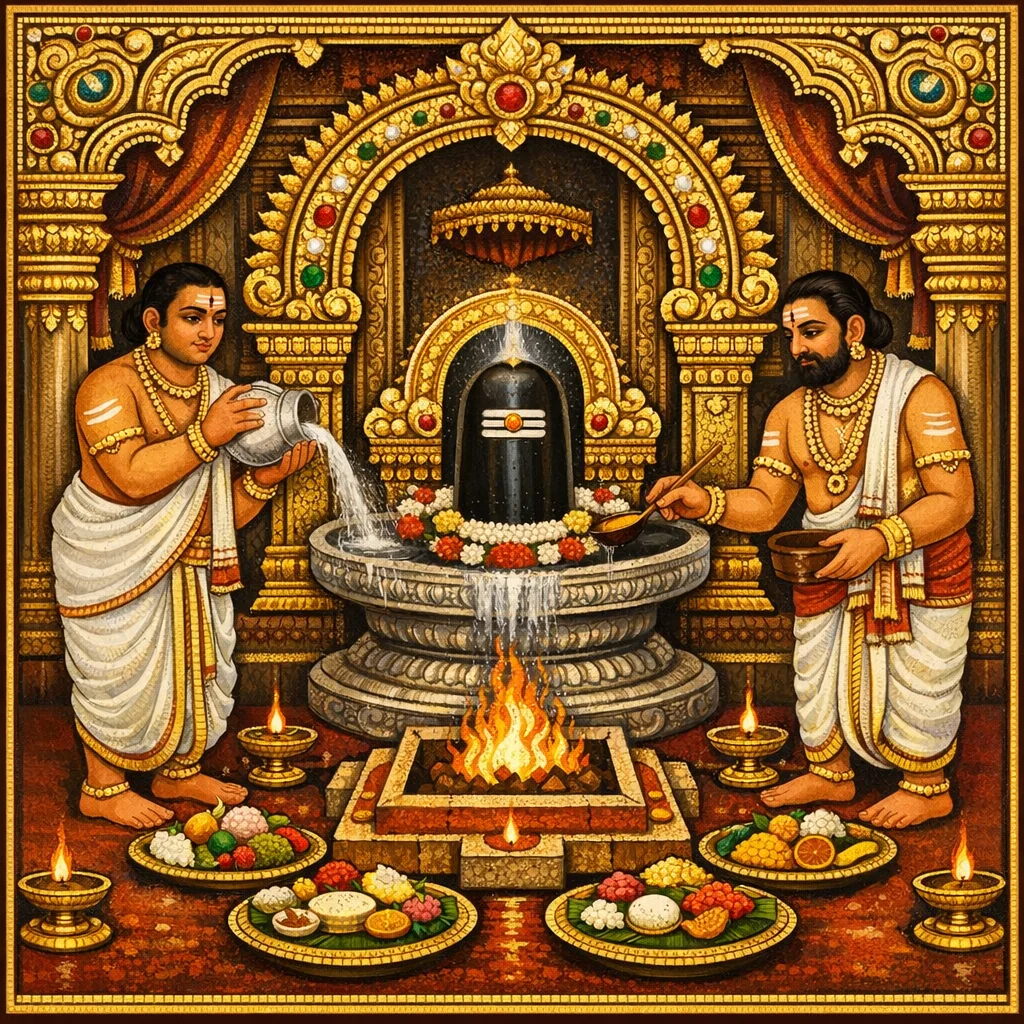
This chapter, following the banner-hoisting rites, teaches jīrṇoddhāra—the rule-bound renovation and recovery of sacred installations. Īśvara lists the defects that make a Śiva-liṅga ritually troublesome: loss of auspiciousness, breakage, swelling/thickening, lightning-strike, enclosure, cracking, deformity, instability, misalignment, directional confusion, and toppling. Remedies include adding supports such as the piṇḍī (pedestal) and vṛṣa (bull emblem), and performing a staged rite: pavilion construction, doorway worship, sthaṇḍila preparation, mantra-satisfaction, Vāstu-deva worship, and external directional bali. The priest petitions Śambhu, performs śānti-homa with prescribed materials and counts, applies aṅga-mantras and the astra-mantra, releases hostile/obstructive presences bound to a kopa-liṅga, then proceeds with sprinkling, kuśa-touch, japa, and reverse-order arghya to the tattva-lords. The liṅga is bound, led, immersed, followed by puṣṭi-homa and protective rites. A key constraint is repeated: consecrated liṅgas—and even old or broken shrines—should not be moved; renovation must preserve sanctity. The chapter ends with an architectural warning: excessive constriction inside the temple portends death, while excessive expansion brings loss of wealth.
Shlokas
Verse 1
इत्य् आग्नेये महापुराणे ध्वजारोहणादिविधिर्नाम द्व्यधिकशततमो ऽध्यायः अथ त्र्यधिकशततमो ऽध्यायः जीर्णोद्धारः ईश्वर उवाच जीर्णादीनाञ्च लिङ्गानामुद्धारं विधिना वदे लक्ष्मोज्झितञ्च भग्नञ्च स्थूलं वज्रहतं तथा
Thus ends, in the Agni Mahāpurāṇa, the chapter entitled “The procedure for hoisting the temple-banner and related rites.” Now begins the next chapter, “Renovation (jīrṇoddhāra).” The Lord (Īśvara) said: “I shall set forth, according to the proper rule, the ritual procedure for removing and renewing liṅgas that have become worn and the like—those deprived of auspiciousness, broken, excessively thickened or swollen, or struck by lightning.”
Verse 2
संपुटं स्फुटितं व्यङ्गं लिङ्गमित्येवमादिकं इत्यादिदुष्टलिङ्गानां योज्या पिण्डी तथा वृषः
A liṅga that is improperly enclosed or covered (saṃpuṭa), cracked (sphuṭita), or deformed/blemished (vyaṅga), and others of that kind—when the liṅga is defective in such ways, one should ritually provide the pedestal-base (piṇḍī) and likewise the bull (vṛṣa) as remedial adjuncts.
Verse 3
चालितञ्चलितं लिङ्गमत्यर्थं विषमस्थितं दिड्मूढं पातितं लिङ्गं मध्यस्थं पतितं तथा
A liṅga that is shaken or unsteady; one that is placed far out of proper position; one set in an uneven posture; one whose orientation is confused with respect to the directions; a liṅga that has fallen; and likewise one that, though placed in the middle, has still toppled—all these are counted as defects.
Verse 4
एवंविधञ्च संस्थाप्य निर्ब्रणञ्च भवेद्यदि नद्यादिकप्रवाहेन तदपाक्रियते यदि
Having installed it in this manner, if it becomes free from fissures or blemishes, and if that defect or impurity is carried away by the current of a river or similar flowing water, then the installation is deemed rectified.
Verse 5
ततो ऽन्यत्रापि संस्थाप्य विधिदृष्टेन कर्मणा न्यूनादिदोषनाशार्थं कृत्वेति झ न्यूनादिदोषनाशाय हुत्वेति घ , ज च कर्तर्भोगवत इति ख , छ च त्याज्या पिण्डीति घ निम्नमित्यर्थमिति ज सन्त्याज्यमिति झ सुस्थितं दुस्थितं वापि शिवलिङ्गं न चालयेत्
Then, having re-established it elsewhere by the act prescribed in the ritual rules, one should perform the rite intended to remove defects such as deficiencies in procedure. Whether the Śiva-liṅga is well placed or ill placed, one should not move or disturb the Śiva-liṅga.
Verse 6
शतेन स्थापनं कुर्यात् सहस्रेण तु चालनं पूजादिभिश् च संयुक्तं जीर्णाद्यमपि सुस्थितं
With a hundred (units of the prescribed fee) one should perform the re-installation; with a thousand, the shifting (of the image or structure). When joined with worship and the other rites, even what is worn-out and the like becomes firmly and properly established.
Verse 7
याम्ये मण्डपमीशे वा प्रत्यग्द्वारैकतोरणं विधाय द्वारपूजादि स्थण्डिले मन्त्रपूजनं
On the southern side (yāmya) one should construct the ritual pavilion—or, alternatively, in the north-east (īśāna). Having made a single ceremonial arch (toraṇa) at the west-facing doorway, one should perform the rites beginning with worship of the doorway, and worship the mantras upon the prepared ritual ground (sthaṇḍila).
Verse 8
मन्त्रान् सन्तर्प्य सम्पूज्य वास्तुदेवातुं पूर्ववत् दिग्बलिं च वहिर्दत्वा समाचम्य स्वयं गुरुः
Having satisfied and duly worshipped the mantras, and likewise worshipped Vāstu-deva as prescribed earlier, he should offer the directional bali outside. Then, performing ācamana (ritual sipping for purification), the guru himself proceeds with the rite.
Verse 9
ब्राह्मणान् भोजयित्वा तु शम्भुं विज्ञापयेत्ततः दुष्टलिङ्गमिदं शंभोः शान्तिरुद्धारणस्य चेत्
After feeding the brāhmaṇas, one should then formally petition Śambhu (Śiva): “O Śambhu, this liṅga is defective; if pacification (śānti) is to be done, it should be done by removal and re-installation (uddhāraṇa).”
Verse 10
रुसिस्तवादिविधिना अधितिष्ठस्व मां शिव एवं विज्ञाप्य देवेशं शान्तिहोमं समाचरेत्
“O Śiva, abide in me (and preside over this rite) according to the prescribed procedure of invocation and praise.” Thus, having duly informed the Lord of the gods, one should perform the pacificatory fire-offering (śānti-homa).
Verse 11
मध्वाज्यक्षीरदूर्वाभिर्मूलेनाष्टाधिकं शतं ततो लिङ्गं च संस्थाप्य पूजयेत् स्थिण्डिले तथा
With honey, ghee, milk, and dūrvā grass—together with the prescribed root—one should perform the rite one hundred and eight times. Thereafter, having installed the liṅga, one should worship it likewise upon the prepared altar-platform (sthiṇḍila).
Verse 12
ॐ व्यापकेश्वरायेति नाट्यन्तं शिववादिना अकेश्वरायेति तत्त्वेनाभ्यन्तरादिने इति ख ॐ व्यापकेश्वरायेति नात्यन्तशिववाचिनेति घ ॐ व्यापकेश्वरायेति तत्त्वेनात्यन्तवादिने इति छ ॐ व्यापकं हृदयेश्वराय नमः ॐ व्यापकेश्वराय शिरसे नमः इत्य् आद्यङ्गमन्त्राः ततस्तत्राश्रितं तत्त्वं श्रावयेदस्त्रमस्ततः
“Om, obeisance to Vyāpakeśvara”—thus it is recited. Variants are also taught: “(Om)… the teacher of Śiva’s doctrine, not in an excessive manner”; “(Om)… the speaker of Śiva’s teaching, not excessively”; and “(Om)… the teacher of the ultimate doctrine through the principle (tattva).” Then come the initial aṅga-mantras: “Om, obeisance to the all-pervading Lord of the Heart”; “Om, obeisance to Vyāpakeśvara at the Head.” Thereafter, one should cause the tattva established there to be ‘heard/activated’, and then apply the Astra-mantra.
Verse 13
सत्त्वः कोपीह यः कोपिलिङ्गमाश्रित्य तिष्ठति लिङ्गन्त्यक्त्वा शिवाज्ञाभिर्यत्रेष्टं तत्र गच्छतु
Whoever, being wrathful here, abides resorting to the Kopa-liṅga—having abandoned that liṅga, by Śiva’s commands let him proceed to whatever place is desired.
Verse 14
विद्याविद्येश्वरैर् युक्तः स भवोत्र भविष्यति सहस्रं प्रतिभागे च ततः पाशुपताणुना
Endowed with the Lords of knowledge (vidyā) and of esoteric know-how (avidyā), he becomes—here itself—Bhava (Śiva). And in each allotted share, the result accrues a thousandfold, thereafter through the Pāśupata “atom” (Pāśupata aṇu), the subtle essence-seed of the Pāśupata discipline.
Verse 15
हुत्वा शान्त्यम्बुना प्रोक्ष्य स्पृष्ट्वा कुशैर् जपेत्ततः दत्वार्घं च विलोमेन तत्त्वतत्त्वाधिपांस् तथा
Having performed the oblation (huta), one should sprinkle with sanctifying water (śānty-ambu) for purification; then, after touching (the body/implements) with kuśa grass, one should recite the mantra as japa. Thereafter, one should also offer arghya in reverse order, successively propitiating the presiding lords of each tattva.
Verse 16
अष्टमूर्तीश्वरान् लिङ्ग पिण्डिकासंस्थितान् गुरुः विसृज्य स्वर्णपाशेन वृषस्कन्धस्थया तथा
The officiating ācārya, having ritually invoked and then dismissed the Lords of the Eight Forms stationed in the liṅga and in the pedestal (piṇḍikā), should next perform the ensuing act with a golden noose, likewise placing it upon the bull’s shoulder as prescribed.
Verse 17
रज्वा वध्वा तया नीत्वा शिवमन्तं गृणन् जनैः तज्जले निक्षिपेन् मन्त्री पुष्ठ्यर्थं जुहुयाच्छतं
Having bound it with a rope and led it by that rope while the people recite the Śiva-mantra, the officiant should immerse it in that water; for puṣṭi—nourishment and prosperity—he should then offer a hundred oblations.
Verse 18
तृप्तये दिक्पतीनाञ्च वास्तुशुद्धौ शतं शतं रक्षां विधाय तद्धाम्नि महापाशुपता ततः
For the satisfaction of the Lords of the Directions, during the rite of Vāstu-purification (vāstu-śuddhi) one should perform the protective acts (rakṣā) a hundred times in each case. Then, in that very sacred precinct, the great Pāśupata—Śiva’s rite/mantra—is to be undertaken thereafter.
Verse 19
लिङ्गमन्यत्ततस्तत्र विधिवत् स्थापयेद् गुरुः असुरैर् मुनिभिर्गोत्रस्तन्त्रविद्भिः प्रतिष्ठितं
Then, in that very place, the preceptor should duly install another liṅga—one that has been consecrated (pratiṣṭhita) by Asuras and sages, and by those versed in the lineages (gotras) and the ritual tantras.
Verse 20
प्रभुरत्रेति ख , छ च पाशुपतात्मनेति ख , ग , छ च दर्भैर् जपेत्तत इति ङ मूर्तिमूर्तीश्वरान् लिङ्गे इति ख , घ , ङ , छ च वास्तुमध्ये घ तत्त्वविद्भिरिति ख , घ , छ , ज च जीर्णं वाप्यथवा भग्नं विधिनापि नचालयेत् एष एव विधिः कार्योजीर्णधामसमुद्धृतौ
Even if a consecrated shrine has grown worn or has even broken, it should not be moved—not even by procedures otherwise laid down. This alone is the rule to be followed when undertaking the recovery and restoration of an old, dilapidated sacred building.
Verse 21
खड्गे मन्त्रगणं न्यस्य कारयेत् मन्दिरान्तरं सङ्कोचे मरणं प्रोक्तं विस्तारो तु धनक्षयः
Having performed nyāsa by installing the group of mantras upon the sword, one should have the temple’s inner precinct constructed. It is declared that excessive constriction brings death, whereas excessive expansion brings loss of wealth.
Frequently Asked Questions
A precise defect-classification for liṅgas (cracked, deformed, unstable, misaligned, lightning-struck, toppled, etc.) and a stepwise corrective protocol combining Vāstu-śuddhi, śānti-homa (108 count), mantra-nyāsa/aṅga-mantras, tattva-lord propitiation, immersion, and protective rites—while repeatedly restricting the movement of consecrated installations.
It frames renovation as sādhanā: correct technique, mantra, and restraint preserve the sanctity of a consecrated presence, converting architectural maintenance into dharmic service that protects community welfare (puṣṭi, rakṣā) while honoring Śiva’s indwelling.
It strongly reiterates a non-movement principle: even if worn or broken, a consecrated liṅga/shrine should not be moved; renovation is to be executed in a way that preserves established sanctity, with corrective rites addressing defects.