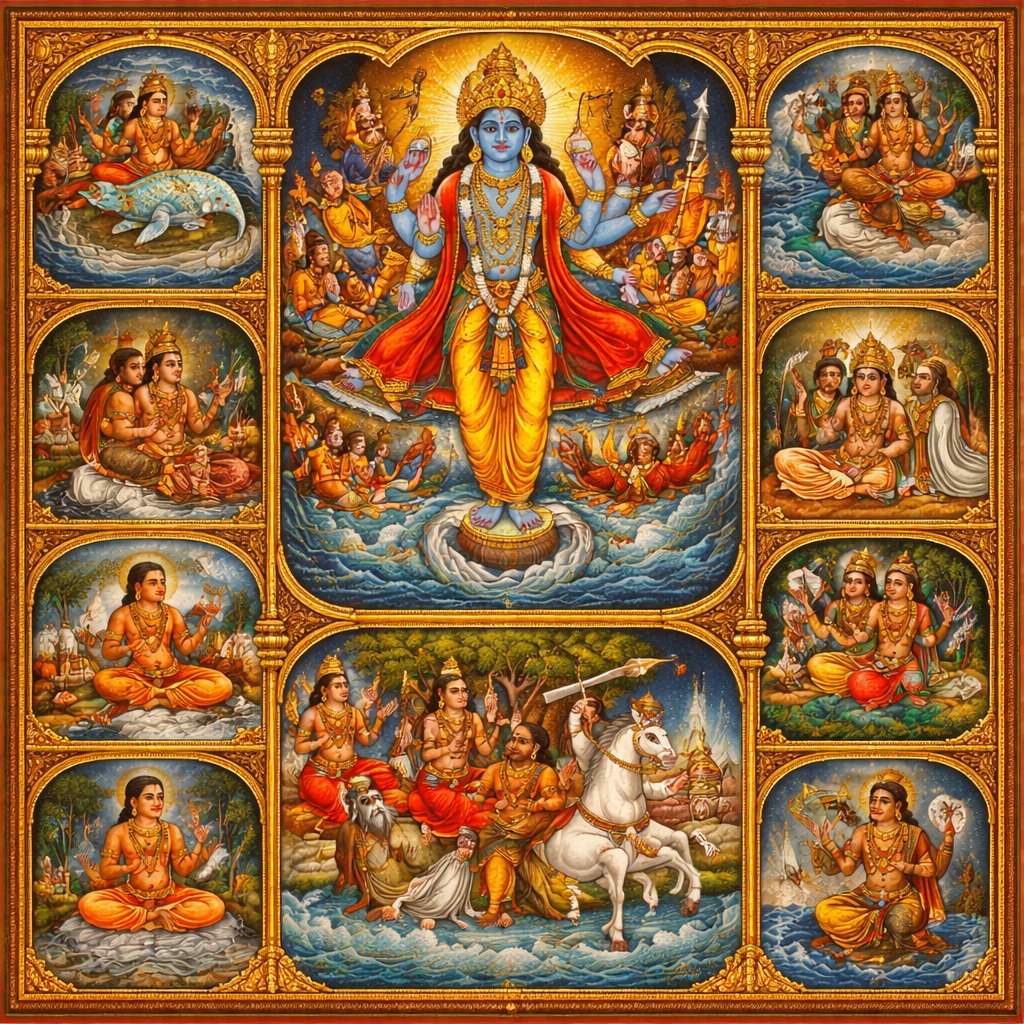
Avatara-lila
Incarnations of the Divine
The opening section narrating the divine incarnations (avataras) of Vishnu, cosmic creation myths, and the foundational theology of the Agni Purana.
Adhyayas in Avatara-lila
Adhyaya 1
Granthaprasthāvanā (Preface): Sāra of Knowledge, Twofold Brahman, and the Purpose of Avatāras
Chapter 1 begins with a maṅgala invocation and presents the Agni Purāṇa as an authoritative, salvific compendium. At Naimiṣa, Śaunaka and other Hari-devotee sages welcome Sūta and ask for the “essence of essences,” the knowledge that yields omniscience. Sūta replies that Viṣṇu—creator and cosmic regulator—is that essence; knowing Him culminates in the realization, “I am Brahman.” The chapter then sets an epistemic map: two Brahmans (śabda-brahman and para-brahman) and two knowledges (aparā and parā). A transmission lineage is established: Sūta learned the sāra from Vyāsa, Vyāsa from Vasiṣṭha, and Vasiṣṭha repeats what Agni taught in an assembly of sages and gods. Agni identifies himself with Viṣṇu and Kālāgni-Rudra and defines the Purāṇa as vidyā-sāra, granting both enjoyment and liberation to reciters and listeners. It enumerates aparā vidyā—Vedas, Vedāṅgas, and allied śāstras such as grammar, mīmāṃsā, dharmaśāstra, logic, medicine, music, dhanurveda, and arthaśāstra—while reserving parā vidyā as that by which Brahman is realized. It closes by introducing avatāra-līlā (Matsya, Kūrma, etc.) as the vehicle for explaining creation cycles, genealogies, manvantaras, and dynastic histories—forms assumed by the formless to teach causes, purposes, and dharma.
Adhyaya 2
मत्स्यावतारवर्णनम् (The Description of the Matsya Incarnation)
Chapter 2 begins the avatāra-līlā by presenting Vasiṣṭha’s request for a coherent account of Viṣṇu’s descents as the causal basis of creation and preservation. Agni replies that the avatāra’s ethical purpose is to destroy the wicked and protect the virtuous. Set at the close of a former aeon during a naimittika pralaya, when the worlds are flooded as ocean, Manu Vaivasvata performs austerity and water-libations on the Kṛtamālā riverbank and meets a tiny fish begging for refuge. As Manu shelters it in a jar, then a lake, and finally the sea, the fish expands miraculously to cosmic size and reveals itself as Nārāyaṇa. Matsya instructs Manu to prepare a boat, gather seeds and necessities, endure the night of Brahmā with the Seven Sages, and bind the boat to Matsya’s horn with the great serpent. The episode culminates in the safeguarding of the Vedas and leads into the later avatāras (Kūrma, Varāha), framing preservation of revelation as the central avatāra-function.
Adhyaya 3
Kūrma-avatāra-varṇana (The Description of the Tortoise Incarnation) — Samudra Manthana and the Reordering of Cosmic Prosperity
Agni continues the avatāra-līlā sequence, turning from Matsya directly to the Kūrma incarnation. The Devas, weakened by Durvāsas’ curse and bereft of Śrī (splendor/prosperity), take refuge in Viṣṇu dwelling in the Kṣīrābdhi (Ocean of Milk). Viṣṇu advises a strategic alliance (sandhi) with the Asuras to churn the ocean for amṛta and the return of Śrī, while declaring that immortality will ultimately belong to the Devas, not the Dānavas. Mandara serves as the churning rod and Vāsuki as the rope; when the mountain sinks, Viṣṇu becomes Kūrma to bear it and sustain the cosmic work. From the churning arise Hālāhala poison, Vāruṇī, Pārijāta, the Kaustubha jewel, divine beings, and Lakṣmī—signs of restored auspicious order. Dhanvantari emerges with amṛta; Viṣṇu then becomes Mohinī to distribute it to the gods, linking the eclipse myth to Rāhu’s severed head and the merit of dāna during grahaṇa. The chapter ends with a Vaiṣṇava–Śaiva pivot: Viṣṇu’s māyā deludes Rudra, yet Viṣṇu proclaims that only Śiva can conquer that māyā—culminating in the Devas’ victory and a phalaśruti promising heavenly reward for recitation.
Adhyaya 4
Varāhādy-avatāra-varṇana (Description of Varāha and Other Incarnations)
Agni begins a compact cycle of avatāras, portraying divine descent as the restoration of yajña (sacrificial order), the devas’ rightful shares, and earthly balance. Hiraṇyākṣa defeats the devas, and Viṣṇu appears as Varāha—explicitly Yajñarūpa, the very form of sacrifice—slays the asuric threat, and secures Dharma’s protection. Hiraṇyakaśipu then seizes sacrificial portions and divine authority, prompting Viṣṇu’s Narasiṃha to re-establish the devas in their proper stations. When the devas seek refuge, Viṣṇu comes as Vāmana into Bali’s sacrifice; through the legally binding gift of water and the request for three strides, he expands to cover the three worlds, sends Bali to Sutala, and restores Indra’s sovereignty. Agni finally outlines Paraśurāma’s descent to remove the earth’s burden of arrogant Kṣatriyas: born to Jamadagni and Reṇukā, he slays Kārttavīrya, avenges Jamadagni’s death, pacifies the earth twenty-one times, and donates the earth to Kaśyapa. The chapter ends with a phalaśruti, declaring that hearing these avatāras leads heavenward and exalting śravaṇa (devotional listening) as a Purāṇic discipline.
Adhyaya 5
Śrīrāmāvatāra-varṇanam (Description of the Incarnation of Śrī Rāma)
Agni proclaims a faithful retelling of the Rāmāyaṇa as Nārada once taught Vālmīki, declaring it a śāstric means that bestows both bhukti (worldly prosperity) and mukti (liberation). Nārada opens with a compressed solar genealogy—from Brahmā through Marīci, Kaśyapa, Sūrya, and Vaivasvata Manu to Ikṣvāku, then Kakutstha, Raghu, Aja, and Daśaratha—placing Rāma’s avatāra within the hereditary frame of rājadharma. Hari manifests fourfold to destroy Rāvaṇa and allied threats, and through the consecrated pāyasa distributed by Ṛśyaśṛṅga are born Rāma, Bharata, Lakṣmaṇa, and Śatrughna. Trained to protect dharma, the princes answer Viśvāmitra’s request by removing yajña-obstacles: slaying Tāḍakā, driving off Mārīca, and killing Subāhu. The narrative turns to Mithilā, where Rāma witnesses Janaka’s rite, strings and breaks Śiva’s bow, wins Sītā, and the brothers marry into Janaka’s line. Returning, Rāma subdues Jāmadagnya (Paraśurāma), completing a rite-to-royalty arc that models disciplined power under dharma.
Adhyaya 6
Śrīrāmāvatāravarṇanam (Description of Śrī Rāma’s Incarnation) — Ayodhyā Abhiṣeka, Vanavāsa, Daśaratha’s Death, Bharata’s Regency
This chapter continues Śrī Rāma’s Avatāra-līlā as a practical lesson in rājadharma, satya (truth), and vow-bound kingship. After Bharata departs, Daśaratha proclaims Rāma’s yuvarāja-abhiṣeka and orders night-long restraint and observance, appointing Vasiṣṭha and the ministers in due sequence. Mantharā then provokes Kaikeyī to invoke her two boons, turning ritual preparations into a political crisis: Rāma’s fourteen-year forest exile and Bharata’s immediate anointing. Bound by satya-pāśa (the noose of truth), Daśaratha collapses under the moral weight of his promise. Rāma accepts exile without revolt, performs filial and social duties (worship, reporting to Kauśalyā, gifts to brāhmaṇas and the poor), and departs with Sītā and Lakṣmaṇa. The route—Tamasā, Śṛṅgaverapura with Guha, Prayāga with Bharadvāja, and Citrakūṭa—frames dharmic renunciation in sacred geography, while the crow episode introduces protective astric knowledge. Daśaratha’s confession of an earlier curse (the Yajñadatta incident) ends in his death from grief. Bharata returns, rejects the taint of adharma, seeks Rāma, and finally rules from Nandigrāma by installing Rāma’s pādukās, symbolizing delegated sovereignty and ideal loyalty.
Adhyaya 7
Chapter 7 — रामायणवर्णनं (Description of the Rāmāyaṇa): Śūrpaṇakhā, Khara’s Defeat, and Sītā-haraṇa Prelude
This chapter continues the Agni Purana’s avatāra-līlā synopsis, compressing key Araṇya-kāṇḍa events into a dharma-centered arc. Rāma honors the ṛṣis (Vasiṣṭha, Atri–Anasūyā, Śarabhaṅga, Sutīkṣṇa) and, by Agastya’s grace, receives weapons before entering Daṇḍakāraṇya, showing kṣatriya-dharma guided by tapas and counsel. At Pañcavaṭī, Śūrpaṇakhā’s desire and aggression lead to her mutilation by Lakṣmaṇa under Rāma’s command, provoking Khara’s retaliation; Rāma destroys Khara’s forces. Śūrpaṇakhā then incites Rāvaṇa to abduct Sītā: Mārīca appears as the golden deer to draw Rāma away, a dying cry deceives Sītā into sending Lakṣmaṇa, and Rāvaṇa kills Jaṭāyus and carries Sītā to Laṅkā’s Aśoka grove. Rāma’s grief becomes purposeful quest—cremating Jaṭāyus, slaying Kabandha, and being directed toward alliance with Sugrīva—linking moral trial, statecraft, and the avatāra’s mission.
Adhyaya 8
Śrīrāmāvatāra-kathana (Account of the Rāma Incarnation) — Kiṣkindhā Alliance and the Search for Sītā
This chapter continues Śrī Rāma’s Avatāra-līlā in the Kiṣkindhā episode, stressing dharmic alliance and disciplined action. Grieving at Pampā, Rāma is guided by Hanūmān to befriend Sugrīva. To establish trust, Rāma displays superhuman might—piercing seven tāla palms with one arrow and hurling Dundubhi’s body far away—then slays Vālin, ends the brothers’ enmity, and restores Sugrīva’s kingship. When Sugrīva delays, Rāma observes Cāturmāsya on Mālyavat; Lakṣmaṇa admonishes him and Sugrīva repents. Search parties of vānaras are dispatched under strict time limits; Hanūmān receives Rāma’s signet-ring for the southern route. As the southern party falters, Sampāti reveals that Sītā is in Laṅkā, in the Aśoka grove, enabling the vānaras to report the decisive geographic and strategic lead for the next stage of the rescue.
Adhyaya 9
Chapter 9 — श्रीरामावतारकथनम् (Śrī Rāmāvatāra-kathanam) | Hanumān’s Ocean-Crossing, Sītā-Darśana, and the Setu Plan
This chapter continues the Rāmāyaṇa avatāra-līlā, presenting Hanumān as the chosen instrument of Śrī Rāma’s dharma-mission. Guided by Sampāti’s counsel, the vānaras face the strategic crisis of crossing the ocean, and Hanumān alone undertakes the mighty leap for the troop’s survival and Rāma’s success. He overcomes sea-borne trials (Maināka’s offer and Siṃhikā’s attack), surveys Laṅkā’s power through its palaces, and finds Sītā in the Aśoka grove. Their exchange confirms identity, fidelity, and proof: Rāma’s ring is given as recognition, and Sītā returns a jewel and message, insisting that Rāma himself must be her rescuer. Hanumān then employs measured force—devastating the grove to gain audience, declaring himself Rāma’s envoy, and warning Rāvaṇa of inevitable defeat. After Laṅkā is burned and Sītā reassured, he returns with “nectar-like” tidings that cool Rāma’s grief. The chapter culminates in alliance and righteous engineering: Vibhīṣaṇa’s refuge and consecration, and the Ocean’s counsel to build Nala’s bridge (setu), enabling the just campaign to advance.
Adhyaya 10
Chapter 10 — श्रीरामावतारवर्णनम् (Description of the Incarnation-Deeds of Śrī Rāma)
This chapter continues the Agni Purāṇa’s Rāmāyaṇa-embedded Avatāra-līlā by condensing the decisive arc of the Laṅkā war into a dharmic and strategic sequence. Nārada narrates how Rāma’s envoy Aṅgada issues an ultimatum to Rāvaṇa, establishing the ethical precondition of war: restitution of Sītā or righteous destruction. The battle unfolds with catalogued vānaras and rākṣasa champions, highlighting organized martial leadership (dhanurveda context) and the chaos of mass combat. Key turns include the slaying of commanders, Indrajit’s māyā and binding weapons, the Garuḍa-linked release, and the healing episode centered on Hanumān’s mountain—marking divine aid integrated with battlefield medicine. The narrative culminates in Rāma’s final victory through the Paitāmaha weapon, followed by state-restoration: Vibhīṣaṇa’s funerary rites, Sītā’s fire-purification, Indra’s amṛta revival of the vānaras, coronation logistics, and Rāma-rājya ideals—prosperity, timely deathlessness, and disciplined punishment of the wicked—presented as rājadharma in avatāric form.
Adhyaya 11
Śrīrāmāvatāra-varṇana (Description of the Incarnation of Sri Rama)
This chapter shifts from the Yuddha-kāṇḍa narrative to a concise avatāra-līlā recap focused on Śrī Rāma’s post-war reign and its dharmic fruits. Nārada visits Rāma in his established kingdom with Agastya and other sages, praising the divine victory marked by Indrajit’s fall. The text then compresses the Rākṣasa lineage—Pulastya to Viśravas, Kubera’s birth, and Rāvaṇa’s rise through Brahmā’s boon—culminating in Indrajit’s identity and his defeat by Lakṣmaṇa for the gods’ security. After the sages depart, it turns to royal governance and frontier pacification: Śatrughna is sent (at the gods’ request) to slay Lavaṇa; Bharata destroys vast hostile forces linked with Śailūṣa and installs Takṣa and Puṣkara as regional rulers, exemplifying rājadharma as protecting the disciplined after removing the wicked. The birth and later recognition of Kuśa and Lava at Vālmīki’s āśrama is noted, followed by a soteriological turn: consecrated kingship is paired with prolonged contemplation of “I am Brahman.” The chapter ends with Rāma’s sacrificial rule and collective ascent, and Agni’s affirmation that Vālmīki composed the Rāmāyaṇa from Nārada’s account; hearing it leads to heavenly attainment.
Adhyaya 12
Chapter 12 — श्रीहरिवंशवर्णनं (Śrī-Harivaṃśa-varṇana) | The Description of the Sacred Harivaṃśa
Agni recounts the Harivaṃśa genealogy from Viṣṇu’s navel-lotus (Brahmā → Atri → Soma → Purūravas → Āyu → Nahuṣa → Yayāti), tracing branching lines that culminate in the Yādavas, with Vasudeva foremost. He then compresses Kṛṣṇa’s avatāra-līlā into an ordered sequence: embryo transfers (including Balarāma), Kṛṣṇa’s midnight manifestation, the exchange with Yaśodā, and Kaṁsa’s brutality. A sky-born Devī foretells Kaṁsa’s doom, is praised with Durgā epithets, and a tri-sandhyā recitation merit is stated. Kṛṣṇa’s Vraja deeds follow—Pūtanā, Yamala-Arjuna, Śakaṭa, Kāliya, Dhenuka, Keśin, Ariṣṭa, and Govardhana—then the Mathurā arc: Kuvalayāpīḍa, Cāṇūra–Muṣṭika, and Kaṁsa’s death. The narrative expands to Jarāsandha’s siege, Dvārakā’s founding, Narakāsura’s defeat, the Pārijāta retrieval, and the Pradyumna–Aniruddha–Uṣā episode, culminating in the Hari–Śaṅkara conflict and the doctrine of non-difference (abheda). It closes with Yādava proliferation and the promise that reading the Harivaṃśa fulfills desired aims and leads to Hari.
Adhyaya 13
Chapter 13 — कुरुपाण्डवोत्पत्त्यादिकथनं (Narration of the Origin of the Kurus and the Pāṇḍavas, and Related Matters)
Agni proclaims a Bhārata-centered narration suffused with Kṛṣṇa-māhātmya, presenting the Mahābhārata as Viṣṇu’s design to lighten Earth’s burden through human instruments, the Pāṇḍavas. The chapter compresses the royal genealogy from Viṣṇu → Brahmā → Atri → Soma → Budha → Purūravas down to Yayāti, Puru, Bharata, and Kuru, establishing Kuru legitimacy. It then summarizes the Śāntanu line: Bhīṣma’s guardianship, Citrāṅgada’s death, the Kāśī princesses, Vicitravīrya’s demise, and Vyāsa’s niyoga producing Dhṛtarāṣṭra and Pāṇḍu; Dhṛtarāṣṭra fathers the Kauravas led by Duryodhana. Pāṇḍu’s curse leads to the Pāṇḍavas’ divine births; Karṇa’s birth and alliance with Duryodhana intensify fate-driven enmity. Key Mahābhārata milestones follow: the lac-house plot, Ekacakrā and Vaka’s slaying, Draupadī’s svayaṃvara, gaining Gāṇḍīva and Agni’s chariot, the Khāṇḍava episode, the Rājasūya, dice-game exile, the Virāṭa incognito year (with variant readings), revelation, Abhimanyu’s marriage, war mobilization, Kṛṣṇa’s embassy, Duryodhana’s refusal, and Kṛṣṇa’s viśvarūpa—setting the ethical and cosmic inevitability of war.
Adhyaya 14
कुरुपाण्डवसङ्ग्रामवर्णनम् (Description of the War between the Kurus and the Pāṇḍavas)
Agni recounts a compressed Mahābhārata war narrative to highlight dharma, impermanence, and kingship. At Kurukṣetra, Arjuna falters on seeing elders like Bhīṣma and Droṇa; Kṛṣṇa teaches the imperishable Ātman and the perishable body, linking spiritual insight to rājadharma—steadiness in success and failure while guarding the kingly law. The chapter then summarizes the shifts in command (Bhīṣma, Droṇa, Karṇa, Śalya) and pivotal deaths: Bhīṣma’s fall on the bed of arrows as he contemplates Viṣṇu awaiting Uttarāyaṇa; Droṇa’s disarming after the report “Aśvatthāmā is slain”; Karṇa’s defeat by Arjuna; Śalya’s death at Yudhiṣṭhira’s hand; and Duryodhana’s final mace-fight with Bhīma. Aśvatthāmā’s night slaughter follows, killing the Pāñcālas and Draupadī’s sons; Arjuna restrains him and takes his crest-jewel, while Hari revives Uttarā’s embryo, securing Parīkṣit’s lineage. The survivors are listed, funerary rites performed, and Bhīṣma teaches peace-giving dharmas (rājadharma, mokṣadharma, dāna). Yudhiṣṭhira completes the Aśvamedha, installs Parīkṣit, and ascends to heaven.
Adhyaya 15
पाण्डवचरितवर्णनम् (The Account of the Pāṇḍavas)
Lord Agni continues the avatāra-līlā by compressing the Mahābhārata’s post-war close into a dharma-centered epitome. Yudhiṣṭhira is established as king; Dhṛtarāṣṭra, Gāndhārī, and Pṛthā retire to the forest, marking the shift from royal duty to renunciation. Vidura attains heaven through a fire-linked end. Viṣṇu’s cosmic aim is declared: to lighten Earth’s burden through the Pāṇḍavas as instruments, and to dissolve the Yādavas under the pretext of a curse (mauṣala). Hari relinquishes the body at Prabhāsa; later Dvārakā is overwhelmed by the ocean, teaching impermanence. Arjuna performs funerary rites, loses efficacy without Kṛṣṇa’s presence, and is consoled by Vyāsa before reporting to Hastināpura. Yudhiṣṭhira installs Parīkṣit and undertakes the Great Departure with his brothers and Draupadī, reciting Hari’s names; the companions fall on the path, and Yudhiṣṭhira ascends to heaven in Indra’s chariot, ending with a phalaśruti promising heavenly attainment through recitation.
Adhyaya 16
Chapter 16 — बुद्धाद्यवतारकथनम् (Narration of Buddha and Other Incarnations)
Agni opens Chapter 16 by declaring that hearing and reciting the account of the Buddha-avatāra yields significant spiritual fruit. Set amid a devas–asuras struggle, the devas—defeated—seek refuge in the Lord; Viṣṇu answers by assuming the form of Māyā-moha and being born as Śuddhodana’s son, deluding the daityas into abandoning Vedic dharma. From this turn arise Veda-vihīna communities, including the Ārhata stream, portrayed as producing pāṣaṇḍa identities and deeds that lead toward naraka. The chapter then diagnoses Kali-yuga: moral collapse, predatory rulers in mleccha guise, and altered traditions about the number of Vedic branches. It culminates in Kalki’s restorative eschatology: armed, with Yājñavalkya as purohita, he destroys the mlecchas, re-establishes varṇāśrama boundaries, and inaugurates the return of Kṛta-yuga. The conclusion universalizes this pattern across kalpas and manvantaras, affirms the innumerability of avatāras, promises heaven to those who hear or recite the Daśāvatāra, and proclaims Hari as the regulator of dharma/adharma and the cause of cosmic emanation and dissolution.