Adhyaya 72
Chapter 72 — स्नानविशेषादिकथनम् (Special Rules of Bathing, Mantra-Purification, and Sandhyā)
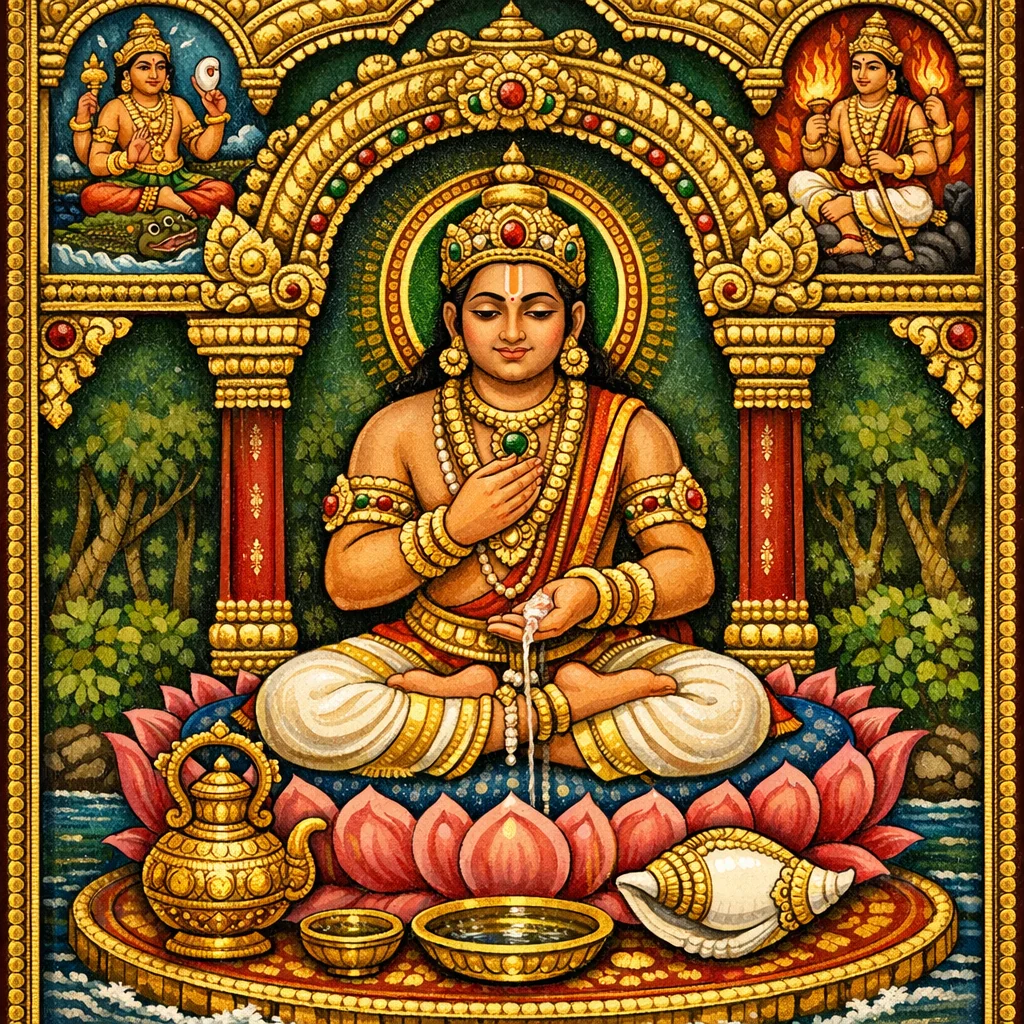
This chapter (in the Vāstu-Pratiṣṭhā & Īśāna-kalpa stream) establishes ritual purification as the technical basis of worship and consecration. The Lord teaches Skanda daily and occasional bathing (snāna), beginning with ritual use of earth/clay (mṛd) purified by the astra-mantra, then a sequence of bodily washing with grass divisions, breath-restraint and immersion, remembrance of the hṛdyāstra, and post-bath purification, followed by Astra-sandhyā and vidhisnāna. It further describes mudrā-governed acts (aṅkuśa, saṃhāra), directional projection of mantra, and Śiva-centered cooling and auspicious recitations applied from head to feet, including the closing of sensory apertures (sammukhīkaraṇa). Specialized baths (Agneya, Māhendra, mantra-snāna, mānasa-snānā) and situational purifications (after sleep, food, contact) are mapped. The Sandhyā-vidhi follows: ācamana, prāṇāyāma, mental japa, deity-meditations for morning/midday/evening, a fourth “witness” sandhyā for knowers, and an esoteric inner sandhyā. Finally, it details hand-tīrthas, mārjana and aghamarṣaṇa, arghya and Gāyatrī-japa, and a structured tarpaṇa sequence to deities, ṛṣis, pitṛs, directions, and protective beings—affirming purity as the gateway to successful pratiṣṭhā and Īśāna-oriented worship.
Shlokas
Verse 1
इत्य् आदिमहापुराणे आग्नेये विनायकपूजाकथनं नाम एकसप्ततितमो ऽध्यायः अथ द्विसप्ततितमो ऽध्यायः स्नानविशेषादिकथनं ईश्वर उवाच वक्ष्यामि स्कन्द नित्याद्यं स्नानं पूजां प्रतिष्ठया खात्वासिना समुद्धृत्य मृदमष्टाङ्गुलां ततः
Thus, in the Agni Purāṇa—within the primordial Mahāpurāṇa—the seventy-first chapter is called “The narration of the worship of Vināyaka.” Now begins the seventy-second chapter, “The narration of special rules of bathing and related observances.” The Lord said: “O Skanda, I shall explain the daily (and other) bathing rites, together with worship and the procedure of consecration. Then, having dug up and lifted clean earth with a spade, one should take a measure of clay of eight finger-breadths.”
Verse 2
सर्वात्मना समुद्धृत्य पुनस्तेनैव पूरयेत् शिरसा पयसस्तीरे निधायास्त्रेण शोधयेत्
Having completely lifted it out, one should fill it again with that very same (substance). Placing it on the bank of the water with head bowed, one should purify it by the weapon-mantra (astra).
Verse 3
तृणानि शिखयोद्धृत्य वर्मणा विभजेत्त्रिधा एकया नाभिपादान्तं प्रक्षाल्य पुनरन्यया
Having plucked blades of grass by their tips, one should divide them into three portions with the protective covering (varmaṇa). With one portion, one should wash from the navel down to the end of the feet; then again with another portion.
Verse 4
अस्त्राभिलब्धयालभ्य दीप्तया सर्वविग्रहं निरुद्धाक्षाणि पाणिभ्यां प्राणान् संयम्य वारिणि
Having obtained it through the successful mastery of the weapon-mantra (astra), with the blazing power that pervades the entire body, one should close the eyes with both hands, restrain the vital breaths (prāṇa), and then immerse in water.
Verse 5
निमज्यासीत हृद्यस्त्रं स्मरन् कालानलप्रभं विघ्नराजक इति ङ, चिह्नितपुस्तकपाठः निजास्त्रेण विशोधयेदिति ख, ग, चिह्नितपुस्तकपाठः मलस्नानं विशोधयेत्थं समुत्थाय जलान्तरात्
Having immersed himself, he should remain within the water, remembering the Hṛdyāstra (Heart-Weapon), radiant like kālānala, the fire of Time. (Some marked manuscript readings add: uttering “vighnarājaka”.) Then, rising up from within the water, he should purify the bath undertaken for removing bodily impurity—(according to some readings) by means of his own astra-mantra.
Verse 6
अस्त्रसन्ध्यामुपास्याथ विधिस्नानं समाचरेत् सारस्वतादितीर्थानां एकमङ्कुशमुद्रया
After performing the Astra-sandhyā worship, one should then undertake the prescribed ritual bath. And by means of the single Aṅkuśa-mudrā, one may obtain the rite or fruit of the sacred fords (tīrthas), beginning with the Sārasvata tīrtha.
Verse 7
हृदाकृष्य तथा स्नाप्य पुनः संहारमुद्रया शेषं मृद्भागमादाय प्रविश्य नाभिवारिणि
Drawing it into the heart and bathing (it) accordingly, then again by the Saṃhāra-mudrā, taking the remaining portion of the clay, one should place it into the water at the navel (nābhi) region.
Verse 8
वामपाणितले कुर्याद्भागत्रयमुदङ्मुखः अङ्गैर् दक्षिणमेकाद्यं पूर्वमस्त्रेण सप्तधा
Facing north, one should mark three divisions on the palm of the left hand. Then, on the right side, beginning with the first aṅga, one should perform the placements in order; on the eastern (front) side, one should apply the astra-mantra in a sevenfold sequence.
Verse 9
शिवेन दशधा सौम्यं जपेद्भागत्रयं क्रमात् सर्वदिक्षु क्षिपेत् पूर्वं हूं फडन्तशरात्मना
Having empowered it with the Śiva-mantra, the gentle Saumya formula should be recited tenfold; then its three parts should be applied in due sequence. First, one should project it into all directions as an arrow-form mantra ending with “hūṃ” and “phaṭ”.
Verse 10
कुर्याच्छिवेन सौम्येन शिवतीर्थं भुजक्रमात् सर्वाङ्गमङ्गजप्तेन मूर्धादिचरणावधि
With the gentle (cooling) Śiva-mantra, one should perform the Śiva-tīrtha rite, proceeding in order along the arms; and, with mantra-recitation for the auspiciousness of the whole body, one should apply it from the head down to the feet.
Verse 11
दक्षिणेन समालभ्य पठन्नङ्गचतुष्टयम् पिधाय खानि सर्वाणि सम्मुखीकरणेन च
Having touched the body/limbs with the right hand, one should recite the fourfold limb-formula; and, by the act of “bringing to the front” (sammukhīkaraṇa), one should also close all the apertures of the senses.
Verse 12
शिवं स्मरन्निमज्जेत हरिं गङ्गेति वा स्मरन् वौषडन्तषडङ्गेन के कुर्यादभिषेचनं
One should immerse in the water while remembering Śiva; or remembering Hari, or uttering “Gaṅgā”. With the six-limbed mantra ending in “vauṣaṭ”, one should perform the consecratory sprinkling (abhiṣecana).
Verse 13
कुम्भमात्रेण रक्षार्थं पूर्वादौ निक्षिपेज्जलं स्नात्वा रजोपचारेण सुगन्धामलकादिभिः
For protection, using only a single water-pot, one should place or sprinkle water to the east first and then to the other directions; and after bathing, one should perform worship with powdered offerings (rajo-upacāra), using fragrant substances such as āmalaka and the like.
Verse 14
स्नात्वा चोत्तीर्य तत्तीर्थं संहारिण्योपसंहरेत् अथातो विधिशुद्धेन संहितामन्त्रितेन च
Having bathed and then emerged from that tīrtha (sacred ford), one should perform the concluding withdrawal (upasaṃhāra) by means of the Saṃhāriṇī formula. Thereafter, one should proceed with what is purified by correct procedure (vidhi-śuddha) and accompanied by the recitation of the Saṃhitā-mantras.
Verse 15
निवृत्यादिविशुद्धेन भस्मना स्नानमाचरेत् शिरस्तः पादपर्यन्तं ह्रूं फडन्तशरात्मना
One should bathe with sacred ash (bhasma) purified by the mantra-principles beginning with Nivṛtti, applying it from the head down to the feet, while identifying with the protective, missile-like mantra that ends with “phaṭ” together with “hrūṃ”.
Verse 16
तेन कृत्वा मलस्नानं विधिस्नानं समाचरेत् क्रूं फडन्तशरात्मना इति ख, ङ, चिह्नितपुस्तकद्वयपाठः क्रूं फडन्तशरात्मना इति ख, ङ, चिह्नितपुस्तकद्वयपाठः ईशतत्पुरुषाघोरगुह्यकाजातसञ्चरैः
Having thereby performed the malasnāna (cleansing bath), one should then carry out the prescribed vidhisnāna (ritual bath), employing the weapon-like, missile-form mantra “krūṃ, phaḍ” (so read the manuscripts marked ‘kha’ and ‘ṅa’), together with the mantra-currents associated with Īśa, Tatpuruṣa, Aghora, Guhyaka, and Ājāta.
Verse 17
क्रमेणोद्धूनयेन्मूर्ध्नि वक्त्रहृद्गुह्यविग्रहात् सन्ध्यात्रये निशीथे च वर्षापूर्वावसानयोः
In proper sequence, one should shake off (impurities) onto the crown of the head, proceeding from the mouth, the heart, the secret part, and the body. This is to be done at the three sandhyā junctions of the day, at midnight, and at the beginning and end of the rainy season.
Verse 18
सुप्त्वा भुक्त्वा पयः पीत्वा कृत्वा चावश्यकादिकम् स्त्रीपुन्नपुंसकं शूद्रं विडालशशमूषिकम्
After sleeping, after eating, after drinking milk, and after performing necessary acts such as evacuation and the like, one should perform purification (ācamanā); likewise after contact with a woman, a man, a napuṃsaka, a Śūdra, a cat, a hare, or a mouse.
Verse 19
स्नानमाग्नेयकं स्पृष्ट्वा शुचा वुद्धूलकं चरेत् सूर्यांशुवर्षसम्पर्कैः प्राङ्मुखेनोर्ध्वबाहुना
Having touched (performed) the Agneya bath, one should, in purity, practice the vuddhūlaka (dust-bath, rolling in clean dust). By contact with the sun’s rays and with falling rain, one should do so facing east with arms uplifted.
Verse 20
माहेन्द्रं स्नानमैशेन कार्यं सप्तपदावधि गोसङ्घमध्यगः कुर्यात् खुरोत्खातकरेणुभिः
The Māhendra bath is to be performed by the Īśa-method: standing amid a herd of cows, one should carry it out for a span of seven steps, using the dust raised by their hooves.
Verse 21
पावनं नवमन्त्रेण स्नानन्तद्वर्मणाथवा सद्योजातादिभिर्मन्त्रैर् अम्भोभिरभिषेचनम्
Purification is performed by bathing with the nine-mantra set, or else by that protective “armor” (varma) mantra; or by sprinkling with water consecrated through mantras such as “Sadyojāta” and the others.
Verse 22
मन्त्रस्नानं भवेदेवं वारुणाग्नेययोरपि मनसा मूलमन्त्रेण प्राणायामपुरःसरम्
In this same manner, mantra-bathing (mantra-snānā) is to be performed for Varuṇa- and Agni-related rites as well—done mentally with the root-mantra (mūla-mantra), preceded by the practice of prāṇāyāma.
Verse 23
कुर्वीत मानसं स्नानं सर्वत्र विहितं च यत् वैष्णवादौ च तन्मन्त्रैर् एवं स्नानादि कारयेत्
One should perform the mental bath (mānasa-snānā), which is enjoined in all contexts; and in Vaiṣṇava and other rites, one should likewise carry out bathing and related purifications by means of their respective mantras.
Verse 24
सन्ध्याविधिं प्रवक्ष्यामि मन्त्रैर् भिन्नैः समं गुह संवीक्ष्य त्रिः पिवेदम्बु ब्रह्मतीर्थेन शङ्करैः
I shall explain the procedure of Sandhyā together with the distinct mantras. Having looked into the hollow of the joined palms, one should sip water three times, using the brahma-tīrtha (the base of the thumb).
Verse 25
स्वधान्तैर् आत्मतत्त्वाद्यैस्ततः खानि स्पृशेद्धृदा शकलीकरणं कृत्वा प्राणायामेन संस्थितः
Then, using the mantras ending in “svadhā”, beginning with the Ātma-tattva (principle of the Self), he should touch the bodily apertures with firm resolve; having performed the rite of śakalīkaraṇa (division/placing into parts), he should remain established in prāṇāyāma (regulated breath-control).
Verse 26
त्रिः समावर्तयेन् मन्त्री मनसा शिवसंहितां आचम्य न्यस्य सन्ध्याञ्च ब्राह्मीं प्रातः स्मरेन्नरः
A mantra-practitioner should mentally recite the Śiva-mantra collection three times; then, having performed ācamana and done nyāsa, he should remember the Brāhmī Sandhyā in the morning.
Verse 27
हंसपद्मासनां रक्तां चतुर्वक्त्रां चतुर्भुजां गुह्यकाजातसंरवैर् इति ख, चिह्नितपुस्तकपाठः तत्खरोत्खातरेणुभिरिति ख, चिह्नितपुस्तकपाठः स्मरेत्तत इति ग, चिह्नितपुस्तकपाठः प्रस्कन्दमालिनीं दक्षे वामे दण्डकमण्डलुं
One should meditate upon (the Goddess) seated upon a swan and a lotus-seat, red in complexion, four-faced and four-armed… wearing a garland that hangs upon the chest; in the right hand she holds the japamālā (rosary), and in the left, a staff (daṇḍa) and a water-pot (kamaṇḍalu).
Verse 28
तार्क्ष्यपद्मासनां ध्यायेन्मध्याह्ने वैष्णवीं सितां शङ्खचक्रधरां वामे दक्षिणे सगदाभयं
At midday one should meditate on the white, radiant Vaiṣṇavī, seated upon Garuḍa and a lotus-seat, bearing conch and discus on the left, and on the right holding a mace and showing the gesture of fearlessness (abhayā).
Verse 29
रौद्रीं ध्यायेद् वृषाब्जस्थां त्रिनेत्रां शशिभूषितां त्रिशूलाक्षधरां दक्षे वामे साभयशक्तिकां
One should meditate upon Raudrī, seated upon the bull and upon a lotus-seat, three-eyed, adorned with the moon, holding a trident and an axe in her right hands, and in her left hands holding a spear (śakti) and granting fearlessness (abhayā).
Verse 30
साक्षिणीं कर्मणां सन्ध्यां आत्मानंतत्प्रभानुगं चतुर्थी ज्ञानिनः सन्ध्या निशीथादौ विभाव्यते
The twilight-meditation that is the Witness of actions—namely, the Self (Ātman) that follows, i.e., is illumined by That radiance—is the fourth Sandhyā for the knowers; it is to be contemplated at the beginning of midnight.
Verse 31
हृद्बिन्दुब्रह्मरन्ध्रेषु अरूपा तु परे स्थिता शिवबोधपरा या तु सा सन्ध्या मरमोच्यते
That inner practice which is formless abides in the supreme Reality within the heart, the subtle point (bindu), and the brahma-opening (brahma-randhra) at the crown; devoted to the realization of Śiva, it is called the Sandhyā of the secret/inner doctrine.
Verse 32
पैत्र्यं मूले प्रदेशिन्याः कनिष्ठायाः प्रजापतेः ब्राह्म्यमङ्गुष्ठमूलस्थं तीर्थं दैवं कराग्रतः
At the base of the forefinger is the Pitṛ (ancestral) tīrtha; at the base of the little finger is the Prajāpati tīrtha. At the base of the thumb is the Brāhma tīrtha, and at the front tips of the hand (the fingertips) is the Daiva (divine) tīrtha.
Verse 33
सव्यपाणितले वह्नेस्तीर्थं सोमस्य वामतः ऋषीणां तु समग्रेषु अङ्गुलीपर्वसन्धिषु
On the palm of the left hand is the Tīrtha of Agni; to its left side is the Tīrtha of Soma. The Tīrthas of the Ṛṣis, in their entirety, are located at the junctions of the finger-joints.
Verse 34
ततः शिवात्मकैर् मन्त्रैः कृत्वा तीर्थं शिवात्मकं मार्जनं संहितामन्त्रैस्तत्तोयेन समाचरेत्
Then, having consecrated the ritual water (tīrtha) with mantras embodying Śiva, making it a Śiva-natured tīrtha, one should perform mārjana (sprinkling/purificatory wiping) with the Saṃhitā-mantras, using that very water.
Verse 35
वामपाणिपतत्तोययोजनं सव्यपाणिना उत्तमाङ्गे क्रमान्मन्त्रैर् मार्जनं समुदाहृतं
Mārjana (ritual purification by sprinkling) is declared to be the act of taking the water that has fallen into the left palm and, with the right hand, applying it in due sequence upon the head while reciting the mantras.
Verse 36
नीत्वा तदुपनासाग्रं दक्षपाणिपुटस्थितं बोधरूपं सितं तोयं वाममाकृष्य स्तम्भयेत्
Having brought that white water—held cupped in the right palm and endowed with restorative efficacy—to the tip of the patient’s nostril, one should draw it in through the left nostril and thereby arrest the disorder or flow.
Verse 37
तत्पापं कज्जलाभासम्पिङ्गयारिच्य मुष्टिना क्षिपेद्वज्रशिलायान्तु तद्भवेदघमर्षणं
That sin—appearing like soot—having been scraped off with a tawny (piṅgā) implement, should be cast away with the fist onto a hard stone (vajra-śilā); this act becomes the rite called Aghamarṣaṇa, the “removal of sin”.
Verse 38
स्वाहान्तशिवमन्त्रेण कुशपुष्पाक्षतान्वितं शिवायार्घ्याञ्जलिन्दत्वा गायत्रीं शक्तितो जपेत्
With a Śiva-mantra ending in “svāhā”, and accompanied by kuśa grass, flowers, and unbroken rice grains, having offered an arghya in cupped hands to Śiva, one should recite the Gāyatrī according to one’s capacity.
Verse 39
दाक्षिण्यः कर्मणां सन्ध्या इति ख, चिह्नितपुस्तकपाठः कुम्भयेदिति ख, ङ, चिह्नितपुस्तकपाठः तर्पणं सम्प्रवक्ष्यामि देवतीर्थेन मन्त्रकात् तर्पयेद्धौं शिवायेति स्वाहान्यान् स्वाहया युतान्
“Now I shall expound the rite of tarpaṇa, using the devatīrtha hand-gesture and the appropriate mantras. One should offer libations with the mantra ‘dhauṃ śivāya’, and also other offerings accompanied by the utterance ‘svāhā’.”
Verse 40
ह्रां हृद्याय ह्रीं शिरसे ह्रूं शिखायै ह्रैं कवचाय अस्त्रायाष्टौ देवगणान् हृदादित्येभ्य एव च
“Hrāṃ” is to be placed on the heart; “Hrīṃ” on the head; “Hrūṃ” on the śikhā (crown-lock); “Hraiṃ” as the kavaca (protective armor); and then the weapon-mantra (astra) is applied. Thus one should assign/invoke the eight groups of deities—from the Heart-deities up to the Ādityas as well.
Verse 41
हां वसुभ्यो ऽथ रुद्रेभ्यो विश्वेभ्यश् चैव मरुद्भ्यः भृगुभ्यो हामङ्गिरोभ्य ऋषीन् कण्ठोपवीत्यथ
Then one should offer the oblation-formula “hāṃ” to the Vasus; then to the Rudras; and likewise to the Viśvedevas and the Maruts. Next, offer to the Bhṛgus and to the Aṅgirases—thereafter honoring the Ṛṣis, with the sacred thread worn around the neck (kaṇṭhopavīta).
Verse 42
अत्रेये ऽथ वसिष्ठाय नमश्चाथ पुलस्तये कृतवे भारद्वजाय विश्वामित्राय वै नमः
Salutation to Ātreya, of Atri’s lineage; salutation to Vasiṣṭha; salutation also to Pulastya; to Kratu; to Bhāradvāja; and indeed, salutation to Viśvāmitra.
Verse 43
प्रचेतसे मनुष्यांश् च सनकाय वषट् तथा हां सनन्दाय वषट् सनातनाय वै वषट्
“To Pracetas, and to mankind—vaṣaṭ. Likewise, to Sanaka—vaṣaṭ; ‘hāṃ’ to Sanandana—vaṣaṭ; and indeed to Sanātana—vaṣaṭ.”
Verse 44
सनत्कुमाराय वषट् कपिलाय तथा वषट् पञ्चशिखाय द्युभवे संलग्नकरमूलतः
“(Offer the vaṣaṭ call) to Sanatkumāra; likewise (offer) vaṣaṭ to Kapila; (and offer) vaṣaṭ to Pañcaśikha; and to Dyubhava.” (These are to be performed with the bases of the fingers placed together, as a ritual hand-placement).
Verse 45
सर्वेभ्यो भूतेभ्यो वौषट् भूतान् देवपितॄनथ दक्षस्कन्धोपवीती च कुशमूलाग्रतस्तिलैः
Saying, “Vauṣaṭ—obeisance/oblation to all beings,” one should then make offerings to the beings, to the gods, and to the ancestors (Pitṛs), wearing the sacred thread over the right shoulder and using kuśa grass (held by root and tip) together with sesame seeds.
Verse 46
कव्यबालानलायाथ सोमाय च यमाय च अर्यम्णे चाग्निसोमाय वर्हिषद्भ्यः स्वधायुतान्
Then one should offer the svadhā-invoked oblations to Kavyavāhana (the fire that conveys offerings to the Pitṛs), to Anala, to Soma, to Yama, to Aryaman, to Agni-Soma, and to the Barhiṣad Pitṛs.
Verse 47
आज्यपाय च सोमाय विशेषसुरवत् पितॄन् ॐ हां ईशानाय पित्रे स्वधा दद्यात् पितामहे
For the Pitṛs one should also offer oblations to Ājyapā and to Soma, honoring them with special reverence as one does the gods. With the mantra “Oṃ hāṃ—to Īśāna, to the Pitṛ—svadhā,” one should present the svadhā-offering to the grandfather (pitāmaha).
Verse 48
शान्तप्रपितामहाय तथाप्रेतपितॄंस् तथा पितृभ्यः पितामहेभ्यः स्वधाथ प्रपितामहे
“With the svadhā formula,” one should offer to the pacified great-grandfathers (prapitāmaha); likewise to the departed Pitṛs (preta). One should offer to the fathers and to the grandfathers—“svadhā!”—and also to the great-grandfathers.
Verse 49
वृद्धप्रपितामहेभ्यो मातृभ्यश् च स्वधा तथा हां मातामहेभ्यः स्वधा हां प्रमातामहेभ्यश् च
“To the elder great-grandfathers (vṛddha prapitāmaha) and to the mothers—svadhā; likewise, hāṃ. To the maternal grandfathers (mātāmaha)—svadhā, hāṃ; and to the maternal great-grandfathers (promātāmaha) also.”
Verse 50
वृद्धप्रमातामहेभ्यः सर्वेभ्यः पितृभ्यस् तथा मरीचये पुलस्त्यायेति ङ, चिह्नितपुस्तकपाठः हां ईशानाय पित्रे च सदाज्याय पितामहायेति ख, चिह्नितपुस्तकपाठः सर्भेभ्यः स्वधा ज्ञातिभ्यः सर्वाचार्येभ्य एव च दिशां दिक्पतिसिद्धानां मातॄणां ग्रहरक्षसां
“(Oblations) to the elders and to the maternal grandfathers; to all the Pitṛs as well; and (also) to Marīci and to Pulastya”—so reads one marked manuscript-variant. Another marked reading is: “hāṃ—unto Īśāna as Father, and unto Sadājya as Grandfather.” (Further oblations are to be offered) to all the kinsmen with the svadhā-formula, and likewise to all teachers; (and also) to the directions—namely to the Lords of the Directions (Dikpatis), to the Siddhas, to the Mothers (Mātṛs), and to the Grahas and Rākṣasas (protective/terrific beings).
Frequently Asked Questions
A tightly ordered purification protocol: ritual clay extraction and re-filling, astra-mantra śodhana, mudrā-regulated applications, directional mantra-projection, and graded baths (malasnāna → vidhisnāna), culminating in Sandhyā, mārjana/aghamarṣaṇa, and tarpaṇa sequences.
It frames bodily and environmental purity as a sādhana: mantra, prāṇāyāma, and sandhyā-meditations convert routine cleansing into inner alignment with Śiva-consciousness, making external ritual readiness (for worship/pratiṣṭhā) inseparable from inner discipline aimed at purification of karma and realization.
Brāhmī in the morning (red, four-faced, four-armed), Vaiṣṇavī at midday (white, Garuḍa-seat, conch/discus), and Raudrī in the evening (three-eyed, moon-adorned, trident/axe), plus a fourth ‘witness’ Sandhyā for knowers and an inner formless Sandhyā focused on Śiva-realization.
Pitṛ-tīrtha at the base of the forefinger, Prajāpati-tīrtha at the base of the little finger, Brāhma-tīrtha at the base of the thumb, Daiva-tīrtha at the fingertips; additionally Agni-tīrtha on the left palm, Soma-tīrtha to its left side, and Ṛṣi-tīrthas at finger-joint junctions.