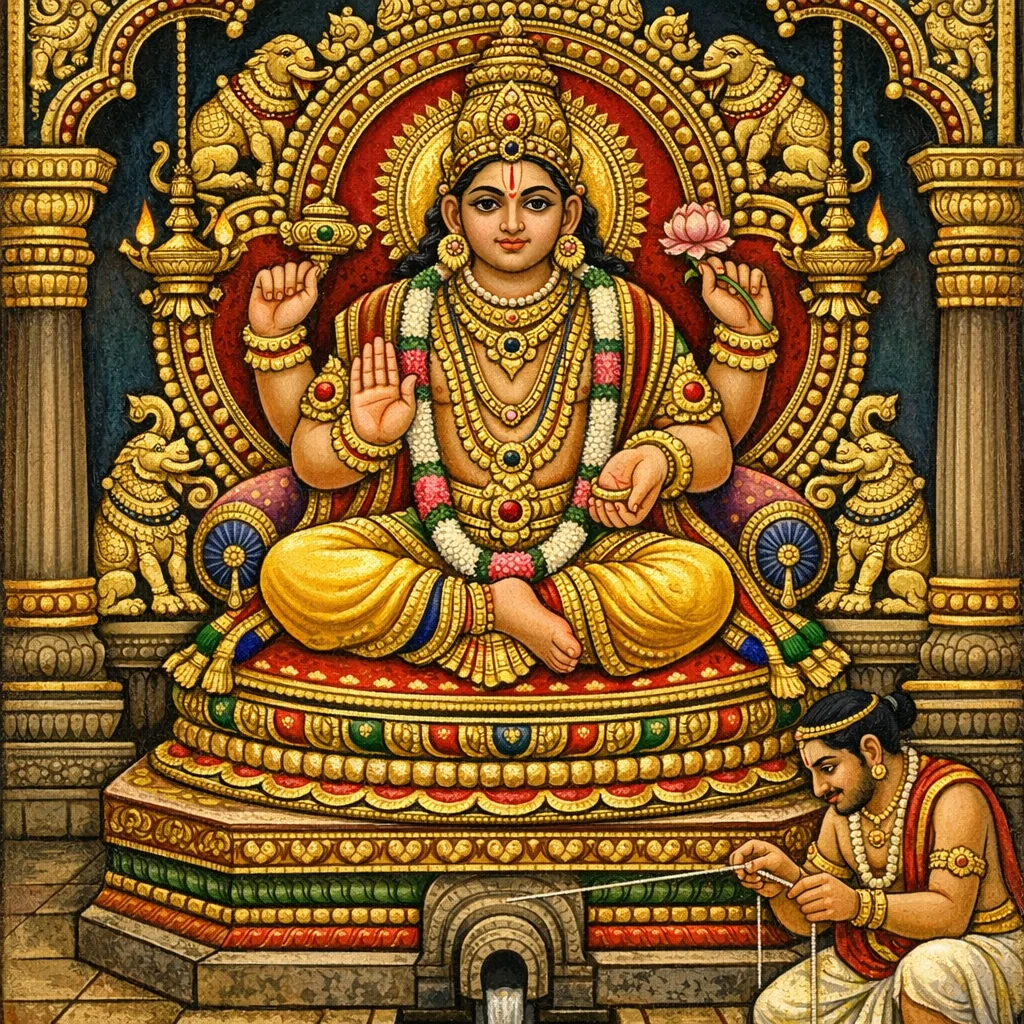
Adhyaya 55
Chapter 55 — Piṇḍikā-lakṣaṇa-kathana (Defining Features of the Pedestal/Base for Icons)
Continuing the Vāstu–Pratiṣṭhā and Īśāna-kalpa stream, Lord Agni moves from the prior chapter’s metaphysical frame (manifest and unmanifest) into precise rules for icon-installation. He defines the piṇḍikā (pedestal/base) by proportion: its length is set in relation to the image, while breadth and the mekhalā banding follow fractional measures. He then prescribes foundation practice—pit dimensions, a slight northern slope, and the praṇāla (drainage spout) exit-point—showing how ritual purity is safeguarded through water-management design. The chapter standardizes layered height divisions (a sixteen-part scheme) and details component segmentation for the lower, middle, and neck portions. It extends these norms to “common” images, links shrine-door proportion to the temple-door measure, and directs prabhā ornamentation with gaja and vyālaka motifs. Finally, it universalizes iconometric standards: male deities follow the Śiṣṇu/Hari measure and goddesses follow Lakṣmī’s measure, ensuring śobha (aesthetic harmony) as a dharmic requirement.
Shlokas
Verse 1
इत्य् आदिमहापुराणे आग्नेये व्यक्ताव्यक्तलक्षणं नाम चतुःपञ्चाशत्तमो ऽध्यायः अथ पञ्चपञ्चाशत्तमो ऽध्यायः पिण्डिकालक्षणकथनं भगवानुवाच अतः परंप्रवक्ष्यामि प्रतिमानान्तु पिण्डिकाम् दैर्घ्येण प्रतिमातुल्या तदर्धेन तु विस्तृता
Thus ends, in the Agni Purāṇa, the fifty-fourth chapter entitled “Characteristics of the Manifest and the Unmanifest.” Now begins the fifty-fifth chapter: the description of the defining features of the piṇḍikā (pedestal/base). The Blessed Lord said: “Next I shall explain the piṇḍikā belonging to images (pratimā-s). In length it should be equal to the image, and in breadth it should be half of that.”
Verse 2
उच्छ्रितायामतोर्धेन सुविस्तारार्धभागतः तृतीयेन तु वा तुल्यं तत्त्रिभागेण मेखला
The mekhalā (girdle/band) should be made in this measure: by half of the height/length, and by half of the breadth at its widest; or else it may be set as one-third—namely, the mekhalā is determined by dividing that measure into three parts.
Verse 3
खातं च तत्प्रमाणं तु किञ्चिदुत्तरतो नतम् विस्तारस्य चतुर्थेन प्रणालस्य विनिर्गमः
The pit (foundation trench) should be of the prescribed measure and made to slope slightly toward the north; and the outlet of the praṇāla (drainage-spout) should emerge at a distance equal to one-fourth of the structure’s breadth.
Verse 4
समूलस्य विस्तारमग्रे कुर्यात्तदर्धतः विस्तारस्य तृतीयेन तोयमार्गन्तु कारयेत्
At the front, one should make the breadth equal to the full original base-width; behind that, it should be half of it. And one should provide a water-channel whose width is one-third of the main breadth.
Verse 5
पिण्डिकार्धेन वा तुल्यं दैर्घ्यमीशस्य कीर्तितम् ईशं वा तुल्यदीर्घञ्च ज्ञात्वा सूत्रं प्रकल्पयेत्
The length (measure) of the icon of Īśa (the Lord) is declared to be equal to half of the piṇḍikā (pedestal/base). Or, having ascertained an Īśa icon of length equal to the intended standard, one should prepare the measuring-cord (sūtra) accordingly.
Verse 6
मांशेनेति ङ, चिह्नितपुस्तकपाठः त्रिभागेन तु बाहुल्यमिति ङ, चिह्नितपुस्तकपाठः पिण्डिकार्धेन बाहुल्यमिति ङ, चिह्नितपुस्तकपाठः दैर्घ्यं कुशस्येति ग, ङ, चिह्नितपुस्तकपाठः कुशम्बाहुल्यदीर्घञ्चेति ङ, चिह्नितपुस्तकपाठः उच्छ्रायं पूर्ववत् कुर्याद्भागषोडशसङ्ख्यया अधः षट्कं द्विभागन्तु कण्ठं कुर्यात्त्रिभागकम्
The height should be made as previously stated, by dividing it into sixteen parts. Of these, the lower portion is six parts; the next (middle) portion is two parts; and the neck should be made as three parts.
Verse 7
शेषास्त्वेकैकशः कार्याः प्रतिष्ठानिर्गमास् तथा पट्टिका पिण्डिका चेयं सामान्यप्रतिमासु च
All the remaining parts should be fashioned one by one; likewise, the prescribed outlets/openings for the installation rite (pratiṣṭhā) should be made. This rule regarding the pedestal-slab (paṭṭikā) and the base (piṇḍikā) applies also to common (non-specialized) images.
Verse 8
प्रासादद्वारमानेन प्रतिमाद्वारमुच्यते गजव्यालकसंयुक्ता प्रभा स्यात् प्रतिमासु च
The doorway of the image-shrine (for the icon) is prescribed in proportion to the measure of the temple doorway (prāsāda); and in the icons as well, the prabhā (aureole/ornamental arch) should be furnished with elephant and vyālaka motifs.
Verse 9
पिण्डिकापि यथाशोभं कर्तव्या सततं हरेः सर्वेषामेव देवानां शिष्णूक्तं मानमुच्यते देवीनामपि सर्वासां लक्ष्म्युक्तं मानमुच्यते
Even the piṇḍikā (pedestal-base) of Hari should always be made in a manner that is aesthetically fitting. For all male deities, the standard of proportion is said to be that prescribed for Śiṣṇu; and for all goddesses, the standard of proportion is said to be that prescribed for Lakṣmī.
Frequently Asked Questions
Icon-installation metrics: piṇḍikā length–breadth ratios, mekhalā fractional measures, a north-sloping foundation pit, and praṇāla outlet placement at one-fourth of the breadth—linking proportion with drainage and purity.
By treating measurement, orientation, and water-management as sacred duties within Pratiṣṭhā: correct form (rūpa), function (praṇāla/drainage), and beauty (śobha) become disciplined offerings that sustain dharma and support focused worship.
The chapter states that male deities follow the proportional standard associated with Śiṣṇu/Hari, while all goddesses follow the Lakṣmī standard, ensuring consistent iconometric harmony.