Yoga & Brahma-vidya
Yoga & the Knowledge of Brahman
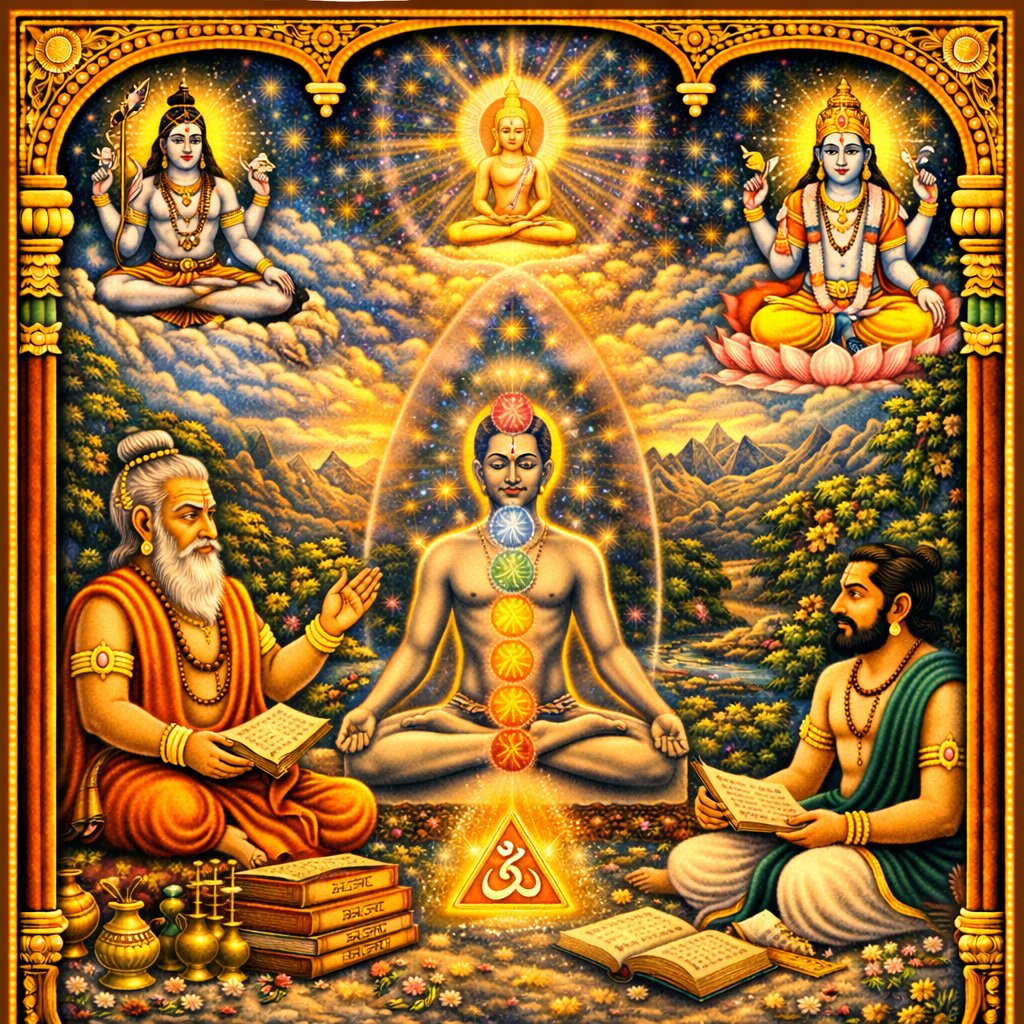
The culminating section on yoga practices, meditation, Brahma-vidya (knowledge of the Absolute), and the path to final liberation.
Adhyayas in Yoga & Brahma-vidya
Adhyaya 368
Explanation of the Final Dissolution (Ātyantika Laya) and the Arising of Hiraṇyagarbha — Subtle Body, Post-Death Transit, Rebirth, and Embodied Constituents
Lord Agni teaches that “final dissolution” (ātyantika-laya) is not merely cosmic destruction but the extinguishing of bondage through liberating knowledge, born from insight into inner afflictions and the dispassion that follows. He then charts the jīva’s post-death course: departing the gross enjoyment-body (bhoga-deha), taking an ātivāhika transit body, being led along Yama’s path where dharma and adharma are judged by Citragupta, and depending on śrāddha/piṇḍa offerings until sapiṇḍīkaraṇa admits one into the ancestral order. The chapter distinguishes auspicious and inauspicious enjoyment-bodies for karmic fruition, describes descent from heaven and release from hell into lower wombs, and details fetal growth month by month, the suffering in utero, and the shock of birth. Finally, Agni presents an embodied cosmology: how ākāśa, agni, jala, and pṛthvī generate senses and tissues; how the guṇas (tāmasa/rājasa/sāttvika) shape mind and conduct; and how Ayurvedic categories (doṣas, rasa, ojas, skin layers/kalās) explain vitality—placing body-science as supportive knowledge for yoga and Brahma-vidyā.
Adhyaya 369
Chapter 369 — शरीरावयवाः (The Limbs/Organs and Constituents of the Body)
Lord Agni presents the human body as an ordered field for medical knowledge and spiritual discernment. He classifies the five organs of cognition—ear, skin, eyes, tongue, nose—with their objects—sound, touch, form, taste, smell—and the five organs of action—anus, genitals, hands, feet, speech—with their functions. Mind is said to preside over the senses, their objects, and the five mahābhūtas, and the teaching rises to Sāṅkhya categories: the Self, the Unmanifest (prakṛti), the twenty-four tattvas, and the Supreme Puruṣa—joined yet distinct like fish and water. The text describes bodily receptacles (āśaya), channels (srotas/śirā), and organ-origins with doṣa/guṇa associations, including reproductive conditions affecting conception, the lotus-like heart as the seat of the jīva, and detailed counts of bones, joints, sinews, muscles, and networks (jāla, kūrca). Measures of bodily fluids in añjali culminate in contemplation: knowing the body as a mass of mala and doṣa, one should relinquish identification with it and abide in the Self.
Adhyaya 370
Chapter 370: नरकनिरूपणम् (Naraka-nirūpaṇa) — Description of Hell (with the physiology of dying and the subtle transition)
Agni continues his ordered teaching, turning from Yama’s routes to a precise account of dying and the post-mortem passage. It opens with a quasi-physiological description: bodily heat is disturbed, vāyu constricts the system, obstructs the doṣas, and shuts down prāṇa-sthānas and marmas. Seeking an exit, vāyu is said to depart “upward” (eyes, ears, nostrils, mouth) for auspicious karma, or “downward” (anus, genitals) for inauspicious karma, while the yogin departs sovereignly through the brahma-randhra at the crown. As prāṇa and apāna converge and awareness is veiled, the jīva—centered in the navel region—assumes an atīvāhika transitional subtle body, seen by gods and siddhas with divine sight. Yama’s messengers then lead the subtle person along the terrifying Yama-mārga; offerings by relatives sustain him until judgment before Yama and Citragupta. The chapter catalogs vast hell-realms and their rulers, describes severe punishments, and concludes with karmic rebirth outcomes for mahāpātakas, finally widening to the threefold suffering (ādhyātmika, ādhibhautika, ādhidaivika) and recommending jñāna-yoga, vows, gifts, and worship of Viṣṇu as remedies.
Adhyaya 371
Chapter 371 — Yama-Niyama and Praṇava-Upāsanā (Oṅkāra) as Brahma-vidyā
Agni defines yoga as ekacittatā (one-pointedness) and upholds citta-vṛtti-nirodha as the supreme means to realize the jīva–Brahman relation. The chapter codifies the five yamas—ahiṃsā, satya, asteya, brahmacarya, aparigraha—and the five niyamas—śauca, santoṣa, tapas, svādhyāya, īśvara-pūjana—teaching ethics as the indispensable ground of Brahma-vidyā. Ahiṃsā is exalted as the highest dharma; satya is refined as speech that is ultimately beneficial, governed by the rule of truth-and-pleasantness. Brahmacarya is explained as an eightfold restraint from thought to deed, and aparigraha is limited to the minimum needed for bodily maintenance. The teaching then moves from purification and tapas to svādhyāya centered on Praṇava: Om is analyzed as A-U-M with the subtle “half-mātrā,” and correlated with the Vedas, worlds, guṇas, states of consciousness, and divine triads. Meditation on the “Fourth” (turīya) in the heart-lotus is prescribed, with the bow-arrow-target metaphor: Praṇava as bow, self as arrow, Brahman as target. Finally, mantra-practice is ritualized through Gāyatrī-meter attribution, viniyoga for bhukti-mukti, kavaca/nyāsa, Viṣṇu-worship, homa, and disciplined japa culminating in Brahman’s manifestation; the chapter closes by affirming that meanings dawn fully for one who has para-bhakti to God and equal reverence to the Guru.
Adhyaya 372
Āsana–Prāṇāyāma–Pratyāhāra (Posture, Breath-control, and Withdrawal of the Senses)
Lord Agni begins a yoga instruction that is technical yet aimed at liberation. The practitioner prepares a clean practice-space and a steady seat (neither too high nor too low), layered with cloth, deerskin, and kuśa grass. With the body aligned (torso, head, neck) and the gaze fixed at the nose-tip (nasāgra-dṛṣṭi), protective and stabilizing placements of heels and hands are prescribed, stressing stillness and one-pointedness as prerequisites for inward contemplation of the Supreme. Prāṇāyāma is then defined as the regulated extension and restraint of prāṇa, detailing the classical triad—recaka (exhalation), pūraka (inhalation), and kumbhaka (retention)—and time-measures/types (kanyaka, madhyama, uttama) as metrics for regulation. Benefits are presented medically and spiritually—health, vigor, voice, complexion, and doṣa-reduction—while warning that unmastered breath-discipline can worsen ailments. Japa and dhyāna are declared essential for “garbha” (the inner seed-state/concentration), culminating in the doctrine of sense-conquest: the senses generate heaven and hell; the body is a chariot, the senses horses, the mind the charioteer, and prāṇāyāma the whip. Finally, pratyāhāra is defined as drawing back the senses from the ocean of objects, urging self-rescue through refuge in the “tree of knowledge.”
Adhyaya 373
Chapter 373 — ध्यानम् (Dhyāna / Meditation)
Lord Agni defines dhyāna as uninterrupted, undistracted contemplation—again and again fixing the mind on Viṣṇu/Hari and, at its summit, on Brahman itself. Meditation is a stabilized single-current cognition (pratyaya) without intervening thoughts, practicable anywhere and at all times (walking, standing, sleeping, waking). He sets out a fourfold framework—meditator, meditation, object, and purpose—linking yoga-abhyāsa to both mukti and the eight aiśvarya (aṇimā and related powers). The chapter extols “dhyāna-yajña” as the supreme inner sacrifice, pure and non-violent, surpassing external rites; it purifies the mind and yields apavarga. A graded visualization is taught: sequencing the three guṇas, three colored maṇḍalas, the heart-lotus with symbolic correspondences (petals as siddhis; stalk/pericarp as jñāna–vairāgya), and the thumb-sized Oṅkāra or a radiant lotus-seated Lord transcending Pradhāna and Puruṣa. Practice culminates in Vaiṣṇava iconographic contemplation and a mahāvākya-like resolve, “I am Brahman… I am Vāsudeva,” balanced with japa; japa-yajña is praised as unrivaled for protection, prosperity, liberation, and conquest of death.
Adhyaya 374
Chapter 374 — ध्यान (Dhyāna) — Colophon & Transition to Dhāraṇā
This unit serves as a textual hinge: it closes the prior teaching on meditation (dhyāna) and explicitly transitions to the next, more technical yoga limb—dhāraṇā (concentration). The chapter-ending colophon stresses the soteriological aim of the practice—attaining Hari (Viṣṇu) and the “fruit” of disciplined contemplation—while preserving variant manuscript readings that witness a living transmission. By placing dhyāna immediately before dhāraṇā, the Agni Purāṇa signals a structured yogic pedagogy: the mind is first trained in sustained meditative orientation, then refined into precise fixation upon chosen loci and principles. Within the Purāṇa’s encyclopedic project, this chapter exemplifies how inner yogic method is treated as a śāstric science, with definitional boundaries and progression, embedded in Agni’s divine instruction to Vasiṣṭha and, by extension, to practitioners seeking clarity of mind and liberation.
Adhyaya 375
Adhyāya 375 — समाधिः (Samādhi)
Lord Agni defines samādhi as meditation in which only the Self shines—steady like an unmoving ocean and a lamp in a windless place—when sensory activity and mental constructions cease. He then describes the yogin’s experience: seeming insentience to externals, absorption into Īśvara, and the rise of portent-like signs and temptations—divine enjoyments, royal gifts, spontaneous learning, poetic genius, medicines, rasāyana, and arts—explicitly declared distractions to be cast off like straw for Viṣṇu’s grace. The teaching widens into Brahma-vidyā: purity as the prerequisite for self-knowledge; the one Self appearing as many like space in pots or the sun in water; cosmogenesis through buddhi, ahaṅkāra, elements, tanmātras, and guṇas; bondage by karma and desire and liberation by knowledge. It also integrates eschatology: the upward “bright path” (archirādi) to transcendent attainment versus the return-path (dhūmādi). It concludes that even a righteous householder may be liberated through truth, just wealth, hospitality, śrāddha, and tattva-jñāna.
Adhyaya 376
Chapter 376 — ब्रह्मज्ञानम् (Knowledge of Brahman)
Lord Agni begins teaching Brahma-jñāna as the direct cure for saṃsāra-born ignorance, centered on the liberating recognition “ayam ātmā paraṃ brahma—aham asmi.” Through viveka, the body is rejected as non-Self because it is perceived like an object; the senses, mind, and prāṇa are likewise treated as instruments, not the witnessing subject. The Self is affirmed as the inner light in all hearts—seer and experiencer—shining like a lamp in darkness. Agni then gives a samādhi-entry contemplation: tracing cosmic emanation from Brahman through the elements, and reversing it by laya (dissolution) as the gross is reabsorbed into Brahman, introducing Virāṭ (cosmic gross), liṅga/Hiraṇyagarbha (subtle body with seventeen constituents), and the three states—waking, dream, deep sleep—with viśva, taijasa, prājña. Reality is said to be inexpressible (anirvacanīya), approached by “neti,” and attained by realized knowledge rather than karma. The teaching culminates in mahāvākya-like affirmations of witness-consciousness free from ignorance; the fruit is liberation, as the brahma-jñānī “becomes Brahman.”
Adhyaya 377
Brahma-jñāna (Knowledge of Brahman)
In this Yoga–Brahma-vidyā section, Lord Agni gives a concentrated non-dual proclamation through repeated self-identification: “I am Brahman, the supreme Light.” The teaching proceeds by systematic negation (apavāda) of all limiting adjuncts—first the gross elements (earth, fire, wind, space), then cosmic and psychological identifications (Virāṭ; waking/dream/deep sleep; taijasa/prājña), the organs of action and perception, the inner instruments (mind/manas, intellect/buddhi, citta, ahaṅkāra), and prāṇa with its divisions. Agni further denies conceptual frames such as measure/measured, cause/effect, existence/non-existence, difference/non-difference, and even the limiting spiritual notion of “witnesshood,” culminating in Brahman as Turīya—beyond the three states. The chapter closes by affirming Brahman’s intrinsic nature as eternal purity, consciousness, freedom, truth, bliss, and non-duality, and links this realization to the highest samādhi as the direct bestower of mokṣa.
Adhyaya 378
Chapter 378: Brahma-jñāna (Knowledge of Brahman)
Lord Agni sets forth a graded path of attainments: sacrifice (yajña) yields divine and cosmic states, tapas leads to Brahmā’s station, renunciation with dispassion (vairāgya) to prakṛti-laya, and knowledge (jñāna) to kaivalya. Jñāna is defined as discrimination between the sentient and the insentient, and the Supreme Self—support of all—is praised as Viṣṇu and Yajñeśvara, worshipped by pravṛtti-oriented ritualists and realized by nivṛtti-oriented jñāna-yogins. Two modes of knowing are distinguished: śabda-brahman grounded in āgama/veda and para-brahman realized through viveka; “Bhagavān” is explained by etymology and the six bhagas (aiśvarya, vīrya, yaśas, śrī, jñāna, vairāgya). Bondage is diagnosed as avidyā—superimposing Self on non-Self—and the water–fire–pot analogy separates ātman from prakṛti’s adharma. Practice is prescribed: withdraw the mind from objects, remember Hari as Brahman, and establish yoga as the mind’s union with Brahman, stabilized through yama-niyama, āsana, prāṇāyāma, pratyāhāra, and samādhi. Since the formless Absolute is difficult at first, meditation begins with form and culminates in non-difference, with perceived difference attributed to ignorance.
Adhyaya 379
Adhyāya 379 — अद्वैतब्रह्मविज्ञानम् (Advaita-brahma-vijñāna)
Agni announces a focused exposition of Advaita-brahma-vijñāna, introduced through a seeker’s austerity at Śālagrāma and worship of Vāsudeva, with a warning that attachment shapes rebirth (the deer-attachment motif) though yoga can restore one’s true state. The teaching unfolds in a social episode: an avadhūta-like knower, forced into labor to carry a palanquin, instructs a king by analytically dismantling agency and identity. Mapping “carrier,” “carried,” and “palanquin” onto bodily limbs, elements, and conventional labels, he shows that ‘I’ and ‘you’ are linguistic impositions upon guṇa-streams driven by karma accumulated through avidyā, while the Self is pure, nirguṇa, and beyond prakṛti. The chapter then turns to the Nidāgha–Ṛtu dialogue as formal Advaita pedagogy: hunger and satisfaction reveal bodily limits, whereas the Self pervades all like space, neither going nor coming. Non-duality culminates in recognizing the undivided universe as the very nature of Vāsudeva, and liberation is affirmed as knowledge-born, the “enemy” that fells the tree of saṃsāric ignorance.
Adhyaya 380
अध्याय ३८० — गीतासारः (The Essence of the Gītā)
This chapter shifts from prior advaita-brahma-vijñāna to a concentrated “Gītā-sāra” taught by Agni: a curated digest of Kṛṣṇa’s counsel to Arjuna, promising both bhukti (worldly fruition) and mukti (liberation). It moves from the metaphysics of the unborn Self that ends grief to the psychology of bondage—sense-contact → attachment → desire → anger → delusion → ruin—prescribing sat-saṅga and desire-renunciation as the pivot to steady wisdom. It establishes karma-yoga: act while offering works into Brahman, abandon attachment, and see the Self in all beings. Devotion and refuge in the Lord are given as the means to cross māyā, with precise definitions of adhyātma, adhibhūta, adhidaivata, and adhiyajña, and the doctrine of final remembrance (smaraṇa) at death with Oṃ. The chapter further explains kṣetra/kṣetrajña and the disciplines of “knowledge” (humility, non-violence, purity, detachment), describes Brahman’s all-pervading nature, and systematizes a guṇa-based taxonomy of knowledge, action, doer, austerity, charity, and food. It concludes by sacralizing svadharma as worship of Viṣṇu, linking practical duty to spiritual perfection in Agni Purāṇa’s encyclopedic synthesis of ethics, yoga, and metaphysics.
Adhyaya 381
Chapter 381 — यमगीता (Yama-gītā)
Agni introduces the Yama-gītā as a mokṣa teaching once spoken by Yama to Naciketas, promising both bhukti and mukti to reciters and listeners. Yama exposes human delusion: the impermanent self longs for stable possessions. He then weaves together authoritative “songs” of śreyas—sense-restraint and Self-contemplation (Kapila), equal vision and non-possessiveness (Pañcaśikha), discernment of life-stages (Gaṅgā–Viṣṇu), and remedies for suffering (Janaka). The teaching turns Vedāntic: the notion of difference within the non-different Supreme must be pacified; abandoning desire yields realized knowledge (Sanaka). Viṣṇu is identified as Brahman, transcendent and immanent, known through many divine names. Practices—meditation, vows, worship, dharma-hearing, gifts, and tīrtha—support realization. The Naciketas chariot metaphor teaches mastery of the senses through mind and buddhi, ascending the hierarchy up to Puruṣa. Finally, the eight limbs of yoga (yama, niyama, āsana, prāṇāyāma, pratyāhāra, dhāraṇā, dhyāna, samādhi) are outlined, ending in non-dual identity: the jīva, freed from avidyā, becomes Brahman.
Adhyaya 382
Āgneya-Purāṇa-māhātmya (The Greatness and Self-Testimony of the Agni Purāṇa)
The chapter closes the prior “Yama-gītā” and immediately proclaims the Agni Purāṇa as brahmarūpa and mahān, embodying vidyādvaya: teaching for the manifest order (saprapañca) and for the transcendent (niṣprapañca). Agni surveys the Purāṇa’s encyclopedic range—Vedas and auxiliary sciences, Dharmaśāstra, Nyāya–Mīmāṃsā, Ayurveda, polity, martial and performing arts—clarifying aparā vidyā (comprehensive disciplines) versus parā vidyā (realization of the supreme Akṣara). The teaching then turns to Viṣṇu-bhakti as the practical essence: devotion and meditation on Govinda/Keśava remove sin, counter Kali’s affliction, and define authentic dhyāna, kathā, and karma. A strong māhātmya follows, declaring protective and purifying merits from hearing, reciting, writing, worshipping, gifting, and even keeping the book at home, along with seasonal merits and ritual honors for Purāṇa reciters. The speakers (Agni → Vasiṣṭha → Vyāsa → Sūta) reaffirm Veda-concordance, the synthesis of pravṛtti and nivṛtti dharma, and the promise of bhukti and mukti, culminating in the Upaniṣadic refrain: “Know all as Brahman.”