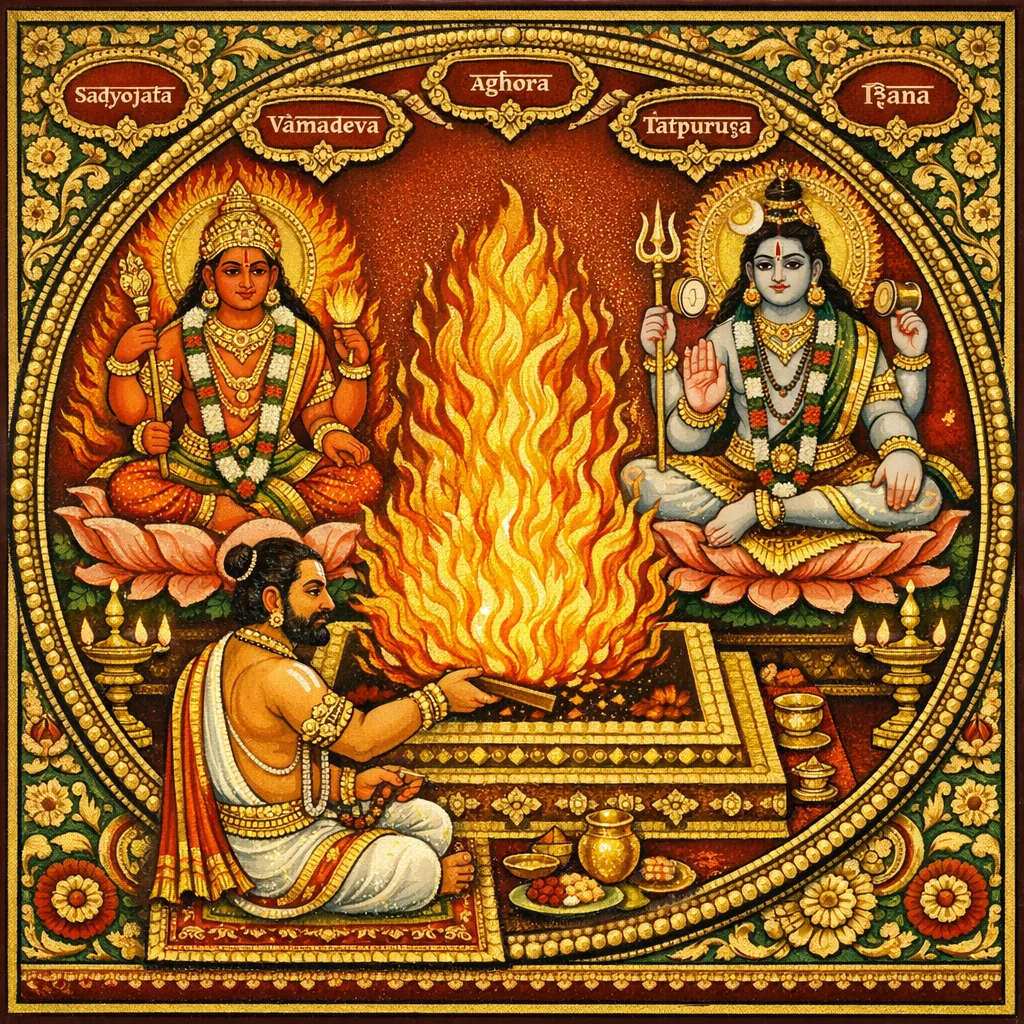
Adhyaya 75
Agnisthāpana-vidhi (Procedure for Establishing the Sacred Fire) and Protective Īśāna-kalpa Homa Sequences
This chapter sets forth a stepwise prayoga for installing and enlivening the sacrificial fire within a regulated ritual enclosure. The officiant approaches the agnyāgāra with the argha vessel, examines the north-facing kuṇḍa, and establishes protection through prokṣaṇa, kuśa-tapping, the astra-mantra, and varma/kavaca safeguards. The kuṇḍa is prepared outwardly (removing excavated earth, filling, leveling, plastering, and drawing lines), while inward preparation proceeds by nyāsa, bīja-dhyāna, and the invocation of Vāgīśvarī and Īśā. Agni is brought from a perpetual source, consecrated and purified, unified as anala-traya, and sealed with dhenu-mudrā and circumambulation. The rite then extends to support household saṃskāras (garbhādhāna, puṃsavana, sīmantonnayana, jātakarma) through prescribed oblation sets and pañcabrahma sequences (Sadyojāta–Īśāna), including vaktra-udghāṭana and vaktra-ekīkaraṇa (unifying the five faces). Finally it details homa measures, the alignment of subtle channels (nāḍī) between yāgāgni and Śiva, and concludes with inner and outer bali offerings to Rudras, Mātṛkās, Gaṇas, Yakṣas, Nāgas, Grahas, Rākṣasas, and Kṣetrapāla, withdrawn by saṃhāra-mudrā for ritual closure and a plea for forgiveness.
Shlokas
Verse 1
ख, चिह्नितपुस्तकपाठः हरहस्ते इति ग, चिह्नितपुस्तकपाठः शिवज्ञानामिति ख, चिह्नितपुस्तकपाठः नमेदष्ताङ्गमूर्तये इति ङ, चिह्नितपुस्तकपाठः अथ पञ्चसप्ततितमो ऽध्यायः अग्निस्थापनादिविधिः ईश्वर उवाच अर्घपात्रकरो यायादग्न्यागारं सुसंवृतः यागोपकरणं सर्वं दिव्यदृष्ट्या च कल्पयेत्
Here begins the seventy-fifth chapter, on the procedure for establishing the sacred fire and related rites. The Lord (Īśvara) said: “Holding the arghya-vessel in his hand, and being well-guarded in proper ritual restraint, he should go to the fire-sanctuary (agnyāgāra). He should also arrange all the requisites of the sacrifice with purified, divine—ritually consecrated—attention.”
Verse 2
उदङ्मुखः कुण्डमीक्षेत् प्रओक्षणं ताडनंकुशैः विदध्यादस्त्रमन्त्रेण वर्मणाभ्युक्षणं मतं
Facing north, one should ritually regard and inspect the fire-pit (kuṇḍa). One should perform the sprinkling of consecrated water (prokṣaṇa) and the light striking/tapping with kuśa grass; and, by means of the Astra-mantra, one should carry out the protective sprinkling (abhyukṣaṇa) as an armour (varma)—this is the accepted procedure.
Verse 3
खड्गेन खातमुद्धारं पूरणं समतामपि कुर्वीत वर्मणा सेकं कुट्टनन्तु शरात्मना
One should remove the excavated earth with a sword; filling in and leveling should also be done. Sprinkling (moistening) is to be performed with the varma (protective implement), and tamping/compacting is to be done with a rod like an arrow-shaft.
Verse 4
सम्मार्जनं समालेपं कलारूपप्रकल्पनं त्रिसूत्रीपरिधानं च वर्मणाभ्यर्चनं सदा
One should always perform: sweeping and cleansing; smearing and plastering the ritual space; arranging artistic forms and designs; wearing the three-threaded cord (trisūtrī); and constant worship by means of the varma, the protective ‘armour’.
Verse 5
रेखात्रयमुदक् कुर्यादेकां पूर्वाननामधः कुशेन च शिवास्त्रेण यद्वा तासां विपर्ययः
One should draw three lines with water; one of them is to be placed below, facing east. This is done with kuśa grass and by employing the Śiva-astra (Śiva’s mantric weapon), or else the order of those lines may be reversed.
Verse 6
वज्रीकरणमन्त्रेण हृदा दर्भैश् चतुष्पथं अक्षपात्रन्ततनुत्रेण विन्यसेद्विष्टरं हृदा
With the Vajrīkaraṇa (adamantine, protective) mantra and with the heart-mantra (hṛdā), one should lay out a four-way, cross-shaped arrangement using darbha grass; with the Tatanutra (protective covering) mantra one should place the akṣa-vessel; then, with the heart-mantra, one should set down the ritual seat (viṣṭara).
Verse 7
हृदा वागीश्वरीं तत्र ईशामावाह्य पूजयेत् वह्निं सदाश्रयानीतं शुद्धपात्रोपरिस्थितं
There, with the heart-mantra, one should invoke and worship Vāgīśvarī (the Goddess of Speech), and also invoke Īśā. One should then establish the sacred fire—brought from a perpetual source—placed upon a pure vessel.
Verse 8
क्रव्यादांशं परित्यज्य वीक्षणादिविशोधितं औदर्यं चैन्दवं भौतं एकीकृत्यानलत्रयं
Discarding the kravyāda portion (flesh-like, impure), and after purifying it by inspection and related procedures, one should unite the factors connected with digestion—namely the lunar (cooling) component and the elemental (earthly) component—thus forming the anala-traya, the triad of ‘fires’.
Verse 9
ॐ हूं वह्निचैतन्याय वह्निवीजेन विन्यसेत् संहितामन्त्रितं वह्निं धेनुमुद्रामृतीकृतं
One should perform nyāsa with the fire-seed (vahni-bīja), intoning: “Oṃ Hūṃ—unto the consciousness of Agni.” Then one should establish Agni consecrated by the Saṃhitā-mantras, and rendered nectar-like through the Dhenu-mudrā.
Verse 10
रक्षितं हेतिमन्त्रेण कवचेनावगुण्ठितं पूजितन्त्रिः परिभ्राम्य कुण्डस्योर्ध्वं प्रदक्षिणं
Having protected it with the Heti-mantra and covered it with the ritual protective sheath (kavaca), and having duly worshipped it, one should circumambulate the fire-pit (kuṇḍa) three times, keeping it on one’s right—performing a clockwise pradakṣiṇā along the upper rim.
Verse 11
दिव्यदृष्ट्या विल्प्कयेदिति घ, ङ, चिह्नितपुस्तकद्वयपाठः शराणुनेति ङ, चिह्नितपुस्तकपाठः शिववीजमिति ध्यात्वा वागीशागर्भगोचरे वागीश्वरेण देवेन क्षिप्यमानं विभावयेत्
Having meditated on the Śiva-seed (śiva-bīja), one should visualize—within the sphere or field of Vāgīśa, the Lord of Speech—that it is being cast forth by the deity Vāgīśvara. (Variant manuscript readings are noted: “divyadṛṣṭyā …” in some, and “śarāṇunā/śarāṇune …” in another.)
Verse 12
भूमिष्ठजानुक्को मन्त्री हृदात्मसम्मुखं क्षिपेत् ततो ऽन्तस्थितवीजस्य नाभिदेशे समूहनं
With the knees placed on the ground, the mantra-practitioner should project (the mantra-power) toward the heart and the Self (Ātman) before him; then, for the seed-syllable established within, one should perform a focused gathering and condensation at the region of the navel.
Verse 13
सम्भृतिं परिधानस्य शौचमाचमनं हृदा गर्भाग्नेः पूजनं कृत्वा तद्रक्षार्थं शराणुना
Having made proper preparations regarding one’s clothing, performed bodily purification and ācamana with a focused heart, one should worship the Garbhāgni—the consecrated inner or household fire; and for its protection, one should carry out the protective act using a śarāṇu (reed or arrow-shaft).
Verse 14
बध्नीयाद्गर्भजं देव्याः ककङ्कणं पाणिपल्लवे गर्भाधानाय सम्पूज्य सद्योजातेन पावकं
For the garbhādhāna rite (conception), one should tie upon the goddess-wife’s tender hand a pregnancy bracelet-amulet (kakaṅkaṇa); having duly worshipped, one should consecrate and purify the sacred fire (pāvaka) by the (mantra of) Sadyojāta.
Verse 15
ततो हृदयमन्त्रेण जुहुयादाहुतित्रयं पुंसवनाय वामेन तृतीये यासि पूजयेत्
Then, using the Hṛdaya-mantra, he should offer three oblations into the fire. For the puṃsavana rite, with the left (hand/side), at the third offering he should worship the invoked deity/śakti, saying “yāsi.”
Verse 16
आहुतित्रितयं दद्याच्छिरसाम्बुकणान्वितं सीमन्तोन्नयनं षष्ठे मासि सम्पूज्य रूपिणा
He should offer a set of three oblations, accompanied by sprinkling water-drops upon the head; then, in the sixth month, having duly worshipped the deity embodied in form, he should perform the sīmantonnayana—the rite of parting the pregnant woman’s hair.
Verse 17
जुहुयादाहुतीस्तिस्रः शिखया शिखयैव तु वक्त्राङ्गकल्पनां कुर्याद्वक्त्रोद्घाटननिष्कृती
He should offer three oblations; using the flame—indeed by the flame alone—he should perform the prescribed placement/visualization of the mouth and limbs. This is the expiatory rite (niṣkṛti) known as vaktra-udghāṭana, the “opening of the mouth.”
Verse 18
जातकर्मनृकर्मभ्यां दशमे मासि पूर्ववत् वह्निं सन्धुक्ष्य दर्भाद्यैः स्नानं गर्भमलापहं
For the jātakarma and the subsequent human rites, in the tenth month, as before: having kindled the sacred fire (vahni), one should perform the bath with kuśa-grass (darbha) and the like—a bath that removes the impurities of the womb.
Verse 19
सुवर्णबन्धनं देव्या कृतं ध्यात्वा हृदार्चयेत् सद्यःसूतकनाशाय प्रोक्षयेदस्त्रवारिणा
Meditating on the Goddess (Devī) as adorned with a golden binding, one should worship her inwardly in the heart; for the immediate removal of sūtaka (ritual impurity), one should sprinkle oneself/the place with water empowered by the astra-mantra.
Verse 20
कुम्भन्तु वहिरस्त्रेण ताडयेद्वर्मणोक्षयेत् अस्त्रेणोत्तरपूर्वाग्रान्मेखलासु वहिः कुशान्
He should strike the ritual water-pot (kumbha) with the Vahni-astra; then he should sprinkle (it/the area) with the Varmaṇa (armor) mantra. With the Astra mantra, he should place kuśa-grass upon the encircling bands (mekhalās) on the outside, with the tips directed toward the north and the east.
Verse 21
ततोन्तस्थितदेवस्य इति ख, चिह्नितपुस्तकपाठः शरात्मना इति ख, चिह्नितपुस्तकपाठः गन्धाद्यैर् इति ख, चिह्नितपुस्तकपाठः कुण्डन्तु इति ख, ङ, चिह्नितपुस्तकद्वयपाठः आस्थाप्य स्थापयेत्तेषु हृदा परिधिविस्तरं वक्ताणामस्त्रमन्त्रेण ततो नालापन्नुत्तये
Then, having installed (the ritual implements/deities) in their respective places, one should establish—by the Hṛdā mantra—the expanse of the enclosing boundary (paridhi). Thereafter, by means of the Astra-mantra, one should perform protective warding for the officiants (and the rite), so that no obstruction or mishap may arise.
Verse 22
समिधिः पञ्च होतव्याः प्रान्ते मूले घृतप्लुताः ब्रह्माणं शङ्करं विष्णुमनन्तञ्च हृदार्चयेत्
Five kindling-sticks (samidh) are to be offered, smeared with ghee at the tip and at the base; and in the heart (hṛdā) one should worship Brahmā, Śaṅkara, Viṣṇu, and Ananta.
Verse 23
दूर्वाक्षतैश् च पर्यन्तं परिधिस्थाननुक्रमात् इन्द्रादीशानपर्यन्तान्तान्विष्टरस्थाननुक्रमात्
Using dūrvā grass and unbroken rice grains (akṣata), one should (worship/mark) the enclosure all the way around in the sequence of the perimeter positions; and one should place (the deities) beginning with Indra and ending with Īśāna, following the sequence of their seat-locations (viṣṭara).
Verse 24
अग्नेरभिमुखीभूतान् निजदिक्षु हृदार्चयेत् निवार्य विघ्नसङ्घातं वालकं पालयिष्यथ
Having turned to face Agni, one should worship with heartfelt devotion in one’s proper directions. Having warded off the multitude of obstacles, you shall protect the child.
Verse 25
शैवीमाज्ञाभिमान्तेषां श्रावयेत्तदनन्तरं गृहीत्वा स्रुक्स्रुवावूर्ध्ववदनाधोमुखैः क्रमात्
He should then cause those standing around the altar to hear the Śaiva injunction (ājñā, command-formula). Thereafter, taking up the two ladles—the sruk and the sruva—he should use them in proper sequence, holding one with its mouth turned upward and the other with its mouth turned downward.
Verse 26
प्रताप्याग्नौ त्रिधा दर्भमूलमध्याग्रकैः स्पृशेत् कुशस्पृष्टप्रदेशे तु आत्मविद्याशिवात्मकं
Having heated the darbha grass in the fire, one should touch (the body) in three ways—with its root, its middle, and its tip. In the region touched by the kuśa, one should establish or contemplate the Self-knowledge (ātma‑vidyā) that is of the nature of Śiva.
Verse 27
क्रमात्तत्त्वत्रयं न्यस्य हां हीं हूं सं रवैः क्रमात् स्रुवि शक्तिं स्रुवे शम्भुं विन्यस्य हृदयाणुना
Then, in due order, one should perform nyāsa of the triad of tattvas. Next, sequentially with the seed-sounds hāṃ, hīṃ, hūṃ, and saṃ—uttered with their proper resonance—one should install Śakti in the sruva and Śambhu (Śiva) in the sruk, using the subtle ‘heart’-mantra as the activating principle.
Verse 28
त्रिसूत्रीवेष्टितग्रीवो पूजितौ कुसुमादिभिः कुशानामुपरिष्टात्तौ स्थापयित्वा स्वदक्षिणे
Having wrapped the (ritual) neck with the three-stranded cord, and having worshipped the two items with flowers and the like, one should place them upon the kuśa grass, on one’s own right side.
Verse 29
गव्यमाज्यं समादाय वीक्षणादिविशोधितं स्वकां ब्रह्ममयीं मूर्तिं सञ्चिन्त्यादाय तद्घृतं
Having taken cow-ghee (gavyam ājya), purified by consecratory acts such as vīkṣaṇa (ritual inspection) and the like, one should meditate upon one’s own desired form that is brahmamayī—pervaded by Brahman—and then take up that ghee for the rite and offering.
Verse 30
कुण्डस्योर्ध्वं हृदावर्त्य भ्रामयित्वाग्निगोचरे पुनर्विष्णुमयीं ध्यात्वा घृतमीशानगोचरे
Having raised (awareness/energy) upward from the fire-pit (kuṇḍa) and drawn it into the heart, and having caused it to circulate within the sphere of Agni, one should again meditate on the oblation as pervaded by Viṣṇu, and then offer the ghee into the sphere of Īśāna (Śiva).
Verse 31
धृत्वादाय कुशाग्रेण स्वाहान्तं शिरसाणुना आस्तीर्येति घ, ङ, चिह्नितपुस्तद्वयपाठः हां ह्रीं ह्रं समिति ख, चिह्नितपुस्तकपाठः हूं हां क्रूं समिति ङ, चिह्नितपुस्तकपाठः शिरसात्मना इति ख, चिह्नितपुस्तकपाठः जुहुयाद्विष्णवे विन्दुं रुद्ररूपमनन्तरं
Having taken it and holding it with the tip of a kuśa grass blade, one should spread/apply the mantra ending in “svāhā” together with the ‘head’-syllable (śiras). (In some marked manuscripts the reading is “hāṃ hrīṃ hraṃ”; in others “hūṃ hāṃ krūṃ”; and elsewhere “śirasātmanā”.) Thereafter, one should offer an oblation to Viṣṇu—as the ‘bindu’—in the form of Rudra.
Verse 32
भावयन्निजमात्मानं नाभौ धृत्वाप्लवेत्ततः प्रादेशमात्रदर्भाभ्यामङ्गुष्टानामिकाग्रकैः
Meditating upon one’s own Self (Ātman), fixing the attention in the navel, one should then perform the ‘plavana’ (“floating”) practice, using two darbha blades of a span’s measure, held at their tips between the thumb and the tip of the ring-finger.
Verse 33
धृताभ्यां सम्मुखं वह्नेरस्त्रेणाप्लवमाचरेत् हृदात्मसम्मुखं तद्वत् कुर्यात् सम्प्लवनन्ततः
With both hands held (in the prescribed manner), facing the fire, one should perform the ‘aplava’ rite by means of the weapon-mantra (astra). In the same way, facing one’s own heart and inner self, one should then perform the ‘samplavana’ (complete immersion/protective pervasion) thereafter.
Verse 34
हृदालब्धदग्धदर्भं शस्त्रक्षेपात् पवितयेत् दीप्तेनापरदर्भेण निवाह्यानेन दीपयेत्
If the darbha (kuśa grass) has been burnt and rendered unfit (e.g., by contact/defilement), it should be ritually purified by casting it away with a weapon (astra-mantra). Then, using another darbha that is already blazing, one should ignite (the rite/fire), having carried it along for the intended procedure.
Verse 35
अस्त्रमन्त्रेण निर्दग्धं वह्नौ दर्भं पुनः क्षिपेत् क्षिप्त्वा घृते कृतग्रन्थिकुशं प्रादेशसम्मितं
Having scorched it with the Astra-mantra, one should again cast the darbha-grass into the fire. After casting it, one should place into ghṛta (ghee) a knotted piece of kuśa-grass, measured to the span of a hand.
Verse 36
पक्षद्वयमिडादीनां त्रयं चाज्ये विभावयेत् क्रामाद्भागत्रयादाज्यं स्रुवेणादाय होमयेत्
One should mentally apportion two portions for iḍā and the related offerings, and three portions within the ājya (ghṛta). Then, in due sequence, taking the ghee from the threefold portion with the ladle (sruva), one should offer it into the fire as oblations (homa).
Verse 37
स्वेत्यग्नौ हा घृते भागं शेषमाज्यं क्षिपेत् क्रमात् ॐ हां अग्नये स्वाहा ॐ हां सोमाय स्वाहा ॐ हां अग्नीषोमाभ्यां स्वाहा उद्घाटनाय नेत्राणां अग्नेर्नेत्रत्रये मुखे
Then, in the purified/bright fire, one should offer a portion of ghṛta; thereafter, the remaining ghee should be cast in, in due sequence, with the mantras: “Oṁ hāṁ, to Agni, svāhā”; “Oṁ hāṁ, to Soma, svāhā”; “Oṁ hāṁ, to Agni-and-Soma, svāhā.” This is for the opening of the eyes, to be placed/uttered at the face, in the triad of Agni’s eyes.
Verse 38
स्रुवेण घृतपूर्णेन चतुर्थीमाहुतिं यजेत् ॐ हां अग्नये स्विष्टकृते स्वाहा अभिमन्त्र्य षडङ्गेन बोधयेद्धेनुमुद्रया
With a ladle (sruva) filled with ghṛta, one should offer the fourth āhuti, reciting: “Oṁ hāṁ—unto Agni as the Svishṭakṛt: svāhā.” Having thus consecrated it with the sixfold (ṣaḍaṅga-nyāsa/limb-mantras), one should then awaken or activate the rite by means of the Dhenumudrā.
Verse 39
अवगुण्ठ्य तनुत्रेण रक्षेदाज्यं शराणुना हृदाज्यविन्दुविक्षेपात् कुर्यादभ्युक्ष्य शोधनं
Having covered it with a protective cuirass (tanūtra), one should safeguard the ghṛta with an ‘arrow’ (śara). If, from the heart-region, drops of ghee are scattered, one should perform purification by sprinkling (abhyukṣya) consecrated water.
Verse 40
वक्त्राभिघारसन्धानां वक्त्रैकीकरणं तथा ॐ हां सद्योजाताय स्वाहा ॐ हां वामदेवाय स्वाहा ॐ हां स्वाहेत्यग्नौ घृते इति ङ, चिह्नितपुस्तकपाठः शरात्मनेति ण, चिह्नितपुस्तकपाठः अघोराय स्वाहा ॐ तत्पुरुषाय स्वाहा ॐ हां ईशानाय स्वाहा इत्येकैकघृताहुत्या कुर्याद्वक्त्राभिघारकं
For the rite called “joining the mouth-anointments” (vaktrābhighāra-sandhāna) and for “making the mouths one” (vaktra-ekīkaraṇa), one should offer ghee into the fire as single oblations, each accompanied by the mantras: “Oṃ hāṃ to Sadyojāta, svāhā”; “Oṃ hāṃ to Vāmadeva, svāhā”; (variant readings occur here in marked manuscripts); “to Aghora, svāhā”; “Oṃ to Tatpuruṣa, svāhā”; and “Oṃ hāṃ to Īśāna, svāhā.” By these one-by-one ghee offerings, the rite of mouth-anointment (vaktrābhighāraka) is to be performed.
Verse 41
औं हां सद्योजातवामदेवाभ्यां स्वाहा ॐ हां वामदेवाघोराभ्यां स्वाहा ॐ हां अघोरतत्पुरुषाभ्यां स्वाहा ॐ हां तत्पुरुषेशानाभ्यां स्वाहा इतिवक्त्रानुसन्धानं मन्त्रैर् एभिः क्रमाच्चरेत् अग्रितो गतया वायुं निरृतादिशिवान्तया
“Auṁ hāṃ—svāhā to Sadyojāta and Vāmadeva; Oṃ hāṃ—svāhā to Vāmadeva and Aghora; Oṃ hāṃ—svāhā to Aghora and Tatpuruṣa; Oṃ hāṃ—svāhā to Tatpuruṣa and Īśāna.” Thus, with these mantras one should perform, in sequence, the ‘linking’ of the Faces (of Śiva) (vaktrānusandhāna), in due order—beginning from the East (Agni) and proceeding through the Wind-direction; following the course of the quarters, starting from the Nirṛti quarter and ending with Śiva (Īśāna).
Verse 42
वक्त्राणामेकतां कुर्यात् स्रुवेण घृतघारया ॐ हां सद्योजातवामदेवाघोरतत्पुरुषेशानेभ्यः स्वाहा इतीष्टवक्त्रे वक्त्राणामन्तर्भावस्तदाकृतिः
With a stream of ghee poured by the ladle (sruva), one should bring about the unification of the (five) Faces, uttering: “Oṃ hāṃ, to Sadyojāta, Vāmadeva, Aghora, Tatpuruṣa, and Īśāna—svāhā.” Thus, into the desired (principal) Face the other faces are absorbed, assuming that very form.
Verse 43
ईशेन वह्निमभ्यर्च्य दत्वास्त्रेणाहुतित्रयं कुर्यात् सर्वात्मना नाम शिवाग्निस्त्वं हुताशन
Having worshipped the fire with the (Īśāna) mantra, and then offering three oblations with the Astra-mantra, one should perform it with one’s whole being, uttering: “By name, you are Śivāgni—O Hutāśana (Fire), receive the offering.”
Verse 44
हृदार्चितौ विसृष्टाग्नौ पितरौ विधिपूरणीं मूलेन वौषडन्तेन दद्यात् पूर्णां यथाविधि
Having worshipped the two Pitṛs with heartfelt devotion and having duly dismissed the sacred fire, one should, according to rule, present the “complete offering” (pūrṇā) that fulfills the rite, using the root-mantra (mūla-mantra) and concluding with the exclamation “vauṣaṭ”.
Verse 45
ततो हृदम्बुजे साङ्गं ससेनं भासुरं परं यजेत् पूर्ववदावाह्य प्रार्थ्याज्ञान्तर्पयेच्छिवं
Then, in the lotus of the heart, one should worship the Supreme, radiant Śiva—together with his aṅga (attendant aspects) and with his hosts—having invoked him as before; and, having offered prayer, one should satisfy (propitiate) Śiva with the oblation of knowledge.
Verse 46
यागाग्निशिवयोः कृत्वा नाडीसन्धानमात्मना शक्त्या मूलाणुना होमं कुर्यादङ्गैर् दशांशतः
Having effected the linking of the nāḍīs (subtle channels) between the sacrificial fire and Śiva, one should, by one’s own inner power (Śakti), perform the fire-offering with the syllabic unit of the root-mantra, and then offer the ancillary (aṅga) mantras as one-tenth portions.
Verse 47
घृतस्य कार्षिको होमः क्षीरस्य मधुनस् तथा शक्तिमात्राहुतिर्दध्नः प्रसृतिः पायस्यतु
For ghee (ghṛta), the fire-offering should be in the measure of one kārṣa; likewise for milk and for honey. For curd (dadhi), the oblation is said to be only a śakti-mātra, that is, a spoonful; and for pāyasa (milk-rice), it is one prasṛti, a cupped-hand measure.
Verse 48
यथावत् सर्वभक्षाणां लाजानां मुष्टिसम्मितं खण्डत्रयन्तु मूलानां कलानां स्वप्रमाणतः
For all edible offerings, the proper measure should be duly observed. For lāja (parched rice), the measure is a fistful; for roots (mūla), three pieces; and for portions (kalā), according to their respective standard measure.
Verse 49
ससेनं भास्करं परमिति ख, चिह्नितपुस्तकपाठः शासनं भास्करं परमिति ग, चिह्नितपुस्तकपाठः शाशनं भास्रं परमिति ङ चिह्नितपुस्तकपाठः शासनं त्र्यक्षरं परमिति घ, चिह्नितपुस्तकपाठः ग्रासार्धमात्रमन्नानां सूक्ष्माणि पञ्च होमयेत् इक्षोरापर्विकं मानं लतानामङ्गुलद्वयं
“sasenaṃ bhāskaraṃ param”—so reads the marked manuscript in recension kha; “śāsanaṃ bhāskaraṃ param”—so reads recension ga; “śāśanaṃ bhāsraṃ param”—so reads recension ṅa; “śāsanaṃ tryakṣaraṃ param”—so reads recension gha. For food-offerings, one should offer five fine portions, each of the measure of half a mouthful. The measure for sugarcane is āparvika; for creepers (vines), it is two finger-breadths.
Verse 50
पुष्पं पत्रं स्वमानेन समिधां तु दशाङ्गुलं चन्द्रचन्दनकाश्मीरकस्तूरीयक्षकर्दमान्
Flowers and leaves should be offered in the proper customary measure; the fuel-sticks for the homa should be ten finger-breadths in length; and one may also offer moon-white sandalwood, saffron, musk, and yakṣa-kardama, a fragrant perfumed paste.
Verse 51
कलायसम्मितानेनान् गुग्गुलं वदरास्थिवत् कन्दानामष्टमं भागं जुहुयाद्विधिवत् परं
With these items measured to the size of a pea, one should duly offer guggulu in pieces like jujube-stones, and take one-eighth part of the tubers, performing the oblation according to rule as the superior method.
Verse 52
होमं निर्वर्तयेदेवं ब्रह्मवीजपदैस्ततः घृतेन स्रुचि पूर्णायां निधायाधोमुखं स्रुवं
Thus one should duly perform the homa with the Brahmanic seed-syllables and mantra-words; then, when the ladle (sruc) has been filled with ghee, one should place the offering-spoon (sruva) facing downward.
Verse 53
स्रुगग्रे पुष्पमारोप्य पश्चाद्वामेन पाणिना पुनः सव्येन तौ धृत्वा शङ्खसन्निभमुद्रया
Having placed a flower at the tip of the sruva, then taking it with the left hand and again holding both implements with the right hand, one should proceed by means of a conch-like mudrā (hand-gesture).
Verse 54
समुद्गतो अर्धकायश् च समपादः समित्थितः नाभौ तन्मूलमाधाय स्रुगग्रव्यग्रलोचनः
Rising up to half his body, standing firmly with both feet even, he should remain steady; placing its root at the navel, he should fix his intent gaze upon the tip of the sruva.
Verse 55
ब्रह्मादिकारणात्यागाद्विनिःसृत्य सुषुम्णया वामस्तनान्तमानीय तयोर्मूलमतन्द्रितः
Having withdrawn from the causal centers beginning with Brahmā and emerged through the Suṣumṇā channel, one should bring that vital current to the end of the left breast; then, remaining vigilant, one should fix attention on the root of the pair (of subtle channels/centers).
Verse 56
मूलमन्त्रमविस्पष्टं वौषडन्तं समुच्चरेत् तदग्नौ जुहुयादाज्यं यवसम्मितधारया
One should recite the root-mantra in a subdued voice, ending it with the exclamation “vauṣaṭ”; then, into that fire, one should offer ghee in a stream measured to the size of a barley grain.
Verse 57
आचामं चन्दनं दत्वा ताम्बूलप्रभृतीनपि भक्त्या तद्भूतिमावन्द्य विदध्यात्प्रणतिं परां
Having offered sipping-water (ācāmana) and sandal paste, and also betel and the like, one should—devoutly venerating that divine radiance and majesty—perform the highest act of prostration.
Verse 58
ततो वह्निं समभ्यर्च्य पडन्तास्त्रेण संवरान् संहारमुद्रयाहृत्य क्षमस्वेत्यभिधाय च
Thereafter, having duly worshipped Agni, one should enclose and secure the surroundings with the Paḍantāstra; then, performing the Saṃhāra-mudrā (the gesture of withdrawal/closure), one should also say, “Forgive (me),” and conclude.
Verse 59
भासुरान् परिधीस्तांश् च पूरकेण हृदाणुना विनिःसृत्य स्वपृष्टया इति ख, चिह्नितपुस्तकपाठः विनिःसृत्य स्वपुष्टया इति ग, चिह्नितपुस्तकपाठः भास्वरानिति ख, ग, घ, ङ, चिह्नितपुस्तकपाठः हृदात्मनेति ख, ग, चिह्नितपुस्तकपाठः श्रद्धया परयात्मीये स्थापयेत हृदम्बुजे
By the in-breath (pūraka), causing those radiant circular rings to issue forth from the subtle atom within the heart, one should—by one’s own focused awareness and with supreme faith—reverently establish them in the heart-lotus, in the supreme Self (parayātmīya).
Verse 60
सर्वपाकाग्रमादाय कृत्वा मण्डलकद्वयं अन्तर्वहिर्बलिं दद्यादाग्नेय्यां कुण्डसन्निधौ
Taking the foremost portion from all cooked foods, and having formed a pair of ritual circles (maṇḍalas), one should offer the bali-oblation—both within and without—on the south-eastern (Agneya) side, near the fire-pit (kuṇḍa).
Verse 61
ॐ हां रुद्रेभ्यः स्वाहा पूर्वे मातृभ्यो दक्षिणे तथा वारुणे हां गणेभ्यश् च स्वाहा तेभ्यस्त्वयं बलिः
“Oṃ. ‘Hāṃ’—to the Rudras, svāhā. To the Mothers in the east, and likewise (to the Mothers) in the south. In the Varuṇa direction, ‘Hāṃ’—to the Gaṇas, svāhā. For them, this is the bali-offering.”
Verse 62
उत्तरे हाञ्च यक्षेभ्य ईशाने हां ग्रहेभ्य उ अग्नौ हामसुरेभ्यश् च रक्षोभ्यो नैरृते बलिः
To the north one should offer the bali with the utterance “hāñ” for the Yakṣas; to the north-east (Īśāna), with “hāṃ”, for the Grahas; in Agni’s (south-eastern) direction, with “hām”, for the Asuras; and in the south-west (Nairṛta), the bali is for the Rākṣasas.
Verse 63
वायव्ये हाञ्च नागेभ्यो नक्षत्रेभ्यश् च मध्यतः हां राशिभ्यः स्वाहा वह्नौ विश्वेभ्यो नैरृते यथा
In the north-west (Vāyavya) quarter one should offer (with the syllable) “hāñ” to the Nāgas; and, from the midst, (offer) to the Nakṣatras. With “hāṃ”, one should make the oblation to the Rāśis, saying “svāhā”, into the fire. Likewise, in the south-west (Nairṛta) quarter, (one should offer) to the Viśvedevas.
Verse 64
वारुण्यां क्षेत्रपालाय अन्तर्बलिरुदाहृतः द्वितीये मण्डले वाह्ये इन्द्यायाग्नियमाय च
In the Varuṇa quarter, the inner offering (antar-bali) is prescribed for the Guardian of the Field (Kṣetrapāla). In the second, outer ritual circle (maṇḍala), offerings are to be made to Indra, to Agni, and to Yama as well.
Verse 65
नैरृताय जलेशाय वायवे धनरक्षिणे ईशानाय च पूर्वादौ हीशाने ब्रह्मणे नमः
Salutation to Nairṛta, guardian of the south-west; to Jaleśa, Lord of the waters; to Vāyu; to the protector of wealth; and to Īśāna. And in the eastern quarter and the rest, salutation to Brahmā in the Īśāna (north-east) direction.
Verse 66
नैरृते विष्णवे स्वाहा वायसादेर्वहिर्बलिः बलिद्वयगतान्मन्त्रान् संहारमुद्रयाअत्मनि
In the south-west (nairṛta) quarter, one should offer oblation with the mantra, “to Viṣṇu, svāhā,” and place an external bali offering meant for crows and the like. Then the mantras employed in the two bali-offerings should be withdrawn back into oneself by means of the Saṃhāra-mudrā (gesture of retraction).
Frequently Asked Questions
It emphasizes layered protection and correctness-by-sequence: kuṇḍa preparation (lines, leveling, plastering), mantra-based armoring (astra/varma/kavaca), precise nyāsa with bīja-syllables, and calibrated oblation counts and measures (e.g., threefold and fourth oblations; kārṣa/prasṛti units).
It converts external ritual into internal sādhana by linking Agni with Śiva through nāḍī-sandhāna, requiring visualization, heart-centered worship (hṛdā), and withdrawal (saṃhāra) so that technical homa becomes a discipline of purification, concentration, and Śiva-oriented realization.