Adhyaya 90
Abhiṣeka-Ādi-Kathana (Consecratory Bathing and Related Rites)
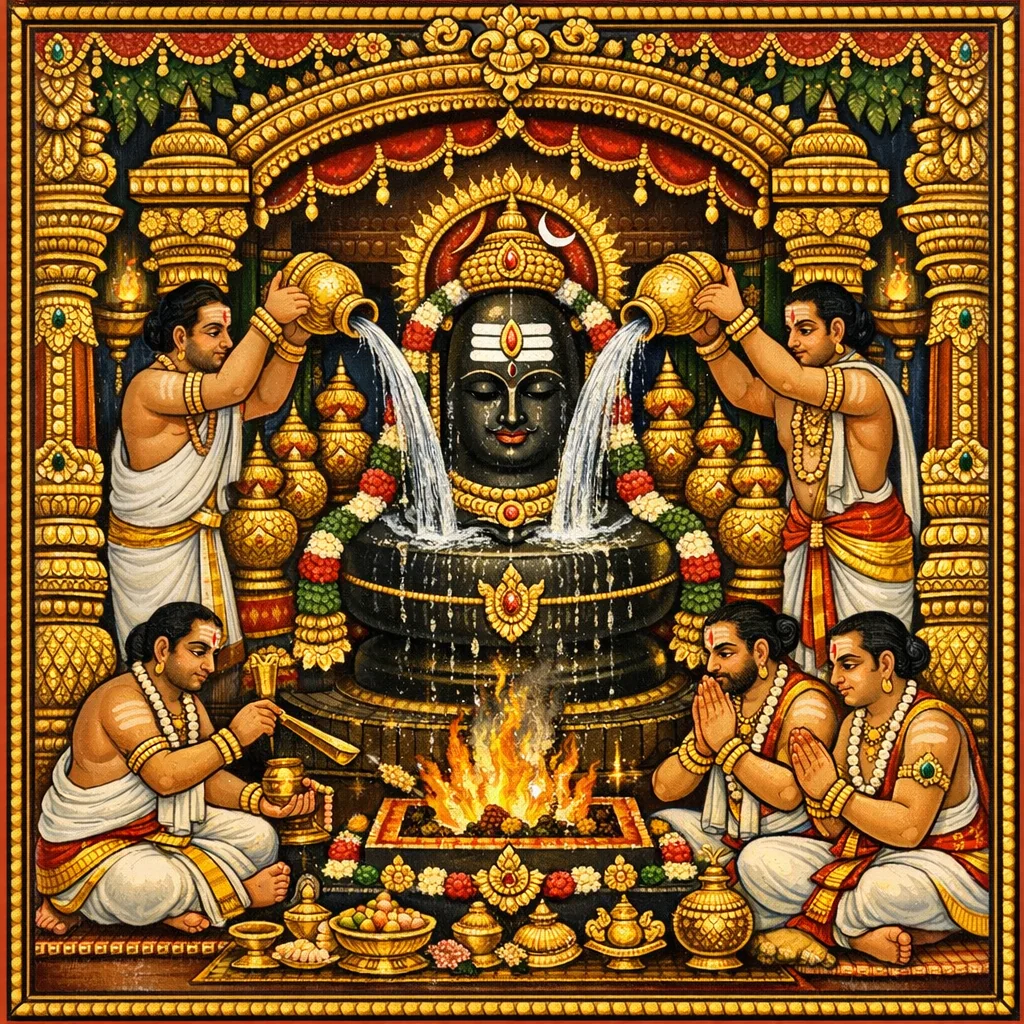
This chapter shifts from the prior topic of initiation to a practical manual on abhiṣeka as a Śaiva rite that empowers the disciple and bestows auspicious prosperity. It begins with Śiva-worship and the ordered placement of nine kumbhas starting from Īśāna (north-east), each linked to symbolic “oceans” such as salt-water, milk, curds, ghee, sugarcane-juice, kādambarī, sweet water, clear water, and whey. A structured installation then follows: eight Vidyeśvaras and Rudra-forms (including Śikhaṇḍin, Śrīkaṇṭha, Tri-mūrta, the One-eyed, the ‘Subtle-named’, and the ‘Infinite’), with Śiva, samudra, and the Śiva-mantra set at the center of a specially built snāna-maṇḍapa functioning as a yāgālaya. The disciple, seated facing east, is purified by nirmañchana with prescribed substances and bathed with kumbha-water while observing ritual restraints; he is then clothed in white and honored with emblems of authority (turban, yogic band, crown, etc.). The rite culminates in formal instruction, prayers to remove obstacles, mantra-cakra worship through five sets of five oblations, ritual marking, and a protective royal abhiṣeka mantra for kings and householders—showing the Agni Purāṇa’s integration of spatial-ritual engineering with soteriological discipline.
Shlokas
Verse 1
इत्य् आदिमहपुराणे आग्नेये एकतत्त्वदीक्षाकथनं नाम ऊननवतितमो ऽध्यायः अथ नवतितमो ऽध्यायः अभिषेकादिकथनं ईश्वर उवाच शिवमभ्यर्च्याभिषेकं कुर्याच्छिष्यादिके श्रिये कुम्भानीशादिकाष्ठासु क्रमशो नव विन्यसेत्
Thus, in the Agni Purāṇa, within the primordial Mahāpurāṇa, ends the eighty-ninth chapter entitled “The Account of Ekataṭṭva (Single-Principle) Initiation.” Now begins the ninetieth chapter, “The Account of Abhiṣeka and Related Rites.” The Lord (Īśvara) said: “Having worshipped Śiva, one should perform the consecratory bathing (abhiṣeka) for the prosperity of the disciple and others; and one should arrange nine ritual pots (kumbhas), in due order, in the directions beginning with Īśāna (the north-east).”
Verse 2
तेषु क्षारोदं क्षीरोदं दध्युदं घृतसागरं इक्षुकादम्बरीस्वादुमस्तूदानष्टसागरान्
Among them are the seas consisting of salt-water, milk, curds, clarified butter (ghṛta), sugarcane-juice, kādambarī (a fermented drink), sweet water, and whey (mastū)—these are the various oceans.
Verse 3
निवेशयेद् यथासङ्ख्यमष्टौ विद्येश्वरानथ एकं शिखण्डिनं रुद्रं श्रीकण्ठन्तु द्वितीयकं
One should install, in proper numerical sequence, the eight Vidyeśvaras; then install one Rudra called Śikhaṇḍin, and as the second, Śrīkaṇṭha.
Verse 4
त्रिमूर्तमेकरुद्राक्षमेकनेत्रं शिवोत्तमं सप्तमं सूक्ष्मनामानमनन्तं रुद्रमष्टमं
The seventh is (Rudra) as the Three-Formed One (Trimūrti): the bearer of a single rudrākṣa, the One-Eyed, Śiva the Supreme. The eighth is Rudra called “Sūkṣma-nāman” (the Subtle-Named) and “Ananta” (the Infinite).
Verse 5
मध्ये शिवं समुद्रञ्च शिवमन्त्रं च विन्यसेत् यागालयान् दिगीशस्य रचिते स्नानमण्डपे
In the centre, one should install (by ritual nyāsa) Śiva, the Ocean (samudra), and the Śiva-mantra, within the snāna-maṇḍapa (bathing pavilion) constructed as the yāgālaya, the sacrificial enclosure of Digīśa, Lord of the Quarters.
Verse 6
कुर्यात् करद्वयायामां वेदीमष्टाङ्गुलोच्छ्रितां श्रीपर्णाद्यासने तत्र विन्यस्यानन्तमानसं
One should construct an altar-platform (vedī) two hand-spans in length and raised to a height of eight finger-breadths; and there, upon a seat made of śrīparṇa and similar sacred leaves, one should install (the deity) Ananta with the mind intent in devotion.
Verse 7
शिष्यं निवेश्य पूर्वास्यं सकलीकृत्य पूजयेत् काञ्जिकौदनमृद्भस्मदूर्वागोमयगोलकैः
Having seated the disciple facing east, and having arranged the complete ritual set in proper order, one should perform worship using kāñjikā (fermented sour gruel), cooked rice, clay, ash, dūrvā grass, and balls made of cow-dung.
Verse 8
सिद्धार्थदधितोयैश् च कुर्यान्निर्मञ्छनं ततः क्षारोदानुक्रमेणाथ हृदा विद्येशशम्बरैः
Using preparations of white mustard (siddhārtha), curd, and water, one should first perform the cleansing rite (nirmañchana). Thereafter, in proper sequence, one should apply alkaline water; and this is to be done with the heart-mantra and with the Vidyeśa–Śambara mantras/charms.
Verse 9
कलसैः स्नापयेच्छिष्यं स्वधाधारणयान्वितं परिधाप्य सिते वस्त्रे निवेश्य शिवदक्षिणे
One should bathe the disciple with consecrated water-pots (kalasa), having him furnished with the proper svadhā-dhāraṇā (ritual formula/observance). Then, clothing him in white garments, one should seat him on the auspicious right-hand side (of Śiva/of the rite).
Verse 10
पूर्वोदितासने शिष्यं पुनः पूर्ववदर्चयेत् उष्णीषं योगपट्टञ्च मुकुटं कर्तरीं घटीं
Seating the disciple upon the seat prescribed earlier, one should again worship him in the same manner as before, offering/placing upon him the turban (uṣṇīṣa), the yogic band (yogapaṭṭa), the crown (mukuṭa), the scissors (kartarī), and the water-pot (ghaṭī).
Verse 11
अक्षमालां पुस्तकादि शिवकाद्यधिकारकं स्वादुगर्गोदानष्टसागरानिति क, ख, चिह्नितपुस्तकपाठः दीक्षाव्याख्याप्रतिष्ठाद्यं ज्ञात्वाद्यप्रभृति त्वया
The reading found in the marked manuscripts (labelled ‘ka’ and ‘kha’) is: “a rosary (akṣamālā), a book, and the like—these are the insignia of authority beginning with Śiva,” and also the listed set “Svādu, Garga, Udāna, Naṣṭa, Sāgara.” Having understood the preliminaries such as initiation (dīkṣā), exposition/teaching, and consecratory establishment (pratiṣṭhā), you should proceed from today onward.
Verse 12
सुपरीक्ष्य विधातव्यमाज्ञां संश्रावयेदिति अभिवाद्य ततः शिष्यं प्रणिपत्य महेश्वरं
After careful examination, one should issue the instruction (ājñā) and have it properly heard/recited by the disciple. Then, having offered respectful salutations, the disciple should bow down in full prostration (pranipāta) to Maheśvara (Śiva).
Verse 13
विघ्नज्वालापनोदार्थं कुर्याद्विज्ञापनां यथा अभिषेकार्थमादिष्टस्त्वयाहं गुरुमूर्तिना
To dispel the blazing fires of obstacles, one should make a formal supplication in the prescribed manner: “I have been instructed by you—who are embodied as the Guru—to perform the consecratory ablution (abhiṣeka).”
Verse 14
संहितापारगः सो ऽयमभिषिक्तो मया शिव तृप्तये मन्त्रचक्रस्य पञ्चपञ्चाहुतीर्यजेत्
“This one is a master of the Saṃhitā; I have anointed (initiated) him. For the satisfaction of Śiva, he should worship the Mantra-circle (Mantra-cakra) by offering five sets of five oblations (āhuti).”
Verse 15
दद्यात् पूर्णां ततः शिष्यं स्थापयेन्निजदक्षिणे शिष्यदक्षिणपाणिस्था अङ्गुष्ठाद्यङ्गुलीः क्रमात्
Then he should give the pūrṇā, the complete offering. Thereafter he should place the disciple at his own right side; and, with the disciple’s right hand, he should arrange (or touch and position) the fingers in order, beginning with the thumb.
Verse 16
लाञ्छयेदुपबद्धाय दग्धदर्भाग्रशम्बरैः कुसुमानि करे दत्वा प्रणामं कारयेदमुं
For the person who has been duly bound (ritually secured), one should apply the ritual mark (lāñchana) using a bundle made from the burnt tips of darbha-grass. Placing flowers in his hand, one should then have him perform praṇāma (reverent prostration).
Verse 17
कुम्भे ऽनले शिवे स्वस्मिसंस्ततस्कृत्यमाविशेत् अनुग्राह्यास्त्वया शिष्याः शास्त्रेण सुपरीक्षिताः
Having established the prescribed rite within the kumbha (consecration-vessel), in the sacred fire, and in Śiva, he should enter (absorb himself) into that action as centered in his own Self (Ātman). The disciples are to be shown favor by you only after they have been thoroughly examined according to the śāstra.
Verse 18
भूपवन्मानवादीनामभिषेकादभीप्सितं आं श्रां श्रौं पशुं हूं फडिति अस्त्रराजाभिषेकतः
For kings, ministers, men, and others, the desired result is attained through consecration (abhiṣeka). The mantra is: “āṃ śrāṃ śrauṃ paśuṃ hūṃ phaḍ”—thus, by the royal consecration of the protective weapon-mantra (astra).
Frequently Asked Questions
Precise ritual-architectural and spatial sequencing: nine kumbhas placed from Īśāna, a central nyāsa of Śiva/samudra/mantra in a snāna-maṇḍapa, and explicit altar metrics (two hand-spans length, eight finger-breadths height) with ordered purification and bathing steps.
It frames consecration as disciplined transformation: purification, mantra-governed installation, and authorized instruction align the disciple’s body and vows with Śiva’s mantra-order, integrating bhukti (prosperity, protection, social legitimacy) with mukti-oriented initiation and inner centering.