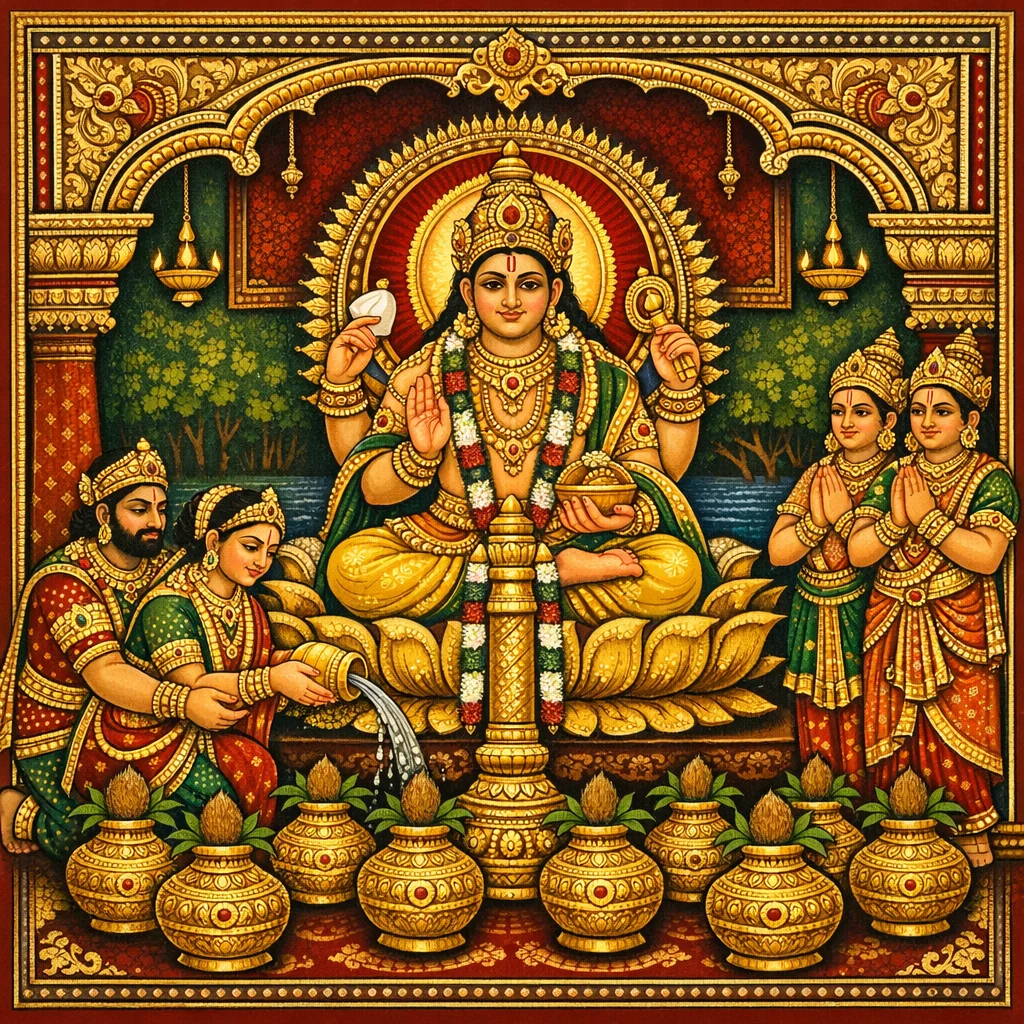
Adhyaya 64
Chapter 64 — कूपादिप्रतिष्ठाकथनं (The Account of the Consecration of Wells and Other Water-Works)
Agni teaches Vasiṣṭha a Varuṇa-centered pratiṣṭhā for water-works—wells, stepwells, ponds, and tanks—honoring water as the living presence of Hari (Viṣṇu), Soma, and Varuṇa. It first prescribes a Varuṇa icon (gold/silver/gem) with dhyāna-lakṣaṇa: two-armed, swan-seated, granting abhaya and holding the nāga-pāśa; then lays out the ritual setting—maṇḍapa, vedi, kuṇḍa, toraṇa, and the vāruṇa-kumbha. A calibrated eight-kumbha scheme assigns waters to directions (ocean, Gaṅgā, rain, springs, rivers, plant-drawn water, tīrtha water), with fallback rules and mantra consecrations. The rite proceeds through purification, netronmīlana, abhiṣeka, offerings (madhuparka, vastra, pavitra), adhi-vāsa, and sajīvakaraṇa, supported by homa sequences, bali to the ten directions, and śānti-toya. Finally, the installation is anchored by a central yūpa/marker set in the water body with measures for each reservoir, followed by jagacchānti, dakṣiṇā, feeding, and a strong dharma teaching that free, unrestricted gifting of water yields merit surpassing great sacrifices.
Shlokas
Verse 1
इत्य् आदिमहापुत्राणे आग्नेये देवादिप्रतिष्ठापुस्तकप्रतिष्ठाकथनं नाम त्रिषष्टितमोध्यायः अथ चतुःषष्टितमोध्यायः कूपादिप्रतिष्ठाकथनं भगवानुवाच कूपवापीतडागानां प्रतिष्ठां वच्मि तां शृणु जलरूपेण हि हरिः सोमो वरुण उत्तम
Thus, in the Agneya (Agni Purāṇa), the sixty-third chapter entitled “The Account of the Consecration of Deities and the Consecration of Scripture (Pratiṣṭhā of the Book)” is concluded. Now begins the sixty-fourth chapter, entitled “The Account of the Consecration of Wells and Other Water-Works.” The Blessed Lord said: “I shall explain the rite of consecration for wells, step-wells/ponds, and tanks; listen to it. For in the form of water, Hari (Viṣṇu), Soma, and the excellent Varuṇa are present.”
Verse 2
अग्नीषोममयं विश्वं विष्णुरापस्तु कारणं हैमं रौप्यं रत्नजं वा वरुणं कारयेन्नरः
The universe is constituted of Agni and Soma; Viṣṇu is the presiding cause, and the Waters are indeed the causal basis. Therefore one should have an image of Varuṇa made—of gold, of silver, or fashioned with gems.
Verse 3
द्विभुजं हंसपृष्ठस्थं दक्षिणेनाभयप्रदं वामेन नागपाशं तं नदीनागादिसंयुतं
Meditate upon him as two-armed, seated upon the back of a swan; with the right hand granting fearlessness, and with the left holding a serpent-noose—attended by river-serpents and the like.
Verse 4
यागमण्डपमध्ये स्याद्वेदिका कुण्डमण्डिता तोरणं वारुणं कुम्भं न्यसेच्च करकान्वितं
In the midst of the sacrificial pavilion there should be a vedi (altar-platform) adorned with a kuṇḍa (fire-pit). One should also erect a toraṇa (ceremonial gateway) and place the vāruṇa-kumbha (Varuṇa-pot), furnished with a karakā (sprinkling vessel).
Verse 5
भद्रके चार्धचन्द्रे वा स्वस्तिके द्वारि कुम्भकान् अग्न्याधानं चाप्यकुण्डे कृत्वा पूर्णां प्रदापयेत्
At the doorway one should place the kumbhas (ritual water-pots) upon a bhadraka-, half-moon-, or svastika-shaped diagram; and after performing agnyādhāna (the installation of the sacred fire), even without a fixed kuṇḍa (a-kuṇḍa), one should then offer the pūrṇā-oblation (the ‘full/complete’ offering).
Verse 6
वरुणं स्नानपीठे तु ये ते शतेति संस्पृशेत् घृतेनाभ्यञ्जयेत् पश्चान्मूलमन्त्रेण देशिकः
On the bathing platform (snāna-pīṭha), the deśika (officiant) should touch and invoke Varuṇa while reciting the formula “ye te śatam…”, and thereafter anoint with ghṛta (ghee), employing the mūla-mantra (root-mantra).
Verse 7
शन्नो देवीति प्रक्षाल्य शुद्धवत्या शिवोदकैः अधिवासयेदष्टकुम्भान् सामुद्रं पूर्वकुम्भके
After washing (the vessels) while reciting “śanno devī…”, one should, with purified and auspicious waters, perform adhivāsana (ritual consecration) for eight kumbhas, and place ocean-water (sāmudra-jala) in the eastern kumbha.
Verse 8
गाङ्गमग्नौ वर्षतोयं दक्षे रक्षस्तु नैर्झरं नदीतोयं पश्चिमे तु वायव्ये तु नदोदकं
In the southeast (Agni quarter) one should use Ganges-water; in the south, rain-water; in the southwest, water from a waterfall or cascading spring (naiṛjhara); in the west, river-water; and in the northwest (vāyavya), water from a stream or flowing current (nado-daka).
Verse 9
औद्भिज्जं चोत्तरे स्थाप्य ऐशान्यां तीर्थसम्भवं अलाभे तु नदीतोयं यासां राजेति मन्त्रयेत्
Having placed the water produced from vegetation in the northern direction, and the water originating from a tīrtha (sacred ford) in the north-east, if these are unavailable one should use river-water instead, consecrating it by reciting the mantra beginning with “yāsāṁ rājā …”.
Verse 10
देवं निर्मार्ज्य निर्मञ्छ्य दुर्मित्रियेति विचक्षणः नेत्रे चोन्मीलयेच्चित्रं तच्चक्षुर्मधुरत्रयैः
Having wiped and cleansed the deity-image, the skilled officiant should recite the mantra beginning with “durmitriye” and then perform the ‘opening of the eyes’ for the painted image; those eyes are to be touched/activated with the ‘three sweet substances’.
Verse 11
ज्योतिः सम्पूरयेद्धैम्यां गुरवे गामथार्पयेत् समुद्रज्येष्ठेत्यभिषिञ्चयेद्वरुणं पूर्वकुम्भतः
He should fill the ritual ladle with ghee for the fire-offering; then he should present a cow to the guru (officiating teacher). Reciting the mantra beginning “samudra-jyeṣṭha…”, he should perform the abhiṣeka of Varuṇa using water from the pūrva-kumbha, the consecrated pot placed in the east.
Verse 12
समुद्रं गच्छ गाङ्गेयात् सोमो धेन्विति वर्षकात् देवीरापो निर्झराद्भिर् नदाद्भिः पञ्चनद्यतः
O waters of the Gaṅgā, go to the ocean. From the rain-cloud you are Soma, and the milch-cow (dhenu) that yields abundance. O divine Waters, come from springs and from rivers, from Pañcanada, the land of the Five Rivers.
Verse 13
उद्भिदद्भ्यश्चोद्भिदेन पावमान्याथ तीर्थकैः आपो हि ष्ठा पञ्चगव्याद्धिरण्यवर्णेति स्वर्णजात्
With the mantras “Udbhidadbhyaḥ” and “Udbhidenā”, with the Pāvamānī purificatory formulas, and then with tīrtha-water (sanctified waters); with the mantra “Āpo hi ṣṭhā”, with pañcagavya (the five products of the cow), and with the hymn “Dhiraṇyavarṇāḥ”—thus purification is to be performed, bestowing a golden radiance of purity.
Verse 14
आपो अस्मेति वर्षोप्त्यैर् व्याहृत्या कूपसम्भवैः वरुणञ्च तडागोप्त्यैर् वरुणाद्भिस्तु वश्यतः
By the mantra “Āpo asm-”, together with rain-invoking formulas and the utterance of the vyāhṛtis, using water drawn from a well; and by water taken from a pond together with pond-protecting formulas, one brings Varuṇa himself under control—indeed, by Varuṇa’s own waters, that is, water consecrated for Varuṇa.
Verse 15
आपो देवीति गिरिजैर् एकाशीविघटैस्ततः स्नापयेद्वरुणस्येति त्वन्नो वरुणा चार्घ्यकं
Then, using mountain-born water (spring or river water) kept in consecrated jars, one should bathe Varuṇa while reciting “Āpo devīḥ…”. Thereafter, offering arghya to Varuṇa, one should recite “Varuṇasya…” and also “Tvanno Varuṇa…”.
Verse 16
व्याहृत्या मधुपर्कन्तु वृहस्पतेति वस्त्रकं वरुणेति पवित्रन्तु प्रणवेनोत्तरीयकं
With the Vyāhṛtis one should offer the madhuparka; with the mantra “Bṛhaspati” one should present the garment; with the mantra “Varuṇa” one should present the pavitra (a kuśa ring/fillet for ritual purity); and with the Praṇava (Oṃ) one should offer the upper cloth (uttarīya).
Verse 17
नदीक्षोदमिति ख, चिह्नितपुस्तकपाठः आसां रुद्रेति कीर्तयेदिति ङ, ग, चिह्नितपुस्तकपाठः इन्द्रियेति विचक्षण इति ग, घ, चिह्नितपुस्तकपाठः यद्वारण्येन पुष्पादि प्रदद्याद्वरुणाय तु चामरं दर्पणं छत्रं व्यजनं वैजयन्तिकां
“nadīkṣodam”—so reads the Kha recension (a marked manuscript reading). “One should recite ‘āsāṃ rudre …’”—so read the Ṅa and Ga recensions (marked reading). “(…) ‘indriye …’ (…) ‘vicakṣaṇa’”—so read the Ga and Gha recensions (marked reading). Alternatively, one should offer to Varuṇa forest-flowers and the like; and also offer a cāmara (fly-whisk), a mirror, a parasol, a fan, and a vaijayantikā (victory garland/banner).
Verse 18
मूलेनोत्तिष्ठेत्युत्थाप्य तां रात्रिमधिवासयेत् वरुणञ्चेति सान्निध्यं यद्वारण्येन पूजयेत्
Having raised (the installed form) with the root-mantra “mūlena uttiṣṭha” (“Arise by the root [mantra]”), one should keep it in adhi-vāsa (consecratory lodging) for that night; and with the invocation “varuṇam ca iti”, one should worship so that the deity’s sānnidhya (abiding presence) is secured—either by that very Vāruṇa means.
Verse 19
सजीवीकरणं मूलात् पुनर्गन्धादिना यजेत् मण्डपे पूर्ववत् प्रार्च्य कुण्डेषु समिदादिकं
For the rite of sajīvikaraṇa (revivification, re-ensouling), one should worship beginning from the root (the base), and then worship again with perfumes and the like. Having first worshipped in the maṇḍapa as before, one should offer in the fire-pits (kuṇḍas) the fuel-sticks (samidh) and the other prescribed oblations.
Verse 20
वेदादिमन्त्रैर् गन्धाद्याश् चतस्रो धेनवो दुहेत् दिक्ष्वथो वै यवचरुं ततः संस्थाप्य होमयेत्
With the Vedic opening mantras, one should “milk out” (extract and prepare) the four dhenu-offerings, beginning with fragrant substances. Then, in the directions, one should set up a yava-caru (a cooked barley oblation); having established it, one should perform the homa, the fire-offering.
Verse 21
व्याहृत्या वाथ गायत्र्या मूलेनामन्त्रयेत्तथा सूर्याय प्रजापतये द्यौः स्वाहा चान्तरिक्षकः
Then one should consecrate (invoke) with the Vyāhṛtis or with the Gāyatrī, and likewise with the root-mantra. Thereafter (offer/recite) for Sūrya and for Prajāpati: “Dyauḥ, svāhā,” and also for Antarikṣa, the mid-region.
Verse 22
तस्यै पृथिव्यै देहधृत्यै इह स्वधृतये ततः इह रत्यै चेह रमत्या उग्रो भीमश् च रौद्रकः
To Her—Pṛthivī, the Earth—who upholds bodies, here one should invoke for one’s own steadiness. Then here (invoke) for delight, and here for enjoyment. (Invoke also) Ugra the Fierce, Bhīma the Terrible, and Raudraka the Wrathful.
Verse 23
विष्णुश् च वरुणो धाता रायस्पोषो महेन्द्रकः अग्निर्यमो नैरृतो ऽथ वरुणो वायुरेव च
And (there are) Viṣṇu, Varuṇa, Dhātṛ, Rāyaspoṣa, and Mahendra; Agni, Yama, and Nairṛta; and then Varuṇa again, and Vāyu as well.
Verse 24
कुवेर ईशो ऽनन्तो ऽथ ब्रह्मा राजा जलेश्वरः तस्मै स्वाहेदं विष्णुश् च तद्विप्रासेति होमयेत्
One should offer oblations into the fire, invoking: “Kubera; Īśa; Ananta; then Brahmā; the King (Indra); Jaleśvara, Lord of the Waters (Varuṇa);—to him, svāhā; this offering, svāhā; and Viṣṇu; and ‘to the brāhmaṇas’,” thus performing the homa.
Verse 25
सोमो धेन्विति षड् हुत्वा इमं मेति च होमयेत् आपो हि ष्ठेति तिसृभिरिमा रुद्रेति होमयेत्
Having offered six oblations with the mantra beginning “somo dhenv…”, one should also offer with “imaṃ me…”. Then, with the three verses beginning “āpo hi ṣṭhā…”, and with the mantra “imā rudra…”, one should offer further oblations.
Verse 26
दशादिक्षु बलिं दद्यात् गन्धपुष्पादिनार्चयेत् प्रतिमां तु समुत्थाप्य मण्डले विन्यसेद् बुधः
One should offer bali in the ten directions and worship with sandal-paste, flowers, and the like; then, having lifted up the icon, the wise person should place it in its proper position within the ritual maṇḍala.
Verse 27
पूजयेद्गन्धपुष्पाद्यैर् हेमपुष्पादिभिः क्रमात् मण्डले इति ख, ङ, चिह्नितपुस्तकद्वयपाठः मूले त्वग्नौ च होमयेदिति ङ, चिह्नितपुस्तकपाठः वायुः सोमो महेन्द्रक इति ङ, चिह्नितपुस्तकपाठः जलाशयांस्तु दिग्भागे वितस्तिद्वयसम्मितान्
One should worship in proper sequence with perfumes, flowers, and the like, also with golden flowers and similar offerings. In the maṇḍala, according to certain variant readings, one is instructed to offer homa into the fire at the base; and in some recensions deities such as Vāyu, Soma, and Mahendra are also mentioned. One should further establish water-reservoirs in the directional sectors, each measuring two vitastis (spans).
Verse 28
कृत्वाष्टौ स्थण्डिलान् रम्यान् सैकतान् देशिकोत्तमः वरुणस्येति मन्त्रेण साज्यमष्टशतं ततः
Having prepared eight pleasing sand-made ritual altars (sthaṇḍilas), the excellent officiant-priest then offers eight hundred ghee oblations, using the mantra beginning “(O) Varuṇa…”.
Verse 29
चरुं यवमयं हुत्वा शान्तितोयं समाचरेत् सेचयेन्मूर्ध्नि देवं तु सजीवकरणं चरेत्
Having offered into the fire a cooked oblation (caru) prepared from barley, one should then perform the rite with the “peace-water” (śānti-toya). One should sprinkle that water upon the deity’s head, thereby carrying out the rite of revivification (sajīvakaraṇa).
Verse 30
ध्यायेत्तु वरुणं युक्तं गौर्या नदनदीगणैः ॐ वरुणाय नमो ऽभ्यर्च्य ततः सान्निध्यमाचरेत्
One should meditate upon Varuṇa, attended by Gaurī and by hosts of rivers and streams. Having worshipped with the mantra “Oṃ, obeisance to Varuṇa” (Oṃ varuṇāya namaḥ), one should then perform the rite of sānnidhya for obtaining divine presence.
Verse 31
उत्थाप्य नागपृष्ठाद्यैर् भ्रामयेत्तैः समङ्गलैः आपो हि ष्ठेति च क्षिपेत्त्रिमध्वाक्ते घटे जले
Having lifted it up, one should cause it to be rotated with auspicious articles such as the nāga-pṛṣṭha and the like; and, reciting the mantra “āpo hi ṣṭhā…”, one should cast that sanctifying substance/flower into the water contained in a pot (ghaṭa) sweetened with the “three honeys” (tri-madhu).
Verse 32
जलाशये मध्यगतं सुगुप्तं विनिवेशयेत् स्नात्वा ध्यायेच्च वरुणं सृष्टिं ब्रह्माण्डसञ्ज्ञिकां
One should place it, well concealed, in the middle of a water-reservoir. Having bathed, one should meditate upon Varuṇa and upon the creation known as the Brahmāṇḍa, the cosmic egg.
Verse 33
अग्निवीजेन सन्दग्द्ध्य तद्भस्म प्लावयेद्धरां सर्वमपोमयं लोकं ध्यायेत् तत्र जलेश्वरं
Having burned the earth-element with the fire-bīja (agni-bīja), one should flood the earth with its ash. One should then meditate on the entire world as consisting of water, and thereupon contemplate the Lord of the Waters (Jaleśvara).
Verse 34
तोयमध्यस्थितं देवं ततो यूपं निवेशयेत् चतुरस्रमथाष्टास्रं वर्तुलं वा प्रवर्तितं
Having established the deity in the midst of the water, one should then set up the sacrificial post (yūpa), fashioned either square, octagonal, or circular in form.
Verse 35
आराध्य देवतालिङ्गं दशहस्तं तु कूपके यूपं यज्ञीयवृक्षोत्थं मूले हैमं फलं न्यसेत्
Having duly worshipped the deity’s emblem (liṅga), one should set up in the pit (kūpaka) a sacrificial post (yūpa) of ten hands in length, made from a tree fit for sacrifice; and at its base one should place a golden ‘fruit’ (finial/offering).
Verse 36
वाप्यां पञ्चदशकरं पुष्करिण्यां तु विंशतिकं तडागे पञ्चविंशाख्यं जलमध्ये निवेशयेत्
In a stepwell (vāpī) one should install (the central marker/pillar) of fifteen hands; in a lotus-pond (puṣkariṇī), of twenty; and in a lake/tank (taḍāga), that which is known as twenty-five—placing it in the middle of the water.
Verse 37
यागमण्डपाङ्गेण वा यूपब्रस्केति मन्त्रतः स्थाप्य तद्वेष्टयेद्वस्त्रैर् यूपोपरि पताकिकां
Having installed it with the mantra “yāgamaṇḍapāṅgeṇa” or with the mantra “yūpabraska,” one should then wrap it with cloths, and place a small banner upon the yūpa (sacrificial post).
Verse 38
चरुं सचमसं हुत्वेति ख, चिह्नितपुस्तकपाठः उत्थाय इति ख, ग, घ, चिह्नितपुस्तकपाठः सुवर्तितमिति ङ, चिह्नितपुस्तकपाठः यूपस्थानेति मन्त्रत इति ग, घ, ङ, चिह्नितपुस्तकपाठः तदभ्यर्च्य च गन्धाद्यैर् जगच्छान्तिं समाचरेत् दक्षिणां गुरवे दद्याद्भूगोहेमाम्बुपात्रकं
Having offered into the fire the caru (cooked oblation) together with the ladle (camasa), one should then rise and, in the prescribed manner (as indicated in the ritual recensions), perform worship there with fragrances and the like, and carry out the rite of ‘pacification of the world’ (jagacchānti). One should give the teacher (guru) the priestly fee (dakṣiṇā)—land, a cow, gold, and a vessel filled with water.
Verse 39
द्विजेभ्यो दक्षिणा देया आगतान् भोजयेत्तथा आब्रह्मस्तम्बपर्यन्ता ये केचित्सलिलार्थिनः
One should give dakṣiṇā (a priestly honorarium) to the twice-born, and likewise feed those who have come. And whatever beings there may be—from Brahmā down to a blade of grass—who seek water should be given it.
Verse 40
ते तृप्तिमुपगच्छन्तु तडागस्थेन वारिणा तोयमुत्सर्जयेदेवं पञ्चगव्यं विनिक्षिपेत्
“May they attain satisfaction with water drawn from a pond.” In this manner one should pour out the water as an offering, and then place (or administer) the pañcagavya.
Verse 41
आपो हि ष्ठेति तिसृभिः शान्तितोयं द्विजैः कृतं तीर्थतोयं क्षिपेत् पुण्यं गोकुलञ्चार्पयेद्विजान्
With the three verses beginning “Āpo hi ṣṭhā…”, the twice-born should prepare pacificatory water (śānti-water). One should then cast in sacred tīrtha-water as a meritorious act, and also present a herd of cows (or a cow-gift) to the twice-born (brāhmaṇas).
Verse 42
अनिवारितमन्नाद्यं सर्वजन्यञ्च कारयेत् अश्वमेधसहस्राणां सहस्रं यः समाचरेत्
One should arrange a supply of food and provisions that is withheld from none and intended for all people. Whoever practices this (as a regular vow of feeding) attains merit equal to performing a thousand sets of a thousand Aśvamedha sacrifices.
Verse 43
एकाहं स्थापयेत्तोयं तत्पुण्यमयुतायुतं विमाने मोदते स्वर्गे नरकं न स गच्छति
Whoever establishes (provides) water even for a single day gains merit amounting to countless tens of thousands; he rejoices in heaven in a celestial vimāna and does not go to hell.
Verse 44
गवादि पिवते यस्मात्तस्मात् कर्तुर् न पातकं तोयदानात्सर्वदानफलं प्राप्य दिवं यजेत्
Because cows and other beings drink that water, no sin accrues to the doer. By the gift of water, having obtained the fruit of all gifts, one should worship the gods and attain heaven.
Frequently Asked Questions
A precise directional protocol for an aṣṭa-kumbha set: distinct water-types are assigned to specific quarters (including ocean-water in the eastern kumbha), combined with mantra-purifications, followed by homa/bali/śānti-toya and a measured central yūpa/marker (different lengths for vāpī, puṣkariṇī, and taḍāga).
By framing public water provision as yajña and dāna: correct ritual consecration aligns the work with cosmic order (ṛta), while unrestricted water-gifting and feeding cultivate compassion and merit, supporting artha/kāma ethically and reinforcing dharma as a basis for inner purification and eventual mokṣa.
Varuṇa is central as Jaleśvara (Lord of Waters). The chapter explicitly identifies water as a form in which Hari (Viṣṇu), Soma, and Varuṇa are present, making Varuṇa-pratiṣṭhā the theological anchor for sanctifying waterworks.
The text preserves multiple recension readings (e.g., Kha, Ga, Gha, Ṅa) for certain mantra-phrases and procedural cues, indicating a living ritual tradition where regional manuscript lines preserved slightly different liturgical details.