Adhyaya 56
Chapter 56 — दिक्पालयागकथनम् (Account of the Worship of the Guardians of the Directions)
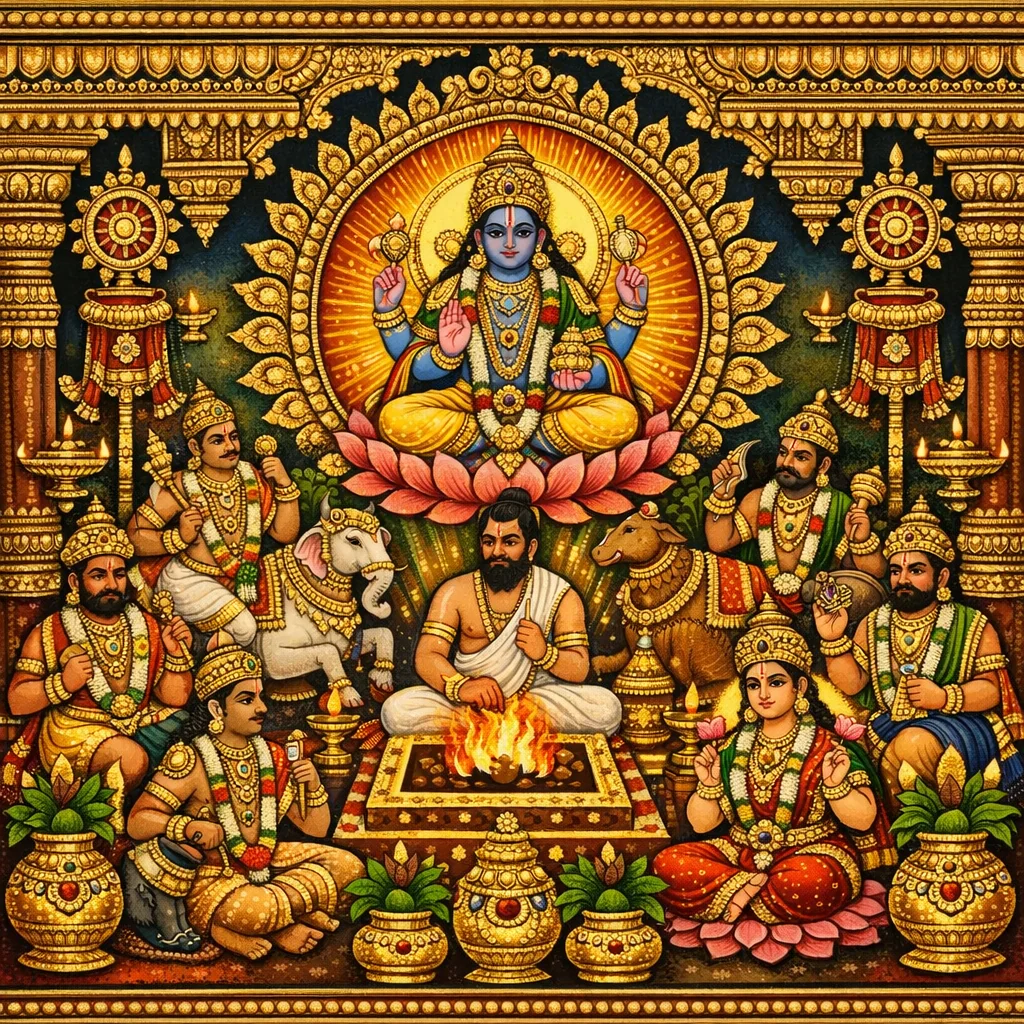
Bhagavān explains the pratiṣṭhā-pañcaka by mapping icon, pedestal-base, and consecration into a metaphysical triad: the pratimā is ensouled by Puruṣa, the piṇḍikā corresponds to Prakṛti, and Lakṣmī signifies the stabilizing act of pratiṣṭhā; their conjunction is called yogaka. The rite begins for wish-fulfillment (iṣṭa-phala) and proceeds through spatial and architectural preliminaries: drawing the garbha-sūtra axis, classifying and measuring the maṇḍapa, arranging snāna and kalaśa functions, and preparing yāga-dravyas. The altar (vedī) is set by proportion (one-third/one-half measures), adorned with kalaśas, ghaṭikās, and canopies, and all materials are purified with pañcagavya. The guru self-consecrates by meditating on Viṣṇu and worshipping the self as the ritual locus, while qualified mūrtipās are installed at each kuṇḍa. Gateways (toraṇas) and posts are assigned woods by direction; the setup includes mantra-worship (“syonā pṛthvī”), sprouts at pillar-bases, the Sudarśana emblem, banner rules, and extensive kalaśa placement. Finally, the dikpālas are invoked into pots and worshipped in order—Indra (east), Agni (southeast), Yama (south), Nairṛta, Varuṇa (west), Vāyu (northwest), Soma/Kubera (north), Īśāna (northeast), Brahman for the zenith, and Ananta for the nadir—each charged to guard the corresponding gate and quarter, sealing the ritual space as a protected cosmic mandala.
Shlokas
Verse 1
इत्य् आदिमहापुराणे आग्नेये पिण्डिकालक्षणं नाम पञ्चपञ्चाशत्तमो ऽध्यायः अथ षट्पञ्चाशत्तमो ऽध्यायः दिक्पालयागकथनं भगवानुवाच प्रतिष्ठापञ्चकं वक्ष्ये प्रतिमात्मा तु पूरुषः प्रकृतिः पिण्डिका लक्ष्मीः प्रतिष्ठा योगकस्तयोः
Thus, in the Agni Purāṇa, the fifty-fifth chapter entitled “The Characteristics of the Piṇḍikā” is concluded. Now begins the fifty-sixth chapter, “The Account of the Worship of the Guardians of the Directions (Dikpālas).” The Blessed Lord said: “I shall explain the fivefold system of consecration (pratiṣṭhā-pañcaka). The image (pratimā) has Puruṣa as its inner self; the Piṇḍikā is Prakṛti; Lakṣmī is the consecration (pratiṣṭhā); and their conjunction is called Yogaka.”
Verse 2
इच्छाफलार्थिभिस्तस्मात्प्रतिष्ठा क्रियते नरैः गर्भसूत्रं तु निःसार्य प्रासादस्याग्रतो गुरुः
Therefore, men who seek the fulfillment of their desired results perform the rite of consecration (pratiṣṭhā); having drawn out the garbha-sūtra—the sanctum’s guiding cord or axis-line—the officiating guru (ācārya) brings it forth to the front of the temple.
Verse 3
अष्टषोडशविंशान्तं मण्डपञ्चाधमादिकम् स्नानं कलशार्थञ्च यागद्रव्यार्थमर्धतः
Beginning with the (measurements) of eight, sixteen, and up to twenty (units), the text explains the maṇḍapa (ritual pavilion) and the fivefold classification starting from the lowest type; likewise, it teaches the bathing rite (snāna), the purpose and use of the consecration-pot (kalaśa), and—briefly, in outline—the materials required for sacrifice/worship (yāga-dravya).
Verse 4
त्रिभागेणार्धभागेन वेदिं कुर्यात्तु शोभनाम् प्रतिमाद्रव्यमुच्यते इति ख, ङ, चिह्नितपुस्तकपाठः गर्भसूत्रन्तु निर्मायेति ङ, चिह्नितपुस्तकपाठः कलशैर् घटिकाभिश् च वितानाद्यैश् च भूषयेत्
With a measure of one-third and one-half (according to the prescribed proportion), one should construct the altar (vedī) in a pleasing manner. (In certain marked manuscript readings it continues: “the material for the icon is stated,” and “the garbha-sūtra is to be made.”) One should adorn it with ritual water-pots (kalaśas), small pots (ghaṭikās), canopies (vitānas), and other such decorations.
Verse 5
पञ्चगव्येन सम्प्रोक्ष्य सर्वद्रव्याणि धारयेत् अलङ्कृतो गुरुर्विष्णुं ध्यात्वात्मानं प्रपूजयेत्
Having sprinkled (purified) all the ritual substances with pañcagavya, one should gather and keep ready all the materials. Then the Guru, duly adorned, should meditate upon Viṣṇu and solemnly worship his own self (as the consecrated locus of the rite).
Verse 6
अङ्गुलीयप्रभृतिभिर्मूर्तिपान् वलयादिभिः कुण्डे कुण्डे स्थापयेच्च मूर्तिपांस्तत्र पारगान्
Using ritual emblems such as rings and the like, together with bracelets and similar ornaments, one should install in each fire-pit (kuṇḍa) the mūrtipāḥ, the image-bearers—namely the officiants fully proficient in that procedure.
Verse 7
चतुष्कोणे चार्धकोणे वर्तुले पद्मसन्निभे पूर्वादौ तोरणार्थन्तु पिप्पलोडुम्बरौ वटं
In the square, the half-square, and the circular layout resembling a lotus, one should place—on the eastern side and in the other directions, for the purpose of the gateways (toraṇas)—the pippala (aśvattha), the udumbara, and the vaṭa (banyan).
Verse 8
प्लक्षं सुशोभनं पूर्वं सुभद्रन्दक्षतोरणं सुकर्म च सुहोत्रञ्च आप्ये सौम्ये समुच्छ्रयम्
Plakṣa wood is most auspicious for the eastern side. For the southern toraṇa, Subhadra is recommended. Likewise, Sukarma and Suhotra are prescribed; and for the western and northern sides, Āpya and Saumya are to be used for the raised structure (superstructure/post).
Verse 9
पञ्चहस्तं तु संस्थाप्य स्योनापृथ्वीति पूजयेत् तोरणस्तम्भमूले तु कलशान्मङ्गलाङ्कुरान्
Having set it up to a measure of five hastas, one should worship it with the mantra “syonā pṛthvī.” And at the base of the gateway-pillars (toraṇa-stambhas), one should place ritual water-pots (kalaśas) with auspicious sprouts (maṅgala-aṅkuras).
Verse 10
प्रदद्यादुपरिष्टाच्च कुर्याच्चक्रं सुदर्शनं पञ्चहस्तप्रमाणन्तु ध्वजं कुर्याद्द्विचक्षणः
He should place it at the top and fashion the Sudarśana discus (cakra) as an emblem. The banner (dhvaja) should be made to a measure of five hastas; the skilled artisan should construct it with two eye-like apertures or markings.
Verse 11
वैपुल्यं चास्य कुर्वीत षोडशाङ्गुलसन्मितं सप्तहस्तोच्छ्रितं वास्य कुर्यात् कुण्डं सुरोत्तम
O best of gods, one should make its breadth to the measure of sixteen aṅgulas; and for it one should construct the kuṇḍa, the ritual fire‑pit, with a height of seven hastas.
Verse 12
अरुणोग्निनिभश् चैव कृष्णः शुक्लोथ पीतकः रक्तवर्णस् तथा श्वेतः श्वेतवर्णादिकक्रमात्
He is reddish, with a luster like fire; also black, white, and then yellow; likewise of red hue and also white—thus, in the sequence beginning with the white coloration and so on.
Verse 13
कुमुदः कुमुदाक्षश् च पुण्डरीकोथ वामनः शङ्कुकर्णः सर्वनेत्रः सुमुखः सुप्रतिष्ठितः
(Names:) “Kumuda”; “Kumudākṣa” (lotus‑eyed); “Puṇḍarīka” (like the white lotus); and “Vāmana” (the Dwarf‑incarnation); “Śaṅkukarṇa” (conch‑eared); “Sarvanetra” (the eye of all, the all‑seeing); “Sumukha” (of auspicious countenance); and “Supratiṣṭhita” (firmly established).
Verse 14
पूज्या कोटिगुणैर् युक्ताः पूर्वाद्या ध्वजदेवताः जलाढकसुपूरास्तु पक्वविम्बोपमा घटाः
The banner‑deities beginning with the eastern one are to be worshipped, being endowed with virtues multiplied a koṭi‑fold. And the ritual pots (ghaṭas) should be filled completely with water by the āḍhaka‑measure, rounded and full like ripe bimba fruits.
Verse 15
समाहित इति ङ, चिह्नितपुस्तकपाठः श्वेतवर्नक्रमात् ध्वजा इति ङ, चिह्नितपुस्तकपाठः कृष्णवर्णः क्रमाद्ध्वजा इति ङ, चिह्नितपुस्तकपाठः अष्टाविंशाधिकशतं कालमण्डनवर्जिताः सहिरण्या वस्त्रकण्ठाः सोदकास्तोरणाद्वहिः
“Samāhita”—so reads the marked manuscript. “The banners are in the sequence of white colour”—so reads the marked manuscript; “in sequence, the banners are of black colour”—so reads the marked manuscript. (They are) one hundred and twenty‑eight (128) in number, devoid of black decorative marks; adorned with gold, with cloth neck‑bands, and with water (vessels/offerings); placed outside the toraṇa (festooned gateway).
Verse 16
घटाः स्थाप्याश् च पूर्वादौ वेदिकायाश् च कोणगान् चतुरः स्थापयेत् कुम्भानाजिघ्रेति च मन्त्रतः
After placing the ritual pots beginning in the east, one should set four kumbhas at the four corner-points of the altar (vedikā), and then perform the smelling/wafting rite with the mantra “ājighreti,” in accordance with the prescribed mantras.
Verse 17
कुम्भेष्वावाह्य शक्रादीन् पूर्वादौ पूजयेत् क्रमात् इन्द्रागच्छ देवराज वज्रहस्त गजस्थित
Having invoked Śakra (Indra) and the other deities into the ritual pots (kalaśas), one should worship them in proper sequence, beginning from the eastern position. (Invocation:) “O Indra, come—king of the gods, bearer of the vajra, seated upon the elephant.”
Verse 18
पूर्वद्वारञ्च मे रक्ष देवैः सह नमोस्तु ते त्रातारमिन्द्रमन्त्रेण अर्चयित्वा यजेद् बुधः
“Protect my eastern doorway together with the gods—obeisance to you.” Having worshipped Indra, the Protector, with an Indra-mantra, the wise person should then perform the rite of offering and worship.
Verse 19
आगच्छाग्रे शक्तियुत च्छागस्थ बलसंयुत रक्षाग्नेयीं दिशं देवैः पूजां गृह नमोस्तु ते
Come forth to the fore—endowed with power, mounted upon a goat, possessed of strength. Protect the south-eastern (Agni) direction together with the gods; accept this worship. Homage to you.
Verse 20
अग्निमूर्धेतिमन्त्रेण यजेद्वा आग्नेय नमः महिषस्थ यमागच्छ दण्डहस्त महाबल
One should perform worship with the mantra beginning “Agnimūrdhā…”, or else with the salutation “Obeisance to the Agneya (the fire-aspect).” (Then invoke:) “O Yama, seated upon a buffalo—come forth! O mighty one, bearing a staff in your hand!”
Verse 21
रक्ष त्वं दक्षिणद्वारं वैवस्वत नमोस्तु ते वैवस्वतं सङ्गमनमित्यनेन यजेद्यमं
O Vaivasvata (Yama), protect the southern gate; homage be to you. With this mantra beginning “vaivasvataṃ saṅgamanam”, one should worship Yama.
Verse 22
नैरृतागच्छ खड्गाढ्य बलवाहनसंयुत इदमर्घ्यमिदं पाद्यं रक्ष त्वं नैरृतीं दिशं
O guardian of the Nairṛta quarter (south‑west), come—armed with a sword and attended by a mighty mount. Here is the arghya-offering; here is water for washing the feet. Protect the Nairṛta (south‑western) direction.
Verse 23
एष ते नैरृते मन्त्रेण यजेदर्घ्यादिभिर् नरः मकरारूढ वरुण पाशहस्त महाबल
With this Nairṛta-direction mantra, one should worship (Varuṇa) with arghya and the other customary offerings: “O Varuṇa, rider of the makara, wielder of the noose (pāśa), O mighty one!”
Verse 24
आगच्छ पश्चिमं द्वारं रक्ष रक्ष नमोस्तु ते उरुं हि राजा वरुणं यजेदर्घ्यादिभिर्गुरुः
Come to the western gate; protect, protect—obeisance to you. Indeed, the king (or patron) should worship Varuṇa with arghya and the other customary offerings, under the guidance of the teacher (guru).
Verse 25
आगच्छ वायो सबल ध्वजहस्त सवाहन वायव्यं रक्ष देवैस्त्वं समरुद्भिर् नमोस्तु ते
O Vāyu, come forth—mighty, banner in hand, and mounted upon your vehicle. O lord of the north‑west (Vāyavya direction), protect this rite/space together with the gods and the Maruts. Homage be to you.
Verse 26
शक्तिहस्त इति ङ, चिह्नितपुस्तकपाठः अग्निमूर्ध्वेति अर्घ्याद्यैर् इति ख, चिह्नितपुस्तकपाठः नरवाहनसंयुत इति ख, ङ, चिह्नितपुस्तकपाठः वात इत्य् आदिभिश्चार्वेदोन्नमो वायवेपि वा आगच्छ सोम सबला गदाहस्त सवाहन
Variant readings note that the deity is described as “weapon-in-hand” (śakti-hasta) and “mounted on a man” (nara-vāhana-saṃyuta). With the formula beginning “vāta …” one should perform worship; or else recite “obeisance to Vāyu.” Then say: “Come, O Soma—together with your power (sabalā), holding a mace (gadā-hasta), and accompanied by your vehicle (sa-vāhana).”
Verse 27
रक्ष त्वमुत्तरद्वारं सकुवेर नमोस्तु ते सोमं राजानमिति वा यजेत्सोमाय वै नमः
“Protect the northern doorway; obeisance be to you together with Kubera.” Or else, one should worship there with the formula “Soma, the King,” saying, “Salutation indeed to Soma.”
Verse 28
आगच्छेशान सबल शूलहस्त वृषस्थित यज्ञमण्डपस्यैशानीं दिशं रक्ष नमोस्तु ते
O Īśāna, come forth—mighty, holding a trident, and seated upon a bull. Protect the north‑eastern (Īśānī) direction of this sacrificial pavilion (yajña-maṇḍapa). Salutations to you.
Verse 29
ईशानमस्येति यजेदीशानाय नमोपि वा ब्रह्मन्नागच्छ हंसस्थ स्रुक्स्रुवव्यग्रहस्तक
One should perform worship with the mantra “īśānam asya …”, or else with “obeisance to Īśāna.” (Saying:) “O Brahman, come—seated upon the Haṃsa—having hands occupied with the ladle and the offering-spoon.”
Verse 30
सलोकोर्ध्वां दिशं रक्ष यज्ञस्याज नमोस्तु ते हिरण्यगर्भेति यजेन्नमस्ते ब्रह्मणेपि वा
“Protect the upper direction together with its world (realm), O Lord of sacrifice; obeisance to you.” One should worship with the mantra “Hiraṇyagarbha”; or else also with the salutation “Obeisance to you, O Brahman.”
Verse 31
अनन्तागच्छ चक्राढ्य कूर्मस्थाहिगणेश्वर अधोदिशं रक्ष रक्ष अनन्तेश नमोस्तु ते नमोस्तु सर्पेति यजेदनन्ताय नमोपि वा
“O Ananta, come forth—O bearer of the discus, O lord of the hosts of serpents who abides upon the Tortoise! Protect, protect the lower direction (the nadir). O Ananteśa, salutations to you; salutations! One should worship with the formula ‘Homage, O Serpent,’ or else simply with ‘Homage to Ananta.’”
Frequently Asked Questions
It is a fivefold consecration framework where the icon is grounded in Puruṣa, the piṇḍikā base corresponds to Prakṛti, Lakṣmī signifies the stabilizing consecration, and their conjunction is termed yogaka—linking metaphysics to ritual installation.
It functions as the sanctum’s guiding axis-line; drawing it out establishes orientation and ritual alignment before the mandapa/vedi arrangements and dikpāla protections are installed.
By invoking guardians into kalaśas and assigning them to protect each gate and quarter (including zenith and nadir), the ritual space becomes a sealed cosmic mandala, ensuring stability, auspiciousness, and efficacy of consecration.