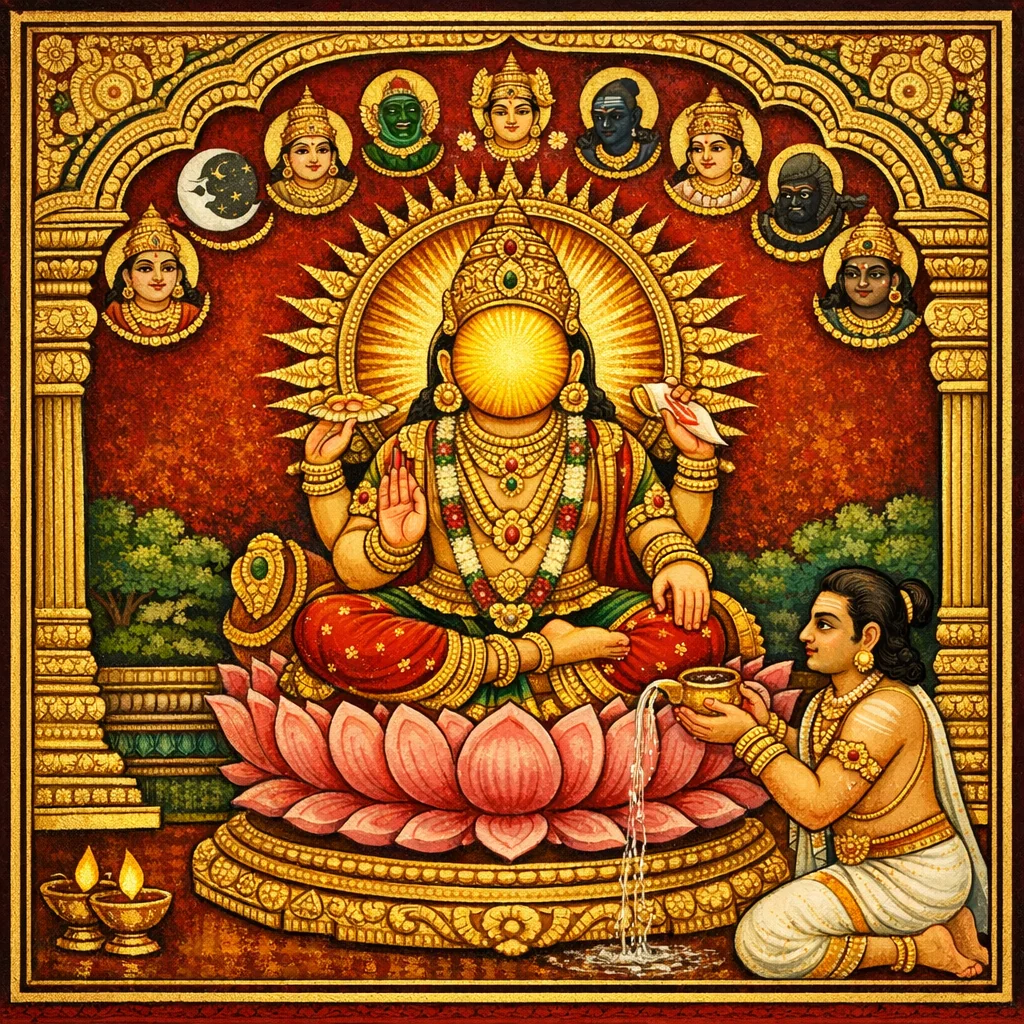
Adhyaya 73
अध्याय ७३: सूर्यपूजाविधिः (Sūrya-pūjā-vidhi — The Procedure for Sun-Worship)
This chapter teaches a structured Sūrya-upāsanā in the Īśāna-kalpa ritual idiom, emphasizing nyāsa, bīja-mantra placements on the body, mudrā rites, and layered protection (rakṣā/avaguṇṭhana). It begins with consecratory placements on hands and limbs and an identity-filled contemplation—“I am Sūrya, made of radiance”—then offers arghya as the chief act of reverence. A red mark/diagram is prepared and worshipped as the ritual locus; materials are sprinkled, and worship proceeds facing east. The rite expands into spatial/protective mapping: Gaṇeśa is worshipped at prescribed points, the Guru is honored in the fire, and the central pedestal/seat is established for the solar form. A lotus-mandala is populated with solar bījas and śaktis (rāṃ, rīṃ, raṃ, rūṃ, reṃ, raiṃ; roṃ, rauṃ), culminating in installing the ṣaḍakṣara solar form on the arkāsana. Invocation mantras (including “Hrāṃ Hrīṃ Saḥ”) accompany vimba-, padma-, and bilva-mudrās; aṅga-nyāsa (heart, head, śikhā, kavaca, netra, astra) is performed with directional assignments. Planetary obeisance is integrated through bīja worship (Soma, Budha, Bṛhaspati, Śukra; plus Mars, Saturn, Rāhu, Ketu). The rite closes with japa, arghya, stuti, a formal request for forgiveness, subtle withdrawal/compaction (saṃhāriṇī upasaṃskṛti), and the claim that through Ravi, japa, dhyāna, and homa become efficacious.
Shlokas
Verse 1
इत्य् आदिमहापुराणे आग्नेये स्नानादिविधिर्नाम द्विसप्ततितमो ऽध्यायः अथ त्रिसप्ततितमो ऽध्यायः सूर्यपूजाविधिः ईश्वर उवाच वक्ष्ये सूर्यार्चनं स्कन्द कराङ्गन्यासपूर्वकं अहं तेजोमयः सूर्य इति ध्यात्वार्घ्यमर्चयेत्
Thus, in the Agni Purāṇa, the seventy-second chapter entitled “Rules for Bathing and Related Rites” concludes. Now begins the seventy-third chapter: “The Procedure for Sun-Worship.” The Lord said: “I shall teach the worship of Sūrya, O Skanda, preceded by the consecratory placements (nyāsa) upon the hands and limbs. Meditating, ‘I am Sūrya, made of radiance,’ one should worship by offering arghya, the respectful water-offering.”},{
Verse 2
पूरयेद्रक्तवर्णेन ललाटाकृष्टविन्दुना तं संपूज्य रवेरङ्गैः कृत्वा रक्षावगुण्ठनं
He should fill the prescribed spot or diagram with red pigment, using a dot drawn from the forehead; then, having worshipped that mark with the offerings that constitute the Sun’s aṅgas, he should perform the rite of protective covering (rakṣā-avagunṭhana).
Verse 3
सम्प्रोक्ष्य तज्जलैर् द्रव्यं पूर्वास्यो भानुमर्चयेत् ॐ अं हृद्वीजादि सर्वत्र पूजनं दण्डिपिङ्गलौ
Having sprinkled the ritual materials with that water, facing east one should worship the Sun. Worship everywhere should begin with the heart-seed: “Oṃ aṃ”; and Daṇḍin and Piṅgala are to be worshipped as attendant deities.
Verse 4
द्वारि दक्षे वामपार्श्वे ईशाने अं गणाय च अग्नौ गुरुं पीठमध्ये प्रभूतं चासनं यजेत्
At the doorway—on the right, on the left, and in the north-east (Īśāna)—one should worship Gaṇeśa with the syllable “aṃ”; in the fire (agni) one should worship the Guru; and in the middle of the pedestal (pīṭha) one should worship the Mighty One together with his seat (āsana).
Verse 5
अग्न्यादौ विमलं सारमाराध्यं परमं सुखं सितरक्तपीतनीलवर्णान् सिंहनिभान् यजेत्
Beginning with Agni, one should worship the immaculate, essential supreme principle—worthy of propitiation and productive of highest bliss—in forms of white, red, yellow, and blue hues, lion-like in appearance.
Verse 6
पद्ममध्ये रां च दीप्तां रीं सूक्ष्मां रं जयांक्रमात् रूं भद्रां रें विभूतीश् च विमलां रैममोघया
In the center of the lotus, one should place the bīja rāṃ as the Radiant power, rīṃ as the Subtle power; then in proper sequence raṃ as the Victorious power; next rūṃ as the Auspicious power, reṃ as the Lord-of-Manifestations power, and finally raiṃ as the Stainless, Unfailing power.
Verse 7
रों रौं विद्युता शक्तिं पूर्वाद्याः सर्वतोमुखाः ॐ हां हृद्वीजादीति ख, चिह्नितपुस्तकपाठः रुं जयां क्रमादिति ख, चिह्नितपुस्तकपाठः रं मध्ये अर्कासनं स्यात् सूर्यमूर्तिं षडक्षरं
With the syllables roṃ and rauṃ, one should install the Lightning-Power (Vidyut-Śakti). Beginning from the eastern direction, the placement is made with faces turned in all directions. (According to a marked manuscript reading: “oṃ hāṃ—beginning with the heart-seed (hṛd-bīja)”; and another marked reading: “ruṃ—place Jayā in due order”.) In the middle, with raṃ, there should be the Arka-seat (arkāsana); there one should establish the six-syllabled solar form (ṣaḍakṣara Sūrya-mūrti).
Verse 8
ॐ हं खं खोल्कयेति यजेदावाह्य भास्करं ललाटाकृष्टमञ्जल्यां ध्यात्वा रक्तं न्यसेद्रविं
Reciting “Oṁ haṁ khaṁ kholkaye”, one should worship after invoking Bhāskara (the Sun). Drawing the joined palms up to the forehead and meditating on Ravi (the Sun) as red, one should perform nyāsa, the ritual placement of the Sun (mantra/deity).
Verse 9
ह्रां ह्रीं सः सूर्याय नमो मुद्रयावाहनादिकं विधाय प्रीतये विम्बमुद्रां गन्धादिकं ददेत्
Reciting “Hrāṃ Hrīṃ Saḥ—obeisance to Sūrya,” one should perform the preliminary rites beginning with invocation by means of the prescribed mudrā; for the deity’s satisfaction, one should then show the vimba-mudrā and offer perfumes and the other customary upacāras.
Verse 10
पद्ममुद्रां बिल्वमुद्रां प्रदर्श्याग्नौ हृदीरितं ॐ आं हृदयाय नमः अर्काय शिरसे तथा
Having displayed the Lotus Mudrā and the Bilva Mudrā, one should utter over Agni (the sacred fire) the heart-mantra: “Oṃ āṃ—obeisance to the Heart,” and likewise the head-mantra: “to Arka—obeisance to the Head.”
Verse 11
भूर्भुवः स्वः सुरेशाय शिखायै नैरृते यजेत् हुं कवचाय वायव्ये हां नेत्रायेति मध्यतः
One should worship/assign “bhūr bhuvaḥ svaḥ” to the Lord of the gods as the Śikhā (crown-tuft) in the south-west; “huṁ” as the Kavaca (protective armour) in the north-west; and “hāṁ” as the Netra (eye-mantra) in the centre.
Verse 12
वः अस्त्रायेति पूर्वादौ ततो मुद्राः प्रदर्शयेत् धेनुमुद्रा हृदादीनां गोविषाणा च नेत्रयोः
First, beginning with the eastern direction, one should apply the protective formula “vaḥ astrāya”; thereafter one should display the ritual hand-gestures (mudrās). The Dhenumudrā is to be applied to the heart and the other vital placements, and the Govīṣāṇā-mudrā to the eyes.
Verse 13
अस्त्रस्य त्रासनी योज्या ग्रहणां च नमस्क्रिया सों सोमं बुं बुधं वृञ्च जीवं भं भार्गवं यजेत्
A protective averting rite (trāsanī) should be employed for the astra (weapon-mantra), and the rite of obeisance should be performed for the planets. One should worship Soma with “soṃ”, Budha with “buṃ”, Bṛhaspati (Jīva) with “vṛñ”, and Bhārgava (Śukra) with “bhaṃ”.
Verse 14
दले पूर्वादिके ऽग्न्यादौ अं भौमं शं शनैश् चरं रं राहुं कें केतवे च गन्धाद्यैश् च खखोल्कया
In the petal located in the eastern direction and the others—beginning with the south-east (Agni’s quarter)—one should place (nyāsa) the seed-syllables: “aṁ” for Mars (Bhauma), “śaṁ” for Saturn (Śanaiścara), “raṁ” for Rāhu, and “keṁ” for Ketu; and one should worship them with fragrance and the other offerings, together with the accompanying formula ‘khakholkā’.
Verse 15
मूलं जप्त्वार्घ्यपात्राम्बु दत्वा सूर्याय संस्तुतिः नत्वा पराङ्मुखञ्चार्कं क्षमस्वेति ततो वदेत्
Having recited the root-mantra and offered the water from the arghya vessel to Sūrya, one should utter a hymn of praise to Sūrya; then, bowing and turning away from Arka (the Sun), one should thereafter say: “Forgive me.”
Verse 16
शराणुना फडन्तेन समाहत्याणुसंहृतिं भां नेत्रायेति ग, चिह्नितपुस्तकपाठः पराङ्मुखञ्चार्घ्यमिति ख, ग, चिह्नितपुस्तकपाठः शवानुना फडन्तेन समाहृत्यानुसंहतिमिति ख, चिह्नितपुस्तकद्वयपाठः शवाणुना फडन्तेन समहत्यार्थं संहतिमिति ग, चिह्नितपुस्तकपाठः हृत्पद्मे शिवसूर्येतिसंहारिण्योपसंस्कृतिं
Striking the subtle obstruction with the missile-mantra ending in “phaḍ”, one should perform aṇu-saṃhṛti (subtle withdrawal/compaction). In one recension: utter “bhāṃ, to the Eye (netra)!”; in another: “Offer arghya while facing away.” In yet another reading: “Having gathered it with the ‘phaḍ’-ending śavāṇu-mantra, perform the subtle compaction.” Thus, in the lotus of the heart, one should complete the concluding consecration (upasaṃskṛti) of the saṃhāriṇī (withdrawal/dissolution procedure) with the formula “Śiva–Sūrya …”.
Verse 17
योजयेत्तेजश् चण्डाय रविनिर्माल्यमर्पयेत् अभ्यर्च्यैशे जपाद्ध्यानाद्धोमात्सर्वं रवेर्भवेत्
One should unite one’s radiance (tejas) with Caṇḍa, the fierce form of the Sun, and offer to Ravi the garlands and consecrated remnants dedicated to Ravi. Having worshipped the Lord, by mantra-recitation (japa), meditation (dhyāna), and fire-offering (homa), everything is accomplished through Ravi (the Sun).
Frequently Asked Questions
A tightly sequenced ritual technology: kara-aṅga-nyāsa, lotus-mandala bīja placement (rāṃ–raiṃ plus roṃ/rauṃ), installation of the ṣaḍakṣara Sūrya-mūrti on the arkāsana, and aṅga-nyāsa with directional assignments (śikhā in the south-west, kavaca in the north-west, netra in the centre, astra from the east).
By coupling identity-meditation (“I am Sūrya, made of radiance”) with disciplined mantra, mudrā, and protective rites, it frames external worship as an internalization of solar consciousness—purifying attention, regulating ritual space, and aligning bhakti with yogic transformation toward dharma and higher realization.
Yes. It prescribes graha-namaskriyā and bīja worship for key planets (Soma, Budha, Bṛhaspati, Śukra; plus Mars, Saturn, Rāhu, Ketu), presenting the solar rite as cosmically comprehensive—harmonizing luminary and planetary forces within a single liturgical architecture.