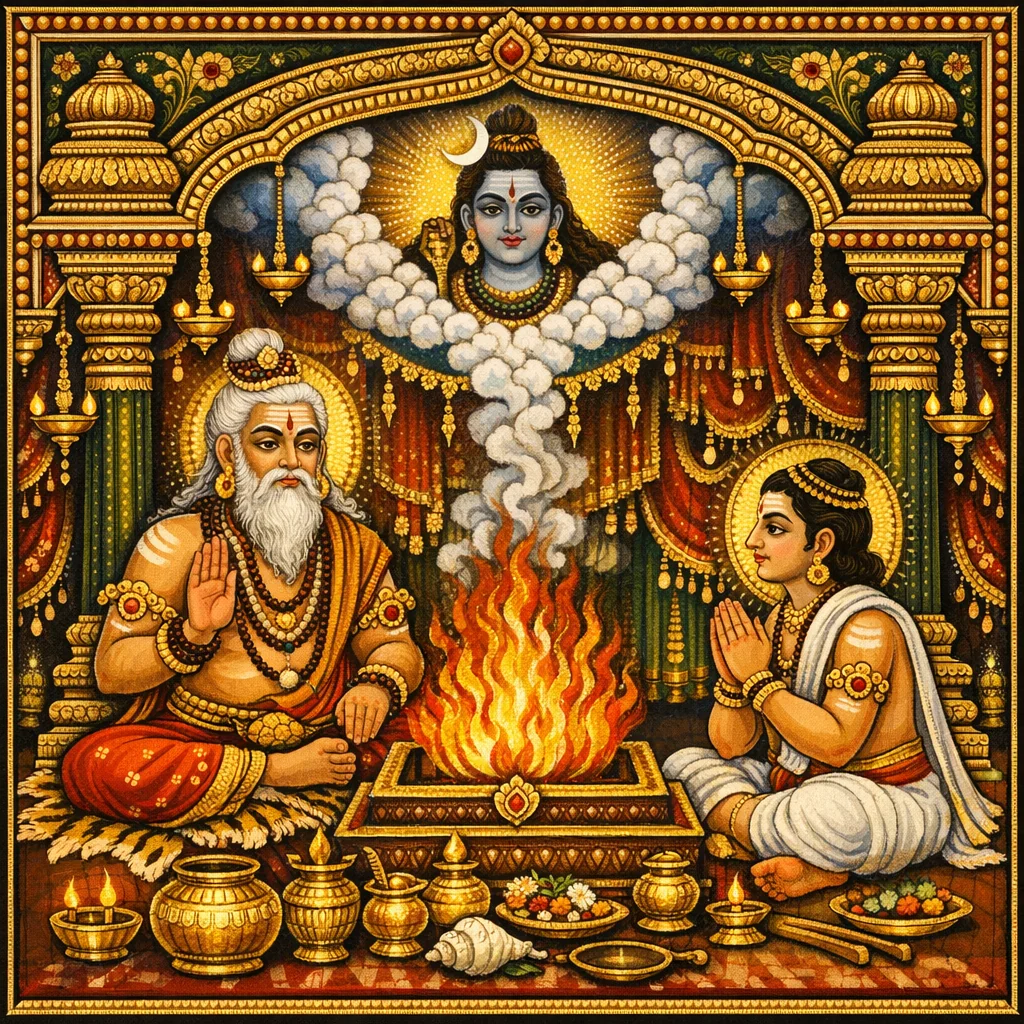
Adhyaya 84
अधिवासनं नाम निर्वाणदीक्षायाम् (Adhivāsana in the Nirvāṇa-dīkṣā)
This chapter is the preparatory threshold (adhivāsana) for Nirvāṇa-dīkṣā. It sets the ritual setting and the guru’s purity as prerequisites for initiatory efficacy. Rising before dawn, the guru bathes and performs daily purifications, and keeps sāttvika dietary discipline by avoiding curd, raw meat, intoxicants, and related impurities. Auspicious and inauspicious dream-omens are noted as signs of subtle conditions; adverse signs are pacified through a Ghora-based śānti-homa. The text thus links outer observance (ācāra) with inner readiness, presenting initiation as a convergence of ethics, omen-science, and mantra-ritual technology in the Agni Purāṇa. This adhivāsana frame prepares for the later sequence: entering the yāgālaya, undertaking purifying vidyā, and aligning the practitioner with the rite’s soteriological aim.
Shlokas
Verse 1
आग्नेये निर्वाणदीक्षायामधिवासनं नाम त्र्यशीतितमो ऽध्यायः यागालयं व्रजेदिति ङ, चिह्नितपुस्तकपाठः विद्यामास्थाय पावनीमिति ङ, चिह्नितपुस्तकपाठः चतुरशीतितमो ऽध्यायः निर्वाणदीक्षाविधानं ईश्वर उवाच अथ प्रातः समुत्थाय कृतस्ननादिको गुरुः दध्यार्द्रमांसमद्यादेः प्रशस्ताभ्यवहारिता
In the Agni Purāṇa, the eighty-third chapter is called “Adhivāsana in the Nirvāṇa-dīkṣā” (the preliminary consecratory rite connected with the ‘nirvāṇa’ initiation). [Variant reading in a marked manuscript: “One should go to the sacrificial hall (yāgālaya).” Variant reading: “Having undertaken the purifying vidyā.”] Now begins the eighty-fourth chapter, “The procedure of the Nirvāṇa-dīkṣā.” The Lord said: “Then, rising early in the morning, the guru—having performed bathing and other purificatory acts—should partake of commendable food, avoiding curd, raw meat, intoxicants, and the like.”
Verse 2
गजाश्वरोहणं स्वप्ने शुभं शुक्लांशुकादिकं तैलाभ्यङ्गादिकं हीनं होमो घोरेण शान्तये
In a dream, riding an elephant or a horse is auspicious; likewise, seeing or wearing white garments and the like. But oil-anointing and similar acts are inauspicious; to pacify their evil, one should perform a fire-offering (homa) with the rite/mantra called ‘Ghora’ for appeasement.
Verse 3
नित्यकर्मद्वयं कृत्वा प्रविश्य मखमण्डपं स्वाचान्तो नित्यवत् कर्म कुर्यान्नैमित्तिके विधौ
Having performed the two daily obligatory rites, and then entering the sacrificial pavilion, after duly performing ācāmana (purificatory sipping of water), one should carry out the prescribed acts of the occasional rite (naimittika-vidhi) in the same manner as the daily observances.
Verse 4
ततः संशोध्य चात्मानं शिवहस्तं तथात्मनि विन्यस्य कुम्भगं प्रार्च्य इन्द्रादीनामनुक्रमात्
Then, having purified oneself, one should perform nyāsa by placing the ‘Śiva-hand’ (Śiva-hasta) upon oneself; thereafter, having duly worshipped the ritual water-vessel (kumbha/kalaśa), one should worship Indra and the other deities in proper sequence.
Verse 5
मण्डले स्थण्डिले वापि प्रकुर्वीत शिवर्चनं तर्पणं पूजनं वह्नेः पूर्णान्तं मन्त्रतर्पणं
Whether in a consecrated ritual circle (maṇḍala) or upon a prepared altar-ground (sthaṇḍila), one should perform the worship of Śiva—namely tarpaṇa (libations) and pūjana (offerings); and for the Fire, Agni, one should perform mantra-accompanied libations up to the concluding full oblation (pūrṇāhuti).
Verse 6
दुःखप्रदोषमोषाय शस्त्रेणाष्टाधिकं शतं हुत्वा हूं सम्पुटेनैव विदध्यात् मन्त्रदीपनं
To remove suffering and the afflictions arising from evil influences, one should perform a fire-offering one hundred and eight times, using a weapon as the ritual implement and employing the mantra enclosed with the syllable “hūṃ”; thereby the kindling/activation of the mantra (mantra-dīpana) is accomplished.
Verse 7
अन्तर्बलिविधानञ्च मध्ये स्थण्डिलकुम्भयोः कृत्वा शिष्यप्रवेशाय लब्धानुज्ञो वहिर्व्रजेत्
Having performed the prescribed inner bali-offering in the space between the ritual altar (sthaṇḍila) and the consecrated pot (kumbha), and having obtained permission for the disciple’s admission, he should then go outside.
Verse 8
कुर्यात्समयवत्तत्र मण्डलारोपणादिकं सम्पातहोमं तन्नाडीरूपदर्भकरानुगं
There, at the prescribed time, one should perform the installation of the maṇḍala and the other preliminaries, and then carry out the sampāta-homa according to the ordained procedure, using the hand accompanied by darbha-grass arranged in the form of a tubular nāḍī-channel.
Verse 9
तत्सन्निधानाय तिस्त्रो हुत्वा मूलाणुनाअहुतीः कुम्भस्थं शिवमभ्यर्च्य पाशसूत्रमुपाहरेत्
For invoking His immediate presence, having offered three oblations with the mūlāṇu, one should worship Śiva as established in the ritual pot (kumbha) and then bring forth and prepare the pāśa-sūtra, the ritual cord.
Verse 10
शुक्लाम्बरादिकमिति ख, चिह्नितपुस्तकपाठः अस्मल्लब्धपञ्चपुस्तकेषु दध्यार्द्रमांसमद्यादेरित्यारभ्य होमो घोरेण शान्तये इत्य् अन्तः पाठः पूर्वेणानन्वित इव प्रतिभाति पाशसूत्रं समाहरेदिति ङ, चिह्नितपुस्तकपाठः स्वदक्षिणोर्ध्वकायस्य शिष्यस्याभ्यर्चितस्य च तच्छिखायां निबध्नीयात् पादाङ्गुष्ठावलम्बितं
“(Beginning with) śuklāmbarādikam”—thus reads the collated manuscript marked Kha. In the five manuscripts available to us, there is an internal insertion beginning with “from curd, raw meat, liquor, and the like…” and ending with “…a homa is performed for the pacification of the terrible (influences)”; however, this inserted passage seems not to connect smoothly with the preceding text. “One should gather the pāśa-sūtra (noose-cord),”—thus reads the collated manuscript marked Ṅa. (According to that reading) it should be tied into the śikhā (tuft) of the disciple—who has been worshipped—on the right/upper side of his body, letting it hang down to the great toe.
Verse 11
तं निवेश्य निवृत्तेस्तु व्याप्तिमालोक्य चेतसा ज्ञेयानि भुवनान्यस्यां शतमष्टाधिकं ततः
Having established that principle in Nivṛtti and mentally contemplated its pervasiveness, one should understand the worlds contained within it—one hundred and eight in number—thereafter.
Verse 12
कपालो ऽजश् च बुद्धश् च वज्रदेहः प्रमर्दनः विभूतिरव्ययः शास्ता पिनाकी त्रिदशाधिपः
He is Kapāla, the bearer of the skull; Aja, the Unborn; Buddha, the Awakened Knower; Vajradeha, whose body is adamantine; Pramardana, the Subduer; Vibhūti, the all-pervading Glory; Avyaya, the Imperishable; Śāstā, the Ruler and Chastiser; Pinākī, wielder of the bow Pināka; and Tridaśādhipa, Lord of the Thirty Gods.
Verse 13
अग्नी रुद्रो हुताशो च पिङ्गलः खादको हरः ज्वलनो दहनो बभ्रुर्भस्मान्तकक्षपान्तकौ
“Agni” is Rudra; Hutāśa, the consumer of oblations; Piṅgala, tawny-hued; Khādaka, the devourer; Hara, the remover; Jvalana, the blazing one; Dahana, the burner; Babhru, the brown/tawny one; Bhasmāntaka, the ender by reducing to ash; and Kṣapāntaka, the destroyer who brings things to their end.
Verse 14
याम्यमृत्युहरो धाता विधाता कार्यरञ्जकः कालो धर्मो ऽप्यधर्मश् च संयोक्ता च वियोगकः
He is the remover of Yama’s death; Dhātā, the Sustainer, and Vidhātā, the Ordainer—the inspirer who impels beings to action. He is Kāla, Time; he is Dharma and also Adharma; he is the one who unites and the one who separates.
Verse 15
नैरृतो मारणो हन्ता क्रूरदृष्टिर्भयानकः ऊर्ध्वांशको विरूपाक्षो धूम्रलोहितदंष्ट्रवान्
Nairṛta—also named Māraṇa and Hantā—of cruel gaze and terrifying aspect; Urdhvāṃśaka; Virūpākṣa; and the one whose fangs are smoky-red in hue.
Verse 16
बलश्चातिबलश् चैव पाशहस्तो महाबलः श्वेतश् च जयभद्रश् च दीर्घबाहुर्जलान्तकः
Bala and Atibala; Pāśahasta, the noose-bearer, and Mahābala; Śveta and Jayabhadra; Dīrghabāhu, the long-armed, and Jalāntaka, the ender of the waters—these are the invoked names/powers.
Verse 17
वडवास्यश् च भीमश् च दशैते वारुणाः स्मृताः शीघ्रो लघुर्वायुवेगः सूक्ष्मस्तीक्ष्णः क्षपान्तकः
Vaḍavāsya and Bhīma—these ten are remembered as the Vāruṇas, beings belonging to Varuṇa’s sphere: Śīghra, Laghu, Vāyuvega, Sūkṣma, Tīkṣṇa, and Kṣapāntaka.
Verse 18
पञ्चान्तकः पञ्चशिखः कपर्दी मेघवाहनः जटामुकुटधारी च नानारत्नधरस् तथा
He is the Slayer of the “five” (sources of bondage), the Five-crested One; the Lord with matted locks; He whose vehicle is the cloud; the Bearer of a crown of matted hair; and likewise the Wearer of many kinds of jewels.
Verse 19
निधीशो रूपवान् धन्यो सौम्यदेहः प्रसादकृत् प्रकाशो ऽप्यथ लक्ष्मीवान् कामरूपो दशोत्तरे
He is the Lord of treasures, handsome and fortunate; gentle in form, bestowing grace; radiant; and also endowed with prosperity (Lakṣmī), able to assume forms at will—thus proclaimed in the “ten-plus” set.
Verse 20
विद्याधरो ज्ञानधरः सर्वज्ञो वेदपारगः मातृवृत्तश् च पिङ्गाक्षो भूतपालो बलिप्रियः
He is the bearer of sacred sciences and the holder of true knowledge; all-knowing, and one who has crossed to the far shore of the Vedas. He is devoted to the Mother(-goddesses) and their observances; tawny-eyed; protector and governor of beings; and one who delights in ritual offerings (bali).
Verse 21
प्रवर्धन इति ङ, चिह्नितपुस्तकपाठः वरुण इति ख, चिह्नितपुस्तकपाठः जनान्तक इति ङ, चिह्नितपुस्तकपाठः सर्वविद्याविधता च सुखदुःखहरा दश अनन्तः पालको धीरः पातालाधिपतिस् तथा
“Pravardhana”—so reads one marked manuscript; “Varuṇa”—so reads another; “Janāntaka”—so reads a marked manuscript. (These are) the ten (names): the Ordainer of all knowledges, the Remover of pleasure and pain; and likewise Ananta, Pālaka, Dhīra, and the Lord of Pātāla (the netherworld).
Verse 22
वृषो वृषधरो वीर्यो ग्रसनः सर्वतोमुखः लोहितश् चैव विज्ञेया दश रुद्राः फणिस्थिताः
Know these as the ten Rudras stationed upon the serpent (Śeṣa): Vṛṣa, Vṛṣadhara, Vīrya, Grasana, Sarvatomukha, and Lohita.
Verse 23
शम्भुर्विभुर्गणाध्यक्षस्त्र्यक्षस्त्रिदशवन्दितः संहारश् च विहारश् च लाभो लिप्सुर्विचक्षणः
He is Śambhu, the all-pervading Lord, the overseer of the Gaṇas, the Three-eyed One, revered by the gods; he is both dissolution and divine sport, both attainment and the seeker of attainment, and the supremely discerning one.
Verse 24
अत्ता कुहककालाग्निरुद्रो हाटक एव च कुष्माण्डश् चैव सत्यश् च ब्रह्मा विष्णुश् च सप्तमः
He is the Devourer; the Deceiver; the Fire of Time; Rudra; Hāṭaka (gold) itself; Kuṣmāṇḍa; the Truth; Brahmā; Viṣṇu—and the Seventh in the sequence of names.
Verse 25
रुद्रश्चाष्टाविमे रुद्राः कटाहाभ्यन्तरे स्थिताः एतेषामेव नामानि भुवनानामपि स्मरेत्
These are the eight Rudras; they abide within the interior of the cosmic basin. One should also recollect the very names of these (Rudras), as well as the names of the worlds.
Verse 26
भवोद्भवः सर्वभूतः सर्वभूतसुखप्रदः सर्वसान्निध्यकृद् ब्रह्मविष्णुरुद्रशरार्चितः
He is the source from which existence (becoming) arises; he is the indwelling presence in all beings; he bestows happiness upon all creatures; he brings about his presence everywhere; and he is worshipped by the hosts of Brahmā, Viṣṇu, and Rudra.
Verse 27
संस्तुत पूर्वस्थित ॐ साक्षिन् ॐ रुद्रान्तक ॐ पतङ्ग ॐ शब्द ॐ सूक्ष्म ॐ शिव सर्वसर्वद सर्वसान्निध्यकर ब्रह्मविष्णुरुद्रकर ॐ नमः शिवाय ॐ नमो नमः अष्टाविंशति पादानि व्योमव्यापि मनो गुह सद्योहृदस्त्रनेत्राणि मन्त्रवर्णाष्टको मतः
Having offered praise, one should recite the primordial, ever-present Śiva: “Oṃ, Witness; Oṃ, Destroyer of Rudra’s foes; Oṃ, Patanga, the sun-bird; Oṃ, Sound; Oṃ, Subtle; Oṃ, Śiva—bestower of all, maker of the presence of all everywhere, the one who brings forth Brahmā, Viṣṇu, and Rudra; Oṃ namaḥ śivāya; Oṃ, homage, homage.” It is held that this formulation has twenty-eight “feet” (pādas); it is all-pervading like the sky, hidden in the mind-cave; and it is connected with Sadyojāta, Hṛdaya, Astra, Netra, and the like—thus the mantra is considered an eight-syllabled/eight-lettered formula.
Verse 28
वाय ॐ नमो नमः इति अनर्चित संस्तुत पूर्वविन्द ॐ साक्षिण ॐ रुद्रान्तक ॐ पतङ्ग ॐ ज्ञान ॐ शब्द ॐ सूक्ष्म ॐ शिव ॐ सर्व ॐ सर्वद ॐ सर्वसान्निध्यकर ब्रह्मविष्णु रुद्रकर ॐ नमः शिवाय ॐ नमो नम इति च, चिह्नितपुस्तकपाठः वीजाकारो मकारश् च नाड्याविडापिङ्गलाह्वये प्राणापानावुभौ वायू घ्राणोपस्थौ तथेन्द्रिये
“Vāya—‘Oṃ, homage again and again’”: thus one recites the un-worshipped yet praised form, preceded by the bindu (fore-dot), with the epithets: “Oṃ the Witness; Oṃ Rudrāntaka (destroyer of the fierce); Oṃ Pataṅga (the Sun-bird); Oṃ Knowledge; Oṃ Sound; Oṃ the Subtle; Oṃ Śiva; Oṃ the All; Oṃ the giver of all; Oṃ the maker of the presence of all; the maker of Brahmā, Viṣṇu, and Rudra; Oṃ namaḥ śivāya; Oṃ, homage again and again”—so it is recited. In the marked-book reading: the seed-syllables “a” and “ma” are placed in the nāḍīs called Iḍā and Piṅgalā; the two winds, prāṇa and apāna; and likewise the sense-faculties connected with the nose and the generative organ.
Verse 29
गन्धस्तु विषयः प्रोक्तो गन्धादिगुणपञ्चके पार्थिवं मण्डलं पीतं वज्राङ्गं चतुरस्रकं
Smell is declared to be the sense-object within the fivefold set of qualities beginning with smell. The maṇḍala of the earth element is yellow, firm like a vajra, and four-sided (square).
Verse 30
विस्तारो योजनानान्तु कोटिरस्य शताहता अत्रैवान्तर्गता ज्ञेया योनयो ऽपि चतुर्दश
Its extent is a koṭi of yojanas, multiplied a hundredfold; and within it one should understand the fourteen yonis (orders/wombs of birth) as contained here itself.
Verse 31
प्रथमा सर्वदेवानां मन्वाद्या देवयोनयः मृगपक्षी च पशवश् चतुर्धा तु सरीसृपाः
The first class is that of all the gods; beginning with Manu are the divinely born lineages. There are also wild beasts such as deer, birds, and domesticated animals; and reptiles are said to be of four kinds.
Verse 32
स्थावरं पञ्चमं सर्वं योनिः षष्ठी अमानुषी पैशाचं राक्षसं याक्षं गान्धर्वं चैन्द्रमेव च
All immobile beings (sthāvara) constitute the fifth category; the sixth yoni (class of birth) is non-human—namely, piśāca, rākṣasa, yākṣa, gāndharva, and also the aindra (celestial/Indra-related) class.
Verse 33
सौम्यं प्राणेश्वरं ब्राह्ममष्टमं परिकीर्तितं अष्टानां पार्थिवन्तत्त्वमधिकारास्पदं मतं
The eighth principle is declared to be the gentle, life-governing Brahmic power. Among these eight, the earthly principle is regarded as the foundation and locus of operative authority in the manifested realm.
Verse 34
लयस्तु प्रकृतौ बुद्धौ भोगो ब्रह्मा च कारणं ततो जाग्रदवस्थानैः समस्तैर् भुवनादिभिः
Dissolution (laya) indeed occurs into Prakṛti; experience or enjoyment (bhoga) occurs in the Buddhi; and Brahmā is the causal principle. From that cause arise in their entirety the waking states (jāgrat), together with the worlds and all the rest.
Verse 35
निवृत्तिं गर्भितां ध्यात्वा स्वमन्त्रेण नियोज्य च वमुद्रया रेचकेन कुम्भे संस्थाप्य ॐ हां निवृत्तिकलापाशाय नम इत्य् अनेनार्घ्यं दत्वा सम्पूज्य विमुखेनैव स्वाहान्तेनै सन्निधानायाहुतित्रयं सन्तर्पणाहुतित्रयं च दत्वा ॐ हां ब्रह्मणे नम इति ब्रह्माणमावाह्य सम्पूज्य च स्वाहान्तेन सन्तर्प्य ब्रह्मन् तवाधिकारे ऽस्मिन् मुमुक्षुं दोक्ष्ययाम्यहं
Having meditated on Nivṛtti (the Nivṛtti-kalā) as “garbhitā” (enclosed/latent within the rite), and having applied her by one’s own mantra, one should, by the Va-mudrā and by exhalation (recaka), establish that power in the kumbha, the ritual water-vessel. With the formula “Oṃ hāṃ, obeisance to the noose of the Nivṛtti-kalā (nivṛtti-kalā-pāśa),” one should offer arghya and worship fully. Then, facing away (vimukha), with the svāhā-ending mantra, one should offer three oblations for presence (sannidhāna) and three oblations for satiation (tarpana). Thereafter, with “Oṃ hāṃ brahmaṇe namaḥ,” one should invoke Brahmā, worship him, and satiate him with svāhā-ending offerings, saying: “O Brahman, in this sphere of your authority, I shall initiate (dokṣyayāmi) this seeker of liberation (mumukṣu).”
Verse 36
भाव्यं त्वयानुकूलेन विधिं विज्ञापयेदिति आवाहयेत्ततो देवीं रक्षां वागीश्वरीं हृदा
Thinking, “May the rite proceed favorably for me,” one should inform the presiding power of the intended procedure; then, with the heart (hṛd) as the seat of meditation, one should invoke the Goddess—Protection, Vāgīśvarī.
Verse 37
इच्छाज्ञानक्रियारूपां षड्विधां ह्य् एककारणं पूजयेत्तर्पयेद्देवीं प्रकारेणामुना ततः
Then, in this very manner, one should worship and offer tarpana to the Goddess—she whose forms are will (icchā), knowledge (jñāna), and action (kriyā); who is sixfold; and who is the single causal source.
Verse 38
वागीश्वरीं विनिःशेषयोनिविक्षोभकारणं हृत्सम्पुटार्थवीजादिहूं फडन्तशराणुना
With the (mantra of) Vāgīśvarī—held to be the cause of the complete agitation of the yoni, the generative source—one should offer the oblation “hūṃ”, together with the seed-syllable and its related members, within the “hṛt-sampuṭa” (heart-enclosure), concluding with the weapon-syllable “phaḍ”, as though discharged by an arrow-weapon.
Verse 39
ताडयेद्धृदये तस्य प्रविशेत्स विधानवित् ततः शिष्यस्य चैतन्यं हृदि वह्निकणोपमं
The officiant, versed in the prescribed rite, should strike or touch the disciple at the region of the heart and then cause (the mantra) to enter and awaken within. Thereupon the disciple’s consciousness (caitanya), in the heart, becomes like a spark of fire.
Verse 40
निवृत्तिस्थं युतं पाशैर् ज्येष्ठया विभजेद्यथा ॐ हां हूं हः हूं फटों हां स्वाहेत्यनेनाथ पूरकेणाङ्कुशमुद्रया
He should then, as prescribed, arrange or differentiate that which is stationed in Nivṛtti together with the noose-bonds (pāśas), by means of (the power of) Jyeṣṭhā. Next, using the mantra “Oṃ hāṃ hūṃ haḥ hūṃ phaṭ oṃ hāṃ svāhā” and performing inhalation (pūraka), he should apply the Aṅkuśa (goad) mudrā.
Verse 41
तदाकृष्य स्वमन्त्रेण गृहीत्वाअत्मनि योजयेत् ॐ हां ह्रूं हां आत्मने नमः पित्रोर्विभाव्य संयोगं चैतन्यं रेचकेन तत्
Having drawn it in with one’s own mantra, one should grasp it and unite it within oneself. (Recite:) “Oṃ hāṃ hrūṃ hāṃ—ātmanē namaḥ” (“Salutation to the Self”). Visualizing the union of the two (iḍā and piṅgalā / prāṇa and apāna), one should, by exhalation (recaka), send forth that consciousness (caitanya).
Verse 42
ब्रह्मादिकारणत्यागक्रमान्नीत्वा शिवास्पदं ॐ हूं ह्रीं हामिति ख, चिह्नितपुस्तकपाठः प्रविश्येच्चेति ख, ङ, चिह्नितपुस्तकपाठः ॐ हां हां क्षं हामिति ख, चिह्नितपुस्तकपाठः गर्भाधानार्थमादाय युगपत् सर्वयोनिषु
Having led (the jīva/seed) through the sequence of relinquishing the causal principles beginning with Brahmā and the rest, into Śiva’s station, (one employs the mantra) “oṃ hūṃ hrīṃ hām”—so reads a marked manuscript tradition. Another marked reading adds, “(he) should enter.” Another marked reading gives: “oṃ hāṃ hāṃ kṣaṃ hām.” Taking this (mantra/nyāsa) for the purpose of garbhādhāna (the rite of conception), it is to be applied simultaneously in all yonis, that is, in every generative source.
Verse 43
क्षिपेद्वागीश्वरीयोनौ वामयोद्भवमुद्रया ॐ हां हां हां आत्मने नमः पूजयेदप्यनेनैव तर्पयेदपि पञ्चधा
With the “Vāma-yodbhava” mudrā, one should place (the mantra/oblation) into the yoni, the source-seat of Vāgīśvarī. Reciting, “Oṃ hāṃ hāṃ hāṃ—obeisance to the Ātman,” one should worship by that very (mantra) and also perform tarpaṇa in a fivefold manner.
Verse 44
अन्ययोनिषु सर्वासु देहशुद्धिं हृदा चरेत् नात्र पुंसवनं स्त्र्यादिशरीरस्यापि सम्भवात्
In all other (non-human) yonis, one should perform bodily purification mentally, inwardly. In such cases the puṃsavana rite is not applicable, since even a female body (or another kind of body) may come to be.
Verse 45
सीमन्तोन्नयनं वापि दैवान्यङ्गानि देहवत् शिरसा जन्म कुर्वीत जुगुप्सन् सर्वदेहिनां
One should perform the sīmantonnayana rite as well, and the other divine rites, as though they were embodied. With reverence he should “bring about a birth” (i.e., establish the rite), shunning any act that harms or dishonors all embodied beings.
Verse 46
तथैव भावयेदेषामधिकारं शिवाणुना भोगं कवचमन्त्रेण शस्त्रेण विषयात्मना
In the same manner, one should visualize their adhikāra (authorization/competence) through the auspicious subtle principle, śiva-aṇu; and visualize bhoga (enjoyment/experience) by means of the kavaca-mantra, the protective armour-mantra, and their śastra (weapon) as having the very nature of the objects of sense (viṣaya).
Verse 47
मोहरूपमभेदश् च लयसज्ञं विभावयेत् शिवेन श्रोतसां शुद्धिं हृदा तत्त्वविशोधनं
One should contemplate the “form” of delusion (moha) and also abheda (non-difference), recognized as the state of laya (dissolution). Through Śiva there is purification of the inner channels (śrotas), and through the heart (hṛdā) the purification of the tattvas, the fundamental principles.
Verse 48
पञ्च पञ्चाहुतीः कुर्यात् गर्भाधानादिषु क्रमात् मायया मलकर्मादिपाशबन्धनिवृत्तये
One should, in due sequence, offer five sets of five oblations in the rites beginning with garbhādhāna (the conception-rite), employing mantraic power (māyā), for the removal of the bondage formed of impurity (mala), karmic residues, and other fetters.
Verse 49
निष्कृत्यैव हृदा पश्चाद् यजेत शतमाहुतीः मलशक्तिनिरोधेन पाशानाञ्च वियोजनं
Having first performed inward expiation (niṣkṛti), with the heart (hṛdā) as the seat of intent, one should thereafter worship by offering a hundred oblations; by restraining the power of impurity (mala), the bonds (pāśa) are severed.
Verse 50
स्वाहान्तायुधमन्त्रेण पञ्चपञ्चाहुतीर्यजेत् मायाद्यन्तस्य पाशस्य सप्तवारास्त्रजप्तया
One should perform the offering with the weapon-mantra (āyudha-mantra) ending in “svāhā,” making five sets of five oblations. For the noose (pāśa) whose mantra begins with “māyā,” it is to be done by reciting the weapon-mantra seven times.
Verse 51
कर्तर्या छेदनं कुर्यात् कल्पशस्त्रेण तद्यथा ॐ हूं निवृत्तिकलापाशाय हूं फट् ॐ हं हं हां आत्मने नम इति ख, चिह्नितपुस्तकपाठः शिखात्मने ख, चिह्नितपुस्तकपाठः पञ्चपञ्चाहुतीर्दद्यादिति ग, ङ, चिह्नितपुस्तकपाठः बन्धकत्वञ्च निर्वर्त्य हस्ताभ्याञ्च शराणुना
One should perform the cutting (i.e., the severing of the binding) with scissors, using the prescribed ritual weapon (kalpa-śastra), as follows: “Oṃ hūṃ—unto the noose (pāśa) of the series of kalā of Nivṛtti—hūṃ phaṭ.” (In some marked manuscripts it is read as “Oṃ haṃ haṃ hāṃ, salutations to the Self (ātman),” or “to the Self of the topknot/flame (śikhātmā),” and in some readings it is added: “one should offer five sets of five oblations.”) Having thus effected the state of bandhaka (binding), one should also operate with both hands, using an arrow-like implement/shaft (śarāṇu).
Verse 52
विसृज्य वर्तुलीकृत्य घृतपूर्णे स्रुवे धरेत् दहेदनुकलास्त्रेण केवलास्त्रेण भस्मसात्
Having released it, one should make the action/formation circular and then place it in a ladle (sruva) filled with ghee (ghṛta); one should burn it to ashes by means of the Anukalā-astra, or alternatively by the Kevalā-astra.
Verse 53
कुर्यात् पञ्चाहुतीर्दत्वा पाशाङ्कुशनिवृत्तये ॐ हः अस्त्राय हूं फट् प्रायश्चित्तं ततः कुर्यादस्त्राहुतिभिरष्टभिः
To remove the impediment called the “noose and goad,” one should offer five oblations. Then one should perform the expiatory rite with the weapon-mantra—“Oṃ haḥ astrāya hūṃ phaṭ”—by offering eight oblations with the astra-mantra.
Verse 54
अथावाह्य विधातारं पूजयेत्तर्पयेत्तथा तत ॐ हां शब्दस्पर्शशुद्धब्रह्मन् गृहाण स्वाहेत्याहुतित्रयेणाधिकारमस्य समर्पयेत् दग्धनिःशेषपापस्य ब्रह्मन्नस्य पशोस्त्वया
Then, having invoked Vidhātṛ, the Ordainer, one should worship him and likewise offer tarpana libations. Thereafter, with the mantra, “Oṃ Hāṁ, O Brahman purified as sound and touch—accept (this), svāhā,” one should, by three oblations, formally confer the ritual authorization (adhikāra) upon this. O Brahman, by you the sins of this sacrificial animal are completely burnt away without remainder.
Verse 55
बन्धाय न पुनः स्थेयं शिवाज्ञां श्रावयेदिति ततो विसृज्य धातारं नाड्या दक्षिणया शनैः
One should not remain again in that state for the purpose of bandha (retention); rather, one should mentally intone the command of Śiva. Then, having released the breath, one should slowly exhale through the right nāḍī (channel).
Verse 56
संहारमुद्रयात्मानं कुम्भकेन निजात्मना राहुयुक्तैकदेशेन चन्द्रविम्बेन सन्निभं
By means of the Saṃhāra-mudrā, and through breath-retention (kumbhaka) with one’s own inner self, one should visualize oneself as resembling the lunar disc—partly covered in one region, as if conjoined with Rāhu.
Verse 57
आदाय योजयेत् सूत्रे रेचकेनोद्भवाख्यया पूजयित्वार्घ्यपात्रस्थतोयविन्दुसुधोपमं
Taking it up, one should apply it to the ritual thread (sūtra) while performing exhalation (recaka), with the mantra known as “Udbhava”. Having worshipped, one should contemplate or offer the water-drop placed in the arghya-vessel, resembling nectar (amṛta).
Verse 58
विसृज्य पितरौ दद्याद्वौषडन्तशिवाणुना पूरणाय विधिः पूर्णा निवृत्तिरिति शोधिता
Having respectfully dismissed the invited Pitṛs, one should then offer the concluding oblation with the Śiva-mantra ending in “vauṣaṭ,” for the rite’s completion. Thus the procedure is made complete; this is declared to be the proper “nivṛtti,” the ritual’s withdrawal and closure.
Frequently Asked Questions
Eligibility conditioning: the guru’s pre-dīkṣā purification (snāna, nitya-karmas), dietary prohibitions, and śānti-homa using the Ghora rite to neutralize inauspicious dream signs.
It frames liberation-initiation as dependent on disciplined purity and correct remediation, aligning personal conduct and subtle omens with Dharmic order before higher mantra-operations begin.