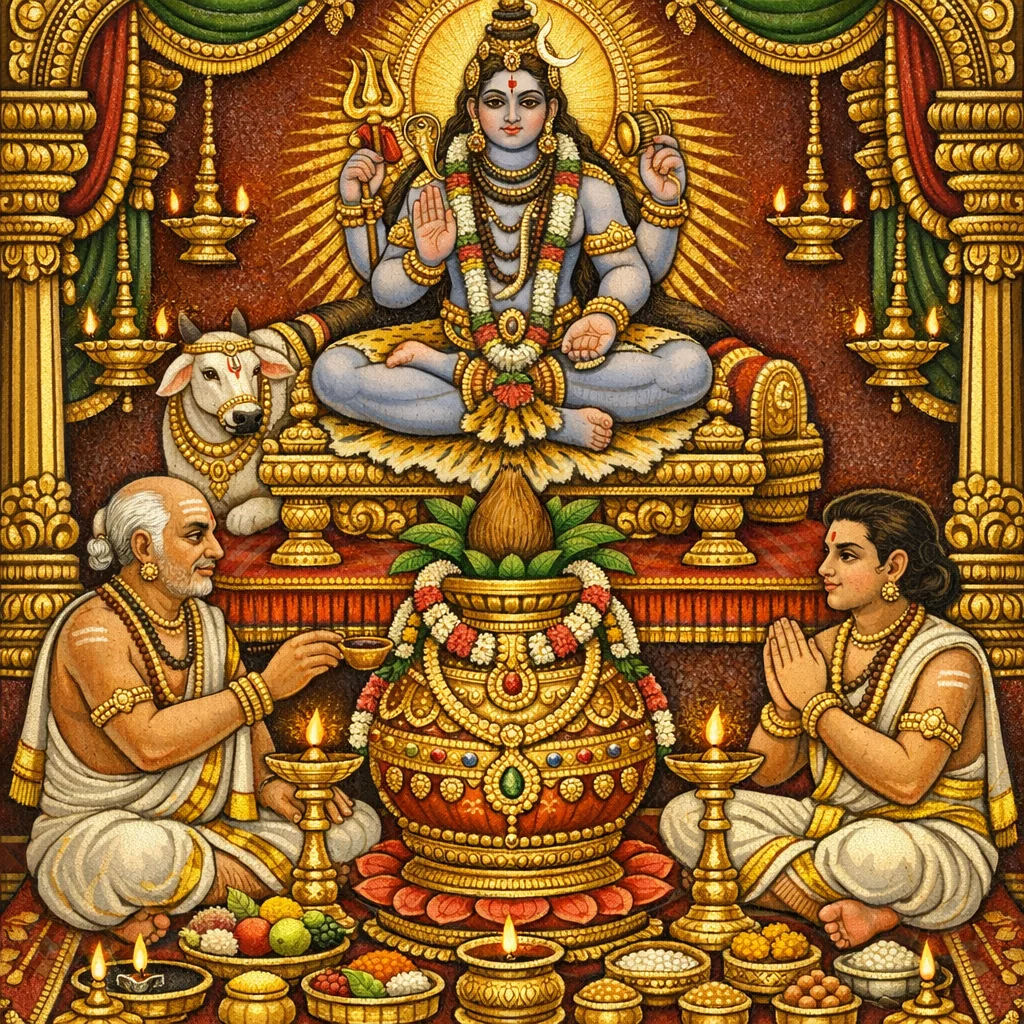
Adhyaya 89
Teaching of the One-Principle (Ekatattva) Initiation (एकतत्त्वदीक्षाकथनम्)
Lord Agni, speaking to Sage Vasiṣṭha, presents a concise initiation system called Ekatattva-dīkṣā, set forth as a streamlined method within the wider Īśāna-kalpa and pratiṣṭhā setting. The chapter opens by instructing the practitioner to complete preliminary rites in proper sequence, including personally binding the ritual cord (sūtra-bandha). Its central contemplation is to internalize the entire tattva-series—from Kālāgni up to Śiva—within one equal Reality, like gems held together by a single thread. After invoking the deity beginning with Śiva-tattva, the officiant performs the sacramental rites (such as garbhādhāna and related steps) as previously taught, specifically empowered by the root-mantra (mūla-mantra), and includes the formal offering of all due fees (śulka) for ritual completeness. The teaching culminates in granting a “full” transmission bearing the living force of tattva (tattva-vāta), said to be sufficient by one method for the disciple’s attainment of nirvāṇa. The sequence concludes with Śiva-kumbha abhiṣeka, using designated pots for yojanā (ritual arrangement) and sthiratva (stability).
Shlokas
Verse 1
इत्य् आदिमहापुराणे आग्नेये निर्वाणदीक्षासमापनं नाम अष्टाशीतितमो ऽध्यायः अथोननवतितमो ऽध्यायः एकतत्त्वदीक्षाकथनं ईश्वर उवाच अथैकतात्त्विकी दीक्षा लघुत्वादुपदिश्यते सूत्रबन्धादि कुर्वीत यथायोगं निजात्मना
Thus, in the Agni Purāṇa—the primordial Mahāpurāṇa—ends the eighty-eighth chapter entitled “Completion of the Nirvāṇa-Initiation.” Now begins the eighty-ninth chapter: “Teaching of the One-Principle (Ekatattva) Initiation.” The Lord said: “Next, the ‘one-tattva’ initiation is taught, because it is concise. One should perform the binding of the ritual cord (sūtra-bandha) and the other preliminary rites, as appropriate, by one’s own self (personally).”
Verse 2
कालाग्न्यादिशिवान्तानि तत्त्वानि परभावयेत् समतत्त्वे समग्राणि सूत्रे मणिगणानिव
One should deeply contemplate the principles (tattva) beginning with Kālāgni and ending in Śiva, for all of them—entire and complete—are held together within the one, equal Reality, like clusters of gems upon a thread.
Verse 3
आवाह्य शिवतत्त्वादि गर्भाधानादि पूर्ववत् मूलेन किन्तु कुर्वीत सर्वशुल्कसमर्पणं
Having invoked the deity beginning with the Śiva-tattva, one should perform the rites such as garbhādhāna and the rest as previously taught—yet doing so with the root-mantra (mūla-mantra); and one should also offer to the deity all śulka, namely every ritual fee and due.
Verse 4
प्रददीत ततः पूर्णां तत्त्ववातोपगर्भितां एकयैव यया शिष्यो निर्वाणमधिगच्छति
Thereafter, he should impart the complete teaching—laden with the breath/wind of the true tattvas—by that single method alone through which the disciple attains nirvāṇa.
Verse 5
योजनायै शिवे चान्यां स्थिरत्वापादनाय च दत्वा पूर्णां प्रकुर्वीत शिवकुम्भाभिषेचनं
After offering one kumbha to Śivā for the rite of yojanā (arrangement) and another to Śiva for bestowing stability (sthiratva), one should then—having presented the full kumbha—perform Śiva’s kumbha-abhiṣeka, the consecratory bathing by means of the ritual pot.
Frequently Asked Questions
Its concision and unifying method: the entire tattva-series (Kālāgni through Śiva) is contemplated as held within one equal Reality, enabling a complete transmission through a single streamlined procedure.
By framing correct preliminaries, tattva-contemplation, mūla-mantra-based rites, and Śiva-kumbha abhiṣeka as a complete initiatory transmission (pūrṇā) through which the disciple is said to attain nirvāṇa.