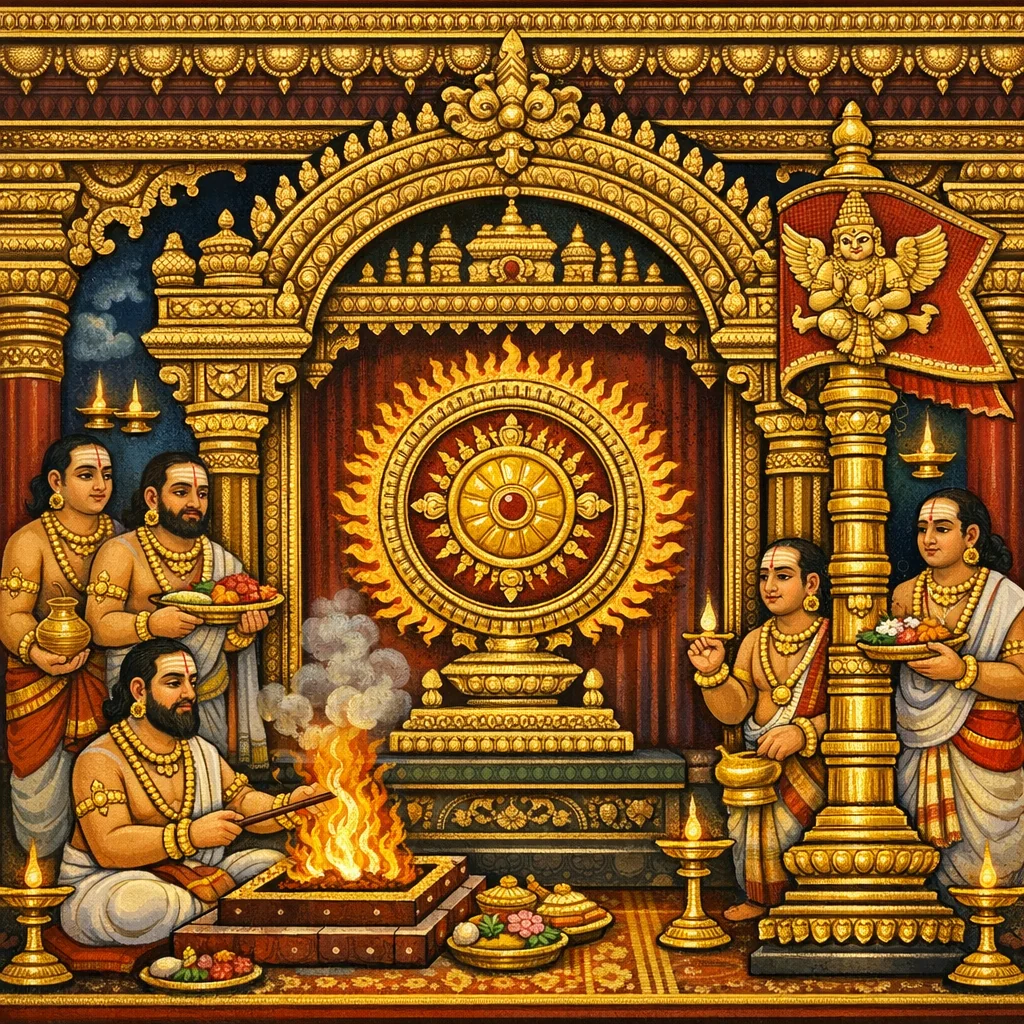
Adhyaya 61
Chapter 61 — द्वारप्रतिष्ठाध्वजारोहाणादिविधिः (Gateway Installation, Flag Hoisting, and Allied Rites)
This chapter codifies an Agneya Vidyā sequence that links temple building to living ritual power. It opens with concluding purification (avabhṛtha-snānā) and a grid installation of kumbhas in eighty-one positions, completing the mandalization of space before Hari is established. The doorway (dvāra) is then consecrated through offerings, bali, honoring the guru, depositing gold beneath the threshold, and a prescribed homa; guardian deities Caṇḍa–Pracaṇḍa and Śrī/Lakṣmī are placed at key structural points, and Śrī Sūkta worship with dakṣiṇā completes the social-ritual economy. The text turns to hṛt-pratiṣṭhā (heart-installation): a consecrated kumbha containing eight gems, herbs, metals, seeds, iron, and water is animated as prāṇa by Narasiṃha-mantra sampāta and Nārāyaṇa-tattva nyāsa. A hallmark Vāstu-śāstra doctrine follows, contemplating the prāsāda as Puruṣa with architectural members mapped to organs (door as mouth, śukanāśā as nose, praṇāla as lower orifices, sudhā as skin, kalaśa as hair/topknot). The chapter culminates in dhvajarohana, detailing proportions, placement (Īśāna/Vāyavya), banner materials and ornaments, cakra construction (8/12 spokes), layered nyāsa (Sūtrātman in the staff; niṣkala in the flag), and concludes with circumambulation, mantras, gifts, and the royal merit of banner-dāna.
Shlokas
Verse 1
इत्य् आदिमहापुराणे आग्नेये वासुदेवप्रतिष्ठादिकथनं नाम षष्टितमो ऽध्यायः अथ एकषष्टितमो ऽध्यायः द्वारप्रतिष्ठाध्वजारोहाणादिविधिः भगवानुवाच वक्षे चावभृतस्नानं विष्णोर् नत्वेति होमयेत् एकाशीतिपदे कुम्भान् स्थाप्य संस्थापयेद्धरिं
Thus, in the Agni Purāṇa, the sixtieth chapter entitled “Account of the installation of Vāsudeva and related matters” ends. Now begins the sixty-first chapter, “Rules for the installation of the gateway, the raising of the flag, and other rites.” The Blessed Lord said: “I shall describe the concluding purification-bath (avabhṛtha-snānā). One should perform the homa with the utterance ‘having bowed to Viṣṇu’. Having placed kumbhas at the eighty-one positions, one should install Hari (Viṣṇu).”
Verse 2
पूजयेद् गन्धपुष्पाद्यैर् बलिं दत्वा गुरुं यजेत् द्वारप्रतिष्ठां वक्ष्यामि द्वाराधो हेम वै ददेत्
Let him worship with perfumes, flowers, and the like; having offered the bali, he should honor the guru. I shall now describe the installation of the doorway: beneath the door one should indeed place gold.
Verse 3
अष्टभिः कलशैः स्थाप्य शाखोदुम्बरकौ गुरुः गन्धादिभिः समभ्यर्च्य मन्त्रैर् वेदादिभिर्गुरुः
Having set up the rite with eight consecration pitchers, the guru should be established with a branch and an udumbara (fig-wood) implement; then, worshipping with fragrances and the like, the guru should be honored with mantras—Vedic and related authoritative formulas.
Verse 4
कुण्डेषु होमयेद्वह्निं समिल्लाजतिलादिभिः दत्वा शय्यादिकञ्चाधो दद्यादाधारशक्तिकां
In the fire-pits (kuṇḍas) one should perform homa, offering into the fire fuel-sticks (samidh), parched rice, sesame, and the like; and, after giving a bed and similar gifts below as an ancillary donation, one should bestow the rite/empowerment called Ādhāra-śaktikā.
Verse 5
शाखयोर्विन्यसेन्मूले देवौ चण्डप्रचण्दकौ ऊर्ध्वोदुम्बरके देवीं लक्ष्मीं सुरगणार्चितां
At the base of the two branches one should install the two deities Caṇḍa and Pracaṇḍa; and upon the upper part of the udumbara (fig-wood arrangement) one should install the Goddess Lakṣmī, worshipped by the hosts of gods.
Verse 6
न्यस्याभ्यर्च्य यथान्यायं श्रीसूक्तेन चतुर्मुखं दत्वा तु श्रीफलादीनि आचार्यादेस्तु दक्षिणां
Having performed nyāsa and then worshipped according to the prescribed rule, one should adore the four-faced Brahmā with the Śrī Sūkta; then one should offer auspicious fruits (śrī-phala) and the like, and give the dakṣiṇā (honorarium) to the officiating ācārya and others.
Verse 7
प्रतिष्ठासिद्धद्वारस्य त्वाचार्यः स्थापयेद्धरिं विष्णुर्नुकेति घ, ङ, चिह्नितपुर्स्तकद्वयपाठः समिदाज्यतिलादिभिरिति ङ, चिह्नितपुस्तकपाठः अथाभ्यर्च्येति ङ, चिह्नितपुस्तकपाठः प्रासादादस्य प्रतिष्ठन्तु हृत्प्रतिष्ठेति तां शृणु
When the doorway has been duly prepared for the installation rite (pratiṣṭhā), the officiating ācārya should establish Hari (Viṣṇu). (Some recensions read here: “viṣṇur nuke/nu ke iti”.) He should proceed with offerings such as sacred fuel-sticks, ghee, sesame, and the like (as one marked manuscript reads); then, having performed worship (so reads the same source), let them install the deity from the prāsāda (temple). Listen to that procedure called “installation in the heart” (hṛt-pratiṣṭhā).
Verse 8
समाप्तौ शुकनाशाया वेद्याः प्राग्दर्भमस्तके सौवर्णं राजतं कुम्भमथवा शुक्लनिर्मितं
At the conclusion of the śukanāśā (the vedi’s beak-like projecting end), upon the eastern darbha-tip of the altar, one should place a water-pot (kumbha) made of gold or silver, or else fashioned from a white, pure material.
Verse 9
अष्टरत्नौषधीधातुवीजलौहान्वितं शुभं सवस्त्रं पूरितं चाद्भिर्मण्डले चाधिवासयेत्
Within the maṇḍala, for ritual consecration (adhivāsana), he should install an auspicious vessel or deposit furnished with the eight gems, medicinal herbs, metals, seeds, and iron; covered with cloth and filled with water.
Verse 10
सपल्लवं नृसिंहेन हुत्वा सम्पातसञ्चितं नारायणाख्यतत्त्वेन प्राणभूतं न्यसेत्ततः
After offering it into the fire with the Narasiṃha-mantra, together with fresh sprouts or leaves (pallava), and having accumulated its potency through repeated oblations (sampāta), one should then perform nyāsa—installing it as the very life-breath—by means of the principle called ‘Nārāyaṇa-tattva’.
Verse 11
वैराजभूतान्तं ध्यायेत् प्रासादस्य सुरेश्वर ततः पुरुषवत्सर्वं प्रासादं चिन्तयेद् बुधः
O Lord of the gods, one should meditate upon the prāsāda (temple) as extending up to the Vairāja-bhūta level; thereafter, the wise should contemplate the entire temple as having the form of a Person (Puruṣa).
Verse 12
अधो दत्वा सुवर्णं तु तद्ववद् भूतं घटं न्यसेत् गुर्वादौ दक्षिणां दद्याद् ब्राह्मणादेश् च भोजनं
Having placed gold beneath, one should set down a pot (ghaṭa/kumbha) prepared in the prescribed manner. One should then give the sacrificial fee (dakṣiṇā) first to the guru and others, and also provide a meal for the Brahmins and the remaining invited recipients.
Verse 13
ततः पश्चाद्वेदिबन्धं तदूर्ध्वं कण्ठबन्धनं कण्ठोपरिष्टात् कर्तव्यं विमलामलसारकं
Thereafter one should make the binding of the altar (vedi-bandha). Above it one should prepare the “throat-binding” (kaṇṭha-bandhana), to be made above the neck, clean, stainless, and firm in essence (sāraka).
Verse 14
तदूर्ध्वं वृकलं कुर्याच्चक्रञ्चाद्यं सुदर्शनं मूत्तिं श्रीवासुदेवस्य ग्रहगुप्तां निवेदयेत्
Above that one should fashion the protective vṛkala, and also the foremost discus, Sudarśana. Then one should present or install the consecrated image of Śrī Vāsudeva as a “graha-protection” (graha-guptā) against planetary afflictions.
Verse 15
कलशं वाथ कुर्वीत तदूर्ध्वं चक्रमुत्तमं वेद्याश् च परितः स्थाप्या अष्टौ विघ्नेश्वरास्त्वज
Then one should prepare the ritual water-pot (kalaśa); above it one should place an excellent cakra-disc. And around the altar (vedī), eight Vighneśvaras—lords who remove obstacles—are to be installed.
Verse 16
ः तत्त्वभूतमिति घ, ङ, चिह्नितपुस्तकपाठः तदूर्ध्वं चूर्णकं कुर्यादिति ग, ङ, चिह्नितपुस्तकपाठः तदूर्ध्वं चुल्वकं कुर्यादिति ख, घ, चिह्नितपुस्तकद्वयपाठः अष्टौ वेद्येश्वरास्त्वज इति ग, घ, ङ, चिह्नितपुस्तकत्रयपाठः चत्वारो वा चतुर्दिक्षु स्थापनीया गरुत्मतः ध्वजारोहं च वक्ष्यामि येन भूतादि नश्यति
The reading “tattvabhūtam” is found in the marked manuscripts (gha, ṅa). Above that, “one should make a cūrṇaka” is the reading of the marked manuscripts (ga, ṅa). Above that, “one should make a culvaka” is the reading of the two manuscripts (kha, gha). The reading “aṣṭau vedyeśvarāḥ” occurs in three marked manuscripts (ga, gha, ṅa). One should install either eight or four Garuḍa-emblems in the four directions. Now I shall describe the raising of the banner (dhvaja), by which spirits and the like are destroyed.
Verse 17
प्रासादविम्बद्रव्याणां यावन्तः परमाणवः तावद्वर्षसहस्राणि तत्कर्ता विष्णुलोकभाक्
For as many atoms (paramāṇu) as there are in the materials used for a temple (prāsāda) and its icon (vimba), for that many thousands of years the maker attains a share in Viṣṇu’s world (Viṣṇuloka/Vaikuṇṭha).
Verse 18
कुम्भाण्डवेदिविम्बानां भ्रमणाद्वायुनानघ कण्ठस्यावेष्टनाज् ज्ञेयं फलं कोटिगुणं ध्वजात्
O sinless one, by the wind-driven circling of the kumbhāṇḍa-ornaments, the vedī (altar), and the vimba (emblem/disc), and by the fluttering that wraps around the “neck” of the flagstaff, one should know that the resulting religious merit is multiplied koṭi-fold (ten millionfold) through the dhvaja (sacred flag).
Verse 19
पताकानां प्रकृतिं विद्धि दण्डं पुरुषरूपिणं प्रासादं वासुदेवस्य मूर्तिभेदं निबोध मे
Understand the proper nature of the temple flags (patākā); know the flagstaff (daṇḍa) as having the form of a person; and learn from me the classifications of the prāsāda (temple structure) and the distinct icon-forms (mūrti-bheda) of Vāsudeva.
Verse 20
धारणाद्धरणीं विद्धि आकाशं शुषिरात्मकं तेजस्तत् पावकं विद्धि वायुं स्पर्शगतं तथा
Know earth (dharaṇī) by its function of support; know ether (ākāśa) as having the nature of hollowness/space. Know that tejas (radiance) is indeed fire (pāvaka); and likewise know air (vāyu) as that which is characterized by touch (sparśa).
Verse 21
पाषाणादिष्वेव जलं पार्थिवं पृथिवीगुणं प्रतिशब्दोद्भवं शब्दं स्पर्शं स्यात् कर्कशादिकं
In stone and the like, water is present; it is ‘pārthiva’ (earthy in nature) and bears the qualities of earth. There sound arises as a responsive echo, and the tactile quality is of the kind called ‘rough’ (karkaśa) and the like.
Verse 22
शुक्लादिकं भवेद्रूपं रसमन्नादिदर्शनं धूपादिगन्धं गन्धन्तु वाग् भेर्यादिषु संस्थिता
Form (rūpa) is characterized by whiteness and the like; taste (rasa) is recognized through food and the like; and scent (gandha) through incense and the like. Sound (śabda), however, is established in speech (vāk) and in instruments such as the bherī (kettle-drum) and the like.
Verse 23
शुकनाशाश्रिता नासा बाहू तद्रथकौ स्मृतौ शिरस्त्वण्डं निगदितं कलशं मूर्धजं स्मृतं
The nose is said to correspond to the «śukanāsa» (the projecting beak-like front of the shrine); the arms are understood as its «rathaka» (side projections). The head is described as the «aṇḍa» (the dome-like mass), and the «mūrdhaja» is understood as the «kalaśa» (the finial pot).
Verse 24
कण्ठं कण्ठमिति ज्ञेयं स्कन्धं वेदी निगद्येते पायूपस्थे प्रणाले तु त्वक् सुधा परिकीर्तिता
The throat is to be understood as «kaṇṭha»; the shoulder (skandha) is spoken of as the «vedī» (altar/platform). In the region of the anus and the genitals is the «praṇāla» (channel/conduit); and the skin (tvak) is declared to be «sudhā» (a plaster-like white covering).
Verse 25
मुखं द्वारं भवेदस्य प्रतिमा जीव उच्यते तच्छक्तिं पिण्डिकां विद्धि प्रकृतिं च तदाकृतिं
Its mouth is said to be its “doorway”; the image (pratimā) is called the “living being” (jīva). Know its power (śakti) to be the piṇḍikā (pedestal/base), and its nature (prakṛti) to be its very form (ākṛti).
Verse 26
अपाठः धारणीं धरणीं विद्धि इति ङ, चिह्नितपुस्तकपाठः पार्थिवं पृथिवीतलमिति ख, चिह्नितपुस्तकपाठः पार्थिवं पृथिवीजलमिति ग, चिह्नितपुस्तकपाठः रसमास्थाय दर्शनं रसमाह्वादि दर्शनमिति ख, चिह्नितप्सुअतकपाठः निश् चलत्वञ्च गर्भोस्या अधिष्ठाता तु केशवः एवमेव हरिः साक्षात्प्रासादत्वेन संस्थितः
“(Some copies read:) ‘Know dhāraṇī as dharaṇī.’” (Marked readings state:) “The earthly element (pārthiva) is the surface of the earth,” or “the earthly element is the water of the earth.” (Another marked reading:) “Perception (darśana) arises by resorting to rasa (essence/flavour),” or “perception is that which begins with the bringing-forth/invocation of rasa.” Further, the womb-chamber (garbha) has steadiness and immobility; its presiding deity is Keśava. Thus indeed Hari himself is directly established in the form of the temple (prāsāda).
Verse 27
जङ्घा त्वस्य शिवो ज्ञेयः स्कन्धे धाता व्यवस्थितः ऊर्ध्वभागे स्थितो विष्णुरेवं तस्य स्थितस्य हि
Know that Śiva is to be understood as abiding in his shanks (jaṅghā, the lower legs); in the shoulder-region Dhātā is established; and in the upper part Viṣṇu is situated—thus indeed is his divine placement.
Verse 28
प्रासादस्य प्रतिष्ठान्तु ध्वजरूपेण मे शृणु ध्वजं कृत्वा सुरैर् दैत्या जिताः शस्त्रादिचिह्नितं
Now hear from me the consecration of the temple, performed in the form of a ritual flag: having fashioned the flag and marked it with emblems such as weapons, one should depict the Daityas as conquered by the Devas.
Verse 29
अण्डोर्ध्वं कलशं न्यस्य तदूर्ध्वं विन्यसेद्ध्वजं विम्बार्धमानं दण्डस्य त्रिभागेनाथ कारयेत्
Placing the finial pot (kalaśa) above the egg-shaped member (aṇḍa), and above that installing the flag (dhvaja), one should then fashion the circular disc (vimba) to a measure equal to one half (of the standard), and set it according to one third of the staff (daṇḍa).
Verse 30
अष्टारं द्वादशारं वा मध्ये मूर्तिमतान्वितं नारसिंहेन तार्क्ष्येण ध्वजदण्डस्तु निर्ब्रणः
One should fashion (the sacred emblem) as an eight-spoked or twelve-spoked wheel, with a figured image set in the center; it may be accompanied by Narasiṃha and by Tārkṣya (Garuḍa). The flagstaff (dhvaja-daṇḍa) should be free from wounds or blemishes.
Verse 31
प्रासादस्य तु विस्तारो मानं दण्डस्य कीर्तितं शिखरार्धेन वा कुर्यात् तृतीयार्धेन वा पुनः
The breadth of the prāsāda is stated to be the measure of the daṇḍa. One should set the proportion by taking either one half of the śikhara, or again by taking one third of it.
Verse 32
द्वारस्य दैर्घ्याद् द्विगुणं दण्डं वा परिकल्पयेत् ध्वजयष्टिर्देवगृहे ऐशान्यां वायवेथवा
One should prescribe a staff (daṇḍa) of length twice that of the door; in a temple (devagṛha), the flagstaff (dhvaja-yaṣṭi) should be set in the north-east (Īśāna) or else in the north-west (Vāyavya) quarter.
Verse 33
क्षौमाद्यैश् च ध्वजं कुर्याद्विचित्रं वैकवर्णकं घण्टाचामरकिङ्किण्या भूषितं पापनाशनं
One should fashion a banner from linen and similar cloths, variegated in many colors, and adorn it with a bell, a yak-tail fan (cāmara), and small tinkling bells; such a banner destroys sin.
Verse 34
दण्डाग्राद्धरणीं यावद्धस्तैकं विस्तरेण तु महाध्वजः सर्वदः स्यात्तुर्यांशाद्धीनतोर्चितः
From the tip of the pole down to the ground, if the breadth is one hasta, it is called a “great banner” (mahā-dhvaja) and is said to bestow all benefits. If reduced by a fourth, it should be regarded as inferior, though still fit for worship.
Verse 35
ध्वजे चार्धेन विज्ञेया पताका मानवर्जिता विस्तरेण ध्वजः कार्यो विंशदङ्गुलसन्निभः
For a standard (dhvaja), the pendant flag (patākā) is to be understood as half its measure, excluding the human figure (emblem). The standard should be made with a breadth of about twenty aṅgulas.
Verse 36
अधिवासविधानेन चक्रं दण्डं ध्वजं तथा जिताः शक्त्यादिचिह्नितमिति ख, चिह्नितपुस्तकपाठः जिताः शक्रादिचिह्नितमिति ग, चिह्नितपुस्तकपाठः विम्बार्धमानं चक्रन्तु इति ख, ङ, चिह्नितपुस्तकपाठः विचित्रञ्चैव वर्णकमिति ख, चिह्नितपुस्तकपाठः देववत् सकलं कृत्वा मण्डपस्नपनादिकं
By the procedure of adhivāsa (pre-consecration installation), one should also set up the discus (cakra), staff (daṇḍa), and banner, marked with the emblem of the mace (gadā) and other insignia (some manuscripts read: marked with Indra and other emblems). The discus should be made at half the measure of the icon and painted in a variegated manner. Having arranged everything as for a deity, one should then perform the pavilion rites such as the ceremonial bathing (snāpana) and related observances.
Verse 37
नेत्रोन्मीलनकं त्यक्ता पूर्वोक्तं सर्वमाचरेत् अधिवासयेच्च विधिना शय्यायां स्थाप्य देशिकः
Setting aside the rite of “opening the eyes” (netronmīlana), the officiating teacher should carry out all the procedures stated earlier; then, in due form, he should perform the adhivāsana (consecratory resting) after placing (the deity/image) upon the ritual bed.
Verse 38
ततः सहस्रशीर्षेति सूक्तं चक्रे न्यसेद् बुधः तथा सुदर्शनं मन्त्रं मनस्तत्त्वं निवेशयेत्
Thereafter, the wise practitioner should perform nyāsa of the hymn beginning with “sahasraśīrṣā” upon the divine discus; likewise, he should install the Sudarśana-mantra and place within it the principle of mind (manas-tattva).
Verse 39
मनोरूपेण तस्यैव सजीवकरणं स्मृतं अरेषु मूर्तयो न्यस्याः केशवाद्याः सुरोत्तम
Its enlivening (sajīvakaraṇa), it is taught, is to be done by mental visualization alone. O best of the gods, in the spokes of the ritual wheel/diagram the forms beginning with Keśava are to be installed by nyāsa.
Verse 40
नाभ्यब्जप्रतिनेमीषु न्यसेत्तत्त्वानि देशिकः नृसिंहं विश्वरूपं वा अब्जमध्ये निवेशयेत्
The officiating teacher (deśika) should install by nyāsa the principles (tattvas) upon the lotus’s navel (nābhi), petals, and encircling rim; and in the center of the lotus he should install either Narasiṁha or the universal form (Viśvarūpa).
Verse 41
सकलं विन्यसेद्दण्डे सूत्रात्मानं सजीवकं निष्कलं परमात्मानं ध्वजे ध्यायन् न्यसेद्धरिं
One should install the ‘manifest’ (sakala) form in the banner-staff, contemplating the Sūtrātman endowed with life-force; and, meditating on the ‘formless’ (niṣkala) Supreme Self, one should install Hari in the banner.
Verse 42
तच्छक्तिं व्यापिनीं ध्यायेद् ध्वजरूपां बलाबलां मण्डपे स्थाप्य चाभ्यर्च्य होमं कुण्डेषु कारयेत्
One should meditate upon that all-pervading Power (Śakti), envisioned in the form of a banner (dhvaja), as the source of strength and the remover of weakness; then, having installed it in the ritual pavilion (maṇḍapa) and duly worshipped it, one should have fire-offerings (homa) performed in the fire-pits (kuṇḍas).
Verse 43
कलशे स्वर्णकलशं न्यस्य रत्नानि पञ्च च स्थापयेच्चक्रमन्त्रेण स्वर्णचक्रमधस्ततः
Placing a golden pot upon the ritual kalaśa, one should also set down the five gems; and then, by the Cakra-mantra, one should install a golden disc (cakra) beneath it.
Verse 44
पारदेन तु सम्प्लाव्य नेत्रपट्टेन च्छादयेत् ततो निवेशयेच्चक्रं तन्मध्ये नृहरिं स्मरेत्
After thoroughly washing (the prepared object/area) with mercury, one should cover it with an ocular cloth; then one should place the protective cakra, and within its center meditate on Nṛhari (Narasimha).
Verse 45
ॐ क्षों नृसिंहाय नमः पूजयेत् स्थापयेद्धरिं ततो ध्वजं गृहीत्वा तु यजमानः सबान्धवः
Reciting, “Oṃ kṣoṃ—obeisance to Nṛsiṃha,” one should worship and install Hari. Then, taking up the ritual flag (dhvaja), the patron of the rite (yajamāna), together with his relatives, should proceed with the observance.
Verse 46
इति ग, चिह्नितपुस्तकपाठः मण्डले इति ग, ङ, चिह्नितपुस्तकद्वयपाठः स्वर्णचक्रन्तु मध्यत इति ङ, चिह्नितपुस्तकपाठः नेत्रं यत्नेन च्छादयेदिति ङ, चिह्नितपुस्तकपाठः ॐ क्षौं नृसिंहाय नम इति ख, चिह्नितपुस्तकपाठः दधिभक्तयुते पात्रे ध्वजस्याग्रं निवेशयेत् ध्रुवाद्येन फडन्तेन ध्वजं मन्त्रेण पूजयेत्
Placing the tip (finial) of the banner/flagstaff into a vessel containing curd mixed with cooked rice, one should install it. Then, using a mantra that begins with “dhruvā-” and ends with the protective exclamation “phaḍ”, one should worship the banner with that mantra. (The preceding phrases are manuscript-variant notes, including readings such as “in the maṇḍala,” “a golden discus in the middle,” “cover the eye with care,” and the mantra “oṃ kṣauṃ nṛsiṃhāya namaḥ.”)
Verse 47
शिरस्याधाय तत् पात्रं नारायनमनुस्मरन् प्रदक्षिणं तु कुर्वीत तुर्यमङ्गलनिःस्वनैः
Placing that vessel upon the head, and remembering Nārāyaṇa, one should perform the circumambulation (pradakṣiṇa), accompanied by the auspicious sounds of musical instruments.
Verse 48
ततो निवेशयेत् दण्डं मन्त्रेणाष्टाक्षरेण तु मुञ्चामि त्वेति सूक्तेन ध्वजं मुञ्चेद्विचक्षणः
Then one should set the flagstaff in place with the eight-syllabled mantra; and with the hymn-formula beginning “muñcāmi tvā” (“I release you”), the discerning officiant should release—i.e., untie and take down—the flag.
Verse 49
पात्रं ध्वजं कुञ्जरादि दद्यादाचार्यके द्विजः एष साधारणः प्रोक्तो ध्वजस्यारोहणे विधिः
A twice-born man (dvija) should present to the officiating teacher (ācārya) a vessel, the flag, and gifts such as an elephant and the like. This is declared to be the general procedure for the hoisting of the ceremonial banner.
Verse 50
यस्य देवस्य यच्चिह्नं तन्मन्त्रेण स्थिरं चरेत् स्वर्गत्वा ध्वजदानात्तु राजा बली भवेत्
Having firmly prepared and set up the banner bearing the emblem of whichever deity it belongs to, one should proceed with that deity’s mantra. By the gift of a banner, the king—after attaining heaven—becomes mighty.
Frequently Asked Questions
It specifies ritual-architectural metrics and placements: 81-pada kumbha layout; gold deposition under the doorway; eight (or variant four) directional emblems; dhvaja proportions relative to door length and śikhara fractions; cakra design (8/12 spokes) and staff blemish-free criteria; and Īśāna/Vāyavya siting for the flagstaff.
By treating architecture and installation as embodied sādhana: the temple is visualized as Puruṣa, and nyāsa installs prāṇa and tattvas into vessels, cakra, staff, and flag—linking external consecration (pratiṣṭhā) to inner consecration (hṛt-pratiṣṭhā) and thereby aligning ritual efficacy with Dharma and purification.