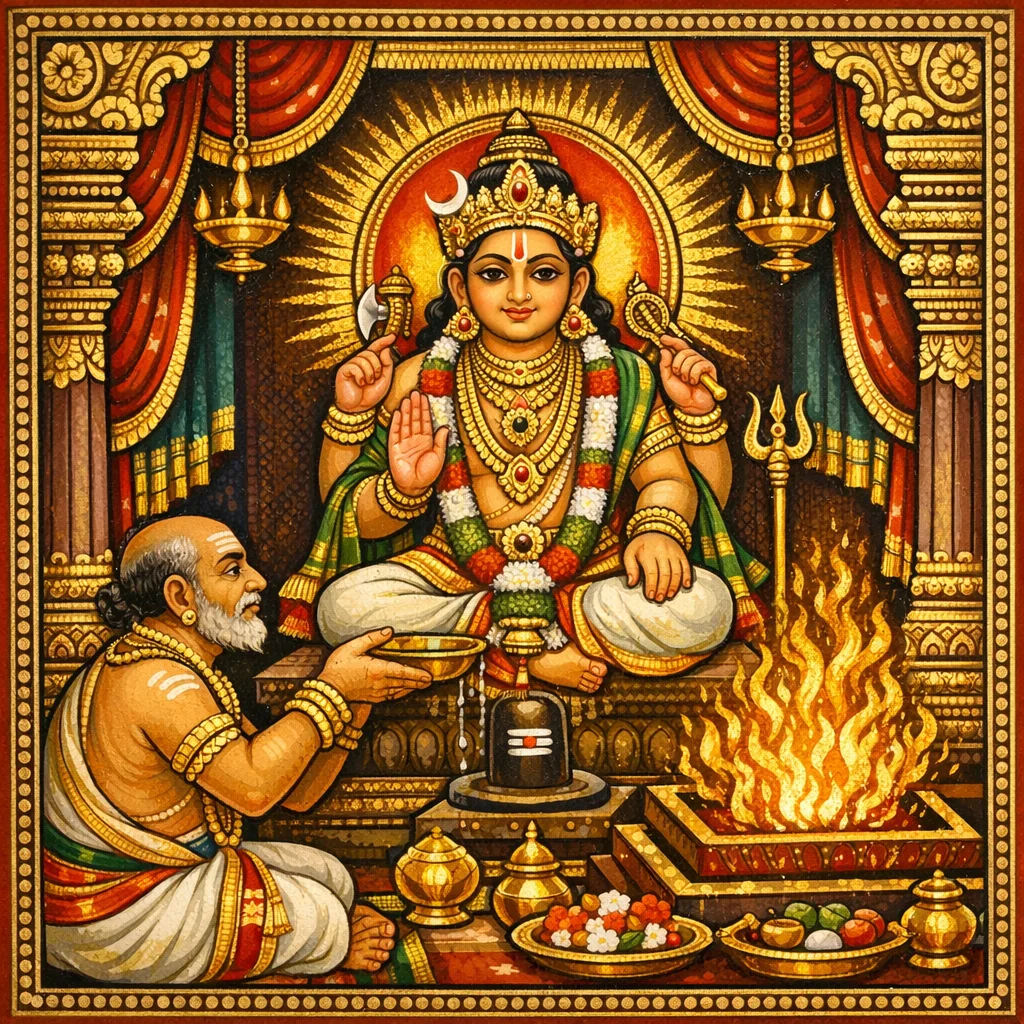
Adhyaya 76
Chapter 76 — चण्डपूजाकथनम् (Narration of the Worship of Caṇḍa/Caṇḍeśa)
This chapter sets out an Īśāna-kalpa ritual sequence in a Śaiva-Agamic setting focused on Caṇḍa/Caṇḍeśa. After approaching Śiva, the practitioner performs worship and homa, asking that the rite’s merit be accepted. It emphasizes offering arghya with the udbhava mudrā and a mantra order in which the hṛd-bīja precedes the root-mantra, followed by praise, prostration, and a distinctive arghya offered while turning away with an explicit plea for forgiveness, expressing ritual humility and acknowledgment of faults. Inner yogic-ritual acts then follow: withdrawal of inner energies using an astra-mantra with Nārāca-mudrā ending in phaṭ, and empowerment of the liṅga by mūrti-mantra. Caṇḍa is worshiped through invocation, aṅga/nyāsa-type mantras (heart, head, śikhā, kavaca, astra), and dhyāna describing his form—born of Rudra–Agni, dark-hued, bearing trident and ṭaṅka, with rosary and kamaṇḍalu. The chapter notes manuscript variants for key mantra readings, prescribes proportional japa (aṅgas at one-tenth), restricts certain material gifts, and by Śiva’s command redirects offerings to nirmālya and food remnants. It concludes with a saṃhāra (dissolution) rite using saṃhāra-mudrā and mantra, purification of the disposal area with cow-dung water, disposal of remnants, ācamana, and continuation of remaining rites.
Shlokas
Verse 1
हः गणेभ्य उ इति ग, चिह्नितपुस्तकपाठः हां ऋपिभ्य इति ङ, चिह्नितपुस्तकपाठः वायव्यामिति ग, चिह्नितपुस्तकपाठः नैरृत इति ङ, चिह्नितपुस्तकपाठः अथ षट्सप्ततितमो ऽध्यायः चण्दपूजाकथनं ईश्वर उवाच ततः शिवान्तिकङ्गत्वा पूजाहोमादिकं मम गृहाण भगवन् पुण्यफलमित्यभिधाय च
“Haḥ—‘to the Gaṇas’,” says one marked manuscript-reading; “Hāṃ—‘to the Ṛṣis’,” says another marked manuscript-reading; “in the north-west (vāyavya) [direction],” says one marked manuscript-reading; “in the south-west (nairṛta) [direction],” says another marked manuscript-reading. Now begins the seventy-sixth chapter, the narration of the worship of Caṇḍa. The Lord said: “Then, having gone near Śiva, and having performed worship, oblations (homa), and the like, say: ‘O Blessed One, accept these acts of worship and fire-offerings of mine as a meritorious fruit,’” and having thus spoken…
Verse 2
अर्घ्योदकेन देवाय मुद्रयोद्भवसञ्ज्ञया हृद्वीजपूर्वमूलेन स्थिरचित्तो निवेदयेत्
With arghya-water (arghya-udaka), one should present the offering to the deity, employing the mudrā known as “mudrā-udbhava,” and reciting the root-mantra preceded by the heart-seed (hṛd-bīja), while keeping the mind steady.
Verse 3
ततः पूर्ववदभ्यर्च्य स्तुत्वा स्तोत्रैः प्रणम्य च अर्घ्यं पराङ्मुखं दत्वा क्षमस्वेत्यभिधाय च
Then, having worshipped as before, having praised with hymns and bowed down, one should offer the arghya while turning one’s face away, and say, “Forgive (me).”
Verse 4
नाराचमुद्रयास्त्रेण फडन्तेनात्मसञ्चयं संहृत्य दिव्यया लिङ्गं मूर्तिमन्त्रेण योजयेत्
Having withdrawn into oneself the gathered vital/inner energies by the astra-mantra accompanied by the Nārāca-mudrā and ending with the syllable “phaṭ”, one should then unite (consecrate/empower) the liṅga with the divine mūrti-mantra.
Verse 5
स्थण्डिले त्वर्चिते देवे मन्त्रसङ्घातमात्मनि नियोज्य विधिनोक्तेन विदध्याच्चण्डपूजनं
When the deity has been worshipped upon the prepared ritual ground (sthāṇḍila), one should, within oneself, apply/implant the collected body of mantras; then, following the prescribed procedure, one should perform the worship of Caṇḍa, the fierce form of the Goddess.
Verse 6
ॐ चण्डेशानाय नमो मध्यतश् चण्डमूर्तये ॐ धूलिचण्डेश्वराय हूं फट् स्वाहा तमाह्णयेत्
“Om—obeisance to Caṇḍeśāna; (place/recite it) in the middle for Caṇḍamūrti. Om—to Dhūli-Caṇḍeśvara: hūṃ, phaṭ, svāhā.” Thus one should invoke him.
Verse 7
चण्डहृदयाय हूं फट् ॐ चण्डशिरसे तथा ॐ चण्डशिखायै हूं फट् चण्डायुः कवचाय च
“hūṃ phaṭ” to the heart of Caṇḍa; likewise “oṃ” to the head of Caṇḍa; and “oṃ hūṃ phaṭ” to the topknot (śikhā) of Caṇḍa; and (recite) the kavaca-mantra for the āyuḥ, the life-force of Caṇḍa.
Verse 8
चण्डस्त्राय तथा हूं फट् चण्डं रुद्राग्निजं स्मरेत् शूलटङ्कधरं कृष्णं साक्षसूत्रकण्डलुं
One should employ the mantra, “(obeisance) to Caṇḍāstra—hūṃ phaṭ,” and meditate upon Caṇḍa, born of Rudra and Agni: dark-hued, bearing a trident and a tanka (hatchet/pick), and holding a rosary and a kamaṇḍalu (water-pot).
Verse 9
टङ्काकरे ऽर्धचन्द्रे वा चतुर्वक्त्रं प्रपूजयेत् लिचण्डेश्वराय इति ग, चिह्नितपुस्तकपाठः क्रूं फडिति ङ, चिह्नितपुस्तकपाठः हूं चण्डशिरसे स्वाहेति ग, चिह्नितपुस्तकपाठः हूं फट् चण्दत इति ग, घ, चिह्नितपुस्तकद्वयपाठः टङ्कारेणार्धचन्द्रे इति ख, चिह्नितपुस्तकपाठः यथाशक्ति जपं कुर्यादङ्गानान्तु दशांशतः
One should duly worship the Four-faced deity, either in the form of a ṭaṅka (chisel/axe) or in the form of a half-moon. (In some recensions the mantra readings are:) “(obeisance) to Caṇḍeśvara”; or “krūṃ phaḍ”; or “hūṃ—to Caṇḍaśiras—svāhā”; or “hūṃ phaṭ—(to) Caṇḍa…”. Then one should perform mantra-japa according to one’s capacity; and for the ancillary limb-mantras (aṅga-mantras), the count should be one-tenth of the main japa.
Verse 10
गोभूहिरण्यवस्त्रादिमणिहेमादिभूषणं विहाय शेसनिर्माल्यं चण्डेशाय निवेदयेत्
Setting aside (i.e., not offering to him) gifts such as cattle, land, gold, garments, jewels, and gold ornaments, one should instead present to Caṇḍeśa the remaining nirmālya—the sacred garlands and remnants of worship.
Verse 11
लेह्यचोष्याद्यनुवरं ताम्बूलं स्रग्विलेपनं निर्माल्यं भोजनं तुभ्यं प्रदत्तन्तु शिवाज्ञया
Lickables and suckables and other foods, together with the subsequent offering (anuvara), tāmbūla (betel), garlands and unguents, the consecrated remnants (nirmālya), and food—these are given to you by Śiva’s command.
Verse 12
सर्वमेतत् क्रियाकाण्डं मया चण्ड तवाज्ञया न्यूनाधिकं कृतं मोहात् परिपूर्णं सदास्तु मे
O Caṇḍa, by your command I have performed this entire ritual procedure; if, through delusion, it has been done with any deficiency or excess, may it ever become complete for me.
Verse 13
इति विज्ञाप्य देवेशं दत्वार्घ्यं तस्य संस्मरन् संहारमूर्तिमन्त्रेण शनैः संहारमुद्रया
Thus, having informed the Lord of the gods, and having offered him the arghya (ritual water-offering), remembering him, one should then—slowly—perform the rite of dissolution (saṃhāra) by means of the mantra of the Saṃhāra-form, together with the Saṃhāra-mudrā (gesture of dissolution).
Verse 14
पूरकान्वितमूलेन मन्त्रानात्मनि योजयेत् निर्माल्यापनयस्थानं लिम्पेद्गोमयवारिणा प्रोक्ष्यार्घ्यादि विसृज्याथ आचान्तो ऽन्यत्समाचरेत्
With the root-mantra accompanied by inhalation (pūraka), one should internalize the mantras and unite them within oneself, establishing them in the Self. The place where the nirmālya (discarded offering-remnants) is removed should be smeared with water mixed with cow-dung; then, having sprinkled (it) and cast away the arghya and other remnants, and having performed ācamana, one should proceed with the remaining rites.
Frequently Asked Questions
Precise mantra–mudrā coordination (udbhava for arghya; Nārāca with astra-mantra ending in phaṭ; saṃhāra-mudrā for dissolution), proportional japa rules (aṅga-mantras at one-tenth), and explicit nirmālya handling/purification protocols—along with recorded pāṭhabheda (manuscript variants) for mantra readings.
By framing ritual exactness, humility (explicit kṣamā/forgiveness), internalization of mantras (antar-nyāsa), and controlled dissolution (saṃhāra) as disciplines that purify agency and align the practitioner’s body–speech–mind with Śaiva order, supporting both ritual efficacy and inner steadiness.