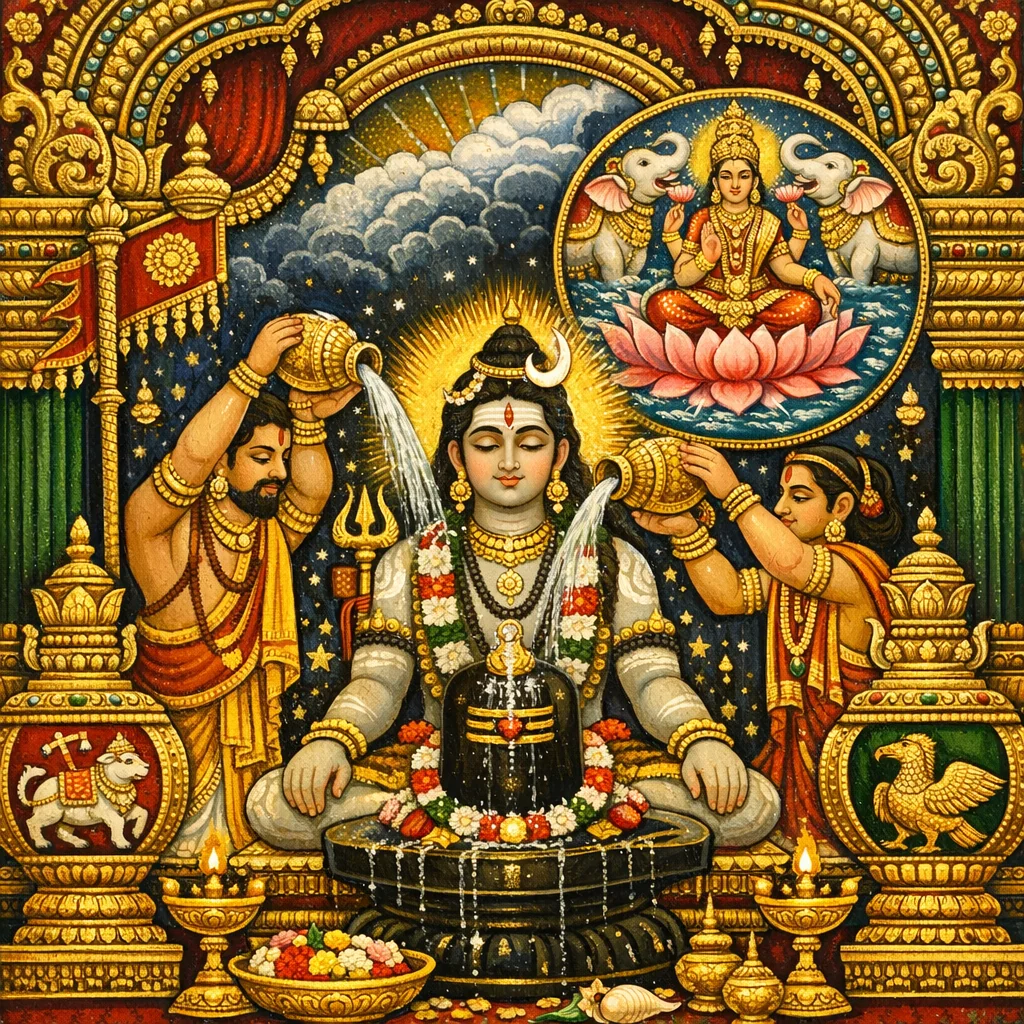
Adhyaya 96
Adhivāsana-vidhi (Procedure for Preliminary Consecration in Vāstu–Pratiṣṭhā / Īśāna-kalpa)
Chapter 96 begins the adhivāsana-vidhi as a disciplined entry into temple installation (pratiṣṭhā): the guru, purified by bath and daily rites, enters the sacrificial pavilion (yajña-maṇḍapa) with assistants and priests to establish protection, order, and divine presence. Worship of toraṇas and the systematic placement of dvārapālas and protective implements remove obstacles and safeguard the kratu. Directional and threshold security is strengthened through dhvaja-devatās, kṣetrapālas, and lokapālas set on kalaśas, with prescribed mantras, offerings, and contemplations. The focus then turns from outer architecture to inner architecture—bhūtaśuddhi, antaryāga, mantra-dravya śodhana, and layered nyāsa—culminating in installing the all-pervading, niṣkala Śiva into the liṅga. Fire rites (homa), Veda-recitation assignments by śākhā, and abhiṣeka sequences (pañcagavya, pañcāmṛta, tīrtha waters, medicinal streams) lead into icon-handling, couching, and Lakṣmī-avataraṇa/marking procedures with proportional metrics. The chapter closes by defining adhivāsa as regulated overnight residence (or shorter alternatives), affirming efficacy even when abbreviated, and presenting precise ritual as a bridge between dharmic success and Śiva-realization.
Shlokas
Verse 1
ज शङ्खिनीत्योषधीगण इति ङ , ज , च हेमताम्रमयो रङ्गराजजञ्चेति ख पारदे इति ख , छ च गन्धकत्रिकमित्यष्टौ इति घ अथ षण्णवतितमो ऽध्यायः अधिवासनविधिः ईश्वर उवाच स्नात्वा नित्यद्वयं कृत्वा प्रणवार्घकरो गुरुः सहायैर् मूर्तिपैर् विप्रैः सह गच्छेन्मखालयं
Now begins the ninety-sixth chapter: the procedure for adhivāsana (preliminary consecration). The Lord said: Having bathed and performed the two daily rites, the guru—having prepared the arghya (offering of water) with the praṇava (Oṃ)—should proceed to the sacrificial hall together with assistants, the attendants responsible for the deity’s image (mūrtipas), and brāhmaṇa priests.
Verse 2
क्षान्त्यादितोरणांस्तत्र पूर्ववत् पूजयेत् क्रमात् प्रदक्षिणक्रमादेषां शाखायां द्वारपालकान्
There, one should worship—sequentially and in the same manner as previously prescribed—the toraṇas beginning with the one named Kṣānti; and, following the order of pradakṣiṇā (circumambulation), one should worship the door-guardians (dvārapālakas) stationed on those doorway-branches (śākhās).
Verse 3
प्राचि नन्दिमहाकालौ याम्ये भृङ्गिविनायकौ वारुणे वृषभस्कन्दौ देवीचण्डौ ततोत्तरे
In the eastern direction place Nandin and Mahākāla; in the southern direction, Bhṛṅgī and Vināyaka; in the western (Varuṇa’s) direction, Vṛṣabha and Skanda; and to the north of that, Devī and Caṇḍa.
Verse 4
तच्छाखामूलदेशस्थौ प्रशान्तशिशिरौ घटौ पर्जन्याशोकनामानौ भूतं सञ्जीवनामृतौ
There, at the base of that branch, stood two calm, cool jars named Parjanya and Aśoka—filled with sañjīvanāmṛta, a life-restoring nectar capable of reviving even the dead.
Verse 5
धनदश्रीप्रदौ द्वौ द्वौ पूजयेदनुपूर्वशः स्वनामभिश् चतुर्थ्यन्तैः प्रणवादिनमोन्तगैः
He should worship them in pairs, in proper sequence—uttering their respective names in the dative case, beginning with the syllable Oṃ and ending with “namaḥ”.
Verse 6
लोकग्रहवसुद्वाःस्थस्रवन्तीनां द्वयं द्वयं ङ च भूतसञ्जीवनासुतौ इति छ भूतसञ्जीवनामृतौ इति ख , ज च धनदद्विपदौ इति ख धनदौ द्विपदौ इति घ धनदश्चापदौ इति ज पूजयेदथ पूर्वश इति ग लोकग्रहवसुद्वाःस्थहस्तादीनामिति ग भानुत्रयं युगं वेदो लक्ष्मीर्गणपतिस् तथा
For the sets beginning with (the groups named) Lokagraha, Vasu, Dvāḥstha, and Sravantī, the items are to be taken two by two; and likewise for what follows. In one recension it reads “bhūta-sañjīvana-asutau,” while in others it reads “bhūta-sañjīvana-amṛtau.” Likewise, variant readings occur as “dhanada-dvipadau,” or “dhanadau dvipadau,” or “dhanadaś cāpadau.” (Another reading has) “then one should worship in the former order,” and (yet another gloss indicates) “of Lokagraha, Vasu, Dvāḥstha—and of the hands and the rest.” The list further includes the triad of the Sun, the Yuga, the Veda, Lakṣmī, and Gaṇapati as well.
Verse 7
इति देवामखागारे तिष्ठन्ति प्रतितोरणं विघ्नसङ्घापनोदाय क्रतोः संरक्षणाय च
Thus, in the divine sacrificial hall they stand at each gateway, to drive away hosts of obstacles and to safeguard the sacrifice (kratu) as well.
Verse 8
वज्रं शक्तिं तथा दण्डं खड्गं पाशं ध्वजंगदां त्रिशूलं चक्रमम्भोजम्पताकास्वर्चयेत् क्रमात्
One should worship, in due sequence, the thunderbolt (vajra), spear (śakti), staff (daṇḍa), sword (khaḍga), noose (pāśa), banner (dhvaja), mace (gadā), trident (triśūla), discus (cakra), and the lotus (ambhoja), placing them upon banners/standards (patākāsu).
Verse 9
ॐ ह्रूं फट् नमः ॐ ह्रूं फट् द्वाःस्थशक्तये ह्रूं फट् नमः इत्य् आदिमन्त्रैः कुमुदः कुमुदाक्षश् च पुण्डरीकोथ वामनः शङ्कुकर्णः सर्वनेत्रः सुमुखः सुप्रतिष्ठितः
With the opening mantras—“Oṃ hrūṃ phaṭ, namaḥ”; and “Oṃ hrūṃ phaṭ, namaḥ to the Door-abiding Śakti (Dvāḥstha-śakti); hrūṃ phaṭ, namaḥ”—one invokes/installs the guardians: Kumuda, Kumudākṣa, Puṇḍarīka, then Vāmana, Śaṅkukarṇa, Sarvanetra, Sumukha, and Supratiṣṭhita.
Verse 10
ध्वजाष्टदेवताः पूज्याः पूर्वादौ भूतकोटिभिः ॐ कौं कुमुदाय नम इत्य् आदिमन्त्रैः
The eight deities of the flag are to be worshipped—beginning with the eastern direction—together with the multitudes of attendant spirits, using the initial mantras such as: “Oṃ kauṃ, obeisance to Kumuda,” and so forth.
Verse 11
हेतुकं त्रिपुरघ्नञ्च शक्त्याख्यं यमजिह्वकं कालं करालिनं षष्ठमेकाङ्घ्रिम्भीममष्टकं
“(They are named) Hetuka; Tripuraghna; Śaktyākhya; Yamajihvaka; Kāla; Karālin—the sixth; Ekāṅghri; and Bhīma—the eighth.”
Verse 12
तथैव पूजयेद् दिक्षु क्षेत्रपालाननुक्रमात् ॐ हुं फट् वक्राय हुं फट् नम इति ग ॐ हुं फट् वज्राय हुं फट् नम इति ङ प्रमुख इति ज ध्वजाश् च देवता इति ग पूजादौ इति ङ , ज च बुद्धाख्यमिति ग बुद्ध्याख्यमिति ज अजजिह्वकमिति ज बलिभिः कुसुमैर् धूपैः सन्तुष्टान् परिभावयेत्
In the same manner, one should worship the Kṣetrapālas in the eight directions, in due sequence—reciting mantras such as: “Oṃ huṃ phaṭ—obeisance to Vakra; huṃ phaṭ,” and “Oṃ huṃ phaṭ—obeisance to Vajra; huṃ phaṭ” (with variant readings in different recensions). Having thus propitiated them, one should honor them with bali-offerings, flowers, and incense, and contemplate them as satisfied.
Verse 13
कम्बलास्तृतेषु वर्णेषु वंशस्थूणास्वनुक्रमात् पञ्च क्षित्यादितत्त्वानि सद्योजातादिभिर्यजेत्
Upon the colored coverings (kambalas) that are spread out, and upon the bamboo-pillars in due sequence, one should ritually worship the five principles beginning with Earth, by means of the mantras such as Sadyōjāta and the rest.
Verse 14
सदाशिवपदव्यापि मण्डपं धाम शाङ्करं पताकाशक्तिसंयुक्तं तत्त्वदृष्ट्यावलोकयेत्
With a vision grounded in true principles (tattva-dṛṣṭi), one should contemplate the Śaṅkara-temple pavilion (maṇḍapa)—the Śaiva sacred abode—pervaded by the state of Sadāśiva, and furnished with banners and the emblematic śakti (power/spear).
Verse 15
दिव्यान्तरिक्षभूमिष्ठविघ्नानुत्सार्य पूर्ववत् प्रविशेत् पश्चिमद्वारा शेषद्वाराणि दर्शयेत्
Having expelled the obstructive forces—celestial, atmospheric, and terrestrial—as prescribed earlier, one should enter through the western doorway and thereafter indicate the remaining doors.
Verse 16
प्रदक्षिणक्रमाद्गत्वा निविष्टोवेदिदक्षिणे उत्तराभिमुखः कुर्याद् भूतशुद्धिं यथा पुरा
Having proceeded in the clockwise (auspicious) order, seated on the southern side of the altar and facing north, one should perform bhūtaśuddhi, the purification of the elements, as prescribed earlier.
Verse 17
अन्तर्यागं विशेषार्घ्यं मन्त्रद्रव्यादिशोधनं कुर्वीत आत्मनः पूजां पञ्चगव्यादि पूर्ववत्
One should perform the inner worship (antaryāga), the special arghya-offering, and the purification of mantras, ritual substances, and related items; and one should carry out self-worship with pañcagavya and the rest, as prescribed earlier.
Verse 18
साधारङ्कलसन्तस्मिन् विन्यसेत्तदनन्तरं विशेषाच्छिवतत्त्वाय तत्त्वत्रयमनुक्रमात्
Upon that supporting pedestal-jar (kalasa), one should then perform the ritual placement (nyāsa); and, especially for the installation/realization of Śiva-tattva, one should place the triad of principles in proper sequence.
Verse 19
ललाटस्कन्धपादान्तं शिवविद्यात्मकं परं रुद्रनारायणब्रह्मदैवतं निजसञ्चरैः
From the forehead through the shoulders and down to the feet, one should contemplate/establish the supreme principle constituted of Śiva-vidyā, whose presiding deities are Rudra, Nārāyaṇa, and Brahmā, by means of one’s own prescribed nyāsa traversals (ritual placements).
Verse 20
अ तत्तु दृष्ट्यावलोकयेदिति ख , छ च शेषद्वाराणि चङ्क्रमेदिति ख , छ च शेषद्वाराणि पूजयेदिति छ स्वात्मन इति ख , घ , छ , ज च निजसंवरैर् इति ग , ङ च निजसञ्चयैर् इति घ ॐ हं हां मूर्तीस्तदीश्वरांस्तत्र पूर्ववद्विनिवेशयेत् तद्व्यापकं शिवं साङ्गं शिवहस्तञ्च मूर्धनि
Then one should contemplate that deity/principle with a steady, focused gaze. One should circumambulate the remaining “doors” (the bodily gateways/locations prescribed in the rite) and worship those remaining gateways. All this is to be done within one’s own Self, by one’s own restraints and one’s own accumulations (of merit/power). Reciting “oṃ haṃ hāṃ”, one should, as taught earlier, install there the divine forms and their presiding lords; and install the all-pervading Śiva together with His limbs (aṅgas), and also place Śiva’s hand upon the crown of the head.
Verse 21
ब्रह्मरन्ध्रप्रविष्टेन तेजसा वाह्यसान्तरं तमःपटलमाधूय प्रद्योतितदिगन्तरं
With the radiance (tejas) that has entered the brahmarandhra (cranial aperture), the veil of darkness—external and internal—is shaken off, and the farthest reaches of the directions are illumined.
Verse 22
आत्मानं मूर्तिपैः सार्धं स्रग्वस्त्रकुसुमादिभिः भूषयित्वा शिवोस्मीति ध्यात्वा बोघासिमुद्धरेत्
Having adorned oneself—together with the attendant deities of the forms—with garlands, garments, flowers, and the like, and meditating, “I am Śiva,” one should then draw forth the Boghāsi sword.
Verse 23
चतुष्पदान्तसंस्कारैः संस्कुर्यान्मखमण्डपं विक्षिप्य विकिरादीनि कुशकूर्चोपसंहरेत्
Having consecrated the sacrificial pavilion (makha-maṇḍapa) by performing the purificatory rites up to the ‘catuṣpada’ and the concluding (‘anta’) saṃskāras, one should then scatter the ritual scatterings (vikira and the like) and finally gather them up with a kuśa-grass broom (kuśa-kūrca).
Verse 24
आसनीकृत्य वर्धन्यां वास्त्वादीन् पूर्ववद्यजेत् शिवकुम्भास्त्रवर्धन्यौ पूजयेच्च स्थिरासने
Having arranged the seat (and taken one’s place), one should worship the Vāstu deities and the others in the vardhanī vessel exactly as prescribed earlier; and, seated firmly upon a steady seat, one should also worship the auspicious Śiva-kumbha (water-pot), the astra (ritual “weapon” mantra), and the vardhanī.
Verse 25
स्वदिक्षु कलशारूढांल्लोकपालाननुक्रमात् वाहायुधादिसंयुक्तान् पूजयेद्विधिना यथा
In their respective directions, one should worship—sequentially—the Lokapālas (Guardians of the Worlds) stationed upon ritual kalaśas, depicted with their mounts, weapons, and other insignia, in the prescribed manner.
Verse 26
ऐरावतगजारूढं स्वर्णवर्णं किरीटिनं सहस्रनयनं शक्रं वज्रपाणिं विभावयेत्
One should visualize Śakra (Indra) as mounted upon the elephant Airāvata—golden-hued, crowned, thousand-eyed, and holding the thunderbolt (vajra) in his hand.
Verse 27
सप्तार्चिषं च विभ्राणमक्षमालां कमण्डलुं ज्वालामालाकुलं रक्तं शक्तिहस्तमजासनं
Meditate upon (that deity) as seven-flamed, bearing a rosary (akṣamālā) and a water-pot (kamaṇḍalu), encircled by a garland of flames, red-hued, holding a spear (śakti) in the hand, and seated upon a goat-seat.
Verse 28
भास्त्रवर्धन्यां पूजयेदस्थिरासने इति घ , ज च वर्णवस्त्रमिति ग स्वर्णवस्त्रमिति ख , ज , च कालं मालाकुलं रक्तमिति ख , ग , ङ , छ च कालं मालाकुलं, व्यक्तमिति ग ज्वालामालाकुलं सक्तमिति घ महिषस्थं दण्डहस्तं यमं कालानलं स्मरेत् रक्तनेत्रं स्वरारूढं खड्गहस्तञ्च नैरृतं
One should worship (him) in the bhāstravardhanī (a bellows-like fire-enhancing vessel/setting), seated on an unsteady seat (according to some recensions). Variant readings describe him as wearing a varṇa-colored garment or a golden garment. One should meditate on Yama as Kāla—garlanded, red in hue (or: clearly manifest), wreathed in a garland of flames—mounted on a buffalo, holding a staff (daṇḍa), as the Time-Fire (kālānala). And one should also meditate on Nairṛta: red-eyed, mounted on a horse, holding a sword.
Verse 29
वरुणं मकरे श्वेतं नागपाशधरं स्मरेत् वायुं च हरिणे नीलं कुवेरं मेघसंस्थितं
One should meditate on Varuṇa as white, mounted upon a makara and holding the serpent-noose (nāgapāśa); on Vāyu as blue, riding a deer; and on Kubera as seated upon a cloud.
Verse 30
त्रिशूलिनं वृषे चेशं कूर्मेनन्तन्तु चक्रिणं ब्राह्माणं हंसगं ध्यायेच्चतुर्वक्त्रं चतुर्भुजं
One should meditate on Īśa (Śiva) bearing a trident and mounted on a bull; on the Discus-bearer (Viṣṇu) as Kūrma and as Ananta; and on Brahmā, who rides a swan—four-faced and four-armed.
Verse 31
स्तम्भमूलेषु कुम्भेषु वेद्यां धर्मादिकान् यजेत् दिक्षु कुम्भेष्वनन्तादीन् पूजयन्त्यपि केचन
In the kalaśas placed at the bases of the pillars, one should worship Dharma and the others upon the altar; and in the kalaśas set in the directions, some also worship Ananta and the others.
Verse 32
शिवाज्ञां श्रावयेत् कुम्भं भ्रामयेदात्मपृष्ठगं पूर्ववत् स्थापयेदादौ कुम्भं तदनु वर्धनीं
He should cause the kalaśa (ritual pot) to be ‘made to hear’ Śiva’s command (Śiva-ādeśa/mantra), then rotate it while keeping it upon his own back; thereafter, as previously prescribed, he should first set the kalaśa in its place and then set the vardhanī-vessel.
Verse 33
शिवं स्थिरासनं कुम्भे शस्त्रार्थञ्च ध्रुवासनं पूजयित्वा यथापूर्वं स्पृशेदुद्भवमुद्रया
Having worshipped, as previously prescribed, Śiva’s “Sthirāsana” in the ritual kumbha, and the “Dhruvāsana” intended for the purpose of weapons, one should then touch (the kumbha/deity-seat) with the Udbhava-mudrā.
Verse 34
निजयागं जगन्नाथ रक्ष भक्तानुकम्पया एभिः संश्राव्य रक्षार्थं कुम्भे खड्गं निवेशयेत्
“O Lord of the universe (Jagannātha), protect my own sacrificial rite, out of compassion for the devotees.” Having caused these protective formulas to be audibly recited for the sake of protection, one should place a sword into the ritual water-pot (kumbha).
Verse 35
दीक्षास्थापनयोः कुम्भे स्थण्डिले मण्डले ऽथवा मण्डलेभ्यर्च्य देवेशं व्रजेद्वै कुण्डसन्निधौ
For the rites of initiation (dīkṣā) and installation (sthāpana), worship should be performed in a consecrated water-pot (kumbha), upon a prepared altar-ground (sthaṇḍila), or within a ritual maṇḍala. Having worshipped the Lord of the gods (Deveśa) through the maṇḍalas, one should then indeed proceed to the vicinity of the fire-pit (kuṇḍa).
Verse 36
कुण्डनाभिं पुरस्कृत्य निनिष्ठा मूर्तिधारिणः गुरोरादेशतः कुर्युर् निजकुण्डेषु संस्कृतिं
Placing foremost the “navel,” the central hub of the fire-pit (kuṇḍa), the initiated practitioners—who bear and maintain the embodied icon (mūrti)—should, by the guru’s command, perform the saṃskṛti, the consecratory purification, in their own fire-pits.
Verse 37
ष्ठगमिति घ स्थिरासने इति ख , घ च शस्त्राणुञ्चेति ख , ग , छ च इमं यागमिति ङ शङ्खन्निवेदयेदिति ग खड्गन्निवेदयेदिति घ , ङ च कुर्युर् निजकुम्भेष्विति ख , घ , छ , ज च जपेयुर्जापिनः सङ्ख्यं मन्त्रमन्ये तु संहितां पठेयुर्ब्राह्मणाः शान्तिं स्वशाखावेदपारगाः
“(Some recensions read:) ‘ṣṭhagam’; (others:) ‘on a steady seat’; (others:) ‘having anointed/prepared the weapons’; (others:) ‘this sacrifice/rite’. (Some read:) ‘he should present the conch (śaṅkha)’; (others:) ‘he should present the sword (khaḍga)’. (Some read:) ‘they should do this in their own kumbhas’. The japa-performers should repeat the mantra the prescribed number of times; but other Brahmins, well-versed in the Veda of their own śākhā, should recite the Saṃhitā for śānti (pacification).
Verse 38
श्रीसूक्तं पावमानीश् च मैत्रकञ्च वृषाकपिं ऋग्वेदी सर्वदिग्भागे सर्वमेतत् समुच्चरेत्
The Ṛgvedin should recite the Śrī-sūkta, the Pāvamānī hymns, the Maitraka hymn, and the Vṛṣākapi hymn—all of these—toward every quarter, in all directions.
Verse 39
देवव्रतन्तु भारुण्डं ज्येष्ठसाम रथन्तरं पुरुषं गीतिमेतानि सामवेदी तु दक्षिणे
‘Devavrata’, ‘Bhāruṇḍa’, ‘Jyeṣṭhasāman’, ‘Rathantara’, ‘Puruṣa’, and ‘Gīti’—these are the Sāman-chants; and the Sāmaveda-priest (Sāmavedin) should be assigned to the southern direction.
Verse 40
रुद्रं पुरुषसूक्तञ्च श्लोकाध्यायं विशेषतः ब्राह्मणञ्च यजुर्वेदी पश्चिमायां समुच्चरेत्
A Yajurvedin, stationed on the western side, should recite the Rudra hymn and the Puruṣa-sūkta, and—especially—the prescribed verses and chapter, together with the Brāhmaṇa portions.
Verse 41
नीलरुद्रं तथाथर्वी सूक्ष्मासूक्ष्मन्तथैव च उत्तरे ऽथर्वशीर्षञ्च तत्परस्तु समुद्धरेत्
He should also recite the Nīlarudra, the Atharvī chant, and likewise the Sūkṣma and Asūkṣma texts; thereafter, with concentrated intent, he should duly recite the Atharvaśīrṣa as the concluding passage.
Verse 42
आचार्यश्चाग्निमुत्पाद्य प्रतिकुण्डं प्रदापयेत् वह्नेः पूर्वादिकान् भागान् पूर्वकुण्डादितः क्रमात्
Having kindled the sacred fire, the officiating teacher should cause it to blaze in the counter/auxiliary fire-pit as well; and he should assign the fire’s portions by direction—beginning with the east—in proper sequence, starting from the eastern fire-pit and proceeding step by step.
Verse 43
धूपदीपचरूणाञ्च ददीताग्निं समुद्धरेत् पूर्ववच्छिवमभ्यर्च्य शिवाग्नौ मन्त्रतर्पणं
After offering incense, a lamp, and the caru oblation, one should then take up the sacred fire; and, worshipping Śiva as before, one should perform mantra-tarpaṇa—libations accompanied by mantras—into the Śiva-fire.
Verse 44
देशकालादिसम्पत्तौ दुर् निमित्तप्रशान्तये प्रदीपयेदिति घ पूर्वादिदिग्भागादिति ज पूर्वादिकाद्भागादिति घ सर्वकुण्डादित इति ख , छ , च आचार्यश्चाग्निमुत्पाद्येत्यादिः ददीताग्निं समुद्धरेदित्यन्तः पाठो ग पुस्तके नास्ति देशकालादिसङ्ख्याप्तौ इति घ होमङ्कृत्वा तु मन्त्रज्ञः पूर्णां दत्त्वा शुभावहां
When the proper conditions of place, time, and the like are obtained, one should kindle the ritual fire to pacify inauspicious omens. (Variant readings note: “from the portion of the eastern and other directions” / “from the eastern portion, etc.”; and “beginning with all the fire-pits”.) (Another note: in the ‘ga’ manuscript, the passage from “The ācārya, having produced the fire…” up to “he should hand over the fire and withdraw” is absent.) When the prescribed count/measure concerning place and time is complete, the knower of mantras, having performed the homa, should offer the pūrṇāhuti—auspicious and welfare-bringing.
Verse 45
पूर्ववच्चरुकं कृत्वा प्रतिकुण्डं निवेदयेत् यजमानालङ्कृतास्तु व्रजेयुः स्नानमण्डपं
Having prepared the caru (cooked oblation) as before, one should offer it into the subsidiary fire-pit (pratikuṇḍa). Then the adorned patrons of the sacrifice (yajamāna) should proceed to the bathing pavilion (snāna-maṇḍapa).
Verse 46
भद्रपीठे निधायेशं ताडयित्वावगुण्ठयेत् स्नापयेत् पूजयित्वा तु मृदा काषायवारिणा
Having placed the Lord (the deity-image) upon the auspicious pedestal (bhadrapīṭha), one should ritually tap it and then veil it. Thereafter, having performed worship, one should bathe it with cleansing earth (clay) and with kaṣāya-water, an astringent decoction.
Verse 47
गोमूत्रैर् गोमयेनापि वारिणा चान्तरान्तरा भस्मना गन्धतोयेन फडन्तास्त्रेण वारिणा
With cow’s urine and also with cow-dung—sprinkling with water at intervals—one should purify and safeguard with ash, with perfumed water, and with water empowered by the weapon-mantra ending in “phaḍ”.
Verse 48
देशिको मूर्तिपैः सार्धं कृत्वा कारणशोधनं धर्मजप्तेन सञ्छाट्य पीतवर्णेन वाससा
The officiating teacher-priest (deśika), together with the image-makers, having performed the purification of the causal factors (kāraṇa-śodhana), should then wipe and cleanse (the work or materials) with a yellow cloth sanctified by the recitation (japa) of dharma-mantras.
Verse 49
सम्पूज्य सितपुष्पैश् च नयेदुत्तरवेदिकां तत्र दत्तासनायाञ्च शय्यायां सन्निवेश्य च
Having duly worshipped with white flowers, one should lead (the deity or honored recipient) to the northern altar. There, after offering a seat (āsana), one should also settle them upon the prepared couch or bed (śayyā) for repose.
Verse 50
कुङ्कुमालिप्तसूत्रेण विभज्य गुरुरालिखेत् शलाकया सुवर्णस्य अक्षिणी शस्त्रकर्मणा
Having first marked out the required lines and parts with a thread smeared with kuṅkuma (saffron), the physician-teacher should incise or trace the operative line; using a golden probe (śalākā), he should perform the surgical procedure upon the eyes.
Verse 51
अञ्जयेल्लक्ष्मकृत् पश्चाच्छास्त्रदृष्टेन कर्मणा कृतकर्मा च शस्त्रेण लक्ष्मी शिल्पी समुत्क्षिपेत्
Afterwards, the maker of auspicious marks (lakṣma-kṛt) should anoint/apply according to the procedure taught in the śāstras; and when the prescribed rites have been duly completed, the artisan should, with the appropriate implement, raise up and set in place “Lakṣmī,” that is, the auspicious emblem or image.
Verse 52
त्र्यंशादर्धोथ पादार्धादर्धाया इति छ शास्त्रकर्मणेति ख , ग , छ , ज च शास्त्रवर्मणेति घ शास्त्रकर्मणि इति ड समुत्किरेत् इति घ , ज च त्र्यंशादप्यथेति घ त्र्यंशादधोथेति ज अर्धतो ऽपिवेति ग अर्धतो वरमिति ज सर्वकामप्रसिद्ध्यर्थं शुभं लक्ष्मावतारणं
From one-third of the prescribed measure up to one-half—indeed, even from half of a quarter (that is, an eighth) up to a half—the procedure is to be carried out according to the authoritative rule of the śāstra, and it should be duly raised/brought up as prescribed. This auspicious rite called “Lakṣmī-avataraṇa” is performed for the accomplishment and success of all desired aims.
Verse 53
लिङ्गदीर्घविकारांशे त्रिभक्तं भागवर्णनात् विस्तारो लक्ष्म देहस्य भवेल्लिङ्गस्य सर्वतः
From the described proportional division into three parts of the liṅga’s measured longitudinal section, the breadth—its defining dimension—of the liṅga’s body is determined uniformly on all sides.
Verse 54
यवस्य नवभक्तस्य भागैर् अष्टाभिरावृता हस्तिके लक्ष्मरेखा च गाम्भीर्याद् विस्तरादपि
In the elephant, the auspicious mark-line (lakṣma-rekhā) is described as being encompassed by eight parts out of a nine-part measure of a yava (barley-corn); it is to be assessed by its depth and also by its breadth.
Verse 55
एवमष्टांशवृद्ध्या तु लिङ्गे सार्धकरादिके भवेदष्टयवा पृथ्वी गम्भीरात्र च हास्तिके
Thus, by increasing the measure by one-eighth, for a liṅga of the “one-and-a-half hasta” (sārdhakara) type and similar sizes, the earth-base (pṛthvī/pīṭha) should be eight yavas in thickness; and for the “one-hasta” (hāstika) type, the depth (gambhīrā) should likewise be set according to that proportion.
Verse 56
एवमष्टांश वृद्ध्या तु लिङ्गे सार्धकरादिके भवेदष्टयवा पृथ्वी गम्भीरान्नवहास्तिके
Likewise, by increasing the measure by one-eighth, for a liṅga beginning with the “one-and-a-half hasta” type, the earth-base (pṛthvī) should measure eight yavas; and for the “nine-hasta” (navahāstika) liṅga it should be set with depth (gambhīrā).
Verse 57
शाम्भवेषु च लिङ्गेषु पादवृद्धेषु सर्वतः लक्ष्म देहस्य विष्कम्भो भवेद्वै यववर्धनात्
Moreover, when a liṅga bears the auspicious Śāmbhava bodily signs, and its feet/base are well developed on all sides, this is a favorable mark (lakṣma): the body’s breadth (viṣkambha) indeed increases through the growth of the “yava” marks.
Verse 58
गम्भीरत्वष्टयुवाभ्यां रेखापि त्र्यंशवृद्धितः सर्वेषु च भवेत् सूक्ष्मां लिङ्गमस्तकमस्तकं
Regarding depth and the prescribed proportions, the incised line (rekhā) too should be increased by one-third; and in all cases it should be made fine and subtle at the upper part, at the head (mastaka) of the liṅga.
Verse 59
गम्भीरा नवहस्तके इति ज सोत्तरेषु इति ज यवस्य नवभक्तस्येत्यादिः पादवृद्धेषु सर्वत इत्य् अन्तः पाठो ङ पुस्तके नास्ति द्व्यंशवृंहितेति ख , घ , छ च त्र्यंशवृंहितेति ङ द्व्यंशवृद्धित इति ज लक्ष्मक्षेत्रेष्टधाभक्ते मूर्ध्निभागद्वये शुभे षड्भागपरिवर्तनमुक्त्वा भागद्वयन्त्वधः
The reading “Deep—for the nine-hasta (liṅga)” is found in manuscript Ja; and “in the northern portion” is also read in Ja. The phrase beginning “of a yava, divided into nine parts…” is noted. The internal reading “with quarter-increments, on all sides” is absent in manuscript Ṅa. As variants: Kha, Gha, and Cha read “increased by two parts”; Ṅa reads “increased by three parts”; Ja reads “increased by two parts.” For an auspicious plot (lakṣma-kṣetra) divided into eight portions, the two portions at the “head” are auspicious; after stating the interchange of six portions, those two portions are to be placed below.
Verse 60
रेखात्रयेण सम्बद्धं कारयेत् पृष्टदेशगं रत्नजे लक्षणोद्धारो यवौ हेमसमुद्भवे
One should have the auspicious mark made on the back region, joined with three lines. For an object born of a gem, the auspicious mark is to be ascertained; and the mark called “yava” is prescribed for that which arises from gold.
Verse 61
स्वरूपं लक्षणन्तेषां प्रभा रत्नेषु निर्मला नयनोन्मीलनं वक्त्रे सान्निध्याय च लक्ष्म तत्
Their defining characteristic is this: in gems there is a pure, unclouded radiance; and “lakṣma” is that very radiance which, by its presence, causes the eyes to open and the face to brighten.
Verse 62
लक्ष्मणोद्धाररेखाञ्च घृतेन मधुना तथा मृत्युञ्जयेन सम्पूज्य शिल्पिदोषनिवृत्तये
For removing defects that arise in craftsmanship, one should duly worship the Lakṣmaṇa-uddhāra line(s) as well—using ghee and honey—and also worship by means of the Mṛtyuñjaya (mantra/rite).
Verse 63
अर्चयेच्च ततो लिङ्गं स्नापयित्वा मृदादिभिः शिल्पिनन्तोषयित्वा तु दद्याद्गां गुरवे ततः
Then one should worship the liṅga; having bathed it with clay and other purifying substances, and having satisfied the artisan who fashioned it, one should thereafter give a cow to the guru as the sacrificial fee (dakṣiṇā).
Verse 64
लिङ्गं धूपादिभिः प्राच्यं गायेयुर्भर्तृगास्त्रयः सव्येन चापसव्येन सूत्रेणाथ कुशेन वा
Facing east, one should offer incense and the other customary services to the Liṅga; then three attendants/singers should sing hymns. (The Liṅga may be) encircled clockwise and counterclockwise, using either a thread or a blade/ring of kuśa grass.
Verse 65
स्मृत्वा च रोचनं दत्वा कुर्यान्निर्मञ्जनादिकं गुडलवणधान्याकदानेन विसृजेच्च ताः
Having remembered the deity/mantra and offered rocanā (yellow pigment), one should perform cleansing acts such as washing and wiping; and by gifting jaggery, salt, and coriander-seed, one should dismiss those impurities or afflictive influences.
Verse 66
गुरुमूर्तिधरैः सार्धं हृदा वा प्रणवेन वा मृत्स्नागोमयगोमूत्रभस्मभिः सलिलान्तरं
Together with those who bear the form or authority of the Guru, one should perform the rite either inwardly in the heart or by the Praṇava (Oṃ), using clay, cow-dung, cow-urine, and ash—thus effecting inner purification by means of water.
Verse 67
स्नापयेत् पञ्चगव्येन पञ्चामृतपुरःसरं च पुष्पावरोधनं दत्वा कुर्यान्निर्मन्थनादिकमिति ज स्पृष्ट्वा च रोचनां दत्वा कुर्यान्निर्मञ्जनादिकमिति ङ गुरुमूर्तिर्यवैर् इति ख , ङ , ज च ततो मृण्मयगोमूत्रभस्मभिरिति ग स्नापयेदित्यर्धश्लोको छ पुस्तके नास्ति विरूक्षणं कषायैश् च सर्वौषधिजलेन वा
One should bathe the deity or ritual object with pañcagavya, preceded by pañcāmṛta. Having offered a floral covering or encirclement, one should then perform the rites beginning with nirmanthana (churning) and the like. After touching the icon and applying rocanā, one should perform the rites beginning with nirmañjana (cleansing by rubbing) and the like. Thereafter purification may be done with clay, cow’s urine, and ash; and one may also perform a drying sprinkling with decoctions, or with water infused with all medicinal herbs. (Textual variants are noted; one half-verse is absent in one recension.)
Verse 68
शुभ्रपुष्पफलस्वर्णरत्नशृङ्गयवोदकैः तथा धारासहस्रेण दिव्यौषधिजलेन च
With water infused with white flowers and fruits, with gold and gems, with horn and barley-water; likewise with a thousand streams of pouring, and also with water prepared with divine medicinal herbs.
Verse 69
तीर्थोदकेन गाङ्गेन चन्दनेन च वारिणा क्षीरार्णवादिभिः कुम्भैः शिवकुम्भजलेन च
The rite should be performed with water from sacred tīrthas, with Gaṅgā-water, with sandal-infused water; with waters kept in pots such as the “Milk-Ocean” pot and the like; and also with water from the Śiva-kumbha, Śiva’s consecration vessel.
Verse 70
विरूक्षणं विलेपञ्च सुगन्धैश् चन्दनादिभिः सम्पूज्य ब्रह्मभिः पुष्पैर् वर्मणा रक्तचीवरैः
Having performed the sprinkling rite and the anointing with fragrant substances such as sandalwood and the like, one should worship fully with sacred flowers and with protective vestments—namely, red robes.
Verse 71
रक्तरूपेण नीराज्य रक्षातिलकपूर्वकं घृतौषधैर् जलदुग्धैश् च कुशाद्यैर् अर्घ्यसूचितैः
Having performed the nīrājana (auspicious waving rite) in a red form, preceded by the application of a protective tilaka, one should carry it out using ghee mixed with medicinal herbs, with water and milk, and with kuśa and related ritual items as indicated for the arghya-offering.
Verse 72
द्रव्यैः स्तुत्यादिभिस्तुष्टमर्चयेत् पुरुषाणुना समाचम्य हृदा देवं ब्रूयादुत्थीयतां प्रभो
Having satisfied the deity by offerings of substances and by hymns and the like, one should worship Him. Then, after performing ācamana with the Puruṣa-mantra and mentally addressing the deity from the heart, one should say: “Rise, O Lord.”
Verse 73
देवं ब्रह्मरथेनैव क्षिप्रं द्रव्याणि तन्नयेत् मण्डपे पश्चिमद्वारे शय्यायां विनिवेशयेत्
One should swiftly convey the deity, indeed by the brahma-chariot, together with the requisite ritual articles; and in the maṇḍapa, at the western doorway, one should place the deity upon a bed or couch.
Verse 74
शक्त्यादिशक्तिपर्यन्ते विन्यसेदासने शुभे बहुरूपेण इति ग , घ , ज च स्तुत्यादिभिस्तुत्यमर्घयेदिति ख , छ च पुरुषात्मनेति ख , ग , घ , छ च समाचर्येति ग तर्पयेदिति ख , छ च शक्त्यादिमूर्तिपर्यन्ते इति ख , घ , ज च पश्चिमे पिण्डिकान्तस्य न्यसेद्ब्रह्मशलान्तदा
On the auspicious seat (āsana), one should perform nyāsa beginning from “Śakti” and continuing up to the end of the prescribed Śakti-series. With the mantra “Bahurūpeṇa …”, and with hymns and the like, one should offer arghya to the One worthy of praise. With “Puruṣātman …”, and after duly carrying out the prescribed acts, one should offer tarpana. With “Śaktyādi-mūrti-paryante …”, then on the western side, along the piṇḍikā (seat-base) up to its end, one should place nyāsa up to the limit of the Brahma-śalā.
Verse 75
शस्त्रमस्त्र शतालब्धनिद्राकुम्भध्रुवासनं प्रकल्प्य शिवकोणे च दत्वार्घ्यं हृदयेन तु
Having arranged in their proper places the weapons and missiles, the ritual seat, the water-pot, and the other steady requisites, and having established them in the Śiva-corner of the altar-space, one should offer arghya (a respectful water-oblation) while reciting the Hṛdaya-mantra.
Verse 76
उत्थाप्योक्तासने लिङ्गं शिरसा पूर्वमस्तकं समारोप्य न्यसेत्तस्मिन् सृष्ट्या धर्मादिवन्दनं
Having lifted up the liṅga and placed it upon the prescribed seat, with its head oriented toward the east, one should duly install it there; then, in proper ritual sequence, one should perform the salutations beginning with Dharma and the others (cosmic principles/deities).
Verse 77
दद्याद्धूपञ्च सम्पूज्य तथा वासांसि वर्मणा गृहोपकृतिनैवेद्यं हृदा दद्यात् स्वशक्तितः
Having duly worshipped, one should offer incense; likewise, one should offer garments and protective gear. One should also present as naivedya (food-offering) household-prepared items, giving them with heartfelt devotion, according to one’s capacity.
Verse 78
घृतक्षौद्रयुतं पात्रमभ्यङ्गाय पदान्तिके देशिकश् च स्थितस्तत्र षट्त्रिंशत्तत्त्वसञ्चयं
A vessel containing ghee mixed with honey should be placed near the feet for the massage (abhyanga); and the preceptor (deśika) should stand there, teaching the compendium of the thirty-six principles (tattvas).
Verse 79
शक्त्यादिभूमिपर्यन्तं स्वतत्त्वाधिपसंयुतं विन्यस्य पुष्पमालाभिस्त्रिखण्डं परिकल्पयेत्
Having performed the nyāsa from Śakti down to Earth, together with the presiding lords of each of one’s own tattvas, one should then arrange a threefold division (trikhaṇḍa) using garlands of flowers.
Verse 80
मायापदेशशक्त्यन्तन्तुर्याशाष्टांशवर्तुलं तत्रात्मतत्त्वविद्याख्यं शिवं सृष्टिक्रमण तु
At the culmination of the power called Māyā stands the “circle” formed from the sixteenth part of Turīyā; there Śiva—known as the knowledge of the Self-principle (ātma-tattva-vidyā)—is to be understood according to the sequence of creation (sṛṣṭi-krama).
Verse 81
एकशः प्रतिभागेषु ब्रह्मविष्णुहराधिपान् विन्यस्य मूर्तिमूर्तीशान् पूर्वादिक्रमतो यथा
Placing, one by one, in the respective divisions (of the diagram or altar-space), the presiding lords—Brahmā, Viṣṇu, and Hara—together with their forms and the Lord of forms (Mūrtīśa), one should do so in the proper order beginning from the East, as prescribed.
Verse 82
क्ष्मावह्निर्यजमानार्कजलवायुनिशाकरान् ति षड्लिङ्गतनुसञ्चयमिति ज षड्विंशतत्त्वसञ्चयमिति घ त्रिशृङ्गमिति ग मायाशादशशक्त्यन्ततूर्या ग्राह्या प्रवर्तनमिति ज मायापदेशेति अर्धश्लोको घ पुस्तके नास्ति तत्रानुतत्त्वविध्याख्यमिति ज सृष्टिक्रमेण चेति ग आकाशमूर्तिरूपांस्तान् न्यसेत्तदधिनायकान्
In the order of emanation (sṛṣṭi-krama), one should perform nyāsa by placing those presiding principles—earth, fire, the yajamāna (sacrificer), the sun, water, wind, and the moon—conceived as forms of the ākāśa-mūrti (the subtle “etheric body”), together with their respective governing lords.
Verse 83
सर्वं पशुपतिं चोग्रं रुद्रं भवमखेश्वरं महादेवञ्च भीमञ्च मन्त्रास्तद्वाचका इमे
These mantras are the verbal designations of (Śiva as) Sarva, Paśupati, Ugra, Rudra, Bhava, Akheśvara, Mahādeva, and Bhīma.
Verse 84
लवशषचयसाश् च हकारश् च त्रिमात्रिकः प्रणवो हृदयार्णुर्वा मूलमन्त्रो ऽथवा क्वचित्
The syllables belonging to the la–va group, and to ṣa, ca, ya, and sā, as well as the syllable ha—together with the three-mātrā Praṇava (Oṁ)—are taught as the “heart-seed” syllable (hṛdaya-bīja); or, in certain contexts, they are to be taken as the root-mantra (mūla-mantra).
Verse 85
पञ्चकुण्डात्मके यागे मूर्तीः पञ्चाथवा न्यसेत् पृथिवीजलतेजांसि वायुमाकाशमेव च
In a sacrifice constituted of five fire-pits, one should install five forms (mūrtis): Earth, Water, Fire, Wind, and also Ether (ākāśa).
Verse 86
क्रमात्तदधिपान् पञ्च ब्रह्माणं धरणोधरं रुद्रमीशं सदाख्यञ्च सृष्टिन्यायेन मन्त्रवित्
Knowing the order of creation, the adept in mantras enumerates in sequence the five presiding lords: Brahmā, Dharaṇīdhara, Rudra, Īśa, and the one called Sadākhya.
Verse 87
मुमुक्षोर्वा निवृत्ताद्याः अजाताद्यास्तदीश्वराः त्रितत्त्वं वाथ सर्वत्र न्यसेद्व्याप्त्यात्मकारणं
For the seeker of liberation, one should perform nyāsa by placing the powers beginning with Nivṛtti, and likewise those beginning with Ajātā together with their presiding lords; or else, everywhere one should install the triad of principles (tri-tattva), understood as the all-pervading Self that is the causal ground.
Verse 88
शुद्धे चात्मनि विद्येशा अशुद्धे लोकनायकाः द्रष्टव्या मूर्तिपाश् चैव भोगिनी मन्त्रनायकाः
When the self is purified, the Vidyeśas (lords of the Vidyās, higher mantra-deities) are to be approached; when it is impure, the Lokanāyakas (worldly guardian-deities) are to be regarded. Likewise, the Mūrtipāsas (protectors of forms), the Bhoginīs (Nāga/serpent powers), and the Mantranāyakas (overlords of mantras) are to be recognized as appropriate.
Verse 89
पञ्चविंशत्तथैवाष्टपञ्चत्रीणि यथाक्रमं एषान्तत्त्वं तदीशानामिन्द्रादीनां ततो यथा
Twenty-five, and likewise eight, five, and three—each in due order. Thereafter, correspondingly, the essential nature (tattva) of these categories and their presiding lords—beginning with Indra—are explained in sequence.
Verse 90
ह , ज च शब्दतत्त्वाधिपतये इति ख , घ , छ च शूक्ष्ममूर्तये इति घ शिवाय नम इत्य् आदि ॐ हां पृथिवीमूर्तये नमः ॐ हां मूर्त्यधिपाय ब्रह्मणे नम इत्य् आदि ॐ हां शिवतत्त्वाधिपाय रुद्राय नम इत्य् आदि नाभिकन्दात्समुच्चार्य घण्टानादविसर्पणं ब्रह्मादिकारणत्यागाद् द्वादशान्तसमाश्रितं
Recite “ha” and “ja” with the formula “to the Lord of the principle of sound (śabda-tattva)”, and “kha”, “gha”, and “cha” with the formula “to the subtle form (sūkṣma-mūrti)”. Then recite “gha—obeisance to Śiva”, and so forth. Likewise: “oṃ hāṃ—obeisance to the Earth-form”; “oṃ hāṃ—obeisance to Brahmā, the Lord of forms”, and so forth; “oṃ hāṃ—obeisance to Rudra, the Lord of the Śiva-principle”, and so forth. Uttering these from the navel-knot (nābhi-kanda), the sound spreads like the resonance of a bell; by abandoning the causal bases beginning with Brahmā, one becomes established in the “twelfth end” (dvādaśānta).
Verse 91
मन्त्रञ्च मनसा भिन्नं प्राप्तानन्दरसोपमं द्वादशान्तात्समानीय निष्कलं व्यापकं शिवं
Separating the mantra from the mind (letting it stand apart from mental fluctuation) and bringing it to a state comparable to the savor of attained bliss, one should draw it in from the “end of the twelve” (dvādaśānta) and contemplate Śiva—partless and all-pervading.
Verse 92
अष्टत्रिंशत्कलोपेतं सहस्रकिरणोज्ज्वलं सर्वशक्तिमयं साङ्गं ध्यात्वा लिङ्गे निवेशयेत्
Having meditated upon (the deity/form) endowed with thirty-eight kalās, radiant with a thousand rays, constituted of all powers (śakti), and complete with its limbs and attendant aspects (sāṅga), one should install it into the liṅga.
Verse 93
जीवन्यासो भवेदेवं लिङ्गे सर्वार्थसाधकः पिण्डिकादिषु तु न्यासः प्रोच्यते साम्प्रतं यथा
Thus, the “life-infusing nyāsa” (jīva-nyāsa) performed upon the liṅga becomes efficacious for accomplishing every intended aim. Now, the nyāsa upon the pedestal and related parts—piṇḍikā and others—is explained in the manner as follows.
Verse 94
पिण्डिकाञ्च कृतस्नानां विलिप्ताञ्चन्दनादिभिः सद्वस्त्रैश् च समाच्छाद्य रन्ध्रे च भगलक्षणे
Having bathed the piṇḍikā (piṇḍikā) properly, one should anoint it with sandalwood and similar substances, cover it with clean cloths, and place it at the opening marked as bhaga-lakṣaṇa—the generative sign.
Verse 95
पञ्चरत्नादिसंयुक्तां लिङ्गस्योत्तरतः स्थितां लिङ्गवत्कृतविन्यासां विधिवत्सम्प्रपूजयेत्
He should duly worship, according to the prescribed rite, that auxiliary offering/icon furnished with the five gems (pañcaratna) and other items, placed to the north of the Liṅga, and arranged in the same manner as the Liṅga itself.
Verse 96
कृतस्नानादिकान्तत्र लिङ्गमूले शिलां न्यसेत् कृतस्नानादिसंस्कारं शक्त्यन्तं वृषभं तथा
After completing the bath and other preliminary observances there, one should place a stone slab at the base of the Liṅga. One should also perform the bath and allied consecratory rites for the Śakti (up to the prescribed limit), and likewise for the Bull (Vṛṣabha, Nandin).
Verse 97
च सहस्रैः साहमासाद्येति ज यवरत्नादिसंयुक्तामिति घ , ज च लिङ्गवत्कृतविन्यासमिति ख , छ च कृतस्नानादिकामिति तद्वल्लिङ्गमूले शिलामिति ख , घ , ङ च कृतस्नानादिकं तद्वल्लिङ्गमूले शिवामिति ज प्रणवपूर्वं हुं पूं ह्रीं मध्यादन्यतमेन च क्रियाशक्तियुतां पिण्डीं शिलामाधररूपिणीं
Preceded by the Praṇava (Oṃ), and inserting in the middle one among the seed-syllables “huṃ”, “pūṃ”, or “hrīṃ”, one should invoke and establish the Piṇḍī—endowed with Kriyā-śakti—who has the form of the supporting stone-base (śilā-ādhara) beneath the Liṅga. (The surrounding phrases indicate variant readings and ritual notes: that the base may be ornamented with grains/jewels, arranged like the Liṅga’s layout, and treated with bathing and other purificatory rites at the Liṅga’s root.)
Verse 98
भस्मदर्भतिलैः कुर्यात् प्राकारत्रितयन्ततः रक्षायै लोकपालांश् च सायुधान्याजयेद्वहिः
Then, for protection, one should construct a threefold enclosure using ash, darbha grass, and sesame; and one should invoke outside the rite-space the Lokapālas, armed with their weapons.
Verse 99
ॐ हूं ह्रं क्रियाशक्तये नमः ॐ हूं ह्रां हः महागौरी रुद्रदयिते स्वाहेति च पिण्डिकायां ॐ हां आधारशक्तये नमः ॐ हां वृषभाय नमः धारिकां दीप्तिमत्युग्रा ज्योत्स्ना चैता बलोत्कटाः तथा धात्री विधात्री च न्यसेद्वा पञ्चनायिकाः
“Om: hūṃ hraṃ—obeisance to Kriyā-śakti, the Power of Action. Om: hūṃ hrāṃ haḥ—(invoke) Mahāgaurī, beloved of Rudra; svāhā”—thus this mantra is to be placed (by nyāsa) in the piṇḍikā. “Om: hāṃ—obeisance to Ādhāra-śakti, the Supporting Power. Om: hāṃ—obeisance to the Bull Vṛṣabha (Nandin).” One should then perform nyāsa of the five leading goddesses (pañcanāyikāḥ): Dhārikā, Dīptimatī, Ugrā, Jyotsnā, and Caitā; and also place Balotkaṭā, Dhātrī, and Vidhātrī as prescribed within the body/diagram.
Verse 100
वामा ज्येष्ठा क्रिया ज्ञाना बेधा तिस्रीथवा न्यसेत् क्रियाज्ञाना तथेच्छा च पूर्ववच्छान्तिमूर्तिषु
One should perform nyāsa by placing the powers as Vāmā, Jyeṣṭhā, Kriyā, and Jñānā—thus as a threefold differentiation; or else one should place Kriyā, Jñānā, and Icchā in the Śānti-forms, in the same manner as previously described.
Verse 101
तमो मोहा क्षमी निष्ठा मृत्युर्मायाभवज्वराः पञ्च चाथ महामोहा घोरा च त्रितयज्वरा
‘Darkness’ (tamaḥ), ‘delusion’ (mohā), ‘wasting/consumption’ (kṣamī), ‘fixed/settled’ (niṣṭhā), ‘death-bringing’ (mṛtyu), and the ‘fever born of māyā’ (māyā-bhava-jvara)—these are the five named fevers; and further there are ‘great delusion’ (mahāmohā) and ‘terrible’ (ghorā), as well as the tri-doṣa fever (tritaya-jvara).
Verse 102
च स्वाहेति ख , ग , ङ , छ च ॐ ह्रीं इति ख , ग , ङ , छ च क्रिया मेधेति ङ तथैवैच्छेति ङ तमा मोहा क्षमा निष्ठा मृत्युर्माय भया ज्वरेति ख उमा मोहा क्षमा नित्या मृत्युर्मायाभयाज्वरा इति ज तिस्रोथवा क्रियाज्ञाना तथा बाधाधिनायिका आत्मादित्रिषु तत्त्वेषु तीव्रमूर्तिषु विन्यसेत्
And one should place the mantra ‘svāhā’ on the letters kha, ga, ṅa, cha, and ca; and ‘oṃ hrīṃ’ likewise on kha, ga, ṅa, cha, and ca. One should place ‘kriyā’ and ‘medhā’ on ṅa, and similarly ‘icchā’ on ṅa. One should place the sequence ‘tamā, mohā, kṣamā, niṣṭhā, mṛtyu, māyā, bhayā, jvarā’ on kha; and (alternatively) ‘umā, mohā, kṣamā, nityā, mṛtyu, māyā, abhayā, jvarā’—thus—on ja. Or else, the triad of powers—kriyā and jñāna (with the implied third śakti), together with the one who governs obstacles—should be installed upon the three tattvas beginning with ātman, in the fierce (tīvra) forms of the deity.
Verse 103
अत्रापि पिण्डिका ब्रह्मशिलादिषु यथाविधि गौर्यादिसंवरैर् एव पूर्ववत् सर्वमाचरेत्
Here too, the piṇḍikā (rice-ball offering) should be performed in due manner on the Brahmaśilā and the like; and, with the prescribed restraints/observances beginning with those of Gaurī, one should carry out everything exactly as stated earlier.
Verse 104
एवं विधाय विन्यासं गत्वा कुण्डान्तिकं ततः कुण्डमध्ये महेशानं मेखलासु महेश्वरं
Having thus performed the prescribed placement (vinyāsa/nyāsa), one should then go near the fire-pit (kuṇḍa); in the middle of the fire-pit one should install Maheśāna (Śiva), and upon the girdle-lines/bands (mekhalā) one should install Maheśvara (the Great Lord).
Verse 105
क्रियाशक्तिं तथान्यासु नादमोष्ठे च विन्यसेत् घटं स्थण्डिलवह्नीशैः नाडीसन्धानकन्ततः
One should perform nyāsa, placing Kriyāśakti (the power of action) in the other stations, and placing Nāda (the inner sound) upon the lips. Then one should establish the Ghaṭa (the vessel), beginning from the throat, by joining the nāḍīs, together with the sthaṇḍila (altar-ground), Agni (fire), and Īśa (Śiva).
Verse 106
पद्मतन्तुसमां शक्तिमुद्वातेन समुद्यतां विशन्ती सूर्यमार्गेण निःसरन्तीं समुद्गतां
He should contemplate Śakti as subtle as a lotus-fiber, lifted up by the upward-moving wind (udvāta), entering by the solar path, and then issuing forth—having risen upward.
Verse 107
पुनश् च शून्यमार्गेण विशतीं स्वस्य चिन्तयेत् एवं सर्वत्र सन्धेयं मूर्तिपैश् च परस्परं
Again, one should contemplate one’s own power/awareness entering by the path of emptiness (the void-channel). In this way, everywhere, the correspondences are to be joined, so that the manifested forms are mutually connected with one another.
Verse 108
सम्पूज्य धारिकां शक्तिं कुण्डे सन्तर्प्य च क्रमात् तत्त्वतत्त्वेश्वरा मुर्तीर्मूर्तीर्शांश् च घृतादिभिः
Having duly worshipped the sustaining Śakti (Dhārikā), and then, in due order, satisfying her in the fire-pit (kuṇḍa) by tarpaṇa, one should offer ghee (ghṛta) and the like to the forms presiding over the tattvas, and also to the portions (aṃśa) of those forms.
Verse 109
सम्पूज्य तर्पयित्वा तु सन्निधौ संहिताणुभिः समुद्यतामिति ङ समुद्गमानिति ज सूर्यमार्गेणेति छ मूर्ति मूर्तीशांश्चेति ज घटस्थण्डिलेत्यादिः, घृतादिभिरत्यन्तः पाठो घ पुस्तके नास्ति संहितात्मभिरिति ख सहितात्मभिरिति छ संघटाणुभिरिति ज शतं सहस्रमर्धं वा पूर्णया सह होमयेत्
Having duly worshipped and then satisfied (the deity) by tarpaṇa, one should perform the homa in the deity’s presence using mantra-units (saṃhitā-aṇu). One should offer oblations—either one hundred, or one thousand, or half that number—together with the full prescribed rite.
Verse 110
तत्त्वतत्त्वेश्वरा मूर्तिर्मूर्तीशांश् च करेणुकान् तथा सन्तर्प्य सान्निध्ये जुहुयुर्मूर्तिपा अपि
Having duly satisfied the icon presiding over the principles (tattvas)—and likewise the lords of the icons together with the attendant ‘kareṇukā’ energies—then, in the state of sānnidhya (divine presence), the mūrtipāḥ (guardians/servants of the icon) should also offer the oblations into the fire.
Verse 111
ततो ब्रह्मभिरङ्गैश् च द्रव्यकालानुरोधतः सन्तर्प्य शक्तिं कुम्भाम्भःप्रोक्षिते कुशमूलतः
Thereafter, with the Brahma-mantras and the auxiliary rites (aṅgas), in accordance with the prescribed materials and the proper time, one should duly ‘santarpya’—satiate/empower—the Śakti; then, at the root of the kuśa grass sprinkled with water from the consecration pot (kumbha), the rite is to be established/performed.
Verse 112
लिङ्गमूलं च संस्पृश्य जपेयुर्होमसङ्ख्यया सन्निधानं हृदा कुर्युर्वर्मणा चावगुण्ठनं
Touching the base of the Liṅga, they should repeat the mantra (japa) a number of times equal to the intended count of oblations in the homa; they should inwardly establish the presence (sannidhāna) in the heart, and also perform the avagunṭhana—ritual veiling/protective covering—by means of the Varma (protective) mantra.
Verse 113
एवं संशोध्य ब्रह्मादि विष्ण्वन्तादि विशुद्धये विधाय पूर्ववत्सर्वं होमसङ्ख्याजपादिकम्
Thus, having purified (the mantra/rite) beginning with Brahmā and ending with Viṣṇu (and the rest) for the sake of complete purity, one should then perform everything as prescribed earlier—namely the required count of homa, japa, and the related observances.
Verse 114
कुशमध्याग्रयोगेन लिङ्गमध्याग्रकं स्पृशेत् यथा यथा च सन्धानं तदिदानीमिहोच्यते
Using a blade of kuśa grass—employing its middle and tip—one should touch the Liṅga at its middle and upper portion. Now, the proper method of sandhāna (joining/setting in place) is stated here, step by step.
Verse 115
, छ च ॐ हां ॐ हां ॐ ॐ वां ॐ भूं हां वां क्ष्मामूर्तये नम इति ज घ पुस्तके भूं भूं वां इति विशेषः ॐ हां हां ॐ ॐ वां ॐ ॐ हूं हूं वाह्यमूर्तये नम इति ङ ओ हां वां आं ॐ आं षां ॐ भूं भूं वा वह्निमूर्तये नमः एवञ्च यजमानादिमूर्तिभिरभिसन्धेयं पञ्चमूर्त्यात्मकेप्येवं सन्धानं हृदयादिभिः
For the letters “cha” and “ca”, recite: “oṃ hāṃ oṃ hāṃ oṃ oṃ vāṃ oṃ bhūṃ hāṃ vāṃ—obeisance to the Earth-form (kṣmā-mūrti).” For “ja” and “gha”, the manuscript tradition specifies the variant reading “bhūṃ bhūṃ vāṃ”. Next: “oṃ hāṃ hāṃ oṃ oṃ vāṃ oṃ oṃ hūṃ hūṃ—obeisance to the Outer/External form (vāhya-mūrti).” Next: “o(ṃ) hāṃ vāṃ āṃ oṃ āṃ ṣāṃ oṃ bhūṃ bhūṃ vā—obeisance to the Fire-form (vahni-mūrti).” Thus one should mentally connect and identify (sandhāna/nyāsa) these mantras with the forms beginning with the sacrificer (yajamāna) and so forth; even when Agni is conceived as consisting of five forms, the same “joining” is to be performed at the nyāsa-loci such as the heart and the rest.
Verse 116
मूलेन स्वीयवीजैर् वा ज्ञेयन्तत्त्वत्रयात्मके शिलापिण्डो वृषेष्वेवं पूर्णाछिन्नं सुसंवरैः
It should be understood—either by the root mantra (mūla) or by one’s own seed-syllables (bīja)—that (this rite/form) is constituted of the three principles (tattva-traya). In this manner, the stone lump to be fashioned as a bull should be made whole and unbroken, with bindings well secured (and properly contained).
Verse 117
भागाभागविशुद्ध्यर्थं होमं कुर्याच्छतादिकं न्यूनादिदोषमोषाय शिवेनाष्टाधिकं शतं
For purifying errors concerning proper allotment and non-allotment (bhāga/abhāga) of ritual portions, one should perform a fire-offering (homa) beginning with one hundred (100) oblations. For removing defects such as insufficiency and the like, one should offer one hundred and eight (108) oblations with the Śiva-mantra.
Verse 118
हुत्वाथ यत् कृतं कर्म शिवश्रोत्रे निवेदयेत् एतत्समन्वितं कर्म त्वच्छक्तौ च मया प्रभो
After making the oblations, one should present—report and dedicate—whatever rite has been performed into Śiva’s hearing (Śiva-śrotra). And, O Lord, this act, thus accompanied by such dedication, has been done by me as well through Your power, the Śakti.
Verse 119
ॐ नमः भगवते रुद्राय रुद्र नमोस्तु ते विधिपूर्णमपूर्णं वा स्वशक्त्यापूर्य गृह्यतां
Oṃ—homage to the Blessed Lord Rudra. O Rudra, salutations to You. Whether this rite is complete according to prescription or incomplete, may it be made whole by Your own power; please accept it.
Verse 120
ॐ ह्रीं शाङ्करि पूरय स्वाहा इति पिण्डिकायां अथ लिङ्गे न्यसेज् ज्ञानी क्रियाख्यं पीठविग्रहे
Reciting the mantra, “Oṁ hrīṁ, O Śāṅkarī, fill (it); svāhā,” the knowledgeable practitioner should perform nyāsa—placing (the mantra/energy)—first upon the piṇḍikā (the pedestal-base), and then upon the liṅga, thereby establishing the ‘kriyā’-designated (operative/ritual) principle in the icon-form of the pīṭha.
Verse 121
आधाररूपिणीं शक्तिं न्यसेद् ब्रह्मशिलोपरि निबध्य सप्तरात्रं वा पञ्चरात्रं त्रिरात्रकं
One should install (perform nyāsa of) the Support-form Power (Ādhāra-śakti) upon the brahma-śilā (the sacred pedestal/stone base), and having ritually bound and secured it, observe it for seven nights, or for five nights, or for three nights.
Verse 122
शिवाग्रे तदिति ङ समर्पितमिति ख , घ , ज च रुद्राय रुद्रो रुद्र नमोस्तु ते इति ङ , ज च स्वशक्त्यापूज्येति ख , छ च ॐ ह्रूं इति घ पूजयेति ख , छ , ङ च निरुध्येति ख , ज , ङ च एकरात्रमथो वापि यद्वा सद्योधिवासनं विनाधिवासनं यागः कृतो ऽपि फलप्रदः
In front of Śiva one may recite “tat” (in one recension), or say “samarpitam” (“it is offered”) (in other recensions). Some versions add: “To Rudra—Rudra, O Rudra, homage to you.” Some read: “having worshipped with one’s own śakti (capacity),” while another prescribes “oṃ hrūṃ.” Some read “worship,” and others “restrain/contain (the rite).” Whether the consecratory observance (adhivāsana) is done for a single night or immediately on the same day, even a yāga performed without adhivāsana still yields results.
Verse 123
स्वमन्त्रैः प्रत्यहं देयमाहुतीनां शतं शतं शिवकुम्भादिपूजाञ्च दिग्बिलञ्च निवेदयेत्
Using one’s own prescribed mantras, one should offer—every day—one hundred and again one hundred oblations (āhuti); and one should also worship the Śiva-kalaśa and related ritual vessels, and present the offering called digbila.
Verse 124
गुर्वादिसहितो वासो रात्रौ नियमपूर्वकम् अधिवासः स वसतेवधेर्भावः समीरितः
Staying at night together with the guru and the other initiatory attendants, in accordance with prescribed restraints—this is called ‘adhivāsa’; it is declared to be the intended observance up to the conclusion of the vasati-vadha (the preparatory period of residence/fast).
Frequently Asked Questions
It emphasizes a layered, security-to-sanctity workflow: (1) liminal protection via toraṇas, dvārapālas, dhvaja-devatās, kṣetrapālas, and lokapālas on kalaśas; (2) internal purification (bhūtaśuddhi, antaryāga); (3) precise nyāsa culminating in niṣkala-Śiva installation into the liṅga; and (4) quantified ritual counts (japa/homa, pūrṇāhuti) plus detailed abhiṣeka materials. It also preserves pramāṇa-style metrics for auspicious mark-lines (lakṣma-rekhā) using yava-based fractional measures.
Externally, it secures the rite-space and icon through protective deities, mantras, and correct placements—supporting bhukti as stability, success, and auspiciousness in temple work. Internally, it trains the practitioner in bhūtaśuddhi, mantra–mind separation, dvādaśānta anchoring, and niṣkala-Śiva contemplation, converting technical installation into a disciplined ascent toward Śiva-identification ("śivo'smīti").