Adhyaya 92
Chapter 92 — प्रतिष्ठाविधिकथनम् (Narration of the Consecration / Installation Procedure)
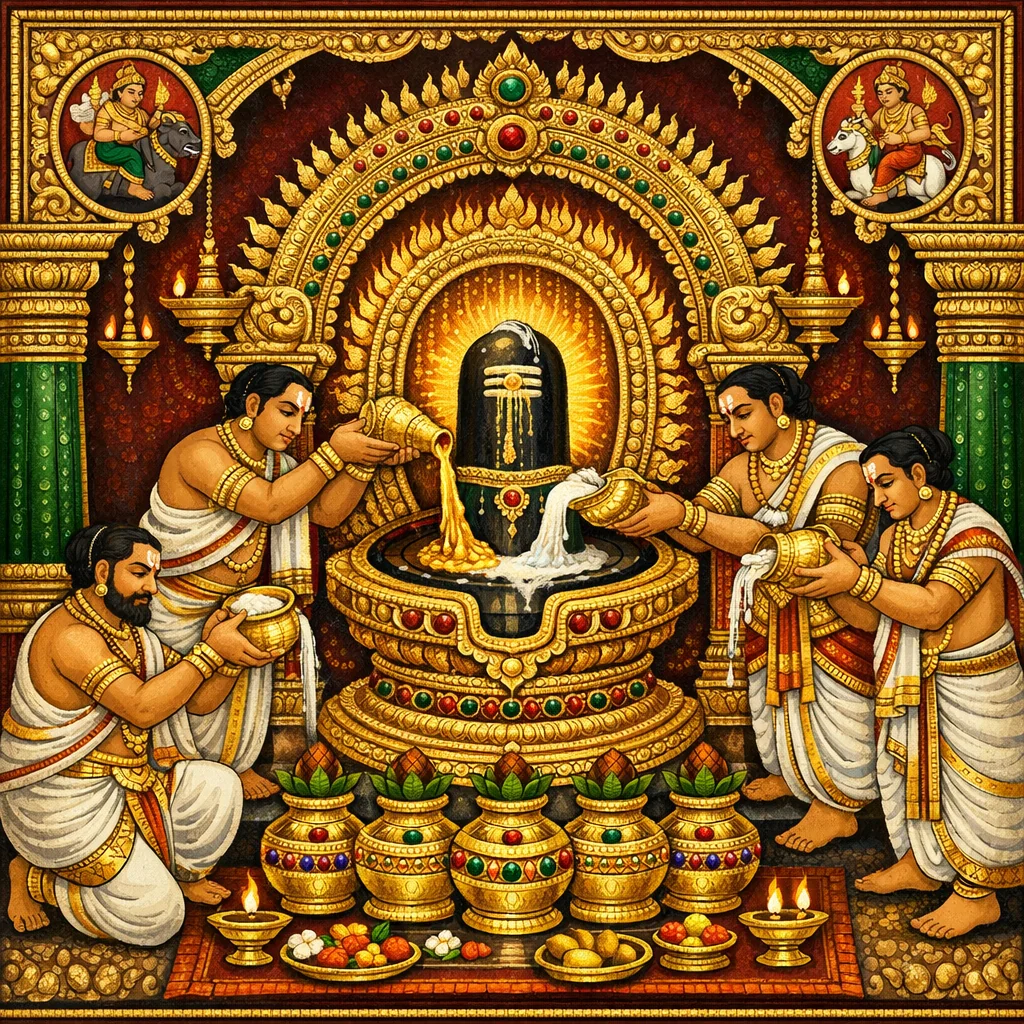
Īśvara speaks to Guha, defining the metaphysical heart of temple installation (pratiṣṭhā): the pīṭha is Śakti, the liṅga is Śiva, and their effective union occurs through Śiva’s subtle potencies (śivāṇu), so pratiṣṭhā is essentially the invocation of caitanya (living consciousness). The chapter lists five modes of pratiṣṭhā, stressing the distinctive role of the brahma-śilā (foundation stone) and distinguishing procedures such as sthāpana (proper placement), sthita-sthāpana (fixed establishment), and utthāpana (re-installation after uddhāra). It then sets out Vāstu-śāstra protocols: fivefold examination of soil for temple-building, land qualities suited to social class, directional preferences, purification of defiled ground, and repeated conditioning of land by excavation, cattle-settlement, or ploughing. A detailed ritual sequence follows—maṇḍapa rites, Aghora-astra protection, drawing lines with auspicious substances, worship of Śiva in the Īśāna compartment, and consecration of tools—culminating in boundary-marking, arghya, and formal parigraha (taking possession) of the site. Next come śalya-doṣa diagnostics (harmful buried objects) using omens, animal sounds, and Mātr̥kā letter-group mappings to directions. Finally, it gives a technical program for selecting and consecrating śilās (including nava-śilā sets), bathing and anointing rites, and an elaborate tattva-nyāsa: installing Śiva-, Vidyā-, and Ātma-tattvas with their presiding deities, lokapālas, bījas, kumbhas, prākāra-protection, homa, and Astra offerings to remove defects and purify the Vāstu-bhūmi.
Shlokas
Verse 1
इत्य् आदिमहापुराणे आग्नेये नानामन्त्रादिकथनं नाम एकनवतितमो ऽध्यायः अथ द्विनवतितमो ऽध्यायः प्रतिष्ठाविधिकथनं ईश्वर उवाच प्रतिष्ठां सम्प्रवक्ष्यामि क्रमात् सङ्क्षेपतो गुह पीठं शक्तिं शिवो लिङ्गं तद्योगः सा शिवाणुभिः
Thus, in the Agni Purāṇa, the ninety-first chapter called “The exposition of various mantras and related matters” concludes. Now begins the ninety-second chapter, “The narration of the consecration procedure.” The Lord said: “O Guha, I shall explain, in due order and concisely, the rite of installation (pratiṣṭhā): the pedestal (pīṭha) is Śakti; Śiva is the liṅga; and their union (yoga) is effected through Śiva’s subtle potencies/particles (śivāṇu).”
Verse 2
प्रतिष्ठायाः पञ्च भेदास्तेषां रूपं वदामि ते यत्र ब्रह्मशिलायोगः सा प्रतिष्ठा विशेषतः
There are five kinds of consecratory installation (pratiṣṭhā); I shall tell you their respective forms. That installation in which there is the placing or connection of the brahma-śilā (the foundational “Brahma-stone”) is, in particular, the distinctive and principal pratiṣṭhā.
Verse 3
स्थापनन्तु यथायोगं पीठ एव निवेशनं प्रतिष्ठाभिन्नपीठस्य स्थितस्थापनमुच्यते
“Establishment” is the proper placing, as appropriate, upon the pedestal (pīṭha) itself. When the pedestal is not distinguished from the consecratory installation (pratiṣṭhā), being treated as one integrated unit, this is called “fixed establishment” (sthita-sthāpana).
Verse 4
उत्थापनञ्च सा प्रोक्ता लिङ्गोद्धारपुरःसरा यस्यां तु लिङ्गमारोप्य संस्कारः क्रियते बुधैः
That rite is called “Utthāpana” (utthāpana), the re-raising or re-installation, preceded by the “Uddhāra of the Liṅga” (liṅga-uddhāra), its ritual lifting/removal. In that procedure, after placing the Liṅga back in position, the wise perform the prescribed saṃskāra (saṃskāra): consecratory purification and re-sanctifying rites.
Verse 5
तथा क्षौ ह्रौ मन्त्राः सूर्यस्येति ग, घ, चिह्नितपुस्तकपाठः आथापनं तदुद्दिष्टं द्विधा विष्ण्वादिकस्य च आसु सर्वासु चैतन्यं नियुञ्जीत परं शिवम्
Likewise, the (bīja-)mantras “kṣau” and “hrau” are stated to belong to Sūrya—so reads the marked (variant) manuscript lesson. There the rite called āthāpana is declared, and it is twofold, even for Viṣṇu and the other deities. In all these forms/placements one should install (invoke) consciousness (caitanya), namely the Supreme Śiva (Paraṃ Śiva).
Verse 6
यदाधारादिभेदेन प्रासादेष्वपि पञ्चधा परीक्षमथ मेदिन्याः कुर्यात्प्रासादकाम्यया
Therefore, according to the distinctions beginning with the foundation and related structural bases, one who desires to build a temple (prāsāda) should also perform the fivefold examination of the ground.
Verse 7
शुक्लाज्यगन्धा रक्ता च रक्तगन्धा सुगन्धिनी पीता कृष्णा सुरागन्धा विप्रादीनां मही क्रमात्
In due order, the lands suited for the brāhmaṇa and the other classes are: white earth with the fragrance of ghee; red earth with a blood-like smell yet pleasant-scented; yellow earth; and black earth with the odor of liquor.
Verse 8
पूर्वेशोत्तरसर्वत्र पूर्वा चैषां विशिष्यते आखाते हास्तिके यस्याः पूर्णे मृदधिका भवेत्
Regarding the eastern, north-eastern, and northern directions, the eastern side among them is held to be the most important. If a pit of one hasta (cubit) is dug and, after refilling, the earth is found in greater quantity (a surplus remains), that site is regarded as excellent.
Verse 9
उत्तमान्तां महीं विद्यात्तोयाद्यैर् वा समुक्षितां अस्थ्यङ्गारादिभिर्दुष्टामत्यन्तं शोधयेद् गुरुः
One should know the earth (the site) to be of the highest grade when it has been well sprinkled with water and the like; but if it has been defiled by bones, charcoal, and similar impurities, the officiating teacher (guru) should purify it thoroughly.
Verse 10
नगरग्रामदुर्गार्थं गृहप्रासादकारणं खननैर् गोकुलावासैः कर्षणैर् वा मुहुर्मुहुः
For establishing cities, villages, and forts, and for constructing houses and palaces, the ground should be repeatedly treated—by digging and excavation, by making it a cattle-settlement (gokula), or by ploughing it again and again.
Verse 11
मण्डपे द्वारपूजादि मन्त्रतृप्त्यवसानकं कर्म निर्वर्त्याघोरास्त्रं सहस्रं विधिना यजेत्
In the maṇḍapa (ritual pavilion), having duly completed the rite beginning with worship of the doorway and ending with the tṛpti (satiation) of the mantras, one should then, according to rule, perform a thousandfold worship or oblation of the Aghora-astra, the protective “weapon-mantra” of Aghora.
Verse 12
समीकृत्योपलिप्तायां भूमौ संशोधयेद्दिशः स्वर्णदध्यक्षतै रेखाः प्रकुर्वीत प्रदक्षिणं
Having leveled and plastered the ground, one should purify the directions. Then, using gold, curd (dadhi), and unbroken rice-grains (akṣata), one should draw the lines of the ritual diagram and perform the rite in pradakṣiṇa—an auspicious clockwise manner.
Verse 13
मध्यादीशानकोष्टस्थे पूर्णकुम्भे शिवं यजेत् वास्तुमभ्यर्च्य तत्तोयैः सिञ्चेत् कुद्दालकादिकं
In the full water‑pot placed in the central Īśāna (north‑east) compartment, one should worship Śiva. Then, having duly worshipped Vāstu (the presiding spirit of the site), one should sprinkle with that very water the spade and the other tools (used for excavation and construction).
Verse 14
रग्रामेत्यर्धश्लोको घ पुस्तके नास्ति मन्त्रदीप्त्यवसानकमिति ग मन्त्रभूम्यवसानकमिति घ निर्वर्त्य घोरास्त्रं महास्त्रमिति ग रेखां प्रकुर्वीतेति ख ,ग च स्वर्णकुण्डे इति ग स्वर्णकुम्भे इति घ , ङ , च बाह्ये रक्षोगणानिष्ट्वा विधिना दिग्बलं क्षिपेत् भूमिं संसिच्य संस्नाप्य कुद्दालाद्यं प्रपूजयेत्
Having completed the rite of the Ghorāstra—also called the Mahāstra—one should draw the prescribed line(s). Then, outside the ritual boundary, after offering to the host of rākṣasas, he should, according to rule, cast the digbala, the “strength of the quarters,” for protection. Sprinkling and ritually bathing the ground, he should duly worship the spade and the other implements.
Verse 15
अन्यं वस्त्रयुगच्छज्ञं कुम्भं स्कन्धे द्विजन्मनः निधाय गीतवाद्यादिब्रह्मगोषसमाकुलं
Placing upon the shoulder of a twice‑born man another water‑pot (kumbha), adorned with a pair of cloths and a banner or streamer, the rite should proceed amid a throng filled with singing, instrumental music, and Vedic recitations (brahma‑ghoṣa).
Verse 16
पूजां कुम्भे समाहृत्य प्राप्ते लग्ने ऽग्निकोष्ठके कुद्दालेनाभिषिक्तेन मध्वक्तेन तु खानयेत्
Having gathered the offerings of worship into the ritual pot (kumbha), when the appointed auspicious moment (lagna) has arrived for the fire‑hearth (agni‑koṣṭhaka), one should dig (the hearth/pit) with a spade consecrated by sprinkling, together with honey and ghee.
Verse 17
नैरृत्यां क्षेपयेन्मृत्स्नां खाते कुम्भजलं क्षिपेत् पुरस्य पूर्वसीमन्तं नयेद् यावदभीप्सितं
One should cast the earth (taken for the rite) toward the south‑west; into the dug pit one should pour water from a pot. Then one should extend the town’s eastern boundary‑line as far as is desired.
Verse 18
अथ तत्र क्षणं स्थित्वा भ्रामयेत् परितः पुरं सिञ्चन् सीमन्तचिह्नानि यावदीशानगोचरं
Then, having stood there for a moment, he should circumambulate the city on all sides, sprinkling consecrated water and marking the boundary-signs (sīmanta-marks), up to the region belonging to Īśāna (the north‑eastern quarter).
Verse 19
अर्घ्यदानमिदं प्रोक्तं तत्र कुम्भपरिब्रमात् इत्थं परिग्रहं भूमेः कुर्वीत तदनन्तरं
This offering of arghya has been taught there; after circumambulating the water-pot (kumbha), one should then perform, in this manner, the ritual taking-possession (parigraha) of the ground immediately thereafter.
Verse 20
कर्करान्तं जलान्तं वा शल्यदोषजिघांसया खानयेद् भूः कुमारीं चेद् विधिना शल्यमुद्धरेत्
To eliminate complications caused by a lodged foreign body (śalya), one should dig (or cut open) the ground until reaching gravelly soil or until water is reached; and if the patient is a young maiden, the foreign body should be extracted according to the proper procedure.
Verse 21
अकचटतपयशहान् मानवश्चेत् प्रश्नाक्षराणि तु अग्नेर्ध्वजादिपातिताः स्वस्थाने शल्यमाख्यान्ति
If a person, when questioned, utters only the syllables ‘a’, ‘ka’, ‘ca’, ‘ṭa’, ‘ta’, ‘pa’, ‘ya’, ‘śa’, ‘ha’, then—by the omen—Agni’s banner cast down and the like indicate that the foreign body (śalya) remains lodged in its proper place (i.e., still embedded).
Verse 22
कर्तुश्चाङ्गविकारेण जानीयात्तत्प्रमाणतः पश्वादीनां प्रवेशेन कीर्तनैर् विरुतैर् दिशः
One should ascertain the result to be expected from the doer’s bodily alterations, according to their established indications; and one should also determine the relevant directions from the entry of animals and the like, and from their cries, calls, and sounds.
Verse 23
मातृकामष्टवर्गाढ्यां फलके भुवि वा लिखेत् शल्यज्ञानं वर्गवशात् पूर्वादीशान्ततः क्रमात्
One should write (the diagram/text) containing the Mātr̥kā letters arranged in eight groups, either on a board or on the ground. The knowledge concerning śalya (a foreign body) is to be set down according to the groups, in sequence, beginning from the East and proceeding through the directions up to the final quarter.
Verse 24
अवर्गे चैव लोहन्तु कवर्गे ऽङ्गारमग्नितः भूमिं संसिच्य संस्थाप्येति ग , घ , ङ च कुद्दालाख्यमिति ग पूर्वमीशान्तमिति ख स्रावयेत् इति ख नव चेत् प्रश्नाक्षराणि भाषन्ते इति ग , घ च पूर्वादीनां तत इति ख चवर्गे भस्म दक्षे स्याट् टवर्गे ऽस्थि च नैरृते
For the a‑varga (vowel-group), the prescribed substance is iron; for the ka‑varga, charcoal produced from fire. Having sprinkled the ground and duly established (the rite/diagram)—so it is said in some recensions. It is termed “kuddāla” (spade). (In another reading) “from the East up to Īśāna (northeast)” is stated, and “one should cause it to flow/drip” is also read. If the nine interrogative syllables are uttered (as the query), so read some manuscripts. Then, for the directions beginning with the East, that allotment applies. For the ca‑varga, ash is assigned in the South; and for the ṭa‑varga, bone is assigned in Nairṛta (the southwest).
Verse 25
तवर्गे चेष्टका चाप्ये कपालञ्च पवर्गके यवर्गे शवकीतादि शवर्गे लोहमादिशेत्
In the ta‑varga one should place (the term/substance) ceṣṭakā; in the pa‑varga, kapāla (skull/kapāla-vessel). In the ya‑varga, śavakītā and similar terms; and in the śa‑varga one should assign loha (metal) and the like.
Verse 26
हवर्गे रजतं तद्वदवर्गाच्चानर्थकरानपि प्रीक्ष्यात्मभिः करापूरैर् अष्टाङ्गुलमृदन्तरैः
In the ha‑varga is placed silver (rajata). Likewise, from the a‑varga too, even those substances/ores that cause harm should be examined by one’s own (experienced) hands—by rubbing and testing with clean, camphor-bright fingers, and by assaying with a lump of earth/clay eight finger-breadths (aṣṭāṅgula) in thickness.
Verse 27
पादोनं खातमापूर्य सजलैर् मुद्गराहतैः लिप्तां समप्लवां तत्र कारयित्वा भुवं गुरुः
Having filled the excavation—leaving it a quarter short (of full depth)—with moistened earth compacted by blows of a mallet (mudgara), the expert (master-builder) should there prepare the ground, plastered and made level, even and uniform.
Verse 28
सामान्यार्घ्यकरो यायान्मण्डपं वक्ष्यामाणकं तोरणद्वाःपतीनिष्ट्वा प्रत्यग्द्वारेण संविशेत्
After offering the general arghya (respectful libation), he should proceed to the maṇḍapa being described; having worshipped the deities presiding over the toraṇa archway and the door, he should enter through the west-facing doorway.
Verse 29
कुर्यात्तत्रात्मशुद्ध्यादि कुण्डमण्डपसंस्कृतिं कलसं वर्धनीसक्तं लोकपालशिवार्चनं
There, one should perform self-purification (ātma-śuddhi) and the other preliminary acts; consecrate the kuṇḍa (fire-pit) and the maṇḍapa; set up the kalaśa (ritual water-pot) together with the vardhanī vessel; and worship the Lokapālas and Lord Śiva.
Verse 30
अग्नेर्जननपूजादि सर्वं पूर्ववदाचरेत् यजमानान्वितो यायाच्छिलानां स्नानमण्डपं
He should perform, as previously prescribed, the entire procedure beginning with the establishment (kindling) and worship of Agni; then, accompanied by the yajamāna (sacrificer), he should proceed to the bathing maṇḍapa of the consecrated stones.
Verse 31
शिलाः प्रासादलिङ्गस्य पादधर्मादिसञ्ज्ञकाः अष्टाङ्गुलोच्छ्रिताः शस्ताश् चतुरस्राः करायताः
The stone slabs for the temple-liṅga, known by names such as ‘pāda’ and ‘dharma’ (and related designations), are recommended to be eight aṅgulas in height, square in shape, and one kara in length.
Verse 32
पाषाणानां शिलाः कार्या इष्टकानां तदर्धतः प्रासादे ऽश्मशिलाः शैले इष्टका इष्टकामये
For a stone-built temple, the slabs should be made of stone; for a brick-built temple, they should be made to half that standard. In a stone shrine the slabs are of stone; in a mountain-stone structure they too are of stone; and in a brick-built structure they are of brick.
Verse 33
अङ्किता नववक्त्राद्यैः पङ्कजाः पङ्कजाङ्किताः नन्दा भद्रा जया रिक्ता पूर्णाख्या पञ्चमी मता
(She is) Aṅkitā, marked with (signs such as) the nine-faced form and the rest; (she is) Paṅkajā and Paṅkajāṅkitā (“marked with the lotus”); (she is) Nandā, Bhadrā, Jayā, Riktā, and also called Pūrṇā—thus the fifth set of names is held to be.
Verse 34
आसां पद्मो महापद्मः शङ्खो ऽथ मकरस् तथा समुद्रश्चेति पञ्चामी निधिकुम्भाः क्रमाधः
Among these, the treasure-jars (nidhi-kumbhas) named Padma, Mahāpadma, Śaṅkha, Makara, and Samudra—these constitute the fifth set of nidhis, arranged in due order below.
Verse 35
नन्दा भद्रा जया पूर्णा अजिता चापराजिता मुशलैर् मुद्गराहतैर् इति ङ वर्धनीयुक्तमिति ग , ङ च यजमानार्चित इति घ नवरुद्राद्यैर् इति घ पाषाणानामित्यादिः, पञ्चमीर्मता इत्य् अन्तः श्लोकद्वयात्मकपाठो ग पुस्तके नास्ति विजया मङ्गलाख्या च धरणी नवमी शिला
The sacred stones are named Nandā, Bhadrā, Jayā, Pūrṇā, Ajitā, and Aparājitā. (In some recensions it is noted:) “struck with pestles and hammers”; (elsewhere:) “endowed with growth-increasing efficacy”; (elsewhere:) “worshipped by the yajamāna (sacrificer)”; (elsewhere:) “(worshipped) along with the Nine Rudras and the rest”; and “of stones…”—such are the variant readings. In the ‘ga’ manuscript, the internal two-verse passage ending with “pañcamīrmatā” is absent. (Further,) Vijayā—also called Maṅgalā—and Dharaṇī are counted as the ninth stone.
Verse 36
सुभद्रश् च विभद्रश् च सुनन्दः पुष्पनन्दकः जयो ऽथ विजयश् चैव कुम्भः पूर्णस्तथोत्तरः
And (these are the names): Subhadra, Vibhadra, Sunanda, Puṣpanandaka, Jaya, Vijaya, Kumbha, Pūrṇa, and Uttara.
Verse 37
नवानान्तु यथासङ्ख्यं निधिकुम्भः पूर्णस्तथोत्तरः आसनं प्रथमं दत्त्वा ताड्योल्लिख्यशराणुना
Then, in due order, (set up) the nine targets; next comes a “treasure-jar” (nidhi-kumbha) filled to the brim. Having first assumed the proper shooting posture (āsana), one should strike and then mark or incise (the target) with the point of the arrow.
Verse 38
सर्वासामविशेषेण तनुत्रेणावगुण्ठनं मृद्भिर्गोमययोगामूत्रकषायैर् गन्धवारिणा
In all such cases without distinction, one should envelop (the person or object) with a protective covering, and perform purification/anointing with earth (clay), preparations containing cow-dung, decoctions of cow-urine, and scented water.
Verse 39
अस्त्रेण हूं फडन्तेन मलस्नानं समाचरेत् विधिना पञ्चगव्येन स्नानं पञ्चामृतेन च
One should perform the cleansing bath to remove impurity using the Astra-mantra ending with “hūṃ phaṭ”; and, according to the prescribed procedure, one should also bathe with pañcagavya and with pañcāmṛta.
Verse 40
गन्धतोयान्तरं कुर्यान्निजनामाङ्किताणुना फलरत्नसुवर्णानां गोशृङ्गसलिलैस्ततः
Then, using a minute particle marked with one’s own name, one should prepare a separate portion of scented water; thereafter, for fruits, gems, and gold, one should perform the rite with water held or poured in a cow’s horn.
Verse 41
चन्दनेन समालभ्य वस्त्रैर् आच्छादयेच्छिलां स्वर्णोत्थमासनं दत्वा नीत्वा यागं प्रदक्षिणं
Having anointed the sacred stone with sandal paste, one should cover it with cloths; having offered a seat made of (or adorned with) gold and having led (the rite) to the place of sacrifice, one should perform pradakṣiṇā—circumambulation in the auspicious clockwise direction.
Verse 42
शय्यायां कुशतल्पे वा हृदयेन निवेशयेत् सम्पूज्य न्यस्य बुद्ध्यादिधरान्तं तत्त्वसञ्चयं
While on a bed or on a couch of kuśa grass, one should install (the deity or maṇḍala) within the heart by the “hṛdaya” mantra; having duly worshipped, one should perform nyāsa of the collection of tattvas, from Buddhi onward up to Dhara.
Verse 43
त्रिखण्डव्यापकं तत्त्वत्रयञ्चानुक्रमान् न्यसेत् बुद्ध्यादौ चित्तपर्यन्ते चिन्तातन्मात्रकावधौ
One should, in due sequence, perform nyāsa by placing the triad of principles that pervades the three divisions, beginning with buddhi and extending up to citta, within the range from cintā (contemplative thought) down to the tanmātras (subtle elements).
Verse 44
इप्येति ग कुशतल्पे वा हॄदयेन विशेषयेत् इति ख कुशतल्पे च हृदयेन निवेशयेत् इति ग बुद्ध्यादौ चित्तपर्यन्ते चित्ततन्मात्रकावधौ इति घ सम्पच्य इत्य् आदिः तन्मात्रकावधावित्यन्तः सार्धैकश्लोकपाठो ग पुस्तके नास्ति तन्मात्रादौ धरान्ते च शिवविद्यात्मनां स्थितिः तत्त्वानि निजमन्त्रेण तत्त्वेशांश् च हृदार्चयेत्
From the tanmātras onward up to the earth element (pṛthivī) is the abiding-place of forms constituted of Śiva-vidyā. One should worship (arcayet) the tattvas with one’s own mantra, and also worship in the heart (hṛdā) the lords presiding over those tattvas.
Verse 45
स्थानेषु पुष्पमालादिचिह्नितेषु यथाक्रमं ॐ हूं शिवतत्त्वाय नमः ॐ हूं शिवतत्त्वाधिपतये रुद्राय नमः ॐ हां विद्यातत्त्वाय नमः ॐ हां विद्यातत्त्वाधिपाय विष्णवे नमः ॐ हां आत्मतत्त्वाय नमः ॐ हां आत्मतत्त्वाधिपतये ब्रह्मणे नमःक्षमाग्नियजमानार्कान् जलवातेन्दुखानि च
On the places marked in sequence with flower-garlands and the like, one should perform nyāsa and recite: “Oṃ hūṃ—obeisance to the Śiva-tattva; Oṃ hūṃ—obeisance to Rudra, lord of the Śiva-tattva; Oṃ hāṃ—obeisance to the Vidyā-tattva; Oṃ hāṃ—obeisance to Viṣṇu, lord of the Vidyā-tattva; Oṃ hāṃ—obeisance to the Ātma-tattva; Oṃ hāṃ—obeisance to Brahmā, lord of the Ātma-tattva”; and one should also invoke/mark kṣamā, Agni, the yajamāna, the sun, water, wind, and the moon.
Verse 46
प्रतितत्त्वं न्यसेदष्टौ मूर्तीः प्रतिशिलां शिलां सर्वं पशुपतिं चोग्रं रुद्रं भवमथेश्वरं
For each tattva, one should perform nyāsa of the eight mūrtis; and upon each stone (or icon-stone), one should install (invoke) Sarva, Paśupati, Ugra, Rudra, Bhava, and Īśvara.
Verse 47
महादेवं च भीमं च मूर्तीशांश् च यथाक्रमात् ॐ धरामूर्तये नमः, ॐ धराधिपतये नमः,इत्यादिमन्त्रान् लोकपालान् यथासङ्ख्यं निजाणुभिः
In due sequence, one should invoke Mahādeva and Bhīma, and also the lords of the mūrtis. With mantras such as “Oṃ, obeisance to the Dharā-mūrti,” “Oṃ, obeisance to the Dharā-adhipati,” and so forth, the Lokapālas are to be worshipped in their proper numerical order, together with one’s own aṇus (subtle attendant auxiliaries).
Verse 48
विन्यस्य पूजयेत् कुम्भांस्तन्मन्त्रैर् वा निजाणुभिः इन्द्रादीनां तु वीजानि वक्ष्यमाणक्रमेण तु
Having arranged them in their prescribed positions, one should worship the ritual pots (kumbhas) with those very mantras—or with one’s own appropriate aṅga (auxiliary) syllables; and the seed-syllables (bījas) of Indra and the other deities are to be applied in the sequence that will be stated next.
Verse 49
लूं रूं शूं पूं वूं यूं मूं हूं क्षूमिति उक्तो नवशिलापक्षः शिला पञ्चपदा तथा भवमखेश्वरम् इति घ , निजात्मभिरिति ख , ग विन्यस्येत्यर्धश्लोको ग पुस्तके नास्ति ॐ हूं घूं बूं यूं मूं हं क्षमितीति ग ॐ कं सूं पूं शूं ह्रूं क्षमितीति घ लूं रूं शूं पूं वूं चूं मूं हूं क्षूमितीति ख प्रतितत्त्वं न्यसेन्मूर्तीः सृष्ट्या पञ्च धरादिकाः
“Lūṃ rūṃ śūṃ pūṃ vūṃ yūṃ mūṃ hūṃ kṣūṃ”—this is taught as the ‘nine-stone set’ (nava-śilā-pakṣa). The ‘stone’ (śilā) is also given as a five-step (pañca-padā) formula. (Variant readings occur: some manuscripts read ‘bhavam-akheśvaram’, others ‘nijātmabhiḥ’; and the half-verse beginning with ‘vinyasya’ is absent in one recension.) Other recensions transmit alternative sequences: “oṃ hūṃ ghūṃ būṃ yūṃ mūṃ haṃ kṣam”; “oṃ kaṃ sūṃ pūṃ śūṃ hrūṃ kṣam”; and “lūṃ rūṃ śūṃ pūṃ vūṃ cūṃ mūṃ hūṃ kṣūṃ”. One should perform nyāsa by placing the corresponding forms (mūrtis) upon each tattva, following the order of creation—beginning with the five supports such as the earth (dharā) and so forth.
Verse 50
ब्रह्मा विष्णुस् तथा रुद्र ईश्वरश् च सदाशिवः एते च पञ्च मूर्तीशा यष्टव्यास्तासु पूर्ववत्
Brahmā, Viṣṇu, Rudra, Īśvara, and Sadāśiva—these are the five sovereign forms; in those rites they are to be worshipped exactly as previously prescribed.
Verse 51
ॐ पृथ्वीमूर्तये नमः ॐ पृथ्वीमूर्त्यधिपतये ब्रह्मणे नमः इत्य् आदि मन्त्राः सम्पूज्य कलशान् पञ्च क्रमेण निजनामभिः निरुन्धीत विधानेन न्यासो मध्यशिलाक्रमात्
Having duly worshipped, with offerings, the mantras beginning with “Oṃ, obeisance to the Earth-embodied (deity),” and “Oṃ, obeisance to Brahmā, the lord of the Earth-form,” and so forth, one should then, in the prescribed manner, successively enclose/secure the five ritual pitchers (kalaśas) by invoking them with their respective names; the nyāsa is to be performed according to the sequence beginning from the central stone/seat (madhya-śilā).
Verse 52
कुर्यात् प्राकारमन्त्रेण भूतिदर्भैस्ततः कुण्डेषु धारिकां शक्तिं विन्यस्याभ्यर्च्य तर्पयेत्
Using the prākāra-mantra, one should ritually establish the protective enclosure with ash and darbha grass; then, in the fire-pits (kuṇḍas), having installed the sustaining Śakti (dhārikā-śakti), one should worship her and perform tarpaṇa (oblations of satisfaction).
Verse 53
तत्त्वतत्त्वाधिपान् मूर्तीर्मूर्तीशांश् च घृतादिभिः ततो ब्रह्मांशशुद्ध्यर्थं मूलाङ्गं ब्रह्मभिः क्रमात्
One should ritually anoint the presiding deities of the tattvas—the divine forms and the portions of those forms—with ghee and the like. Thereafter, for purifying the Brahmā-portions, one should consecrate the root-limb (mūlāṅga) in sequence with the Brahmā (mantras/deities).
Verse 54
कृत्वा शतादिपूर्णान्तं प्रोक्ष्याः शान्तिजलैःशिलाः पूजयेच्च कुशैः स्पृष्ट्वा प्रतितत्त्वमनुक्रमात्
Having completed the rite up to its full count—beginning with a hundred (oblations/recitations) and so on—one should sprinkle the stones (śilāḥ) with pacificatory water (śānti-jala). Then, having touched them with kuśa grass, one should worship them sequentially, tattva by tattva, in due order.
Verse 55
सांनिध्यमथ सन्धानं कृत्वा शुद्धं पुनर्न्यसेत् एवं भागत्रये कर्म गत्वा गत्वा समाचरेत्
Then, having effected proximity (invocation of presence) and performed the required fixing/connection (sandhāna), one should again place (nyāsa) the purified (mantra/deity). Thus, in the three divisions of the rite, the procedure should be performed repeatedly, proceeding step by step.
Verse 56
ॐ आं ईं आत्मतत्त्वविद्यातत्त्वाभ्यां नमः इति धानं इत्य् अतः परं ह्रस्वदीर्घप्रयोगतः इत्य् अतः प्राङ्मध्वगपाठो घ पुस्तके नास्ति ॐ आं हां आत्मतत्त्वविद्यातत्त्वाय नम इति ग ॐ आं इं उं विद्यातत्त्वशिवतत्त्वाभ्यां नम इति ड ॐ आं इं आत्मविद्यातत्त्वाय नम इति ख संस्पृशेद् दर्भमूलाद्यैर् ब्रह्माङ्गादित्रयं क्रमात् कुर्यात्तत्त्वानुसन्धानं ह्रस्वदीर्घप्रयोगतः
“Oṃ āṃ īṃ—obeisance to the tattvas of the Self and of Knowledge”: thus is the placing/installation (dhāna/nyāsa). Thereafter, the procedure is to be performed with the correct application of short and long vowel measures (hrasva–dīrgha). From this point, a reading that proceeds ‘eastward and toward Madhva’ is not found in the ‘gha’ manuscript. Variant readings are: “Oṃ āṃ hāṃ—obeisance to the tattva of Self-and-Knowledge” (ga); “Oṃ āṃ iṃ uṃ—obeisance to the tattvas of Knowledge and Śiva” (ḍa); “Oṃ āṃ iṃ—obeisance to the tattva of Self-and-Knowledge” (kha). One should then touch, beginning with the roots of darbha grass and the like, the triad of Brahmā’s limbs in due order, and perform contemplation/investigation of the tattvas according to the proper short–long usage.
Verse 57
ॐ हां उं विद्यातत्त्वशिवतत्त्वाभ्यां नमः घृतेन मधुना पूर्णांस्ताम्रकुम्भान् सरत्नकान् पञ्चगव्यार्घ्यर्ससिक्तान् लोकपालाधिदैवतान्
“Oṃ. Hāṃ. Uṃ. Salutation to the two principles—Vidyā-tattva and Śiva-tattva.” (One should prepare) copper pitchers (tāmra-kumbha), filled with ghee and honey, furnished with gems, and sprinkled with the arghya-mixture and the essence of the pañcagavya (the five products of the cow), as offerings to the presiding deities of the Lokapālas (guardians of the directions).
Verse 58
पूजयित्वा निजैर् मन्त्रैः सन्निधौ होममाचरेत् शिलानामथ सर्वासां संस्मरेदधिदैवताः
Having worshipped them with one’s own prescribed mantras, one should then perform the homa (fire-offering) in their presence; thereafter, for all the sacred stones, one should recollect and invoke their presiding deities (adhi-devatās).
Verse 59
विद्यारूपाः कृतस्नाना हेमवार्णाः शिलाम्बराः न्यूनादिदोषमोषार्थं वास्तुभूमेश् च शुद्धये यजेदस्त्रेण मूर्धान्तमाहुतीनां शतं शतं
Visualizing (the presiding powers) as embodied Vidyās—ritually bathed, golden-hued, and clad in stone-coloured garments—the officiant should worship with the Astra-mantra up to the crown of the head, offering a hundred oblations and another hundred, to remove defects such as deficiency and the like, and to purify the Vāstu-site and the ground.
Frequently Asked Questions
It systematizes pratiṣṭhā as both metaphysics and procedure: five installation-types (with brahma-śilā as distinctive), site/soil testing, protective Aghora-astra rites, boundary-consecration (sīmanta, parigraha), śalya-doṣa diagnostics via Mātr̥kā groups, and a full tattva-nyāsa program (Śiva/Vidyā/Ātma tattvas with presiding deities, lokapālas, bījas, kumbhas, and homa).
By insisting that true installation is the installation of caitanya (supreme Śiva) into form: correct Vāstu discipline, purification, mantra-protection, and tattva-nyāsa make architecture a sādhana, transforming construction into a dharmic act that supports both communal worship (bhukti) and inner alignment toward liberation (mukti).
Pīṭha is identified as Śakti, the liṅga as Śiva, and their effective union (yoga) is mediated through Śiva’s subtle potencies (śivāṇu), implying that ritual precision is meant to stabilize Śiva-Śakti presence in space.
Śalya-doṣa refers to harmful lodged/buried impurities or obstructions in the ground; the chapter prescribes digging to gravel/water, reading omens and sounds, and using Mātr̥kā letter-groups (eight vargas) mapped to directions and substances (iron, charcoal, ash, bone, etc.) to infer the defect’s nature and location.