Adhyaya 88
Adhyāya 88 — निर्वाणदीक्षाकथनं (Teaching of the Nirvāṇa-Initiation)
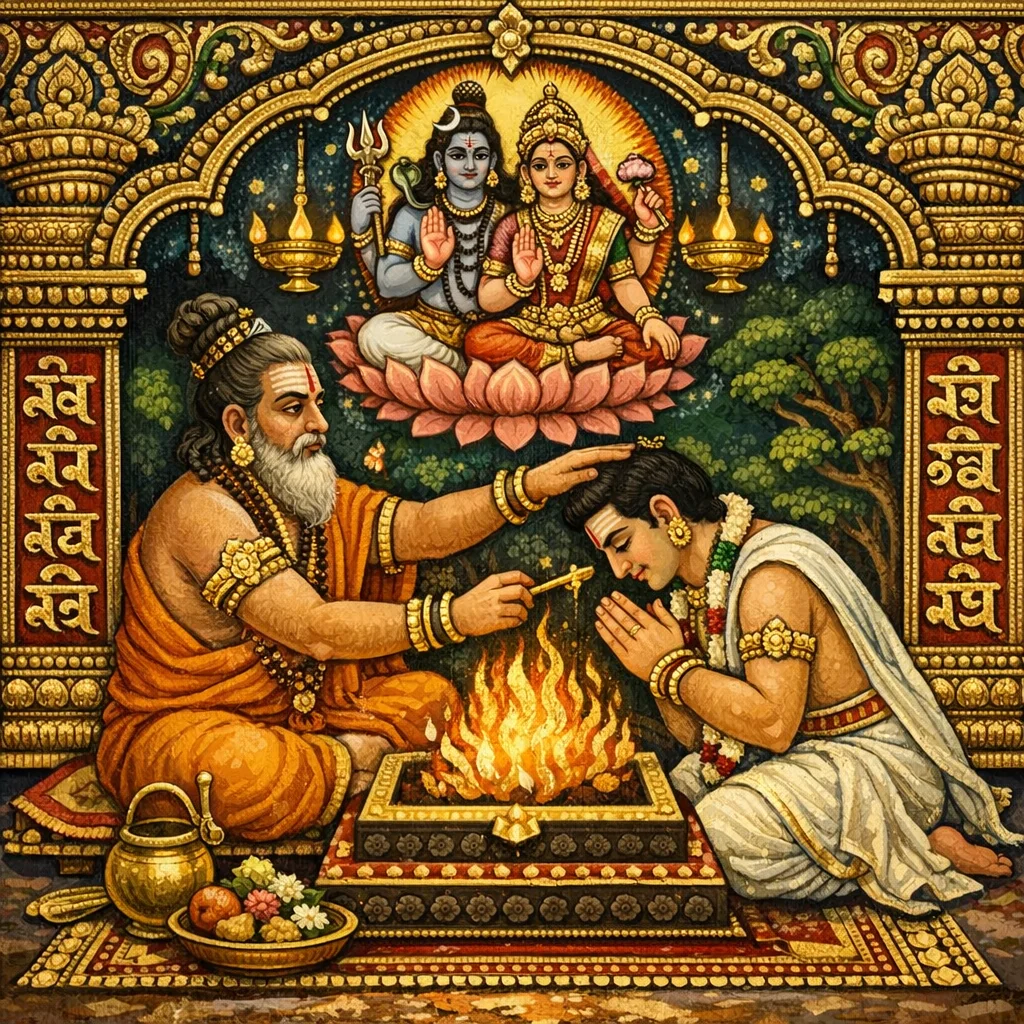
Following the purification of the Śānti rite, this chapter teaches the nirvāṇa-dīkṣā within an Īśāna (Śiva) framework. The Lord sets out sandhāna (mantra-linkages) and a Śakti–Śiva tattva orientation, detailing sixteen phonemic varṇas (from a to visarga) and subtle-body correspondences (nāḍīs Kuhū/Śaṅkhinī; vāyus Devadatta/Dhanañjaya). The Śānti-atīta procedure then unfolds: striking and splitting the kalā-pāśa, entering and separating through specific mantra endings (phaḍ/namo), and coordinating mudrā with prāṇāyāma (pūraka–kumbhaka–recaka) to draw the pāśa upward and install fire in the kuṇḍa. Sadāśiva is invoked and worshipped; the disciple is ritually enlivened (caitanya-vibhāga), placed into Devī’s womb-symbolism, and freed through japa and precisely counted homa offerings (25, then 5 and 8). The chapter culminates in adhikāra-samarpana to Sadāśiva, laya practice up to dvādaśānta, sixfold guṇāpadāna, post-rite soothing with amṛta-drops, blessings, and the formal conclusion of the makha.
Shlokas
Verse 1
इत्य् आदिमहापुराणे आग्नेये निर्वाणदीक्षायां शान्तिशोधनं नाम सप्तशीतितमो ऽध्यायः अथाष्टाशीतितमो ऽध्यायः निर्वाणदीक्षाकथनं ईश्वर उवाच सन्धानं शान्त्यतीतायाः शान्त्या सार्धं विशुद्धया कुर्वीत पूर्ववत्तत्र तत्त्ववर्णादि तद् यथा
Thus, in the Agni Purāṇa, within the section on the nirvāṇa-initiation, the chapter entitled “Purification of the Śānti-rite” is the eighty-seventh. Now begins the eighty-eighth chapter, “The Teaching of the Nirvāṇa-initiation.” The Lord said: “One should perform the sandhāna (joining/connection) of the procedure that has gone beyond the Śānti, together with the Śānti and with complete purification, exactly as before; there, the exposition beginning with the tattva (principles) and the varṇa (letters/colors), and so forth, is as follows.”
Verse 2
ॐ हीं क्षौं हौं हां इति सन्धानानि उभौ शक्तिशिवौ तत्त्वे भुवनाष्टकसिद्धिकं दीपकं रोचिकञ्चैव मोचकं चोर्ध्वगामि च
“Oṃ, hīṃ, kṣauṃ, hauṃ, hāṃ”—these are the sandhānas (mantric linkages). In the tattva of the two—Śakti and Śiva—they bestow accomplishment over the eight worlds (bhuvanāṣṭaka). They are the siddhis named Dīpaka, Rocika, Mocaka, and also Ūrdhvagāmin.
Verse 3
व्योमरूपमनाथञ्च स्यादनाश्रितनष्टमं ओङ्कारपदमीशाने मन्त्रो वर्णाश् च षोडश
In the Īśāna (Śiva) context, the mantra is of the nature of space (vyoman), without a protector (anātha), and as it were “unbased and dissolved” (anāśrita-naṣṭa). Its footing is the syllable Oṃ (oṅkāra-pada), and its constituent phonemes are sixteen in number.
Verse 4
अकारादिविसर्गान्ता वीजेन देहकारकौ कुहूश् च शङ्खिनी नाड्यौ देवदत्तधनञ्जयौ
From “a” up to visarga (ḥ) are the (phonemic) constituents; they are also termed bīja and deha-kāraka. Likewise, the two nāḍīs are Kuhū and Śaṅkhinī, and (among the vital airs) are Devadatta and Dhanañjaya.
Verse 5
मरुतौ स्पर्शनं श्रोत्रं इन्द्रिये विषयो नभः शब्दो गुणो ऽस्यावस्था तु तुर्यातीता तु पञ्चमी
In the principle of wind (vāyu) are touch and the ear as the corresponding sense-organ. Its object is space (ākāśa); its quality is sound. Its state is the transcendent “turyātīta”, declared to be the fifth.
Verse 6
हेतुः सदाशिवो देव इति तत्त्वादिसञ्चयं सञ्चिन्त्य शान्त्यतीताख्यं विदध्यात्ताडनादिकं
Having contemplated the entire aggregation of principles (tattvas) and related categories—realizing that the divine Sadāśiva is the ultimate cause—one should perform the rite called Śānti-Atīta, beginning with the prescribed striking (tāḍana) and allied actions.
Verse 7
कलापाशं समाताड्य फडन्तेन विभिद्य च प्रविश्यान्तर् नमो ऽन्तेन फडन्तेन वियोजयेत्
Having struck the noose (pāśa) of Kalā and then split it with the mantra ending in “phaḍ”, one should enter within; thereafter, with the mantra ending in “namo”, and again with the mantra ending in “phaḍ”, one should effect the separation (release/disjunction).
Verse 8
शिखाहृत्सम्पुटीभूतं स्वाहान्तं सृणिमुद्रया पूरकेण समाकृष्य पाशं मस्तकसूत्रतः
Having enclosed (the mantra) in the “casket” formed from the topknot (śikhā) and the heart, and ending it with “svāhā”, one should, by means of the Sṛṇī-mudrā and with an inhalation (pūraka), draw the noose (pāśa) upward along the head-thread (mastaka-sūtra).
Verse 9
कुम्भकेन समादाय रेचकेनोद्भवाख्यया हृत्सम्पुटनमो ऽन्तेन वह्निं कुण्डे निवेशयेत्
Having gathered (the sacred fire) by breath-retention (kumbhaka), and by exhalation—known as “udbhavā”—together with the closing of the heart-casket and the concluding “namaḥ”, one should install the fire into the ritual fire-pit (kuṇḍa).
Verse 10
अस्याः पूजादिकं सर्वं निवृत्तेरिव साधयेत् सदाशिवं समावाह्य पूजयित्वा प्रतर्प्य च
One should carry out all the rites beginning with worship for this (goddess/observance) just as for Nivṛtti; having duly invoked Sadāśiva, one should worship him and then satisfy him with tarpaṇa offerings.
Verse 11
सदा ख्याते ऽधिकारे ऽस्मिन् मुमुक्षुं दीक्षयाम्यहं भाव्यं त्वयानुकूलेन भक्त्या विज्ञापयेदिति
In this ever-proclaimed and well-known rite, I bestow initiation (dīkṣā) upon the seeker of liberation. What is to be done should be submitted (to the guru/deity) by you with a favorable disposition and with devotion—so it is declared.
Verse 12
पित्रोरावाहनं पूजां कृत्वा तर्पणसन्निधी हृत्सम्पुटात्मवीजेन शिष्यं वक्षसि ताडयेत्
Having invoked the two ancestors and performed their worship, and being present at the tarpaṇa (libation) rite, the teacher, with the bīja (seed-mantra) of the Heart-‘casket’ (hṛt-sampuṭa), should strike/tap the disciple upon the chest.
Verse 13
ॐ हां हूं हं फट् प्रविश्य चाप्यनेनैव चैतन्यं विभजेत्ततः शस्त्रेण पाशसंयुक्तं ज्येष्ठयाङ्कुशमुद्रया
Uttering “oṃ hāṃ hūṃ haṃ phaṭ,” one should cause the mantra-power to enter the implement. By that very mantra one should then apportion/activate consciousness (caitanya) within it; thereafter one should empower the weapon together with the noose (pāśa), employing the Jyeṣṭhā-Āṅkuśa (goad) mudrā.
Verse 14
ॐ हां हूं हं फट् स्वाहान्तेन तदाकृष्य तेनैव पुटितात्मना गृहीत्वा तन्नमो ऽन्तेन निजात्मनि नियोजयेत्
With the mantra ending in “svāhā”—“oṃ hāṃ hūṃ haṃ phaṭ svāhā”—one should draw that invoked essence toward oneself; and with that very mantra, having sealed/fortified oneself and grasped it, one should then install it within one’s own self by means of the mantra ending in “namo”.
Verse 15
ॐ हां हं हीं आत्मने नमः ॐ हां हुं हः फट् इति ख, चिह्नितपुस्तकपाठः ॐ हां हं ह्रीमात्मने नम इति ख, चिह्नितपुस्तकपाठः पूर्ववत् पितृसंयोगं भावयित्वोद्भवाख्यया वामया तदनेनैव देव्या गर्भे नियोजयेत्
“Oṃ hāṃ haṃ hīṃ—obeisance to the Self (Ātman).” (In another marked manuscript reading: “Oṃ hāṃ huṃ haḥ phaṭ”; and in another: “Oṃ hāṃ haṃ hrīṃ—obeisance to the Self.”) Having visualized, as before, the union with the paternal principle, one should, by the left (female) power called ‘Udbhavā’, and precisely by this mantra/means, implant the jīva/seed into the womb of the Goddess (the generative matrix).
Verse 16
गर्भाधानादिकं सर्वं पूर्वोक्तविधिना चरेत् मूलेन पाशशैथिल्ये निष्कृत्यैव शतं जपेत्
One should perform all rites beginning with garbhādhāna (the conception rite) according to the procedure stated earlier. And, for the loosening of bondage (pāśa)—release from karmic fetters—having performed the expiatory act, one should repeat the root-mantra (mūla-mantra) one hundred times.
Verse 17
मलशक्तितिरोधाने पाशानाञ्च वियोजने पञ्चपञ्चाहुतीर्दद्यादायुधेन यथा पुरा
For the veiling (suppression) of the power of impurity (mala-śakti) and for the loosening of the bonds (pāśa), one should offer five sets of five oblations (twenty-five in all) with the prescribed ritual implement (āyudha), as was done in former times.
Verse 18
पाशानायुधमन्त्रेण सप्रवाराभिजप्तया छिन्द्यादस्त्रेण कर्तर्या कलावीजयुजा यथा
Having duly empowered (by recitation) the Pāśa weapon-mantra together with its Pravara formula, one should cut the bond/obstruction with the Cutter-weapon (Kartarī-astra) in the prescribed manner, employing the Kalā-bīja.
Verse 19
ॐ हां शान्त्यतीतकलापाशाय हः हूं फट् विसृज्य वर्तुलीकृत्य पाशानस्त्रेण पूर्ववत् घृतपूर्णे श्रुवे दत्वा कलास्त्रेणैव होमयेत्
Pronouncing, “Oṃ hāṃ—unto the noose (pāśa) of Kalā that transcends appeasement (śānti): haḥ hūṃ phaṭ,” one should discharge the mantra, form it into a circle, and, as previously prescribed, employ the Pāśāstra. Then, placing ghee into the śruva (ritual ladle) filled with ghee, one should perform the homa (fire-offering) using the Kalāstra alone.
Verse 20
अस्त्रेण जुहुयात् पज्च पाशाङ्कुशनिवृत्तये प्रायश्चित्तनिषेधार्थं दद्यादष्टाहुतीस्ततः
One should offer five oblations with the Astra weapon-mantra to remove the noose (pāśa) and the goad (aṅkuśa), that is, restraints and coercive impediments. Thereafter, to bar any further need for expiation (prāyaścitta), one should offer eight oblations.
Verse 21
सदाशिवं हृदावाह्य कृत्वा पूजनतर्पणे पूर्वोक्तविधिना कुर्यादधिकारसमर्पणं
Having invoked Sadāśiva into the heart, and having performed worship and libation-offerings (tarpana) according to the procedure stated earlier, one should then carry out the formal entrustment of ritual authority (adhikāra).
Verse 22
ॐ हां सदाशिव मनोविन्दु शुल्कं गृहाण स्वाहा निःशेषदग्धपाशस्य पशोरस्य सदाशिव बन्धाय न त्वया स्थेयं शिवाज्ञां श्रावयेदिति
“Oṃ. Hāṃ. O Sadāśiva—accept the fee-offering, the mind-seed (manovindu); svāhā. For this bound being (paśu), whose bonds (pāśa) have been completely burnt away: O Sadāśiva, this rite is for binding him to You; he should not remain separate by his own will—thus one should cause him to hear and receive Śiva’s command.”
Verse 23
मूलेन जुहुयात् पूर्णां विसृजेत्तु सदाशिवं ततो विशुद्धमात्मानं शरच्चन्द्रमिवोदितं
With the root-mantra (mūla-mantra) one should offer the complete oblation into the fire; then one should ritually dismiss Sadāśiva, concluding the rite. Thereafter, one should contemplate one’s own Self as wholly purified—like the autumn moon risen in a clear sky.
Verse 24
संहारमुद्रया रौद्र्या संयोज्य गुरुरात्मनि कुर्वीत शिष्यदेहस्थमुद्धृत्योद्भवमुद्रया
Having united the rite within himself by means of the fierce Saṃhāra-mudrā (raudra), the guru should then lift up what abides in the disciple’s body and accomplish it by means of the Udbhava-mudrā.
Verse 25
दद्यादाप्यायनायास्य मस्तके ऽर्घ्याम्बुविन्दुकं क्षमयित्वा महाभक्त्या पितरौ विसृजेत्तथा
Then, for his revitalization, one should place a drop of arghya-water upon his head; having sought forgiveness with great devotion, one should likewise dismiss the two ancestors.
Verse 26
वामया हृदयेनैवेति ग, चिह्नितपुस्तकपाठः खेदितौ शिष्यदीक्षायै यन्मया पितरौ युवां कारुण्यनान्मोक्षयित्वा तद्व्रज त्वं स्थानमात्मनः
“(I acted) indeed with a leftward (contrary) heart”—so reads the marked manuscript variant. “Since I, out of compassion, have released you two parents from suffering for the sake of the disciple’s initiation (dīkṣā), therefore now depart to your own proper abode.”
Verse 27
शिखामन्त्रितकर्तर्या बोधशक्तिस्वरूपिणीं शिखां छिद्याच्छिवास्त्रेण शिष्यस्य चतुरङ्गुलां
With scissors consecrated by mantra, one should cut the disciple’s śikhā—regarded as the very form of the power of awakening (bodha-śakti)—by means of the Śivāstra (Śiva-weapon), to the measure of four finger-breadths.
Verse 28
ॐ क्लीं शिखायै हूं फट् ॐ हः अस्त्राय हूं फट् स्रुचि तां घृतपूर्णायां गोविड्गोलकमध्यगां संविधायास्त्रमन्त्रेण हूं फडन्तेन होमयेत्
“(Recite:) ‘Oṃ klīṃ—unto the śikhā: hūṃ phaṭ’; and ‘Oṃ haḥ—unto the astra: hūṃ phaṭ.’ Having properly placed the ladle (srūci) in a vessel filled with ghee, with a cow-dung pellet set at the center, one should perform the fire-offering (homa) while uttering the astra-mantra ending with ‘hūṃ phaṭ.’”
Verse 29
ॐ हौं हः अस्त्राय हूं फट् प्रक्षाल्य स्रुक्स्रुवौ शिष्यं संस्नाप्याचम्य च स्वयं योजनिकास्थानमात्मानं शस्त्रमन्त्रेण ताडयेत्
Reciting, “Oṃ hauṃ haḥ—unto the Astra (protective missile): hūṃ phaṭ,” having washed the ladle and the pouring-spoon (srūk–srūva), and having bathed the disciple, and then performing ācamana himself, he should strike—i.e., ritually touch and consecrate—his own body at the yojanikā-position with the weapon-mantra.
Verse 30
वियोज्याकृष्य सम्पूज्य पूर्ववद् द्वादशान्ततः आत्मीयहृदयाम्भोजकर्णिकायां निवेशयेत्
Having first separated it, then drawing it inward and worshipping it fully as before, from the dvādaśānta (“end of the twelve”), one should install it in the pericarp of one’s own heart-lotus.
Verse 31
पूरितं श्रुवमाज्येन विहिताधोमुखश्रुचा नित्योक्तविधिनाअदाय शङ्खसन्निभमुद्रया
Having filled the ladle (śruva) with ghee, and with the prescribed downward-turned spoon (śruc), taking it up according to the procedure stated for the daily rite, one should (offer/handle it) with the conch-like mudrā (hand-gesture).
Verse 32
प्रसारितशिरोग्रीवो नादोच्चारानुसारतः समदृष्टिशिवश्चान्तः परभावसमन्वितः
With head and neck held extended and aligned, in accordance with the proper utterance of the sacred sound (nāda), he should remain inwardly tranquil—seeing all with equal vision, established in auspiciousness (Śiva), and endowed with the contemplation of the Supreme Reality.
Verse 33
कुम्भमण्डलवह्निभ्यः शिष्यादपि निजात्मनः गृहीत्वा षड्विधविधानं श्रुगग्रे प्राणनाडिकं
Having taken (and established) the prāṇa-channel (prāṇa-nāḍikā) at the tip of the ladle, drawing it from the kumbha, the maṇḍala, and the ritual fires—and even from the disciple and from one’s own self—one should apply the sixfold prescribed procedure.
Verse 34
सञ्चिन्त्य विन्दुवद् ध्यात्वा क्रमशः सप्तधा यथा प्रथमं प्राणसंयोगस्वरूपमपरन्ततः
Having reflected and meditated upon it as a point (bindu), one should proceed step by step in sevenfold sequence; first, (one should contemplate) the essential nature of the union of prāṇa, and thereafter (the subsequent stages).
Verse 35
अ, ङ, चिह्नितपुस्तकपाठः ॐ ह्रीं शिखायै ह्रं फडिति ग, चिह्नितपुस्तकपाठः गोविन्दलोकमध्यगामिति ख, चिह्नितपुस्तकपाठः वियोज्याकृष्य सङ्गृह्येति ख, ङ, चिह्नितपुस्तकपाठः कुण्डमण्डलवह्निभ्य इति ख, चिह्नितपुस्तकपाठः हृदयादिक्रमोच्चारविसृष्टं मन्त्रसञ्ज्ञकं पूरकं कुम्भकं कृत्वा व्यादाय वदनं मनाक्
Marked manuscript readings record variant mantra-phrases such as: “Oṃ hrīṃ—unto the śikhā (crown-lock), hraṃ, phaḍ”; and readings like “having gone into the midst of Govinda’s world,” “having separated, drawn in, and gathered,” and “(salutation) to the fires of the kuṇḍa and the maṇḍala.” The ritual recitation, emitted in sequence beginning with the heart and so forth, is termed “mantra”; then, having performed inhalation (pūraka) and breath-retention (kumbhaka), one should slightly open the mouth.
Verse 36
सुषुम्णानुगतं नादस्वरूपन्तु तृतीयकं सप्तमे कारणे त्यागात्प्रशान्तविखरं लयः
The third stage is the inner Sound (nāda), whose form proceeds within the Suṣumṇā (central channel). By abandoning even that at the seventh causal level, dissolution (laya) occurs—where all agitation is pacified and dispersion ceases.
Verse 37
शक्तिनादोर्ध्वसञ्चारस्तच्छक्तिविखरं मतं प्राणस्य निखिलस्यापि शक्तिप्रमेयवर्जितं
The upward movement produced by the sound-current of Śakti is regarded as the “summit of that Śakti.” Indeed, even the all-pervading Prāṇa is free from any measurable standard (prameya) of Śakti.
Verse 38
तत्कालविखरं षष्ठं शक्त्यतीतञ्च सप्तमं तदेतद् योजनास्थानं विखरन्तत्त्वसञ्ज्ञकं
The sixth is called Tatkāla-vikhara, and the seventh is Śaktyatīta. This series is the positional arrangement (yojanā-sthāna) known as the Vikharan-tattva classification.
Verse 39
पूरकं कुम्भकं कृत्वा व्यादाय वदनं मनाक् शनैर् उदीरयन् मूलं कृत्वा शिष्यात्मनो लयं
Having performed inhalation (pūraka) and retention (kumbhaka), slightly opening the mouth, one should exhale slowly; making the “root” (mūla) the basis, one should bring about the dissolution (laya) of the disciple’s individual self into the intended meditative absorption.
Verse 40
हकारे तडिदाकारे षडध्वजप्राणरूपिणि उकारं परतो नाभेर्वितस्तिं व्याप्य संस्थितं
In the syllable “ha,” lightning-like in form and embodying the life-force that moves through the six paths (ṣaḍ-adhvan), one should place the syllable “u” beyond it—situated at the navel and pervading the measure of a vitasti (a handspan).
Verse 41
ततः परं मकारन्तु हृदयाच्चतुरङ्गुलं ओङ्कारं वाचकं विष्णोस्ततो ऽष्टाङ्गुलकण्ठकं
Next, one should place the syllable “ma” four aṅgulas (finger-breadths) above the heart; and then, as the signifier of Viṣṇu, one should place the syllable “oṁ” at the throat, eight aṅgulas (above the heart).
Verse 42
चतुरङ्गुलतालुस्थं मकारं रुद्रवाचकं तद्वल्ललाटमध्यस्थं विन्दुमीश्वरवाचकं
The syllable “ma,” situated on the palate (tālu) at a measure of four aṅgulas, denotes Rudra; likewise, the bindu (nasal dot), placed in the middle of the forehead, denotes Īśvara.
Verse 43
नादं सदाशिवं देवं ब्रह्मरन्ध्रावसानकं शक्तिं च ब्रह्मरन्ध्रस्थां त्यजन्नित्यमनुक्रमात्
Meditating, in due sequence, on the Nāda as the deity Sadāśiva whose culmination is at the Brahmarandhra, and then—step by step—relinquishing identification with the Śakti stationed in the Brahmarandhra, one should practice this constantly.
Verse 44
दिव्यं पिपीलिकास्पर्शं तस्मिन्नेवानुभूय च द्वादशान्ते परे तत्त्वे परमानन्दलक्षणे
Experiencing right there the divine sensation like the touch or tingling of ants, one reaches the Dvādaśānta—the supreme Reality—whose hallmark is the highest bliss (paramānanda).
Verse 45
भावशून्ये मनो ऽतीते शिवे नित्यगुणोदये विलीय मानसे तस्मिन् शिष्यात्मानं विभावयेत्
When the mind has dissolved into that Śiva—devoid of all mental constructions, beyond the mind, and the ever-arising source of enduring auspicious qualities—then the teacher should cause the disciple to contemplate his own Self as established in That.
Verse 46
विमुञ्चन् सर्पिषो धारां ज्वालान्ते ऽपि परे शिवे योजनिकास्थिरत्वाय वौषडन्तशिवाणुना
Let him pour forth a continuous stream of ghee, even into the very tip of the flame, for the Supreme Śiva—doing so to make it remain steady for a yojana’s distance—while concluding with the Śiva-mantra terminated by the exclamation “vauṣaṭ.”
Verse 47
वौषडन्तशिवात्मनेति ख, चिह्नितपुस्तकपाठः दत्वा पूर्णां विधानेन गुणापदानमचरेत् ॐ हां आत्मने सर्वज्ञो भव स्वाहा ॐ हां आत्मने परितृप्तो भव स्वाहा ॐ ह्रूं आत्मने अनादिबोधो भव स्वाहा ॐ हौं आत्मने स्वतन्त्रो भव स्वाहा ॐ हौं आत्मनलुप्तशक्तिर्भव स्वाहा ॐ हः आत्मने अनन्तशक्तिर्भवस्वाहाइत्थं षड्गुणमात्मानं गृहीत्वा परमाक्षरात्
After giving the full offering according to the prescribed rite, one should perform the bestowal/installation of the qualities (guṇāpadāna). (Recite:) “Oṃ hāṃ—unto the Self: become all-knowing, svāhā.” “Oṃ hāṃ—unto the Self: become fully satisfied, svāhā.” “Oṃ hrūṃ—unto the Self: become the beginningless awakening/gnosis, svāhā.” “Oṃ hauṃ—unto the Self: become autonomous, svāhā.” “Oṃ hauṃ—unto the Self: become of unfailing power, svāhā.” “Oṃ haḥ—unto the Self: become of infinite power, svāhā.” Thus, taking up the self endowed with six qualities, one proceeds from the Supreme Syllable (paramākṣara).
Verse 48
विधिना भावनोपेतः शिष्यदेहे नियोजयेत् तीव्राणुशक्तिसम्पातजनितश्रमशान्तये
Endowed with the proper contemplative visualization (bhāvanā) and following the prescribed procedure, one should apply it to the disciple’s body in order to pacify the fatigue produced by the impact of intense subtle energies.
Verse 49
शिष्यमूर्धनि विन्यस्येदर्घ्यादमृतविन्दुकं प्रणमय्येशकुम्भादीन् शिवाद्दक्षिणमण्डले
Placing upon the disciple’s crown a drop of “nectar” taken from the arghya-water, he should then cause the disciple to bow to Īśa, the ritual kumbha(s), and the other mandala-deities on the right side of Śiva within the mandala.
Verse 50
सौम्यवक्त्रं व्यवस्थाप्य शिष्यं दक्षिणमात्मनः त्वयैवानुगृहीतो ऽयं मूर्तिमास्थाय मामकीं
With a gentle, auspicious countenance, place the disciple at your right; know that this one has been favored by you alone, for I have assumed my own form—my very presence.
Verse 51
देवे वह्नौ गुरौ तस्माद्भक्तिं चाप्यस्य वर्धय इति विज्ञाप्य देवेशं प्रणम्य च गुरुः स्वयं
Therefore, toward the Deity, toward Fire (Agni), and toward the Guru, increase his devotion as well. Having thus submitted this petition to the Lord of the gods, the Guru himself bowed in reverence.
Verse 52
ं हुं आत्मन्निति ग, चिह्नितपुस्तकपाठः ॐ हौं आत्मन्निति घ, ङ, चिह्नितपुस्तकपाठः ॐ हैं आत्मन्निति ख, चिह्नितपुस्तकपाठः शिवदक्षिणमण्डले इति ग, चिह्नितपुस्तकपाठः भक्तिं नाथास्य वर्धयेति ख, ङ, चिह्नितपुस्तकपाठः श्रेयस्तवास्त्विति ब्रूयादाशिषं शिष्यमादरात् ततः परमया भक्त्या दत्वा देवे ऽष्टपुष्पिकां पुत्रकं शिवकुम्भेन संस्नाप्य विसृजेन्मखं
“(In some recensions the mantra is read as) ‘ṃ huṃ, O Ātman (Self)’; (in others) ‘oṃ hauṃ, O Ātman’; and (elsewhere) ‘oṃ haiṃ, O Ātman.’ (Some readings add:) ‘in the southern maṇḍala of Śiva’; (and others:) ‘May I increase the devotion of this Lord.’ Then, respectfully, he should speak a blessing to the disciple: ‘May auspiciousness be yours.’ After that, with supreme devotion, having offered to the deity the eight-flowered oblation, he should bathe the boy (disciple/son) with the Śiva-kumbha (consecration pot) and conclude (dismiss) the rite (makha).
Frequently Asked Questions
The chapter emphasizes stepwise ritual engineering: sandhāna-mantras, mantra-endings (phaḍ/namo/svāhā/vauṣaṭ), specific mudrās, prāṇāyāma sequencing (pūraka–kumbhaka–recaka), and exact homa counts (25, then 5 and 8, culminating in pūrṇāhuti) to effect pāśa-viyojana and adhikāra-samarpana to Sadāśiva.
By mapping bodily, sonic, and fire-ritual procedures onto Śaiva metaphysics: bonds (pāśa) are ritually loosened and ‘burnt’, the disciple is led through laya up to dvādaśānta, and the self is stabilized via guṇāpadāna—presenting liberation as a disciplined transformation enacted through Agamic precision.