Adhyaya 60
Chapter 60 — वासुदेवप्रतिष्ठादिविधिः (Procedure for the Installation of Vāsudeva and Related Rites)
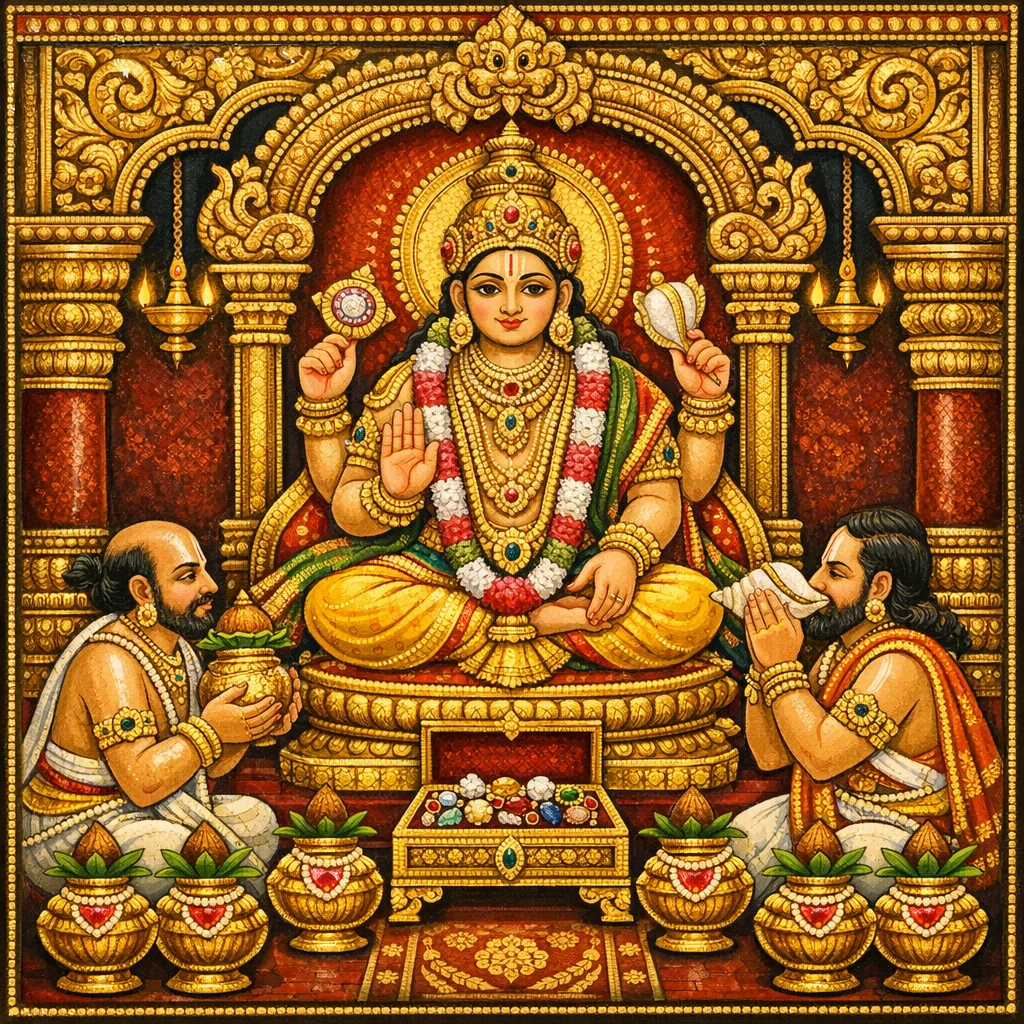
Agni sets forth a stepwise consecration manual (pratiṣṭhā-vidhi) centered on Vāsudeva/Hari. It begins with the spatial canon: the garbhagṛha is divided into seven sectors, and the image is established in the Brahmā-bhāga while honoring the allotted shares of gods, humans, and spirit-beings. The rite proceeds through piṇḍikā-sthāpana and, when required, ratna-nyāsa, linked with Narasiṃha oblations, varṇa-nyāsa, and the depositing of offerings (rice, gems, tridhātu, metals, sandalwood) into nine directional pits with Indra-ādi mantras, encircled by guggulu. A homa-square (khaṇḍila) is prepared; kalaśas are set in eight directions; fire is invoked with an eight-syllabled formula; Gāyatrī-led offerings culminate in pūrṇāhuti and śāntyudaka poured upon the deity’s head. The image is then conveyed in brahma-yāna, processed to the temple with song and Vedic sound, bathed with eight auspicious pots, and fixed at an auspicious lagna upon the pedestal with salutation to Trivikrama. The chapter culminates in inner theology as ritual: jīva-āvāhana and sānnidhya-karaṇa mark the descent of consciousness into the bimba, followed by installation of attendant deities, dikpālas, Garuḍa, and Viśvaksena, bali to bhūtas, and the ethics of dakṣiṇā—ending with a rule of standardization: root-mantras differ by deity, but the remaining procedure is shared across consecrations.
Shlokas
Verse 1
इत्य् आदिमहापुराणे आग्नेये अधिवासनं नाम ऊनषष्टितमो ऽध्यायः अथ षष्टितमोध्यायः वासुदेवप्रतिष्ठादिविधिः भगवानुवाच पिण्डिकास्थापनार्थन्तु गर्भागारं तु सप्तधा विभजेद् ब्रह्मभागे तु प्रतिमां स्थापयेद् बुधः
Thus, in the Agni Purāṇa—the primordial Mahāpurāṇa—ends the fifty-ninth chapter called “Adhivāsana” (the pre-consecratory lodging/infusion rite). Now begins the sixtieth chapter: “The procedure for the installation (pratiṣṭhā) of Vāsudeva and related rites.” The Blessed Lord said: “For the purpose of placing the piṇḍikā (pedestal-base), one should divide the garbhagṛha (sanctum) into seven parts; and in the ‘Brahmā-part’ (the central, most sacred sector) the wise should install the image (pratimā).”
Verse 2
देवमनुषपैशाचभागेषु न कदाचन ब्रह्मभागं परित्यज्य किञ्चिदाश्रित्य चाण्डज
O egg-born one, when allotting portions meant for the gods, humans, and piśācas (spirits), one should never abandon the share belonging to Brahman (the Brahmā/Brāhmaṇa portion). Rather, one should always set something aside, honoring and relying upon that Brahman-share.
Verse 3
देवमानुषभागाभ्यां स्थाप्या यत्नात्तु पिण्डिका नपुंसककशिलायान्तु रत्नन्यासं समाचरेत्
With careful effort, the piṇḍikā (pedestal-lump) should be installed, taking into account both the divine and the human portions, that is, the prescribed proportional divisions. And in the case of a “neuter” (gender-indeterminate) stone, one should duly perform the rite of depositing gems (ratna-nyāsa).
Verse 4
नारसिंहेन हुत्वा रत्नन्यासं च तेन वै चतस्रः स्थापयेच्च गा इति ग, घ, ङ, चिह्नितपुस्तकत्रयपठः घोषयेच्च ततो मखे इति ग, चिह्नितपुस्तकपाठः स्थापयेदाशु पिण्डिकामिति ङ, चिह्नितपुस्तकपाठः वर्णन्यासमिति ग, चिह्नितपुस्तकपाठः व्रीहीन् रत्नांस्त्रिधातूंश् च लोहादींश् चन्दनादिकान्
Having offered oblations with the Narasiṃha (mantra/rite), one should, by that very rite, perform the placement of gems (ratna-nyāsa). Then one should establish the four positions with the utterance “gā”. Thereafter, in the makha (sacrifice), one should make the prescribed proclamation; quickly place the piṇḍikā; and perform varṇa-nyāsa, the placement of syllables/letters. (One should arrange/offer) rice-grains, gems, the three metals/alloys (tridhātu), metals beginning with iron, and sandalwood and similar substances.
Verse 5
पूर्वादिनवगर्तेषु न्यसेन् मध्ये यथारुचि अथ चेन्द्रादिमन्त्रैश् च गर्तो गुग्गुलुनावृतः
In the nine pits beginning with the eastern one, he should place (the offerings/placements), arranging the middle one as he prefers. Then, with the mantras beginning with those of Indra and the others, the pit is to be covered or encircled with guggulu (aromatic resin), as fumigation or ritual coating.
Verse 6
रत्नन्यासविधिं कृत्वा प्रतिमामालभेद्गुरुः सशलाकैर् दर्भपुञ्जैश् च सहदेवैः समन्वितैः
Having performed the prescribed rite of gem-deposition (ratna-nyāsa), the preceptor (guru) should commence the consecratory handling of the image (pratimā), accompanied by ritual needles/pins (śalākā) and bundles of darbha-grass, together with the invocation of the attendant deities (sahadeva).
Verse 7
सवाह्यन्तैश् च संस्कृत्य पञ्चगव्येन शोधयेत् प्रोक्षयेद्दर्भतोयेन नदीतीर्थोदकेन च
After duly preparing (the place or object) with the prescribed auxiliary rites (vāhyanta), one should purify it with pañcagavya; and one should sprinkle it with water sanctified by darbha-grass, as well as with water from a river or a sacred ford (tīrtha).
Verse 8
होमार्थे खण्डिलं कुर्यात् सिकताभिः समन्ततः सार्धहस्तप्रमाणं तु चतुरस्रं सुशोभनं
For the performance of homa, one should prepare a khaṇḍila (homa-ground/altar space), spreading sand all around; it should measure one and a half hastas and be a well-formed, beautiful square.
Verse 9
अष्टदिक्षु यथान्यासं कलशानपि विन्यसेत् पूर्वाद्यानष्टवर्णेन अग्निमानीय संस्कृतं
He should arrange the ritual pots (kalaśas) as prescribed in the eight directions; then, beginning from the East, he should bring in the consecrated fire, invoking it with the eight-syllabled formula.
Verse 10
त्वमग्नेद्युभिरिति गायत्र्या समिधो हुनेत् अष्टार्णेनाष्टशतकं आज्यं पूर्णां प्रदापयेत्
Reciting the Gāyatrī beginning with “tvam agne dyubhiḥ …”, one should offer fuel-sticks (samidh) into the fire. Then, with the eight-syllabled mantra, one should offer eight hundred oblations of ghee (ājya), and finally perform the complete concluding oblation (pūrṇāhuti).
Verse 11
शान्त्युदकं आम्रपत्रैः मूलेन शतमन्त्रितं सिञ्चेद्देवस्य तन्मूर्ध्नि श्रीश् च ते ह्य् अनया ऋचा
Using mango leaves, one should sprinkle upon the deity’s head the pacificatory water (śānty-udaka) that has been empowered a hundred times with the Mūla-mantra, reciting: “May Śrī (prosperity) be yours—indeed—by this Ṛc (sacred verse).”
Verse 12
ब्रह्मयानेन चोद्धृत्य उत्तिष्ठ ब्रह्मणस्पते तद्विष्णोरिति मन्त्रेण प्रासादाभिमुखं नयेत्
Having lifted (the sacred object/deity) onto the Brahma-vehicle (brahma-yāna), one should recite, “Arise, O Brahmaṇaspati, Lord of Brahman,” and with the mantra beginning “tad viṣṇoḥ …” one should lead it facing toward the temple (prāsāda).
Verse 13
शिविकायां हरिं स्थाप्य भ्रामयीत पुरादिकं गीतवेदादिशब्दैश् च प्रासादद्वारि धारयेत्
Having installed Hari upon a palanquin (śivikā), one should carry Him around the city and its environs; accompanied by sounds of song, Vedic recitation, and the like, one should then station the palanquin or image at the doorway of the temple.
Verse 14
इतपुस्तकत्रयपाठः अष्टान्तेनाष्टशतकमिति ख, घ, चिह्नितपुस्तकद्वयपाठः शान्त्युदकमाज्यपात्रैर् इति ख, चिह्नितपुस्तकपाठः ब्रह्मपात्रेणेति ङ, चिह्नितपुस्तकपाठः गीतवाद्यादिशब्दैश् च इति ङ, चिह्नितपुस्तकपाठः स्त्रीभिर्विप्रैर् मङ्गलाष्टघटैः संस्नापयेद्धरिं ततो गन्धादिनाभ्यर्च्य मूलमन्त्रेण देशिकः
(Variant readings are noted in some manuscripts: “with the concluding eight (syllables) making the total one hundred and eight”; “with vessels of appeasement-water and ghee”; “with the brahma-vessel”; and “accompanied by sounds of song and instruments”.) Then, together with women and brāhmaṇas, using the auspicious set of eight ritual pots (aṣṭa-maṅgala ghaṭa), one should bathe Hari by abhiṣeka. Thereafter, the officiating teacher (deśika) should worship Him with sandalpaste and other offerings, reciting the root-mantra (mūlamantra).
Verse 15
अतो देवेति वस्त्राद्यमष्टाङ्गार्घ्यं निवेद्य च स्थिरे लग्ने पिण्डिकायां देवस्य त्वेति धारयेत्
Then, reciting the mantra beginning “ato deve…”, one should offer garments and the rest, and present the eightfold arghya (aṣṭāṅgārghya). At a steady and auspicious ascendant (lagna), one should fix it upon the piṇḍikā (pedestal), reciting “devasya tvam…”.
Verse 16
ॐ त्रैलोक्यविक्रान्ताय नमस्तेस्तु त्रिविक्रम संस्थ्याप्य पिण्डिकायान्तु स्थिरं कुर्याद्विचक्षणः
“Oṃ. Salutation to You, Trivikrama, who strode across the three worlds.” Having duly installed it, the discerning practitioner should make it firm and stable upon the piṇḍikā (pedestal).
Verse 17
ध्रुवा द्यौरिति मन्त्रेण विश्वतश् चक्षुरित्यपि पञ्चगव्येन संस्नाप्य क्षाल्य गन्धदकेन च
With the mantra “dhruvā dyauḥ” and also with “viśvataś cakṣuḥ,” one should bathe with pañcagavya; then wash it off, and further cleanse it with scented water.
Verse 18
पूजयेत् सकलीकृत्य साङ्गं सावरणं हरिं ध्यायेत् स्वं तस्य मूर्तिन्तु पृथिवी तस्य पीठिका
Having arranged the worship as a complete whole, one should worship Hari together with his limbs and attendant aspects, and with the surrounding enclosures (āvaraṇas). One should meditate on one’s own form as his embodiment; the Earth itself is his pedestal (pīṭhikā).
Verse 19
कल्पयेद्विग्रहं तस्य तैजसैः परमाणुभिः जीवमावाहयिष्यामि पञ्चविंशतितत्त्वगं
One should fashion his icon (vigraha) from luminous subtle particles. (Then the officiant declares:) “I shall invoke (āvāhana) the living presence (jīva) that is constituted of the twenty-five principles (tattvas).”
Verse 20
चैतन्यं परमानन्दं जाग्रत्स्वप्नविवर्जितं देहेन्द्रियमनोबुद्धिप्राणाहङ्कारवर्जितं
It is pure consciousness (caitanya), the supreme bliss—free from the waking and dream states; devoid of body, senses, mind, intellect, vital-breath (prāṇa), and egoity (ahaṅkāra).
Verse 21
ब्रह्मादिस्तम्बपर्यन्तं हृदयेषु व्यवस्थितं हृदयात् प्रतिमाविम्बे स्थिरो भव परेश्वर
O Supreme Lord, who abides in the hearts of all beings—from Brahmā down to a mere blade of grass—become steady, having been invoked from the heart into the reflected presence within this image.
Verse 22
सजीवं कुरु बिम्बं त्वं सवाह्याभ्यन्तरस्थितः अङ्गुष्ठमात्रः पुरुषो देहोपाधिषु संस्थितः
Make the image (bimba) as living, for you are present both outwardly and inwardly. The Person (puruṣa), of the measure of a thumb, abides within the bodily limiting adjuncts (upādhis).
Verse 23
ज्योतिर्ज्ञानं परं ब्रह्म एकमेवाद्वितीयकं सजीवीकरणं कृत्वा प्रणवेन निबोधयेत्
The Supreme Brahman is luminous consciousness—knowledge itself—one alone, without a second. Having vivified it and made it experientially present within oneself, one should realize it through the Pranava (Oṃ).
Verse 24
सान्निध्यकरणन्नाम हृदयं स्पृश्य वै जपेत् सूक्तन्तु पौरुषं ध्यायन् इदं गुह्यमनुं जपेत्
Touching the heart, one should indeed recite in japa the Heart-mantra called “Sānnidhya-karaṇa”, the rite that effects divine presence. And, meditating on the Pauruṣa Sūkta, one should recite this secret mantra-formula.
Verse 25
नमस्तेस्तु सुरेशाय सन्तोषविभवात्मने मङ्गलाष्टघटे इति ख, ग, चिह्नितपुस्तकद्वयपाठः ज्ञानविज्ञानरूपाय ब्रह्मतेजोनुयायिने
Salutation to you, O Lord of the gods—whose very nature is the prosperity born of contentment; who are the embodiment of knowledge and realized discernment (jñāna and vijñāna), ever aligned with the radiance of Brahman.
Verse 26
गुणातिक्रान्तवेशाय पुरुषाय महात्मने अक्षयाय पुराणाय विष्णो सन्निहितो भव
O Viṣṇu—who transcends the guṇas, the Supreme Person, the Great Self, the imperishable and the Ancient One—be present here before us.
Verse 27
यच्च ते परमं तत्त्वं यच्च ज्ञानमयं वपुः तत् सर्वमेकतो लीनमस्मिन्देहे विबुध्यतां
And whatever is your supreme Reality, and whatever is your knowledge-constituted form—let it be clearly understood that all of that, as one whole, has become merged in this very body.
Verse 28
आत्मानं सन्निधीकृत्य ब्रह्मादिपरिवारकान् स्वनाम्ना स्थापयेदन्यानायुधान् स्वमुद्रया
Having first established oneself in sacred presence (i.e., ritual proximity/identity), one should install Brahmā and the other attendant deities; and one should also install the other divine weapons by uttering their respective names and employing the prescribed hand-seals (mudrās).
Verse 29
यात्रावर्षादिकं दृष्ट्वा ज्ञेयः सन्निहितो हरिः नत्वा स्तुत्वा स्तवाद्यैश् च जप्त्वा चाष्टाक्षरादिकं
On seeing signs such as the (festival) procession and the ceremonial shower of offerings, one should understand that Hari (Viṣṇu) is present there. Having bowed and praised with stotras and the like, one should also repeat in japa the eight-syllabled mantra (aṣṭākṣara) and related (Viṣṇu) mantras.
Verse 30
चण्डप्रचण्डौ द्वारस्थौ निर्गत्याभ्यर्चयेद्गुरुः अग्निमण्डपमासाद्य गरुडं स्थाप्य पूजयेत्
The officiating teacher (guru), going out, should worship Caṇḍa and Pracaṇḍa who stand at the doorway. Then, having proceeded to the fire-pavilion (agni-maṇḍapa), he should install Garuḍa and perform his worship.
Verse 31
दिगीशान् दिशि देवांश् च स्थाप्य सम्पूज्य देशिकः विश्वक्सेनं तु संस्थाप्य शङ्खचक्रादि पूजयेत्
Having installed the lords of the directions and the deities in their respective quarters and duly worshipped them, the officiating preceptor should then install Viśvaksena and worship the conch (śaṅkha), discus (cakra), and the other emblems/attendant implements.
Verse 32
सर्वपार्षदकेभ्यश् च बलिं भूतेभ्य अर्चयेत् परमवस्त्रसुवर्णादि गुरवे दक्षिणां ददेत्
And one should offer a bali (ritual food-offering) to all attendant beings; one should also worship the bhūtas (elemental spirits). To the guru, one should give a dakṣiṇā consisting of excellent garments, gold, and the like.
Verse 33
यागोपयोगिद्रव्याद्यमाचार्याय नरोर्पयेत् आचार्यदक्षिणार्धन्तु ऋत्विग्भ्यो दक्षिणां ददेत्
A man should present to the officiating ācārya the materials and other requisites used in the sacrifice. Half of the ācārya’s dakṣiṇā, however, should be given as the sacrificial fee to the officiating ṛtvij priests.
Verse 34
अन्येभ्यो दक्षिणां दद्याद्भोजयेद् ब्राह्मणांस्ततः अवारितान् फलान् दद्याद्यजमानाय वै गुरुः
He should give dakṣiṇā to the others and then feed the Brāhmaṇas. The officiating guru should also give to the yajamāna the fruits—what is due and unobstructed—that have not been withheld.
Verse 35
विष्णुं नयेत् प्रतिष्ठाता चात्मना सकलं कुलं य इति ख, चिह्नितपुस्तकपाठः यच्च ते परमं गुह्यमिति ङ, चिह्नितपुस्तकपाठः यात्रावर्षादिकं कृत्वेति ख, चिह्नितपुस्तकपाठः अवारितफलमिति ङ, चिह्नितपुस्तकपाठः प्रतिष्ठाकृदिति ख, ग, घ, ङ, चिह्नितपुस्तकचतुष्टयपाठः सर्वेषामेव देवानामेष साधारणो विधिः मूलमन्त्राः पृथक्तेषां शेषं कार्यं समानकं
The consecrator (pratiṣṭhātā) should lead (the deity) as Viṣṇu; by that act, through himself, he brings along—purifying and elevating—his entire lineage. This is the common procedure for the installation of all deities: their mūla-mantras (root-mantras) are distinct for each, but the remaining ritual actions are performed in the same way.
Frequently Asked Questions
It prescribes dividing the garbhagṛha into seven parts and placing the image in the Brahmā-bhāga (the central, most sanctified sector), establishing spatial correctness as the foundation of consecration.
Ratna-nyāsa is explicitly required when the stone is described as ‘napuṃsaka’ (gender-indeterminate), indicating a compensatory sacralization step to stabilize and empower the icon’s ritual body.
After homa, abhiṣeka, and installation, it formalizes jīva-āvāhana and sānnidhya-karaṇa: the practitioner invokes consciousness constituted of the 25 tattvas, affirming nondual Brahman (one without a second) while ritually establishing divine presence in the image.
It concludes that the installation procedure is broadly common for all deities (sādhāraṇa-vidhi); only the mūla-mantras differ, while the remaining ritual sequence is performed similarly.