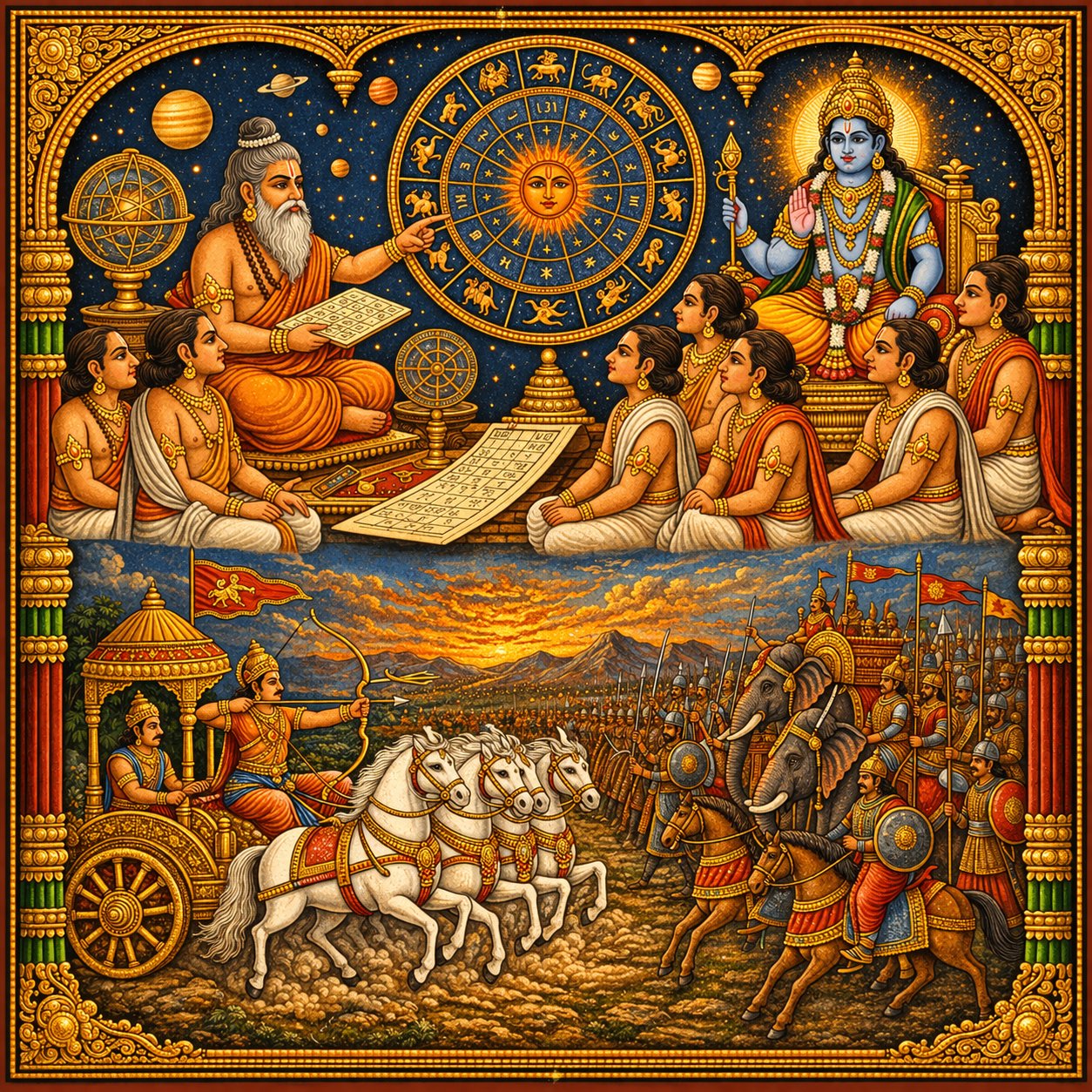
Jyotisha & Yuddhajayarnava
Astrology & Military Strategy
Covers Vedic astrology (jyotisha) including planetary movements, omens, and muhurtas alongside military strategy and the science of warfare victory.
Adhyayas in Jyotisha & Yuddhajayarnava
Adhyaya 121
अध्याय १२१ — ज्योतिःशास्त्रम् (Jyotiḥśāstra / Astral Science)
Lord Agni introduces Jyotiḥśāstra as a discriminative science for judging auspicious and inauspicious outcomes, offered as a condensed essence of comprehensive knowledge. The chapter then serves as a prescriptive muhūrta manual: it governs marriage compatibility through nakṣatra (lunar-mansion) relations (avoiding ṣaṭkāṣṭaka), warns against unions under certain planetary exchanges and combustions (notably Jupiter–Venus conditions), and sets restriction windows during Jupiter’s retrograde or overly swift motion. It extends timing rules to saṃskāras (puṃsavana, annaprāśana, cūḍā/karṇavedha, and upanayana-related rites), to medicine, bathing for disease-release, and commerce (buying versus selling under specific nakṣatras). A second layer introduces mantra-technology and yantra-like applications (Śrīṃ–Hrīṃ sampuṭa; stambhana; mṛtyu-nivāraṇa) integrated into the timing framework. The chapter also outlines astrological diagnostics: house-based results, navatārā-bala/tārā-bala classifications, Tripuṣkara combinations, saṅkrānti omens via karaṇas, eclipse-merit doctrine, and finally planetary daśā durations. Throughout, Agni presents right timing as a dharma-tool governing ritual efficacy, social stability, prosperity, and protection.
Adhyaya 122
Chapter 122 — Kāla-gaṇana (Computation of Time)
Agni begins a technical exposition on orderly time‑reckoning (samāgaṇa), grounded in solar motion and the lunar months beginning from Caitra. The chapter sets out a rule‑based computational scheme using encoded number‑terms and positional operations to derive calendrical factors: vāra (weekday), tithi (lunar day), nāḍī/ghaṭikā (time units), nakṣatra (lunar mansion), yoga, and karaṇa. It details stepwise arithmetic—subtractions, multiplications by 60, quotient‑remainder handling (including “debt”/negative values), and month‑by‑month corrections—along with special cases such as reverse counting from certain rāśis (zodiac signs) and situations of impurity or procedural variance requiring compensatory offerings proportional to the computed discrepancy. The method culminates in rules for stabilizing yoga by equating Sun and Moon measures and for determining karaṇas (including Kintughna at Pratipad), presenting precise calendrics as a dharmic technology that secures ritual timing, social order, and alignment of action with cosmic law.
Adhyaya 123
युद्धजयार्णवीयनानायोगाः (Various Yogas from the Yuddha-jayārṇava)
After concluding the prior unit on kāla-gaṇana (time computation), Lord Agni begins a war-victory digest drawn from the Yuddhajayārṇava. The chapter classifies phonemes and tithis into operational groups (starting with Nandā), assigns letter-ranges to planetary rulers, and thus frames divination as a coded linguistic–astral grid. It introduces diagnostic and measurement themes—nāḍī-spandana, ucchvāsa, and pala—linking bodily pulse and time-units to prognostic reading. It then develops cakra-based war astrology (Svarodaya-cakra, Śani-cakra, Kūrma-cakra, Rāhu-cakra), detailing divisions, directional placements, and death-giving portions, along with nakṣatra/muhūrta naming that governs what actions suit which times. Finally it turns to protection and victory practice: Bhairava-mantra applications (śikhā-bandha, tilaka, añjana, dhūpa-lepana) and wearable herbs and vaśīkaraṇa formulations (tilakas, lepas, oils). Through these layers, the chapter presents Agneya vidyā as a synthesis of Jyotiṣa, ritual technology, and applied pharmacology in service of dharma-guided victory.
Adhyaya 124
Chapter 124 — युद्धजयार्णवीयज्योतिःशास्त्रसारः (Essence of the Jyotiḥśāstra of the Yuddhajayārṇava)
This chapter inaugurates the Yuddhajayārṇava-oriented Jyotiḥśāstra by tying martial victory to a sacral-technical system of phonemes, bīja-syllables, the mantra-seat (mantra-pīṭha), bodily channels (nāḍīs), and auxiliary substances such as oṣadhi (herbs). Agni, echoing Īśvara’s instruction to Umā, teaches that victory in war arises from correct discernment of auspicious and inauspicious factors and from precise ritual–phonetic correspondences. It then grounds all mantra-power in cosmogony: Śakti manifests as a fifteen-syllabled potency from which the universe unfolds; the “five mantras” generate the mantra-pīṭha, described as the life-and-death principle of all mantras. A structured set of correspondences follows—Vedic mantras and deities, vowels as kalās rooted in Brahman, inner nāda and liberation-signifying ikāra, and further mappings to senses, śaktis, and nāḍīs. The chapter culminates in applied rite: aṅga-nyāsa and worship of Mṛtyuñjaya for battlefield victory, while insisting that when the mantra-seat is “lost,” mantric vitality is effectively dead, hence the need for disciplined preservation of mantra’s doctrinal and embodied seat.
Adhyaya 125
Adhyāya 125 — Karṇamoṭī Mahāvidyā, Svarodaya-Prāṇa Doctrine, and Yuddha-Jaya Jyotiṣa
Lord Agni teaches Vasiṣṭha a war-focused body of knowledge that blends mantra-vidyā, subtle physiology, and battle Jyotiṣa. It begins with the Karṇamoṭī-mantra as a wrathful operative formula for marana/pātana, mohana, and uccāṭana, then re-frames Karṇamoṭī as a mahāvidyā grounded in svarodaya (vowel-flow) and the movement of prāṇa between nābhi and hṛd. Tactical guidance follows through vulnerable-point logic (ear/eye piercing) and inner targeting (heart–pāyu–throat) to counter fevers, burning afflictions, and hostile forces. A cakra-based deity taxonomy comes next: śaktis assigned to Vāyu-cakra, Tejas, and Rasacakra, including 32 mātṛkās arranged in octets. The text then formalizes phonetic varga-power for victory (pañcavarga) and expands into Jyotiṣa—tithi–nakṣatra–vāra combinations, aspects (dṛṣṭi), “full/empty” sign logic, and planet-result heuristics for war. Omens (bodily signs), Rāhu-cakra directional sequencing, and victory conditions culminate in stambhana rites, herb/amulet protections, a cremation-ground fire operation, and a Hanumān paṭa whose mere sight routs enemies.
Adhyaya 126
Chapter 126 — Nakṣatra-nirṇaya (Determination of the Lunar Mansions) and Rāhu-Based Victory/Defeat Omens
Īśvara presents a “nakṣatra-bodied sphere” for judging auspicious and inauspicious results by mapping the Sun’s current nakṣatra onto bodily regions (head, face, eyes, heart, limbs, waist, tail). The chapter then turns to Yuddhajayārṇava-style war prognostics: a Rāhu “serpent-hood” diagram made by marking 28 dots and arranging the 27 nakṣatras from the nakṣatra occupied by Rāhu; certain placements (especially seventh-related indications) signify fatality or defect in battle, while others promise honor, victory, and fame. It next lists planetary presiders of yāma half-divisions and gives a tactical rule: keeping Saturn, the Sun, and Rāhu “behind” brings success in battle, travel, and even gambling. Nakṣatras are then classified by functional types (fixed, swift, gentle, fierce; Pitṛ/Nairṛta affiliations) for choosing muhūrta for journeys, installations, construction, excavation, and royal rites. Finally, it states tithi “burning” rules, defines Tripuṣkara (tithi–weekday–nakṣatra sets) that amplify outcomes, notes travel-and-return indicators, and warns against Gaṇḍānta and other dangerous junctions where even auspicious rites and childbirth are said to carry grave risk.
Adhyaya 127
Determination of the Nakṣatras (नक्षत्रनिर्णयः) — Chapter Conclusion Notice
This unit serves as a textual hinge: it formally closes the preceding adhyāya, “Nakṣatra-nirṇaya” (determination of the nakṣatras), and signals a transition into a more applied jyotiṣa section focused on victory-omens. By marking the completion of nakṣatra determination, the Purāṇa shifts from classificatory astral doctrine to electional and operational guidance—how time-signatures and celestial factors are to be handled in real undertakings. In the Agni Purana’s encyclopedic method, such colophons are not mere scribal notes; they preserve a curriculum-like progression from astronomical/astrological foundations (nakṣatra taxonomy) to decision rules relevant to rājadharma, campaigns, and public life.
Adhyaya 128
The Koṭacakra (कोटचक्रम्) — Fort-Diagram and Nakṣatra-Directional Mapping for Victory
Continuing the Yuddhajayārṇava teaching, Īśvara explains the Koṭacakra as a technical fort-diagram made of nested squares—an outer fort, an inner square, and a central square. The chapter then applies Jyotiṣa to spatial strategy by assigning rāśis and specific nakṣatras to directions and to nāḍī divisions, distinguishing an outer channel (vāhya-nāḍī) from an inner/central nāḍī within the koṭa. This directional astrology is made practical: benefic planets joined with the relevant nakṣatras in the fort’s central sector indicate victory, while certain central combinations warn of disruption. Finally, omen-theory becomes procedure—rules for entry and exit based on ingress/egress nakṣatras, with judgment aided by Venus, Mercury, and Mars, and by intelligence indicators (cāra-bheda). Thus geometry, time-reckoning, and celestial signs are integrated as a dharma-coded, divine strategy for securing a fort and meeting predictable outcomes without astonishment.
Adhyaya 129
अर्घकाण्डम् (Argha-kāṇḍa) — Standards of Argha and Month-wise Prescriptions under Portent Conditions
Within the Yuddhajayārṇava stream, Lord Agni turns from tactical diagrams to the dharmic economics of response when ominous signs arise. He defines argha as a calibrated standard of offering and counter-gifting, triggered by public portents—meteor-fall, earthquake, ominous thunder, eclipse, comet-appearance, and directional conflagrations—which Jyotiṣa reads as disturbances needing ritual and material stabilization. The teaching becomes calendrical: one should track such signs month by month and scale the collection and gifting of valuables accordingly. Caitra intensifies effects within a six‑month horizon; Vaiśākha requires a sixfold increase of the gathered store; Jyaiṣṭha and Āṣāḍha stress staple grains (barley, wheat). Later months prescribe proper media: ghee/oil (Śrāvaṇa), garments and grains (Āśvina), grains (Kārttika), purchased gift-items (Mārgaśīrṣa), saffron/perfumes (Puṣya), grains (Māgha), and purchased aromatics (Phālguna). Thus the chapter unites omen-science, seasonal economy, and dharmic gifting into a single war-auspice protocol, where social provisioning and ritual correctness become instruments of resilience and victory.
Adhyaya 130
Chapter 130: घातचक्रम् (Ghāta-cakra) — Maṇḍalas, Portents, and Regional Prognostics for Victory
Lord Agni opens the Ghāta-cakra teaching by setting out victory-seeking maṇḍalas in four divisions, then detailing the Agneya Maṇḍala and its lakṣaṇas. The chapter lists ominous atmospheric and celestial signs—abnormal winds, solar/lunar halos, earthquakes, terrifying thunder-crashes, eclipses, comets, smoky flames, blood-rain, oppressive heat, and stone-falls—and links them to social and ecological distress (disease, famine, low milk yield, crop loss). It then projects these omens onto geopolitical space: parts of the Uttarāpatha and other janapadas are said to decline when portents arise under particular nakṣatras, while other nakṣatra-classes are grouped by directional/elemental lordship (Vāyavya, Vāruṇa, Māhendra), yielding outcomes from ruin to health and abundance. The discourse further turns to administrative-astral diagnostics through village types (mukha-grāma and puccha-grāma) and a configuration of Moon–Rāhu–Sun in one sign, concluding with a rule for determining Soma-grāma at a tithi-junction. Overall, the chapter exemplifies Agneya Vidyā: war-astrology and state prognostics as Dharma-protecting applied science.
Adhyaya 131
Ghāta-cakra and Related Diagrams (घातचक्रादिः)
Lord Agni, speaking as Īśvara, teaches in the Yuddhajayārṇava a structured Jyotiṣa method for deciding war outcomes. He first prescribes cyclic diagrams: vowels set by directions in clockwise order, months from Caitra rotated on a wheel, and tithis from Pratipat to Pūrṇimā marked; auspiciousness is read from specific “contacts” in the Caitra-cycle, with uneven/odd patterns favorable and even patterns unfavorable. Victory and defeat are then linked to nāma-akṣara and svara (short/long vowel) logic, where metrical placement and the rise of vowels at the beginning or end of an utterance are taken as omens of death or triumph. The Naracakra is described as an aggregate of nakṣatras mapped onto a body-figure through nyāsa placements (head, mouth, eyes, hands, ears, heart, feet, secret region), and a lethal yoga is stated when the Sun shares a nakṣatra with Saturn, Mars, and Rāhu. Finally, the Jayacakra is outlined through alphabetic inscription and line-grids, assigning cosmological categories (directions, grahas, sages, tithis, nakṣatras, etc.), computing name-derived totals divided by eight (Vasus), and ranking relative strengths by symbolic animals—forming a compact Agneya Vidyā of war-omens.
Adhyaya 132
Adhyaya 132 — Sevā-cakra and Tārā-cakra (Indicators of Gain/Loss, Compatibility, and Risk)
Lord Agni introduces the Sevā-cakra, a jyotiṣa-based diagnostic wheel for reading lābha–alābha (gain and loss), with special focus on relational and dependency ties—father, mother, siblings, and spouses. The chapter explains how to construct the wheel as a 35-cell grid by vertical and horizontal divisions, place letters using vowels and sparśa consonants, and interpret results through phonetic classification of names. Outcomes are sorted into auspicious accomplishment states (siddha, sādhya, susiddha) and perilous states (ari, mṛtyu), with clear cautions to avoid enemy/death indicators when undertaking actions. A parallel taxonomy links phonetic groups to classes of beings (devas, daityas, nāgas, gandharvas, ṛṣis, rākṣasas, piśācas, humans), forming a comparative ladder of “strength” while enforcing dharmic restraint: the strong should not oppress the weak. The chapter then adds the Tārā-cakra method—derive the nakṣatra from the name’s initial syllable and compute results by mātrā counting and division by twenty, yielding categories such as janma, sampat, vipat, kṣema, and others. Finally, it lists sign-to-sign friendship and hostility pairings (rāśi-maitrī) and warns against serving under a “friend” sign, integrating relationship strategy with predictive technique.
Adhyaya 133
Chapter 133 — Various Strengths (Nānā-balāni) in Jyotiṣa and Battle-Protection Rites
Lord Agni continues the Yuddhajayārṇava teaching by tying Jyotiṣa diagnostics to battlefield success. He describes the ideal bodily marks of a “field-lord” (kṣetrādhipa)—balanced build and constitution—and correlates the placements of Sun, Moon, Mars, Mercury, Jupiter, Venus, and Saturn with temperament and fortune. He then lists daśā-fruits (wealth, land, royal prosperity) and teaches omen-reading through nāḍī flow (left/right breath) and the parity of name-syllables, applying these to trade and war outcomes. The chapter turns to operative Agneya Vidyā: Bhairava-centered weapon-mantras with nyāsa and japa to rout and scatter enemies; army-breaking rites using cremation-ground substances and name-inscription on a drawn effigy. A Garuḍa/Tārkṣya-cakra is given for victory and for neutralizing poisons and spirit/graha afflictions through visualization and syllabic placements. Protective methods culminate in the Picchikā rite (eclipse-japa), distance-repulsion (bhaṅga), Mātṛkā vidyās written on leaves, a seed-enclosed rakṣā-yantra with lotus-petals and phonemic layout, the Mṛtyuñjaya formation, and the Bhelakhī vidyā against hostile magical death—ending with the claim of unconquerability in sword-combat.
Adhyaya 134
Adhyāya 134 — त्रैलोक्यविजयविद्या (Trailokya-vijayā Vidyā)
This chapter presents the Trailokya-vijayā, a victory-granting vidyā taught by Īśvara, as a countermeasure that “crushes” hostile yantras and obstructing forces. It first preserves recensional variants that shade the mantra’s epithet—stressing sorrow-destruction, the power to overpower other mantras, and the removal of enemy, disease, and death—before giving the core revelation. The rite centers on invoking Jaya in a fierce, wrathful form: blue-hued, attended by preta-gaṇas, visualized as twenty-armed, with a mantra sequence commanding piercing, cutting, and triumphant conquest “over the three worlds.” The practitioner performs pañcāṅga-nyāsa and offers red flowers into the fire (homa), joining inner sacralization (nyāsa) to outer oblation. A supplementary formula lists coercive operations—stambhana, mohana, drāvaṇa, ākarṣaṇa—along with cosmic hyperboles (moving mountains, drying oceans), and culminates in an enemy-subduing application using an earthen image linked to a serpent-name.
Adhyaya 135
Chapter 135: सङ्ग्रामविजयविद्या (Saṅgrāmavijayavidyā) — The Vidyā for Victory in Battle
This chapter closes the prior “Trilokyavijaya-vidyā” unit and turns to the Saṅgrāmavijayavidyā within the Yuddhajayārṇava. Īśvara teaches a padamālā (mantra-garland) for stambhana/bandhana-style protection: binding mouth and eyes, restraining hands and feet, and neutralizing hostile duṣṭa-grahas (malevolent seizing forces). The formula expands to a cosmic binding—directions, intermediate directions, what is below, and finally “all”—casting victory as a total-field containment rite. Practical application is given through ash, water, clay, or mustard seeds, followed by the “pātaya” (make fall/overthrow) command and an invocation of Cāmuṇḍā sealed with bīja-like sounds such as “vicce huṃ phaṭ svāhā.” Efficacy is tied to disciplined homa, japa, and pāṭha, and to visualizing a 28-armed deity-form bearing a vast arsenal (sword, shield, mace, staff, bow and arrows, conch, banner, vajra, discus, axe, drum, mirror, śakti-spear, javelin, plough, noose, etc.). The chapter concludes by noting specialized homas (Tarjayantī, Mahīṣa-ghātanī) and restricting transmission of a sesame-and-three-honeys homa, stressing initiatory ethics and controlled dissemination of potent ritual technology.
Adhyaya 136
The Nakṣatra Wheel (नक्षत्रचक्रम्)
In Chapter 136, Lord Agni introduces a practical jyotiṣa device, the nakṣatra-cakra (nakṣatra wheel), for deriving indications for undertakings such as journeys. The wheel is drawn beginning from Aśvinī and arranged in three concentric bands (tri-nāḍī), signifying layered channels of interpretation. The chapter lists nakṣatra groupings with their syllable/mudrā markers (e.g., Muṣṭi–Mudgara, Ṛṣṭi–Mudgara, and sets with Abhaya, Svastika, Stambhikā), implying a coded operational taxonomy for reading outcomes. It further maps certain nakṣatras (Kṛttikā, Rohiṇī; Citrā, Svātī, Viśākhā; Śravaṇā, Revatī) to phonetic markers (Ahi, Bhaṁ), strengthening the wheel’s mnemonic logic. This construct is called the Phaṇīśvara (Serpent-Lord) cakra, and auspiciousness or inauspiciousness is judged from graha configurations conjoined with the tri-nāḍī. A key omen-rule states that conjunctions involving the Sun, Mars, Saturn, and Rāhu are inauspicious, though favorable conditions can turn results auspicious, with interpretations extended to locality (country/village) and relationships (brother, wife, and so on).
Adhyaya 137
Adhyāya 137 — महामारीविद्या (Mahāmārī-vidyā)
This chapter begins immediately after the close of the nakṣatra-cakra section, turning from astral cataloguing to a crisis-protective rite: Mahāmārī-vidyā, a spell/observance to repel calamity and hostile powers. Īśvara teaches a structured nyāsa (heart, head, topknot, armor, and weapon-mantra), invoking fierce forms—Mahāmārī, Kālarātrī, and Mahākālī—thereby ritually “arming” the practitioner. It then prescribes iconography and ritual graphics: a square diagram drawn on a cloth linked with death-impurity, showing a black, three-faced, four-armed figure holding bow, trident, chopper, and skull-staff (khaṭvāṅga), facing east. Other dreadful and auspicious aspects are described, including a terrifying red-tongued form in the southern quarter and a beneficent white form worshipped facing west with fragrant offerings. The chapter proceeds to operational war-rites: mantra recollection for destroying disease and exerting control, and homa formulas with specified fuels and additives to afflict the enemy—bringing suffering, death, expulsion (uccāṭana), and harassment/attrition (utsādana). Finally it outlines battlefield deployment—display of banner/paṭa, accompaniment by maidens, visualization of the enemy’s immobilization—culminating in a guarded transmission of stambhana as Trailokyavijayā Māyā identified with Durgā/Bhairavī, and closing with name-evocations (Kubjikā, Bhairava, Rudra, and Narasiṃha-related forms).
Adhyaya 138
अध्याय १३८: षट्कर्माणि (The Six Ritual Operations)
Īśvara sets out the framework of ṣaṭkarmāṇi—the six operative ritual aims used in mantra systems—and begins with the core technical rule for mantra-inscription: the sādhya (intended target/objective) is written in prescribed positions in relation to the mantra. The chapter then lists arrangement-traditions (sampradāya) that act like ritual “syntax”: pallava (a powerful ucchāṭana-oriented formula), the yoga-method (for uprooting hostile lineages), rodhaka (for stambhana and other restraining acts), and sampuṭa (a protective enclosure for vaśīkaraṇa/ākarṣaṇa). It also notes interweaving patterns such as vidarbha and syllable-by-syllable placement rules. Operational guidance includes timing (ākarṣaṇa in spring) and the proper use of mantra exclamations—svāhā, vaṣaṭ, and phaṭ—according to desired effects (pacification, prosperity, attraction, repulsion, breaking, and peril). The chapter closes with a victory-protective sequence invoking Yama, followed by night-omens/knowledge, Durgā-protection, and a Bhairavī japa formula for enemy-destruction—presented as a disciplined, lineage-mediated technology within dharma.
Adhyaya 139
Chapter 139 — षष्टिसंवत्सराः (The Sixty Years)
Continuing the Yuddhajayārṇava’s pragmatic bent, Īśvara sets out the sixty-year saṃvatsara cycle as a jyotiṣa framework for judging auspicious and inauspicious outcomes relevant to kingship and society. Named years (such as Prabhava, Vibhava, Prajāpati, Aṅgirā, Īśvara, Pramāthī, Vikrama, Durmukha, Hemalamba, Vilamba) are correlated with signs: the prosperity of yajña, public happiness, crop yield, rainfall patterns (moderate or excessive), health and disease, loss of wealth, social harshness, and prospects of victory. The chapter also introduces omen-like readings—blood-like discharges, bloodshot eyes, a tawny sky, surging waters, and ‘siddhārtha/raudra/durmati/dundubhi’ conditions—treating them as time-linked signals for policy, military caution, and welfare measures. The result is a compact, state-facing jyotiṣa manual in which cosmic time becomes actionable intelligence for sustaining dharma, abundance, and strategic success.
Adhyaya 140
Adhyāya 140 — वश्यादियोगाः (Vaśyādi-yogāḥ): Sixteen-Square Diagram, Herb-Lists, and Encoded Formulas for Subjugation, Protection, and Prosperity
Lord Agni presents the technical rite-set called vaśyādi-yoga—procedures for influence, attraction, and allied effects—organized through a dvyaṣṭa-pada (sixteen-square) diagram. The chapter opens with manuscript-aware titling and variant readings, then gives a materia-medica register listing herbs and synonyms (e.g., bhṛṅgarāja, sahadevī, putrañjīva/kṛtāñjalī, viṣṇukrāntā/śita-arkaka), reflecting practical pharmacology. The rite is then mapped by positional deities and categories (ṛtvij, nāga, muni/manu, śiva, vasu, dik, rasa, veda, graha, ṛtu, sūrya, candra), aligning cosmology with the diagram and the body. A procedural sequence follows—dhūpa (fumigation), udvartana (unction), añjana (collyrium), snāna (bathing), and multiple lepa (pastes)—with emphasis on an all-purpose dhūpa and the honor gained by the anointed practitioner. Formula-groups are distinguished by use (house-perfuming, eye-collyrium, bathing, eating, drinking, tilaka), culminating in guṭikā (pills) and lepa for vaśya, weapon-stoppage, water-safety, fertility, easy childbirth, and begetting a son, often via encoded bhūta-saṅkhyā ingredient counts. The close affirms the efficacy (prabhāva) of herbs assigned to the ṛtvij-pada, highlighting the Agni Purana’s hallmark: technical ritual science framed as sacred, systematized knowledge.
Adhyaya 141
Ṣaṭtriṃśat-padaka-jñāna (Knowledge of the Thirty-Six Padakas) — Mṛtasañjīvanī-Rasāyana and Coded Therapeutic Counts
Lord Agni (Īśvara) introduces a technical regimen called the “Thirty-Six Padakas,” a rasāyana science of rejuvenation revered by Brahmā, Rudra, and Indra. The chapter lists thirty-six medicinal substances (dravyas) and teaches that, when compounded in ordered preparations named in sequence (such as Ekādi and onward), they become universal disease-removers and bestow amarī-karaṇa—vitality akin to deathlessness. It sets out dosage ranges and many modes of administration (powder, pills, electuary/avaleha, decoction, sweet bolus, and jaggery–sugar confections), including repeated impregnation with expressed juice to intensify potency. Striking results are claimed: easing of wrinkles and greying, systemic efficacy across the body’s koṣṭhas, and an ideal lifespan of three hundred years under disciplined conduct. A distinctive jyotiṣa-like layer appears through coded enumerations and timing/count schemes (tithi and solar measures; code-terms such as vāṇa, ṛtu, śaila, vasu; references to planetary and eclipse rites), linking therapeutics to calendrical and ritual order. The chapter ends with an explicit ethic of secrecy: this padaka-knowledge is not to be given indiscriminately.
Adhyaya 142
Mantrāuṣadha-ādi (Mantras, Medicinal Herbs, and Ritual Diagrams for Protection and Victory)
Lord Agni begins a technical exposition within the Yuddhajayārṇava, teaching Vasiṣṭha that victory-practice unites mantra, auṣadha (medicinal herbs), and protective cakra/rekhā diagrams. The chapter opens with name-based (nāma) and letter/mātrā computations for natal and horary interpretation, including even/odd letter rules and metrical/guṇa assessment. It then turns to tactical Jyotiṣa: Śani-cakra considerations, avoidance of certain divisions (including specified prahara/yāma partitions), and assigning “day-Rāhu” and “tithi-Rāhu” to directions for battlefield advantage. Diagram methods (mūlabhedaka lines; an eight-line Viṣṭi–Rāhu routing through deities/directions) link astral timing to spatial strategy, with wind-direction treated as an actionable omen. The chapter concludes with applied protection: herbs gathered under Puṣya to ward off missiles and blades, and a powerful multi-bīja protective mantra for graha afflictions, fevers, spirit-troubles, and general rites—showing Agneya Vidyā as a synthesis of cosmology, ritual technology, and pragmatic defense.
Adhyaya 143
Chapter 143 — Worship of Kubjikā (कुब्जिकापूजा)
This chapter shifts from mantras and medicinal remedies to a Śākta-tantric victory rite within the Yuddhajayārṇava. The Lord teaches a stepwise (krama) worship of Kubjikā as “sarvārtha-sādhanī,” able to accomplish comprehensive aims, including success in battle when joined with consecrated substances—especially ājya/ghee—and weapon-empowerment. The rite is technically framed through chakra-pūjā markers, bīja syllables, and a nyāsa that installs mantras on bodily loci (secret organ, hand, heart, head), transforming the practitioner into a consecrated field of power. This power is then externalized into a maṇḍala: astra, kavaca, netra, śikhā and related mantras are stationed in the directional quarters, while an essential multi-syllabic bīja is स्थापित in a 32-petalled core. The ritual expands by pantheon-logic: the Mātṛkās emanate from Caṇḍikā’s supremacy; sacred pīṭhas and directional placements are invoked; and the Vimalapañcaka is distributed across quarters and peaks. It concludes with an ordered mandala population—Gaṇapati/Vaṭuka, gurus, nāthas, and surrounding deities—centering Kubjikā (and Kulaṭā) as the constant focus of sequential worship for protection, mastery, and dharmically framed victory.
Adhyaya 144
Adhyāya 144 — Kubjikā-pūjā (कुब्जिकापूजा)
Lord Īśvara introduces the Kubjikā worship system as a means to secure victory in the puruṣārthas (dharma, artha, etc.), allowing the sādhaka to worship either with the mūla-mantra alone or with the full retinue. The chapter sets out a stepwise procedure: recitation of the extended Kubjikā mantra, followed by kara-nyāsa and aṅga-nyāsa, and the performance of the three sandhyās in the ordered modes Vāmā, Jyeṣṭhā, and Raudrī. A Kaula-style gāyatrī proclaims Kubjikā as sovereign of kula-vāk and as Mahākālī, and the rite expands into pādukā-veneration through structured name-series (including one said to be sixty, ending in namo). The text details mandalic placements, directional worship, bali formulas, and bīja-syllable assignments, culminating in meditation on the Goddess as the 32-letter totality—dark like a blue lotus, six-faced, twelve-armed—adorned with nāga symbolism and bearing weapons and implements. Purification triads (vidyā–devī–guru), site/seat enumerations, and śakti arrays (mātṛkās and ḍākinī groups) are integrated, presenting a complete Agneya ritual-technology where mantra, body-installation, and cosmographic ordering converge into a disciplined victory-sādhana.
Adhyaya 145
Chapter 145: Mālinīnānāmantrāḥ (The Various Mantras of Mālinī)
Īśvara presents a disciplined mantric-ritual regimen centered on Mālinī, explicitly to be preceded by ṣoḍhā-nyāsa (sixfold installation). Nyāsa is framed as a threefold system—Śākta, Śāmbhava, and Yāmala—linking phonemic structure (śabda-rāśi), tattva-theory (three principles), and embodied placement. The chapter then lists metrical/mantric divisions (Vanamālā of twelve syllables; Ratnapañcātmā of five units; Navātmā of nine units) and Śākta-specific subdivisions such as a tri-vidyā form with sixteen pratirūpas (marked by jha), an adhor-aṣṭaka, and a dvādaśāṅga structure. Seed-syllables and weapon-mantras culminate in a universally efficacious formula—“krīṃ hrauṃ klīṃ śrīṃ krūṃ phaṭ” (phaṭ thrice)—praised as sarva-sādhaka. A long technical body-mapping follows, installing syllables and named śaktis/deities on head, eyes, ears, mouth, teeth, throat, shoulders, arms, fingers, hips, navel, heart, thighs, knees, shanks, feet, and subtle tissues (blood, flesh, bone, marrow, semen, prāṇa, kośa). The chapter closes by asserting that worship of the Rudra-Śaktis, empowered by the Hrīṃ bīja, grants comprehensive attainment, exemplifying the Agni Purāṇa’s fusion of practical ritual technology with dharmic and spiritual aims.
Adhyaya 146
Chapter 146 — Aṣṭāṣṭaka Devī-s (अष्टाष्टकदेव्यः)
Lord Agni (speaking here as Īśvara’s voice) introduces Trikhaṇḍī—Brahmā, Viṣṇu, and Maheśvarī—as a mantra-structure bound to the secret “Heart” (hṛdaya) of the Mothers (Mātṛkā). The Mothers are presented as operative powers: they accomplish aims, remain undecaying, move unobstructed, and bring about subjugation, expulsion, and uprooting—especially to cut hostile rites and secure siddhi. The chapter then supplies mantra-units ending in “vicce svāhā,” notes manuscript variants, and lays down technical counts (pada/word totals and placement within a larger mantra-corpus). It prescribes japa and worship with five praṇava boundaries and insertion of the Kubjikā-hṛdaya at word-junctions (pada-sandhi), followed by phonetic placement rules (“middle-of-three” arrangements), Śikhā-Śivā/Bhairava formulas, and three-syllable bīja sets with/without seeds aligned to the 32-letter sequence. The latter half catalogs goddess-names by kula/lineage—Brahmāṇī, Māheśvarī, Kaumārī, Vaiṣṇavī, Vārāhī, Aindrī, Cāmuṇḍā, Mahālakṣmī—emphasizing maṇḍala worship for jaya (victory) in a Yuddhajayārṇava register.
Adhyaya 147
Adhyāya 147 — Guhyakubjikā-Tvaritā Mantra: Upadrava-Śānti, Stambhana–Kṣobhaṇa, and Nyāsa for Jaya (Victory)
In this adhyāya, Īśvara teaches a forceful mantra-technology of protection and victory centered on Guhyakubjikā and Tvaritā. The rite pacifies “upadrava” (afflictions) arising from hostile ritual acts—yantra, mantra, tantra, and powdered applications—covering past, present, and future agency (done, caused, doing, will do). It then lists specialized mantra-functions (kṣobhaṇa, ākarṣaṇa, vaśya, mohana, stambhana) and gives the bīja phonology and varṇa cues used in practice. A Tvaritā mantra-formula for jaya (victory) is provided with a complete nyāsa scheme—āsana, hṛdaya, śiras, śikhā, kavaca, netra, and astra mantras—explicitly sealed with “phaṭ” endings. Nine śaktis are named as operative powers, and the Dūrīs (directional/quarter guardians) are invoked, uniting spatial protection with internal limb-installation. The chapter closes by mapping bījas to deities (Brahmā, Āditya) and reaffirming force-terms like dāruṇa and phaṭ as constant protective operators, linking mantra-discipline to controlled efficacy in conflict, adversity, and ritual defense.
Adhyaya 148
Saṅgrāma-Vijaya-Pūjā (सङ्ग्रमविजयपूजा) — Rapid Worship and Sūrya-Mantra for Victory
In this adhyaya, Īśvara teaches a concise war-victory liturgy centered on Sūrya as the giver of saṅgrāma-jaya (battlefield success). It begins with mantra-nyāsa through Sūrya’s ṣaḍaṅga (six-limbed) formulae, establishing protection, potency, and ritual completeness before entering conflict. Worship then invokes an eightfold set of excellences starting with Dharma, integrating dharma, jñāna (discernment), vairāgya (detachment), and aiśvarya (sovereign power) as inner prerequisites for outer victory. The practitioner constructs a maṇḍala visualization of Sun, Moon, and Fire like the lotus pericarp and filaments, filling it with śaktis named Dīptā, Sūkṣmā, Jayā, Bhadrā, Vibhūti, Vimalā, etc., and with principles such as sattva-rajas-tamas and prakṛti-puruṣa. The rite culminates in a triadic contemplation of self, inner self, and supreme self, guarded by eight dvārapālas, and is sealed with offerings, japa, and homa—granting victory at the outset of battle and in other decisive undertakings.
Adhyaya 149
Lakṣa–Koṭi Homa (लक्षकोटिहोमः)
Lord Agni teaches, within the Yuddhajayārṇava tradition, a homa system that protects in war and upholds sovereignty. The chapter declares homa effective for immediate victory, gaining rulership, and destroying obstacles, yet grounds it in prior purification through Kṛcchra observance and disciplined prāṇāyāma. It prescribes preparatory japa and breath-control (including bīja-like utterances) and fixes the proper times for offerings into the consecrated fire, with a one-meal-per-day regimen to maintain purity until completion. The rite is graded by count—ayuta (10,000), lakṣa (100,000), and koṭi (crore/immense number)—with corresponding fruits: minor attainments, removal of afflictions, and comprehensive wish-fulfilment with protection. It is also presented as a universal pacifier of ominous portents (utpāta), subduing calamities such as drought, excessive rain, pests, and hostile beings. Finally, it gives operational details for large performances: numbers of priests, approved mantra-families (Gāyatrī, graha-mantras, deity-specific sets), permissible oblations (grains, sesame, milk, ghee, kuśa, leaves), and measured construction of the homa-pit—showing Agneya Vidyā as precise ritual engineering in service of dharma and polity.