Adhyaya 100
Chapter 100 — द्वारप्रतिष्ठाकथनम् (Dvāra-pratiṣṭhā-kathana: Procedure for Door Consecration)
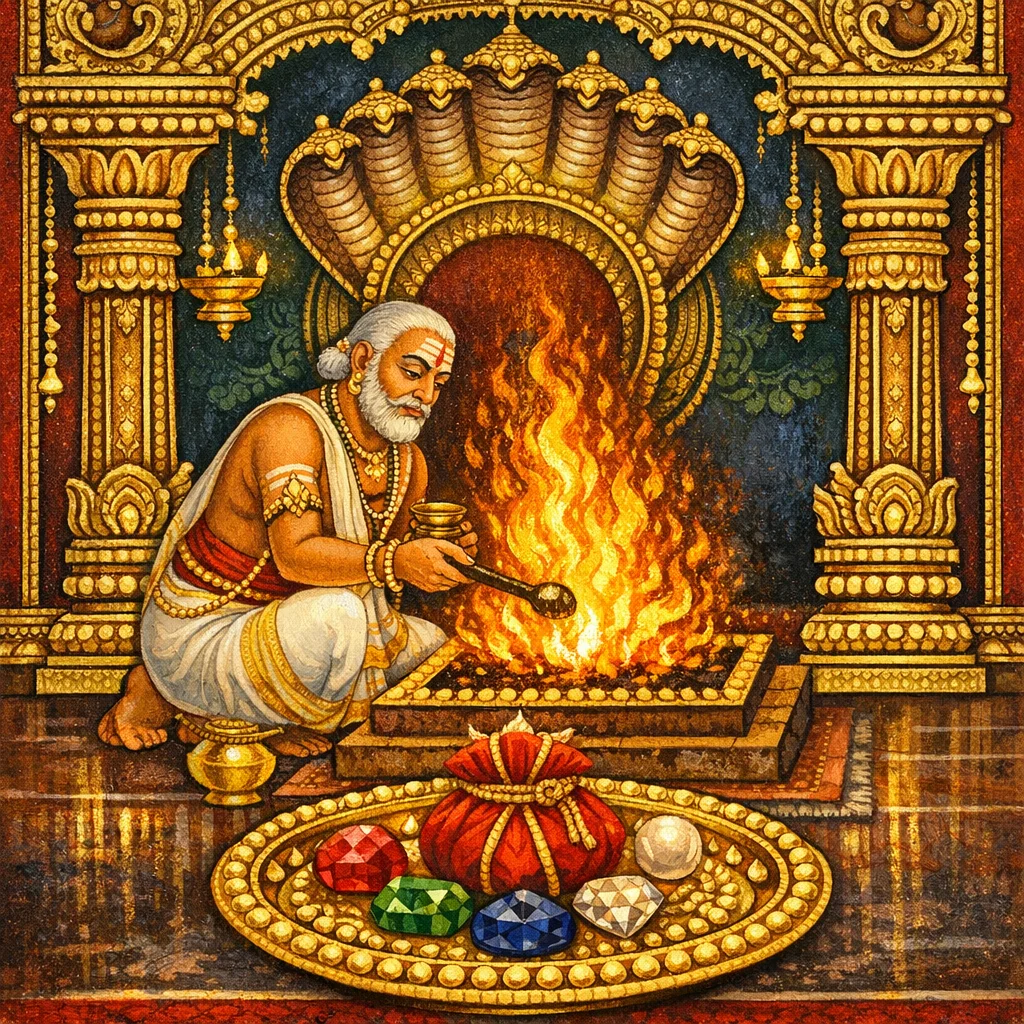
In this adhyāya, Īśvara teaches a specialized pratiṣṭhā (consecration/installation) rite for the doorway (dvāra), treating the threshold as a ritually sensitive interface needing purification, protection, and correct energetic placement. The rite begins by preparing the door-components with decoctions and other purificants and placing them on the śayana (consecration-bed). A triadic nyāsa is then performed on the root, middle, and tip—installing a sequence from Ātman through intermediate principles up to Īśvara—followed by stabilization (sanniveśa), homa, and japa so the installed form is realized “according to its proper form.” Worship continues at the doorway with Vāstu-pūjā under the protection of the Ananta-mantra, along with placing a ratna-pañcaka (five precious items) and performing a śānti-homa to pacify obstacles. The chapter lists protective materia (herbs, grains, and substances) and prescribes a rakṣā-pōṭalī (protective packet) tied with udumbara support while invoking praṇava. Orientation is specified (a slight northern inclination), and further nyāsa places ātma-tattva below, vidyā-tattva on the side-members, and Śiva in the “space-region,” culminating in installation by the mūla-mantra. The rite concludes with offerings to door-attendant deities and supports (talpa etc.) in flexible counts according to capacity, followed by expiatory offerings to remedy deficiencies, directional bali, and appropriate dakṣiṇā.
Shlokas
Verse 1
, च विन्यस्य पदपञ्चकमिति छ विन्यस्य रत्नपञ्चकमिति ज आत्मनेति छ शक्त्यर्थमिति ङ सूर्यमन्त्राश्चेति छ स्थापनेपि वेति ज अथ शततमो ऽध्यायः द्वारप्रतिष्ठाकथनं ईश्वर उवाच द्वाराश्रितप्रतिष्ठाया वक्ष्यामि विधिमप्यथ द्वाराङ्गानि कषायाद्यैः संस्कृत्य शयने न्यसेत्
Now, in the hundredth chapter—on the consecration of the door—Īśvara said: “I shall now explain as well the procedure for the consecration pertaining to the doorway. Having purified and prepared the components of the door with decoctions and the like, one should place them upon the consecration-bed (śayana).”
Verse 2
मूलमध्याग्रभागेषु त्रयमात्मादिसेश्वरं विन्यस्य सन्निवेश्याथ हुत्वा जप्त्वात्र रूपतः
Having performed nyāsa by placing the triad—from Ātman (the Self) up to Īśvara (the Lord)—in the root, middle, and tip sections, one should then firmly establish it; thereafter, having offered oblations and performed japa here, (the deity/mantra) is realized according to its proper form.
Verse 3
द्वारादथो यजेद्वास्तुन्तत्रैवानन्तमन्त्रितः रत्नादिपञ्चकं न्यस्य शान्तिहोमं विधाय च
Then, beginning from the doorway, one should worship the Vāstu-deity right there, having invoked protection with the Ananta-mantra; and, placing the set of five items beginning with gems, one should also perform the pacificatory fire-offering (śānti-homa).
Verse 4
यवसिद्धार्थकाक्रान्ता ऋद्धिवृद्धिमहातिलाः गोमृत्सर्षपरागेन्द्रमोहनीलक्षणामृताः
The items named are: barley; white mustard; the herb called Ākrāntā; Ṛddhi and Vṛddhi; Mahā-tilā; cow-dung; mustard; pollen; the chief (best) among them; Mohanī; Lakṣaṇā; and Amṛtā—these are the names/items enumerated.
Verse 5
रोचना रुग् वचो दूर्वा प्रासादधश् च पोटलीं प्रकृत्योदुम्बरे बद्ध्वा रक्षार्थं प्रणवेन तु
Taking (yellow) rocanā, the herb rug, vacā, and dūrvā grass, and also a portion of prāsāda-dha, one should make them into a small packet (potalī). Having tied it on an udumbara (fig) support/cord, it is to be kept or worn for protection, accompanied by the Praṇava, the syllable Oṁ.
Verse 6
द्वारमुत्तरतः किञ्चिदाश्रितं सन्निवेशयेत् आत्मतत्त्वमधो न्यस्य विद्यातत्त्वञ्च शाखयोः
One should set out the doorway slightly inclined toward the northern side. Having placed the principle of the Self (ātma-tattva) below, one should place the principle of Knowledge (vidyā-tattva) upon the two side-branches (the flanking members).
Verse 7
शिवमकाशदेशे च व्यापकं सर्वमङ्गले ततो महेशनाथं च विन्यसेन्मूलमन्त्रतः
In the region of space one should perform nyāsa, placing Śiva—the all-pervading, all-auspicious Lord. Thereafter, one should also install Maheśanātha by means of the root-mantra (mūla-mantra).
Verse 8
विन्यस्य च निवेशयाथ इति ख विन्यस्य सन्निबोध्याथेति ज अजप्त्वानुरूपत इति ग सर्वपुष्कलमिति ख , घ च द्वाराश्रितांश् च तल्पादीन् कृतयुक्तैः स्वनामभिः जुहुयाच्छतमर्धं वा द्विगुणं शक्तितोथवा
Having performed the prescribed nyāsa (ritual placement), one should then install and consecrate (pratiṣṭhā) the deity or the invoked energies. After placing them, one should awaken them to awareness (sannibodhya). In a manner consonant with the rite—without whispered japa (ajapta) and making all fully complete (sarvapuṣkala)—one should offer oblations into the fire, invoking each by its own name: the door-attendant deities and the supports such as the couch and the like, arranged in proper order. One should make one hundred offerings, or half of that, or twice as many, according to one’s capacity.
Verse 9
न्यूनादिदोषमोषार्थं हेतितो जुहुयाच्च्छतं दिग्बलिम्पूर्ववद्धुत्वा प्रदद्याद्दक्षिणादिकं
To remove faults such as deficiency in the rite, one should offer a hundred oblations into the fire, accompanied by the weapon-mantra (heti-mantra). Then, as before, having made the directional bali-offerings, one should present the prescribed dakṣiṇā (ritual fee) and the remaining due observances.
Frequently Asked Questions
A precise dvāra-pratiṣṭhā sequence: purification of door members, śayana placement, segmental nyāsa (root/middle/tip), Vāstu worship with Ananta-mantra, ratna-pañcaka placement, śānti-homa, and concluding bali/dakṣiṇā with expiation for deficiencies.
Protection is emphasized through the Ananta-mantra (invocation at the doorway) and the praṇava (Oṁ) used with a rakṣā-pōṭalī; the rite also includes śānti-homa and corrective oblations to remove nyūna-doṣa (defects of deficiency).
By mapping metaphysical principles (ātma-tattva, vidyā-tattva, Śiva, Maheśanātha) onto architectural members through nyāsa and installation, it treats the doorway as a sanctified locus where correct form, mantra, and offering align built space with dharma and auspiciousness.