Adhyaya 93
Chapter 93 — वास्तुपूजादिविधानम् (Procedure for Vāstu-worship and Related Rites)
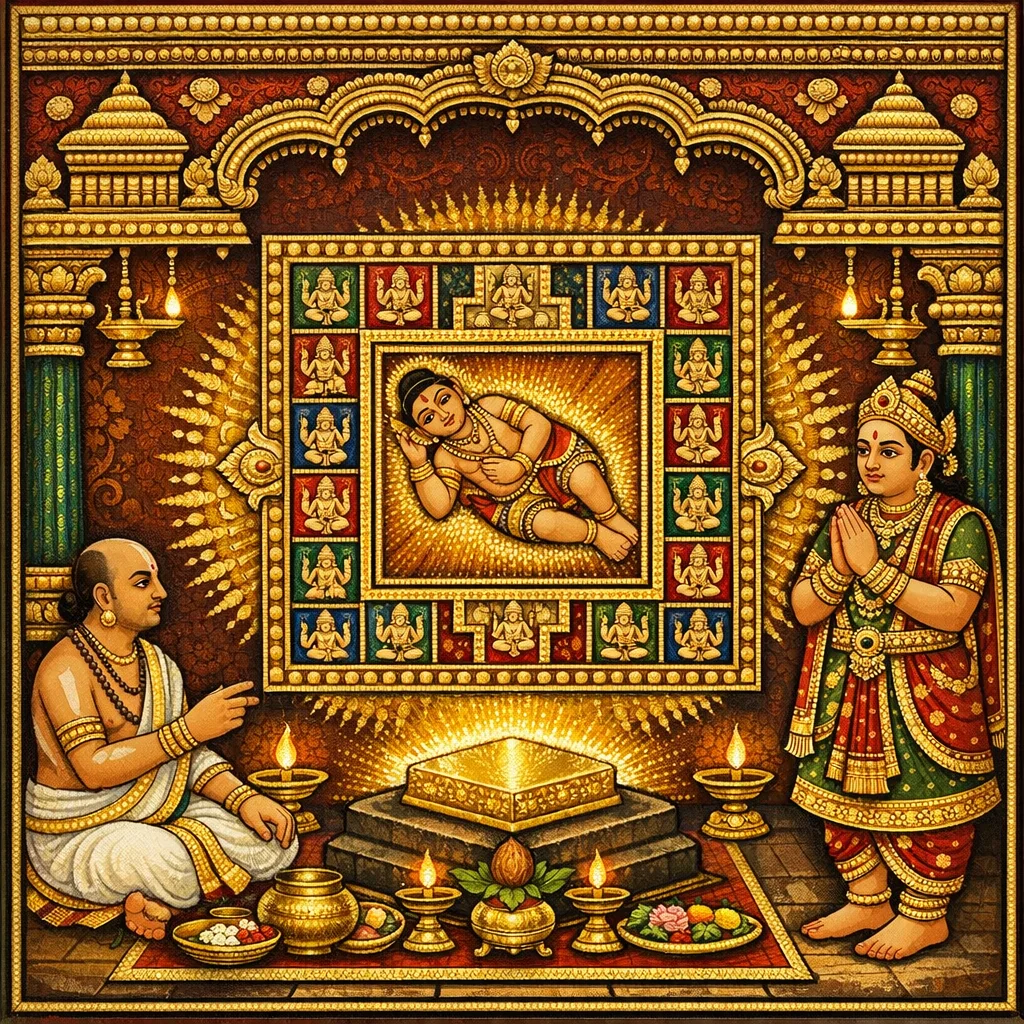
Lord Agni begins a technical yet ritually grounded guide to Vāstu-pratiṣṭhā in the Īśāna-kalpa orientation. After setting out the temple plan, the practitioner establishes the Vāstu-maṇḍapa/maṇḍala on a level, vedi-like polygonal site and divides it into canonical grids—especially the 64-square layout, with mention of 81, 100, 25, 16, and 9-square schemes for houses, cities, and altars. The chapter explains measuring tools (bamboo rods and cords), directional and diagonal placements, and the visualization of the Vāstu-Puruṣa lying supine, asura-like, facing north for structural setting. It then assigns deities to the Vāstu body and grid, names corner-lords and multi-pada occupants (single, double, six, nine), and warns against building on marmas (vital junctions) marked by symbols such as the svastika, vajra, and triśūla. A long offering sequence prescribes specific naivedyas and materials for the directional deities and associated beings, including outer-circuit bhūta-padas like Carakī, Vidārī, and Pūtanā. The chapter closes by reaffirming proportional modules (the five-cubit standard) and prescribing sweet-rice offerings for installations, uniting precise craft with dharmic consecration.
Shlokas
Verse 1
इत्य् आदिमहापुराणे आग्नेये शिलान्यासकथनं नाम द्विनवतितमो ऽध्यायः अथ त्रिनवतितमो ऽध्यायः वास्तुपूजादिविधानम् ईश्वर उवाच ततः प्रासादमासूत्र्य वर्तयेद्वास्तुमण्डपं कुर्यात् कोष्ठचतुःषष्टिं क्षेत्रे वेदास्रके समे
Thus, in the Agni Purāṇa, the ninety-second chapter entitled “The account of laying the foundation-stone” concludes. Now begins the ninety-third chapter: “The procedure for Vāstu-worship and related rites.” The Lord said: Thereafter, having laid out the plan of the temple (prāsāda), one should set out the Vāstu-maṇḍapa (ground-diagram); on a level site shaped as a “Veda-asra,” one should make sixty-four compartments (squares).
Verse 2
कोणेषु विन्यसेद् वंशौ रज्जवो ऽष्टौ विकोणगाः ॐ इं उं इति घ , ङ् च पञ्चगव्येन संसिक्तान् इति ग न्यूनादिदोषनाशार्थमिति घ यजेदस्रेण शुद्ध्यर्थमाहुतीनामिति घ वास्तुमण्डलमिति ग ङ तत इति श्लोकार्धं घ पुस्तके नास्ति विन्यसेद्वंशमिति ख द्विपदाः षट्पदास्तास्तु वास्तुन्तत्रार्चयेद् यथा
One should place bamboo rods at the corners, and eight cords running along the intermediate diagonal directions. Those cord-measures are to be of two and six padas; and there, upon that maṇḍala, one should worship Vāstu (the presiding spirit of the site) in the proper manner.
Verse 3
आकुञ्चितकचं वास्तुमुत्तानमसुराकृतिं स्मरेत् पूजासु कुड्यादिनिवेशे उत्तराननं
For worship, one should visualize Vāstu (Vāstu-Puruṣa) as having curled hair, lying supine, and of an asura-like form; and in setting out walls and other structural elements, one should place it with the face turned to the north.
Verse 4
जानुनी कूर्परौ शक्थि दिशि वातहुताशयोः पैत्र्यां पादपुटे रौद्र्यां शिरो ऽस्य हृदये ऽञ्जलिः
By nyāsa, assign the knees, elbows, and thighs to the quarters of Vāyu and Agni; in the ancestral quarter (the south) place the soles of the feet; in the Rudra quarter (the north) place the head; and in the heart place the joined palms (añjali).
Verse 5
अस्य देहे समारूढा देवताः पूजिताः शुभाः अष्टौ कोणाधिपास्तत्र कोणार्धेष्वष्टसु स्थिताः
Upon this body the auspicious deities are installed and duly worshipped. There, the eight Lords of the corners are stationed in the eight intermediate corner-regions.
Verse 6
षट्पदास्तु मरीच्याद्या दिक्षु पूर्वादिषु क्रमात् मध्ये चतुष्पदो ब्रह्मा शेषास्तु पदिकाः स्मृताः
Marīci and the others are assigned the six-fold positions in the directions, in order beginning with the east; in the center is Brahmā in the four-fold position; the remaining ones are understood to occupy the subsidiary (quarter) positions.
Verse 7
समस्तनाडीसंयोगे महामर्मानुजं फलं त्रिशूलं स्वस्तिकं वज्रं महास्वस्तिकसम्पुटौ
At the junction of all the nāḍīs (channels), the mark called the “fruit” is said to arise adjacent to the great marma (vital junction). There are also the forms/signs named the trident, the svastika, the vajra, and the great-svastika enclosure (sampuṭa).
Verse 8
त्रिकुटुं मणिबन्धं च सुविशुद्धं पदं तथा इति द्वादश मर्माणि वास्तोर्भित्त्यादिषु त्यजेत्
“Trikuṭa”, “Maṇibandha”, and likewise “Suviśuddha” and “Pada”—these (and the rest), making twelve vital points (marmas), should be avoided while laying out the walls and other structural parts of a building-site (vāstu).
Verse 9
साज्यमक्षतमीशाय पर्जन्यायाम्बुजोदकं ददीताथ जयन्ताय पताकां कुङ्कुमोज्ज्वलां
One should offer rice-grains (akṣata) mixed with ghee to Īśa (Śiva); to Parjanya one should give lotus-water; and then to Jayanta one should present a banner bright with kuṅkuma (saffron).
Verse 10
रत्नवारि महेन्द्राय रवौ धूम्रं वितानकं सत्याय घृतगोधूममाज्यभक्तं भृशाय च
To Mahendra (Indra) one should offer jewel-like water; to the Sun, a smoky (incense-like) offering and a canopy; to Satya, wheat prepared with ghee; and to Bhṛśa as well, rice cooked with clarified butter.
Verse 11
विमांसमन्तरीक्षाय शुक्तुन्तेभ्यस्तु पूर्वतः मधुक्षीराज्यसम्पूर्णां प्रदद्याद्वह्नये श्रुचं
For the deity of the mid-space (Antarikṣa), one should offer meatless oblations; and, before the other offerings—beginning with parched-grain preparations (śuktu)—one should present to Agni the ritual ladle filled with honey, milk, and ghee.
Verse 12
लाजान् पूर्णं सुवर्णाम्बु वितथाय निवेदयेत् घ कुर्यादित्यादिः मुत्तानमसुराकृतिमित्यन्तः श्लोकद्वयात्मकपाठो ग पुस्तकके नास्ति कोणार्धेषु व्यवस्थिता इति घ पादिका इति ख मुष्टिकं वक्त्रमिति ख त्रिकोष्ठमिति ग ददीतेति अर्धश्लोको ग पुस्तके नास्ति दद्याद् गृहक्षते क्षौद्रं यमराजे पलौदनं
One should present to Vitatha parched grains (lāja) in full measure, together with gold and water. For harm or affliction affecting the house, one should give honey; and to Yamarāja one should offer cooked rice (palaudana).
Verse 13
गन्धं गन्धर्वनाथाय जिह्वां भृङ्गाय पक्षिणः मृगाय पद्मपर्णानि याम्यामित्यष्टदेवताः
One should assign the fragrance (gandha) to Gandharvanātha, the tongue to Bhṛṅga, birds to Mṛga, and lotus-leaves to Yāmyā—thus are indicated the eight deities of this rite.
Verse 14
पित्रे तिलोदकं क्षीरं वृक्षजं दन्तधावनं दौवारिकाय देवाय प्रदद्याद् धेनुमुद्रया
To the Pitṛ (ancestral spirit) one should offer sesame-water and milk; and to the deity Dauvārika one should present a tree-derived tooth-cleaning twig, doing so with the ‘dhenu’ (cow) hand-gesture (mudrā).
Verse 15
सुग्रीवाय दिशेत् पूपान् पुष्पदन्ताय दर्भकं रक्तं प्रचेतसे पद्ममसुराय सुरासवं
One should offer sweet cakes (pūpa) to Sugrīva; darbha-grass to Puṣpadanta; a red lotus to Pracetā; and a libation of fermented liquor (surāsava) to the Asura.
Verse 16
घृतं गुडौदनं शेषे रोगाय घृतमण्डकान् लाजान् वा पश्चिमाशायां देवाष्टकमितीरितं
For the residual condition (śeṣa), ghee and rice cooked with jaggery (guḍa) are prescribed; and for illness, ghee-cakes (maṇḍaka) or parched rice (lājā) are to be taken. In the western direction, the ‘Deva-aṣṭaka’ (hymn to the eight deities) is said to be recited.
Verse 17
मारुताय ध्वजं पीतं नागाय नागकेशरं मुख्ये भक्ष्याणि भल्लाटे मुद्गसूपं सुसंस्कृतं
For Maruta (Vāyu) one should offer a yellow banner; for the Nāgas, nāgakeśara. For the principal deity (mukhya), offer choice edibles; and for Bhallāṭa, a well-prepared soup of green gram (mudga).
Verse 18
सोमाय पायसं साज्यं शालूकमूषये दिशेत् लोपीमदितये दित्यै पुरीमित्युत्तराष्टकं
One should offer milk-rice (pāyasa) mixed with ghee to Soma; present śālūka (lotus-root) to Ūṣa. One should offer lopī to Aditi, and purī (a fried cake) to Diti—thus concludes the latter set of eight offerings (uttarāṣṭaka).
Verse 19
मोदकान् ब्रह्मणः प्राच्यां षट्पादाय मरीचये सवित्रे रक्तपुष्पाणि वह्न्यधःकोणकोष्ठके
In the eastern direction, one should offer sweet modakas to Brahmā. One should also offer to Ṣaṭpāda and to Marīci; and to Savitṛ one should offer red flowers—placing these offerings in the compartment of the lower (south-eastern) corner associated with Fire.
Verse 20
तदधःकोष्ठके दद्यात् सावित्र्यै च कुशोदकं दक्षिणे चन्दनं रक्तं षट्पदाय विवस्वते
In the compartment below that, one should place kuśa-water as an offering for Sāvitrī; and on the southern side, red sandalwood paste for the six-stepped one, Vivasvat (the Sun).
Verse 21
हरिद्रौदनमिन्द्राय रक्षोधःक्रीणकोष्ठके देवता इति ख प्रदद्यादघमुद्रयेति ख प्रदद्याद्वनमुद्रयेति घ , छ च पद्मं सम्बरायेति घ शालूकं शृणयेति ख , छ च पुरीमित्यवराष्टकमिति ग सवित्रे च कुशोदकमिति ग सावित्र्यै चन्दनमिति ग इन्द्रजयाय मिश्रान्नमिन्द्राधस्तान्निवेदयेत्
One should offer turmeric-rice (haridrā-odana) to Indra. In the rite called “Rakṣo-dhaḥ-krīṇa-koṣṭhaka,” according to the respective mantric designations, one should offer: “to Devatā” (kha reading), to Aghamudrā (kha), and to Vanamudrā (gha/cha). One should offer a lotus to Sambarā (gha), and śālūka (lotus-root/tuber) to Śṛṇaya (kha/cha). One should offer pūrī (a fried cake) to Avarāṣṭaka (ga); to Savitṛ, kuśa-water; to Sāvitrī, sandalwood. For “Indra-jaya” (Indra’s victory rite), one should present mixed food (miśrānna) below, at the base of Indra’s position.
Verse 22
वरुण्यां षट्पदासीने मित्रे सङुडमोदनं रुद्राय घृतसिद्धान्नं वायुकोणाधरे पदे
In Varuṇa’s quarter, one should offer to (the deity) Ṣaṭpadāsīna; and to Mitra, saṅuḍa-modana (a sweet rice preparation). To Rudra one should offer rice prepared with ghee (ghṛta-siddhānna), at the place assigned in the Vāyu corner in the lower (outer) position.
Verse 23
तदधो रुद्रदासाय मासं मार्गमथोत्तरे ददीत माषनैवेद्यं षट्पदस्थे धराधरे
Below that, for a month, one should carry out the prescribed course of offerings for the servant of Rudra; thereafter, in the northern direction, one should present a food-offering of māṣa (black gram) at the place marked by six footsteps, upon the supporting ground (the altar-site).
Verse 24
आपाय शिवकोणाधः तद्वत्साय च तत्स्थले क्रमाद्दद्याद्दधिक्षीरं पूजयित्वा विधानतः
Below, in the Āpāya (southern) quarter and beneath the Śiva-corner, and likewise at that very spot for the calf, one should in due sequence offer curds and milk, having first performed worship in accordance with the prescribed rite.
Verse 25
चतुष्पदे निविष्टाय ब्रह्मणे मध्मदेशतः पञ्चगव्याक्षतोपेतञ्चरुं साज्यं निवेदयेत्
To the Brahmin seated upon a four-legged seat, from the central position, one should present caru (cooked sacrificial rice/porridge) together with ghee, accompanied by pañcagavya and akṣata (unbroken rice grains).
Verse 26
ईशादिवायुपर्यन्तकोणेष्वथ यथाक्रमं वास्तुवाह्ये चरक्याद्याश् चतस्रः पूजयेद् यथा
Then, in the corner-directions beginning with Īśāna and extending up to Vāyu, one should, in due order, worship on the outer circuit of the Vāstu (mandala) the four deities beginning with Carakī, in the prescribed manner.
Verse 27
चरक्यै सघृतं मांसं विदार्यै दधिपङ्कजे पूतनायै पलं पित्तं रुधिरं च निवेदयेत्
One should present meat mixed with ghee to Carakī; offer curds in a lotus-leaf cup to Vidārī; and to Pūtanā one should present a portion of bile and blood.
Verse 28
अस्थीनि पापराक्षस्यै रक्तपित्तपलानि च ततो माषौदनं प्राच्यां स्कन्दाय विनिवेदयेत्
One should offer bones, and also lumps of flesh mixed with blood and bile, to the sinful rākṣasī; thereafter, in the eastern direction, one should present māṣa-odana (rice cooked with black gram) as an offering to Skanda.
Verse 29
अर्यम्णे दक्षिणाशायां पूपान् कृसरया युतान् जम्भकाय च वारुण्यामामिषं रुधिरान्वितं
In the southern quarter, one should offer to Aryaman pūpa-cakes together with kṛsara (a mixed preparation of rice and pulses). And in the watery quarter associated with Varuṇa, one should offer to Jambhaka flesh-food accompanied by blood.
Verse 30
उदीच्यां पिलिपिञ्जाय रक्तान्नं कुसुमानि च यजेद्वा सकलं वास्तुं कुशदध्यक्षतेर्जलैः
In the northern quarter, one should worship Pilipiñja by offering red food and flowers; or else one should consecrate the entire dwelling-site by sprinkling it with water mixed with kuśa grass, curd, and unbroken rice-grains (akṣata).
Verse 31
आपवत्सचतुष्टये इति ख तद्वत्सायै च तत्तले इति घ , ज च वाराह्यै इति ङ , छ च विपचे इति ख , छ च ततो मांसौदनमिति ख घ छ च कुम्भकायेति छ पिलिपिच्छायेति ङ लिपिपिञ्जायेति छ गृहे च नगरादौ च एकाशीतिपदैर् यजेत् त्रिपदा रज्जवः कार्याः षट्पदाश् च विकोणके
“Āpavatsa-catuṣṭaye”—(place/recite this) at the syllable-position “kha”; “Tad-vatsāyai ca tattale”—at “gha” (and also at “ja”); “Vārāhyai”—at “ṅa” (and also at “cha”); “Vipace”—at “kha” (and also at “cha”). Then, “Māṃsa-odana”—at “kha”, “gha”, and “cha”; “Kumbhakāya”—at “cha”; “Pilipicchāya”—at “ṅa”; “Lipipiñjāya”—at “cha”. In a house, in a city, and in other places, one should perform worship employing an eighty-one-word (or eighty-one-step) arrangement. The cords (rajju) should be made in three measures/steps, and along the oblique/diagonal (vikoṇa) they should be in six measures/steps.
Verse 32
ईशाद्याः पादिकास्तस्मिन्नागद्याश् च द्विकोष्ठगाः षट्पदस्था मरीच्याद्या ब्रह्मा नवपदः स्मृतः
In that Vāstu-maṇḍala, Īśa and the others occupy single squares; Nāga and the others occupy two compartments; Marīci and the others occupy six squares; and Brahmā is said to occupy nine squares.
Verse 33
नगरग्रामखेटादौ वास्तुः शतपदो ऽपि वा वंशद्वयं कोणगतं दुर्जयं दुर्धरं सदा
In the planning of a city, village, or hamlet (kheṭa), even if the site is arranged as a Śatapada (a hundred-square vāstu-grid), a “vaṃśa-dvaya” (double beam/lineage) falling in a corner position is always considered hard to overcome and difficult to sustain.
Verse 34
यथा देवालये न्यसस् तथा शतपदे हितः ग्रहाः स्कन्दादयस्तत्र विज्ञेयाश् चैव षट्पदाः
Just as the mantra-placements (nyāsa) are performed in a temple, so too they should be properly arranged upon the ritual “hundred-petalled” lotus. There the Grahas (planetary deities) are to be installed; and Skanda and the others are likewise to be understood as occupying the “six-petalled” lotus.
Verse 35
चरक्याद्या भूतपदा रज्जुवंशादि पूर्ववत् देशसंस्थापने वास्तु चतुस्त्रिंशच्छतं भवेत्
In laying out a site (deśa-saṃsthāpana), the bhūta-padas beginning with the grid called Carakī, and the procedures such as the measuring-cord (rajju) and the bamboo-rod (vaṃśa), are to be applied as previously stated; thus the Vāstu grid becomes of 3,200 units/padas.
Verse 36
चतुःषष्टिपदो ब्रह्मा मरीच्याद्याश् च देवताः चतुःपञ्चाशत्पदिका आपाद्यष्टौ रसाग्निभिः
The metre called Brahmā has sixty-four syllabic units, and so do the deities beginning with Marīci. The metre called Catuḥpañcāśat-padikā has fifty-four units; and the count is to be completed by adding eight, using the numerical code of “rasas” and “fires” (rasa = 6, agni = 3) as a mnemonic aid.
Verse 37
ईशानाद्या नवपदाः स्कन्दाद्याः शक्तिकाः स्मृताः चरक्याद्यास्तद्वदेव रज्जुवंशादि पूर्ववत्
The nine padas are said to begin with Īśāna; the śaktikās are remembered as beginning with Skanda. Likewise, the sets beginning with Carakī are to be understood in the same manner; and the classifications such as rajju and vaṃśa are to be taken as previously explained.
Verse 38
ज्ञेयो वंशसहस्रैस्तु वास्तुमण्डलगः पदैः न्यासो नवगुणस्तत्र कर्तव्यो देशवास्तुवित्
The Vāstu-maṇḍala should be understood—measured and laid out—by its padas (grid-squares) using thousands of measuring-rods (vaṃśa). In that layout, a ninefold nyāsa (ritual placement) should be performed; this is to be done by one skilled in regional (deśa) and architectural (vāstu) principles.
Verse 39
पञ्चचिंशत्पदो वास्तुर्वैतालाख्यश्चितौ स्मृतः अन्यो नवपदो वास्तुः षोडशाङ्घ्रिस् तथापरः
In the context of construction (citi), the Vāstu layout of twenty-five squares (padas) is remembered as that called Vaitāla. Another Vāstu layout is the nine-squared (navapada) plan; and yet another is the sixteen-footed, i.e., sixteen-squared, plan.
Verse 40
षडस्रत्र्यस्रवृत्तादेर्मध्ये स्याच्चतुरस्रकं इपदे इति घ ईशानाद्याः शिवपदा स्कन्दाद्याः पदिका इति घ समञ्च स्थापने वास्तुश् चतुस्त्रिंशच्छतं भवेदिति घ पुस्तके ऽधिकः पाठः चतुःषष्टिपदो ब्रह्मा इत्य् आदिः, रज्जुवंशादि पूर्ववत् इत्य् अन्तः पाठो ग पुस्तके नास्ति खाते वास्तोः समं पृष्ठे न्यासे ब्रह्मशिलात्मके
Within maṇḍala forms such as the hexagon, triangle, circle, and the like, a square is to be set at the center—this is stated to be the “pada” (division). The padas beginning from Īśāna are the Śiva-padas; those beginning from Skanda are called the subsidiary padas (padikā). In establishing the platform (samañca/vedikā), the Vāstu maṇḍala becomes of 332 divisions—so says a recension. In some manuscripts there is an additional reading beginning, “Brahmā has sixty-four padas…”; and the concluding reading, “the cord-lineage (rajju-vaṃśa) etc. is as stated earlier,” is not found in the “ga” manuscript. In the excavation (khāta), on the level back-surface, one should perform the nyāsa as the Brahmaśilā (Brahmā-stone/foundation).
Verse 41
शाषाकस्य निवेशे च मूर्तिसंस्थापने तथा पायसेन तु नैवेद्यं सर्वेषां वा प्रदापयेत्
At the installation of the śāṣāka, and likewise at the establishment (consecration) of an idol, one should present the naivedya as pāyasa (sweet rice); or else offer it collectively for all the deities.
Verse 42
उक्तानुक्ते तु वै वास्तुः पञ्चहस्तप्रमाणतः गृहप्रासादमानेन वास्तुः श्रेष्ठस्तु सर्वदा
Whether a measurement rule has been explicitly stated or not, the standard module for Vāstu is to be taken as five cubits (hasta). Applied in accordance with the dimensions of houses and temples, that Vāstu measure is always the best.
Frequently Asked Questions
The chapter emphasizes precise Vāstu-maṇḍala construction: site leveling, 64-square division (and other grids like 81/100), use of bamboo rods and cord-measures for corners/diagonals, deity-nyāsa by pada-allocation, and avoidance of 12 marma junctions when placing walls and structural elements.
It frames architecture as consecrated action: correct measurement, nyāsa, and offerings transform construction into yajña, aligning craftsmanship with dharma. By ritually harmonizing space (Vāstu) with divine presences, the practitioner supports communal worship and inner purity—linking Bhukti (skillful worldly order) to Mukti (spiritual steadiness and liberation-oriented discipline).